
Choosing A‑Level Subjects After GCSE: Best Combinations, Facilitating Subjects & Expert Tips
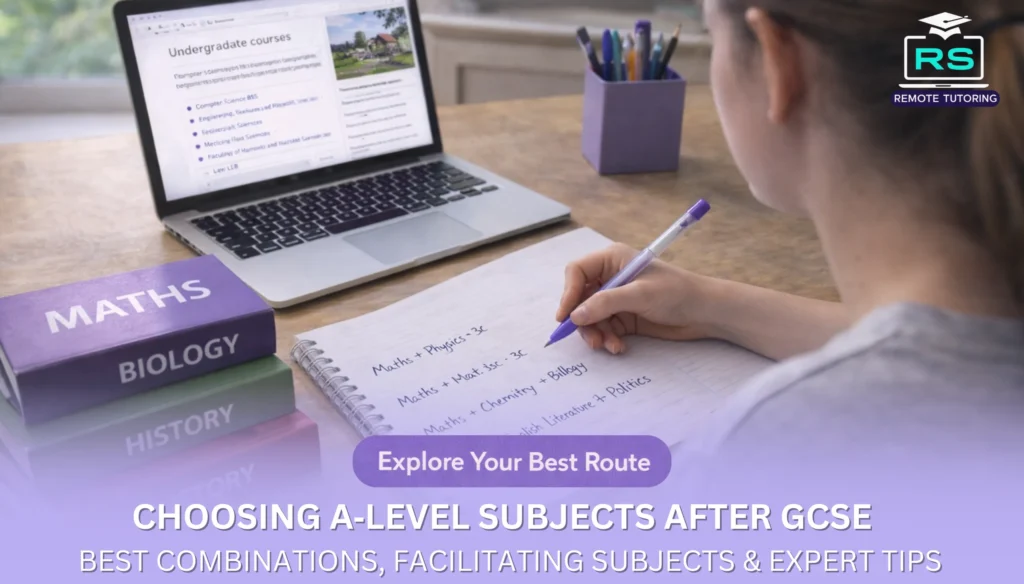
Your A‑level choices can open doors to exciting university courses and careers or unintentionally close them. A-Level Subjects After GCSE, many students feel overwhelmed by the sheer number of subjects and conflicting advice. In this guide, we demystify the process of choosing A‑level subjects, explore the best and worst combinations, and answer the questions students frequently ask. Whether you have a clear career goal or are still undecided, this article will help you make informed choices for the 2026 academic year and beyond. Why your A‑level choices matter The subjects you choose at A‑level shape your future options. A‑level selection can impact which university courses you can apply to. Certain degrees require specific subjects. For example, a pharmacy degree needs chemistry plus at least one of biology, maths or physics, while some English degrees require either English Language or Literature. Choosing the right combination now can therefore keep your pathways open for medicine, law, engineering, psychology or other competitive courses. It’s also important to remember that A‑levels are significantly harder than GCSEs. You’ll be expected to work more independently and master more demanding material. Most students take three subjects because universities typically base offers on three A‑levels; although some ambitious students take four, the workload increases substantially. Picking subjects you enjoy and excel in will make the transition smoother and give you the best chance of success. Core principles for choosing your A‑level subjects Career and study advisors agree on three guiding principles: Facilitating subjects and why they matter ‘Facilitating subjects’ are A‑levels that are highly regarded by universities and appear frequently in entry requirements. Careerpilot notes that these include Mathematics, English Literature, Physics, Biology, Chemistry, History, Geography and modern or classical languages. Choosing at least one or two of these subjects can help you meet a broad range of degree requirements and keep your options open. However, some universities publish lists of subjects they consider ‘less effective preparation’. The London School of Economics, for example, has a list of non‑preferred subjects, while the University of Sheffield publishes a list of preferred subjects. This doesn’t mean you should avoid creative or vocational subjects entirely, but ensure that your other choices meet entry requirements. Entry requirements and minimum grades To enrol on A‑level courses you usually need at least five GCSEs at grades 9 to 4 and grade 6 in the subjects you want to study. Schools and colleges may have their own policies, but most look for at least a grade 6 or 7 in GCSE subjects you intend to continue. If you’re considering a subject not offered at GCSE (such as psychology or law), strong grades in related subjects (e.g., English or history) will help demonstrate aptitude. Best A‑level combinations and what to avoid There is no one‑size‑fits‑all answer, but here are some proven combinations and common pitfalls: STEM pathways If you’re aiming for medicine, engineering or other science degrees, universities often require or recommend Mathematics, Chemistry, Biology or Physics. For medicine and dentistry, chemistry is essential and biology is usually required or recommended. For engineering, maths and physics are must‑haves, while further maths is an advantage but not always essential. Computer science degrees often require maths and sometimes physics. Avoid: choosing only one science if you may apply for a STEM degree later. Careerpilot advises that if you’re taking a science A‑level, you should consider whether you need to take another science or maths to support scientific careers. Humanities and social sciences Degrees in law, politics, economics, history or English typically require at least one essay‑based subject. A common combination is English Literature, History and Politics. Economics degrees may require maths. Geography pairs well with subjects like biology or economics if you are interested in environmental science or international relations. Avoid: choosing only practical subjects without an essay‑based subject if you want to keep your humanities options open. Universities look for evidence of analytical and writing skills. Creative and performing arts If you’re passionate about art, drama, music or design, you should include these subjects. However, complement them with at least one facilitating subject such as English or History to keep academic routes open. Creative industries often value a combination of artistic skills and academic rigour. Avoid: taking multiple creative subjects without any facilitating subject. Some universities may not accept combinations like Art, Photography and Media Studies for traditional academic courses. Business, finance and economics For business or finance degrees, Mathematics is advantageous and sometimes essential. Economics, Business Studies and Politics make a strong trio. Many universities accept both Business Studies and Economics, though Careerpilot cautions that some universities might not like combinations of very similar subjects. If you choose one, pair it with maths or a humanities subject. Avoid: choosing Business Studies and Economics together if your target universities list them as overlapping subjects or non‑preferred combinations. Languages and linguistics Modern languages (French, Spanish, German, Mandarin) and classics (Latin, Greek) open doors to careers in translation, international relations, law and business. They pair well with humanities subjects and with subjects like politics or history. Avoid: dropping languages too soon if you are interested in international careers. Language proficiency is a valuable skill that can differentiate you in the job market. If you don’t know what you want to do Many students have no specific career plan at 16. To keep your options open, choose a mix of subjects across different disciplines. For example: You’ll need to pick only three or four, but using this template helps ensure you cover different skill sets and keep doors open. You could also explore Core Maths or an Extended Project Qualification (EPQ) to demonstrate independent research. Worst A‑level combinations There’s no formal list of forbidden subjects, but certain combinations are less favoured: The role of AS‑levels and independent study AS‑levels (advanced subsidiary) are qualifications taken after one year of study. Oxford College notes that AS‑levels carry 40% of an A‑level’s UCAS points and can influence your predicted grades. Under the new system in England, AS grades do not count towards
How to Prepare for A‑Level Exams in 3 Months (2026 Guide)
Preparing for A‑Level Exam can feel like a marathon. After two years of study, these final tests determine entry to university, apprenticeships or employment. With the 2026 A‑level exam window running from mid‑May to late June, a structured three‑month plan beginning in February or March gives you time to revise deeply, practise exam technique and enter the exam room with confidence. Why Three Months Is Enough for A-Level Exam Preparation Many guides recommend revising for A‑levels over an entire year. While starting early offers breathing space, three months is still enough time to review every topic, practise past papers and sharpen exam technique. if you work smartly. Three months means roughly 12 weeks. When broken into three clear stages, Foundation, Practice and Refinement, you can systematically build knowledge, reinforce it with questions and polish your exam performance. You will need to commit several hours a day, plan effectively and look after your wellbeing. With discipline, the following our 12‑week plan delivers results and help our students outperform in A-levels Exams. Understand Your A‑Level Examinations Before revising, familiarise yourself with the structure of your A‑level course: By knowing your syllabus inside out, you avoid surprises and ensure your revision is complete. Book a Free 1-on-1 Session with Our Tutor Best tutors in the UK Personalized learning plans Flexible online scheduling Start Your Free Trial A-Level Exam Dates 2026 A-Level exams in 2026 will take place from early May to late June 2026, with most written papers starting in the second week of May. Alevels Exam timetables from exam boards such as AQA, Pearson Edexcel, and WJEC show that: Note: Exact dates may vary by subject and exam board, so students should check their personalised exam timetable from their school or college. Knowing A-Levels dates and schedule is very important because it means if you start revising in February or March 2026, you will have solid 12-week window, perfect timeframe for the 3 month preparation strategy set by our tutors. Month by Month A-Levels Exam Preparation Plan Month 1: Build Your Foundation (Weeks 1 to 4) Your first month should lay a solid base. Focus on understanding the syllabus, organising materials, and establishing a study routine. 1. Unpack the Syllabus 2. Create a Personal Study Plan 3. Organise Your Study Materials 4. Start Active Learning 5. Establish a Study Routine Month 2: Practise and Consolidate (Weeks 5 to 8) With the foundations in place, it’s time to strengthen understanding through exam practice and application. This month focuses on turning knowledge into exam‑ready skills. 1. Get Into Past Papers 2. Identify and Fix Weak Spots 3. Use Active‑Recall Strategies 4. Simulate Exam Conditions 5. Balance Your Week Month 3: Refine and Test (Weeks 9 to 12) The final month is about polishing your knowledge, perfecting exam technique and arriving at the exam confident and calm. 1. Mock Exams and Full Practice Papers 2. Finalise Notes and Summaries 3. Fine‑Tune Exam Technique 4. Manage Stress and Stay Healthy Daily and Weekly Study Structure A balanced routine helps you maintain momentum without burning out. Sample Daily Plan Weekly Checklist Essential Tools & Resources Book a Free 1-on-1 Session with Our Tutor Best tutors in the UK Personalized learning plans Flexible online scheduling Start Your Free Trial Exam Day Advice and Post‑Exam Reflection Preparing for Exam Day During the Exam Read here: A-Levels Exam Intructions Guide After the Exam Frequently Asked Questions Final Next Steps to perform Best in A-Levels Exams Your A‑levels are a stepping‑stone to university, apprenticeships and future careers. They demand commitment but also reward structured, strategic preparation. By following this three‑month roadmap, laying a firm foundation, practising intensively and refining your exam technique, you’ll maximise your potential in the 2026 exams. If you want personalised guidance, consider working with a qualified tutor. An experienced tutor can diagnose your weak spots, tailor a study plan to your learning style and provide targeted feedback on past‑paper answers. Start Today Preparing Today Take out your syllabus, mark your exam dates, and map your 12‑week plan. With dedication, discipline and the right resources, you can ace your A‑levels in three months and open the door to your future. Good luck! RajaRaja specializes in Physics and Maths, with over 5 years of experience. He offers KS2, KS3, and GCSE Science and Maths lessons. He graduated from one of the top universities in the UK.
A‑Level Exam Dates 2026: Key Dates, Timetables & What to Expect
Whether you are aiming for university, an apprenticeship or employment, A‑level exams are a pivotal milestone. Knowing exactly when your exams happen in 2026 will help you organise revision, manage stress and avoid last‑minute surprises. This guide of ours summarises the confirmed information from exam boards and provides practical advice on preparing for exam season. What is A-Level Exam Date and When it Take Place in 2026? A‑level exams run once a year, over a six‑week period in the late spring. According to the final Pearson Edexcel timetable, the first exams begin on Monday 11 May 2026 and the final papers conclude on Tuesday 23 June 2026 qualifications.pearson.com. This pattern is consistent across exam boards (AQA, OCR, WJEC/Eduqas) and previous years. Note: AQA had not yet published its 2026 final timetable at the time of writing. Their dates-and-timetables page only lists 2025 PDFs Students taking AQA exams should check for updates early in 2026. Worried About A-Levels? Get Free 1-on-1 with a UK Tutor Clear guidance on what to study (and when) Mock practice tied to real exam dates Flexible online scheduling Start Free A-Level Trial Summary of 2026 A‑Level Exam Date Windows by Board Exam board Earliest exam Last exam Source Pearson Edexcel Monday 11 May 2026 (e.g., Biology B, English Language & Literature, Economics)= qualifications.pearson.com Tuesday 23 June 2026 (Further Mathematics & Advanced Extension papers) qualifications.pearson.com Edexcel GCE Summer 2026 final timetable AQA Likely mid‑May 2026 (based on 2025 pattern – check for 2026 timetable release) Late June 2026 (exact dates TBC) AQA dates & timetables page OCR Mid‑May to late June (final timetable not yet public) ~23 June 2026 OCR usually mirrors Edexcel’s calendar WJEC/Eduqas Final timetables for June 2026 A‑level exams are available on WJEC’s site Exams also run into late June WJEC Key Dates & Timetables What to Expect on Exam Day Sitting an A-level is not just about what is on the paper, the rules and setup matter too. Students should arrive at least 30 minutes early to avoid last-minute stress. Bring the essentials like pens, pencils, erasers, a calculator if your subject allows, and your student ID. Phones, smartwatches, and revision notes must be left outside the exam hall. Note: If you have exam clashes (two papers scheduled at the same time), schools manage this by moving one exam to later in the day. Students are supervised during breaks to prevent any unfair advantage. For those with special access arrangements such as extra time, scribes, or laptops, the school’s exam officer will ensure these are in place on the day. A‑Level Resits Date Unlike GCSEs, there is no November resit window for A‑levels. Save My Exams points out that if you need to retake an A‑level, you must register for the summer 2026 series. This means: How to Access Your A-Levels Exam Timetable If you’re studying through a college or sixth form, they will also distribute customised timetables with your personal paper codes, dates and exam rooms. Using the Timetable to Plan Your Revision Worried About A-Levels? Get Free 1-on-1 with a UK Tutor Clear guidance on what to study (and when) Mock practice tied to real exam dates Flexible online scheduling Start Free A-Level Trial A-Levels Revision Countdown: Key Milestones Breaking revision into stages avoids last-minute cramming and builds confidence leading into May. Important Dates Beyond Exam Week A-Level Results Day 2026 Results day is expected in Thursday, 20 August 2026, when students will be able to collect their grades from their school or college. Many centres also send results by email or make them available through secure portals. At the same time, UCAS Track updates with university confirmations. If results don’t go as planned, students can consider appeals, autumn resits, or Clearing for university places. FAQs Final Takeaways For up‑to‑date information, always check the latest timetables on your exam board’s official website and consult your school or college. Disclaimer: This guide is for information purposes only. Exam dates and procedures may change, so always confirm with your school or official exam board updates. RajaRaja specializes in Physics and Maths, with over 5 years of experience. He offers KS2, KS3, and GCSE Science and Maths lessons. He graduated from one of the top universities in the UK.