Signs Your Child Needs an Online GCSE Tutor in UK
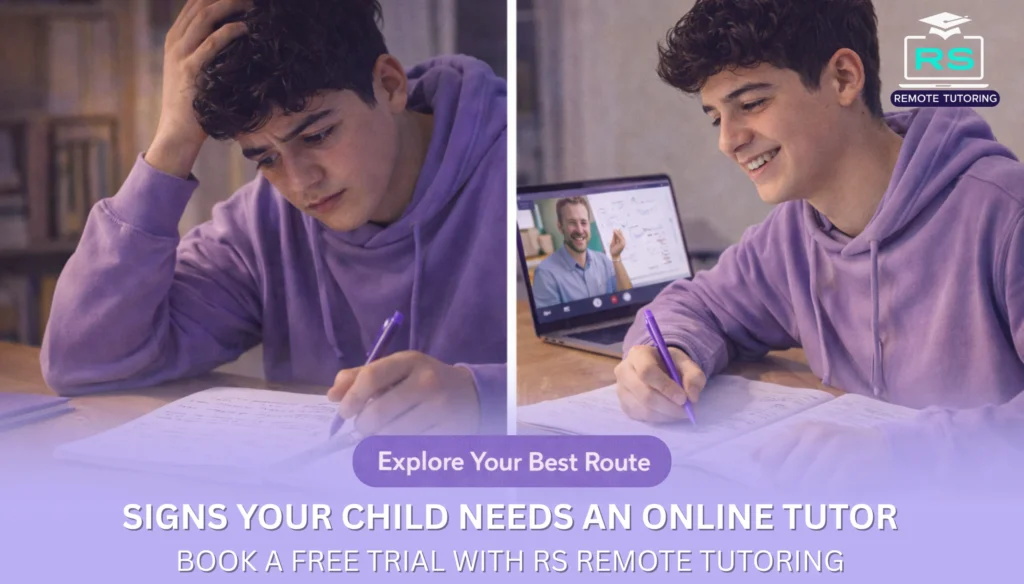
The globalized world has taken a 360 degree turn, transforming each and every aspect of life. In the fast paced world everything is looking for the means of comfort and flexibility, virtual tuitions are becoming very much common. In today’s landscape children are expected to grasp the difficult topics quickly, perform trends well in the examination and develop independent study skills at a very early age. As everyone is well informed that classrooms provide the foundational study landscape, neglecting the needs of the individual learning gaps.This is the point where RS remote tutoring and many other platforms becomes significantly beneficial. Online tutoring is not just like a second or back up option but it is the strategic academic tool backed by research and measurable outcomes. But before referring to or hiring an online tutor the persistent question arises when it becomes strategically important to hire one. How to know, what are the signs that our cold needs an extra online tutor to fill the learning gaps left empty by the school. If you are wondering that your child needs more time or professional support, this guide will help you recognise the clear signs that help you indicate your child may benefit from the early structured online tutoring approach. Why Identifying the Early Signs Matters the Most Before exploring the signs theta sparks to the idea that the child is in need of the expert and strategic online tutor. It is important to understand why identifying these signs matters the most. Research from the Education Endowment foundation shows that targeted one to one tuition can accelerate the learning progress by up to 3-5 additional learning months over the academic year. The key factor is the early interventions. Identifying the signs is utmost necessary as when learning signs are left unreso;ved and unsolved this may leads to; Online tutors provide one to one extra support with boosting the student’s confidence and uplifting their morale so that they can give thor exams with full confidence. Signs that Your Child Needs An Online Tutor The following will explain the signs that spark the idea that the child is in need of expert guidance which is only offered by well trained, experienced online GCSE tutors. 1. Consistent Drop In Grades Despite Tremendous Efforts: One of the foremost signs that parents should hire an online tutor is that students coincidentally are making efforts but not getting their desired grades. Consistency is the key to success but doing efforts smartly is the ultimate key for success. A temporary low score is totally normal. However, sustained decline in the performance grades is not normal; this reflects deeper conceptual gaps. This may usually refers to; According to the studies aligned with education research, students often underperform due to lack of examination techniques, gaps in the structured development not due to lack of intelligence. Our expert tutors at Rs remote tutoring helps; 2. Homework Tasks Excessively Long Another important sign that indicates that a child is in need of an online tutor is that they take too long to complete the homework. If one hour of homework turns into three hours of consistent struggle this is the strong indicator that your child may need a structured approach. Extended homework time may reflect; Educational psychological research states that insufficient study time often stems from inefficient and ineffective strategies rather than laziness. Online effective tutoring helps in this regard in a way; Uplifting the following strategies may help the students to get their desired success. 3. Increase Anxiety Around Specific Subjects: GCSEs exams are the most important ones in the lives of students because they are the stepping stones towards their success journey. While taking and preparing for the GCSEs students often feel overwhelmed especially showing extreme anxiety and stress towards difficult subjects. Ask the following; Does your child: The following speaks of the emotional signals of academic stress. Research suggests that academic stress significantly impacts students’ well being long term motivation. When students repeatedly experience confusion without resolution, anxiety develops. And this is the sign you should consider seriously an expert online tutor providing one to one support. As like us, at RS remote tutoring our expert tutors we provides: 4. Difficulty in Transitioning between the Academic Stages: Some students feel it is really difficult to transition from the academic stages. Research suggests that transitional academic gaps significantly affect long term attainment. Online and structured tutoring is very much necessary at lat at this level because it; Passive Revision Methods Students who are preparing themselves for their GCSEs exam are often relying on the traditional methods of revision, especially revising notes again and again, which according to them is the formal revision strategy that will turn their efforts into the tremendous reward but they are lacking at the most important phase because passive revision won’t work this time. Effective revision methods includes; A trained and effective tutor used these evidence based revision techniques and integrated them into structured lesson plans to make them more effective. Over Reliance on Parental Support: Another sign indicating that a child is in need of the tutor is that child is over relying on parental support. If the parents finds their self in; This is the point where the child is wanting professional assistance. Parents provide emotional encouragement and the well trained tutor provides curriculum aligned instructions. Online tutor at RS remote tutoring restores the balance by; Gifted But Under Challanged Every student encompasses a different level of abilities and talents. Tutoring is not just delivering the lectures, it is about unleashing the students’ talent and giving them enough motivation to use the talent in public spaces. High performing children may; Research indicates that children showing enrichment significantly enhances long term academic development. An online tutor can; Why Online Tutoring Is Highly Effective Today Online tutors are more in the tida’s market because everyone is in need of flexible and feasible tutoring support offering guidance and helping students achieving their desired success. Modern Online tutoring provides;
GCSE or BTEC: Understanding Academic vs Vocational Routes
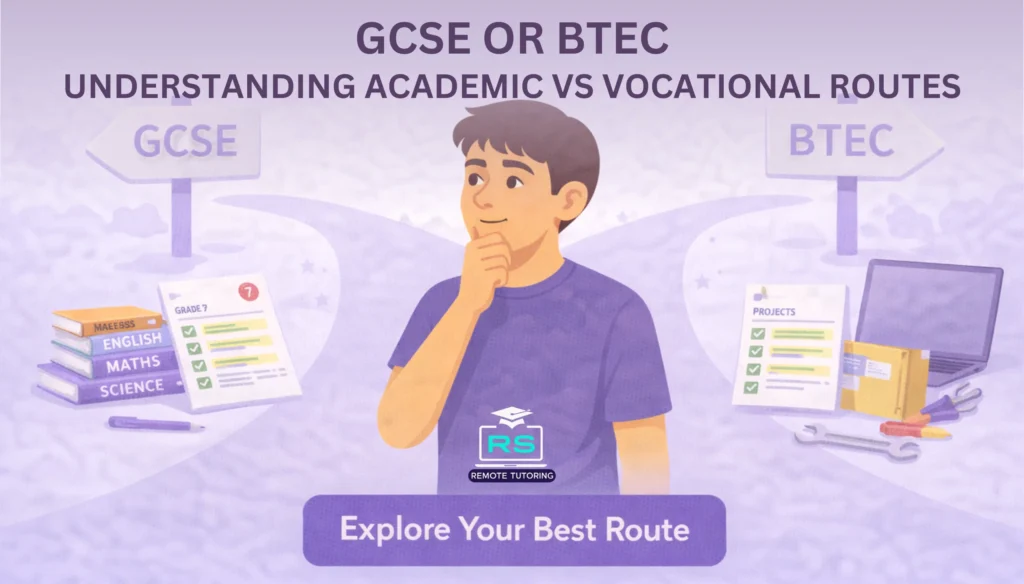
Note for UK families: Choosing between GCSE and BTEC isn’t just a theoretical decision, it can shape the next few years of your child’s education and career. This guide explains what each route involves, compares them in plain English, and highlights how to make the right choice for your situation in London or elsewhere in the UK. What Are GCSEs? GCSEs (General Certificates of Secondary Education) are academic qualifications studied in England, Wales and Northern Ireland. They usually span two years, from Years 10 and 11 in the UK schooling system culminating in external exams. Assessment is heavily exam‑based, though some subjects may include controlled assessments or practical coursework. Key points about GCSEs: Tip: Exam boards such as AQA, Pearson Edexcel and OCR run GCSE exams across UK schools and colleges. Check with your local school or exam centre for registration deadlines (usually January for May/June exams) and exam fees. What Are BTECs? BTEC stands for the Business and Technology Education Council. A BTEC qualification is vocational and designed to prepare students for specific careers. Instead of one final exam, BTECs rely on practical projects, assignments and sometimes online tests across the course. Levels and Equivalency BTECs are available from Entry Level up to Level 7. Here are the most relevant for school‑aged students: BTEC Level Typical age group Equivalent academic level Description and progression Level 1/Level 1 Introductory 14+ GCSE grades D–G (old scale) or grades 1–3 Provides basic knowledge; often called BTEC First Certificate. A First Certificate usually equals one GCSE. Level 2 15–16 GCSE grades 4–9 (old grades A*–C) Examples include BTEC First Diploma or Extended Certificate. A Level 2 Diploma equates to four GCSEs. Successful completion can lead to BTEC Level 3 or A levels. Level 3 16–18 A levels BTEC National Diploma or Extended Diploma. A two‑year Level 3 Extended Diploma equals three A levels and carries UCAS points for university. BTECs are recognised by employers, further‑education colleges and universities. Many universities accept BTEC Nationals for entry into degree courses, especially when combined with A levels. Why Choose a BTEC? Popular BTEC Subjects BTECs are offered in a wide range of fields. Common subjects include: In London, many sixth‑form colleges and FE colleges (e.g., Haringey Sixth Form College, City and Islington College) offer both academic and vocational routes. Visiting open days can help families gauge which courses and campuses feel like the right fit. GCSE vs BTEC: How They Compare Deciding between an academic GCSE path and a vocational BTEC route depends on your strengths, interests and long‑term goals. Below is a side‑by‑side comparison: Feature GCSEs (Academic Route) BTECs (Vocational Route) Main focus Broad academic knowledge across multiple subjects Specialist skills tailored to one sector Assessment style Mostly written exams at the end of Year 11 Continuous coursework, practical projects and online tests Learning style Theoretical study, independent reading and revision Hands‑on practical tasks, portfolios and presentations Flexibility Less flexible once subjects are chosen; heavy exam pressure More flexible; assignments can be paced over the year Recognition Widely recognised by all sixth‑forms, universities and employers Recognised by employers, colleges and many universities. Some competitive university courses may prefer A levels Subject breadth Students choose 8–10 subjects, ensuring broad coverage Students focus on one main subject area but explore it in depth Progression A levels, T levels, apprenticeships, or entry‑level jobs BTEC Level 3 (equivalent to A levels), apprenticeships, or direct employment Assessment and Grades Advantages and Disadvantages GCSE Advantages GCSE Disadvantages BTEC Advantages BTEC Disadvantages Pro tip: If you love a subject like engineering or media and already know your career path, a BTEC could offer in‑depth knowledge and industry exposure. If you’re unsure or want to keep your options broad, GCSEs might be safer. How Do Vocational Qualifications Differ from Academic Ones? Vocational qualifications like BTECs focus on developing skills for a particular job or industry. They involve practical activities, placements and projects and have fewer final exams. Academic qualifications like GCSEs and A levels emphasise theoretical understanding across a range of disciplines and rely heavily on exams. BTEC vs GCSE PE Some schools and colleges offer BTEC Sport or BTEC Sport Science at Level 2 or 3 as an alternative to GCSE Physical Education. The differences include: BTEC Levels and GCSE Equivalencies Understanding how BTEC levels map to GCSE grades helps when comparing routes or calculating UCAS points: Note on grading conversions: Each exam board may have slightly different conversion tables. Always check official guidance from Pearson or your school. How to Decide Between GCSE and BTEC Choosing the right path involves more than just grades. Consider the following: Pro tip: Combine routes. Many students choose a mix of GCSEs and BTECs (e.g., GCSE English and maths alongside a BTEC in digital media). This balanced approach provides both academic grounding and practical experience. FAQs Seasonal Considerations Exam seasons Local opportunities London boasts a wide range of sixth‑form colleges and vocational training centres. Examples include City of Westminster College, London South Bank College and New City College. Many employers in London’s booming media, finance and tech sectors respect vocational qualifications, especially when combined with work placements. Weather and planning London weather can be unpredictable. If your BTEC course involves outdoor projects or placements (e.g., construction or sports), plan for rain. The long days of May and June (exam season) provide ample daylight for revision; winter coursework deadlines may require extra motivation during darker evenings. Conclusion Both GCSEs and BTECs are valid routes to success. GCSEs provide a broad academic foundation and are ideal for students who enjoy theoretical study and plan to pursue traditional university degrees. BTECs offer practical, vocational training with continuous assessment and are perfect for those who thrive on hands‑on learning and want to develop job‑ready skills. In London’s dynamic environment, mixing academic and vocational qualifications is common. By understanding the differences, considering personal strengths and future ambitions, and consulting teachers and careers advisers, families can choose the path or combination that best suits them. Ready to explore your options?
IGCSE vs GCSE: Which Qualification Is Right for You?
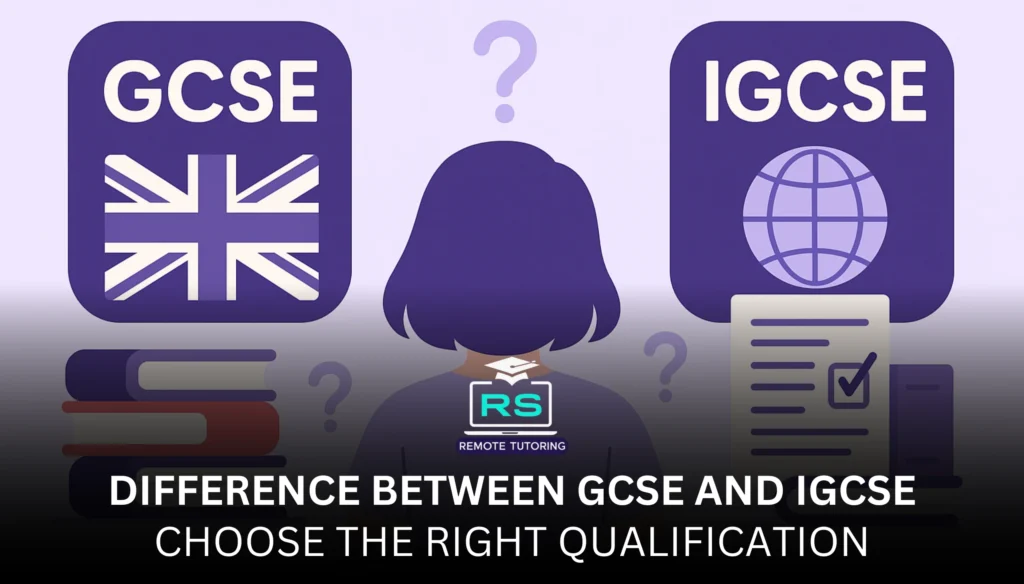
If you’re a student, parent or teacher in the United Kingdom trying to decide whether to follow the International General Certificate of Secondary Education (IGCSE) or the General Certificate of Secondary Education (GCSE), you’re not alone. Both qualifications are recognised by universities and employers around the world, yet they differ in syllabus focus, assessment styles and availability. Getting this decision right can open doors to A‑levels, apprenticeships and university, so it’s worth taking the time to understand how each path works. In this guide, we have discussed IGCSE vs GCSE, the origins of both qualifications, compared their structures, highlighted the differences and dispelled myths like “Is IGCSE harder than GCSE?” What is the GCSE? The General Certificate of Secondary Education (GCSE) is the UK’s standard qualification for pupils aged 14 to 16. It was introduced in 1988 and replaced the old O‑Level and CSE exams. The GCSE forms “the foundation of a student’s academic profile” and is typically studied over two years during Years 10 and 11 (Years 11–12 in Northern Ireland). Students usually take between 9 and 12 subjects, including core subjects such as English Language and Literature, Mathematics and Science. Key features of GCSEs Why GCSEs matter Pro tip: Choose your exam board wisely. AQA papers often emphasise essay writing, whereas Edexcel papers may lean more on data response. Ask your teachers which board aligns with your strengths and verify which boards are accepted by your chosen sixth‑form or college. What is the IGCSE? The International General Certificate of Secondary Education (IGCSE) was launched more than three decades ago by Cambridge Assessment International Education. It was designed to give overseas students access to a qualification “of the same standard as GCSE”. Today, exam boards such as Cambridge and Pearson Edexcel offer IGCSEs worldwide, including in many UK independent schools. Key features of IGCSEs Why do schools choose IGCSEs Independent schools often opt for IGCSEs because they perceive them to be more academically rigorous and internationally oriented. The reduced coursework requirement makes IGCSEs appealing for home‑schooled students and distance learners. Moreover, UK universities, including Oxford and Cambridge, accept IGCSEs as equivalent to GCSEs. Pro tip IGCSEs suit globally mobile families. If you anticipate relocating, the international curriculum and flexible exam sessions can make transitions smoother. Students in countries like Singapore, Malaysia, Italy or the United States also sit IGCSEs, so it’s easier to transfer credits between schools. Key Differences: GCSE vs IGCSE To understand which qualification fits you best, look at the distinctions in curriculum content, assessment methods, grading and availability. Although both are considered equivalent by universities and employers, the differences may suit some learners more than others. Curriculum and subject focus Assessment methods and coursework Availability and exam sessions GCSE and IGCSE Grading systems The grading systems for GCSE and IGCSE differ: Qualification Grading Scale Notes GCSE (England) 9–1 (9 is highest) Equivalent to A* (grade 8/9) to G (grade 1). Some GCSEs in Wales/Northern Ireland still use A*–G. IGCSE (Cambridge) A*–G Core and extended tiers offer grades from C to G and A* to C. IGCSE (Pearson Edexcel) 9–1 Aligns with the GCSE scale; widely used in UK private schools. Cambridge O Level (for comparison) A*–E Fewer coursework options and more localised syllabuses. Recognition and university acceptance Both GCSEs and IGCSEs are recognised equally by universities and employers. Leading universities, including Oxford, Cambridge and the Russell Group, explicitly state that they make no distinction between the two qualifications. Students should focus on achieving high grades rather than worrying about which qualification looks better on an application. Difficulty and perception Many people ask whether IGCSEs are harder than GCSEs. Historically, IGCSEs were considered more rigorous because they relied on final exams, while GCSEs included coursework. After recent GCSE reforms reducing coursework, the gap has narrowed. Difficulty varies by subject and personal strengths: for example, IGCSE Mathematics sometimes includes additional topics like set theory, while GCSE Maths may place more emphasis on statistics. In reality, success in either qualification depends on good study habits, effective revision and quality teaching rather than inherent difficulty. Pro tips for choosing between GCSE and IGCSE How to Choose Subjects in GCSE and IGCSE Whether you take GCSEs or IGCSEs, subject choices play a crucial role in shaping your academic profile. Here’s a roadmap: Core subjects Both qualifications require English, Mathematics and Science. In England, most students take Combined Science (worth two grades) or separate sciences (Biology, Chemistry and Physics). IGCSE students can choose between combined and coordinated science or single sciences; each route is recognised equally by universities. Languages and humanities For GCSEs, languages such as French, German or Spanish are common, and some schools offer Urdu or Mandarin. IGCSEs provide a wider language selection. Humanities options include History, Geography, Religious Studies and Sociology. Creative and vocational subjects Options like Art & Design, Music, Drama, Food Technology and Business Studies enable learners to explore creative or entrepreneurial interests. Ask about assessment methods; for example, GCSE Art heavily weighs coursework, whereas IGCSE Art may emphasise exam portfolios. Local tip for UK students When selecting subjects, consider proximity to fieldwork sites. GCSE Geography often involves field trips; schools in Yorkshire might visit the North York Moors, while those in Cornwall may study coastal erosion along the South West Coast Path. IGCSE fieldwork can be more flexible; you might compare urban regeneration in Manchester with rural changes in Norfolk. In either case, comfortable shoes and waterproof clothing are essential. British weather is unpredictable, especially in October and November exam seasons. IGCSE vs GCSE: Decision Framework Use the following framework to decide which qualification aligns with your needs. Rate each factor from 1 (low importance) to 5 (high importance) for your situation: Record your scores and discuss them with a teacher or careers adviser. This exercise can clarify which pathway aligns best with your goals. Differences Between IGCSE and O Level Many families in South Asia or Africa compare the Cambridge O Level with the IGCSE. Cambridge International states that the two qualifications are equivalent grade for grade. However, there
Online Tuition: How It Works, Benefits, Tools & Success Stories (2026 Guide)
Online tuition has redefined how learners access academic support. Instead of travelling to a tutor’s house or hosting lessons in the family dining room, students now log into video‐conferencing platforms and collaborate with expert tutors in real time. This digital format eliminates geographical barriers, tuition can be delivered from anywhere with a reliable internet connection. It also allows lessons to be recorded, paused and replayed, giving students an extra revision resource that simply doesn’t exist in a face‑to‑face session. In this guide we explain how online tuition works, why it’s so effective and how RS Remote Tutoring’s proven methods have transformed students’ grades and confidence. We’ll cover the pros and cons compared with in‑person tutoring, the tools that power engaging virtual lessons and how to choose a great tutor. We also include real customer stories and answer common questions. By the end you’ll know whether online tutoring is right for your child and how to make the most of it. What Is Online Tuition? Online tuition is personalised instruction delivered via digital platforms. Lessons take place through video conferencing software such as Zoom, Google Meet or Microsoft Teams. According to the Education Endowment Foundation’s online tuition guidance, well-structured online learning can be just as effective as face-to-face sessions. Tutors share presentations, write on interactive whiteboards and send resources through chat features. This setup keeps students and tutors connected as if they were in the same room, while eliminating travel time and opening up access to a wider pool of tutors. A good virtual lesson uses: This combination makes online tutoring interactive, flexible and highly effective for a range of age groups. Benefits of Online Tuition 1. Flexible scheduling and global choice Traditional tutoring restricts students to tutors within driving distance, whereas online tuition provides access to subject specialists from all over the country. Lessons can be scheduled outside school hours and across time zones. This makes it easier to find a tutor who fits your child’s needs and your family’s routine. Government resources on online education also highlight how digital learning improves accessibility, especially for families in rural areas or with busy schedules. 2. Highly personalised learning Online tutors can design lessons to target specific gaps in knowledge or stretch students beyond the school curriculum. Because tuition is one‑to‑one or in small groups, the tutor adapts the pace and style to suit the individual learner. Visual, auditory and kinaesthetic teaching methods can be combined using digital tools. 3. Better access and convenience Online tuition removes the need for travel for students. It provide learning in a familiar, comfortable environment at home. For families in rural areas or busy schedules, this offers a convenience which makes it easier to commit to regular classes and lessons. It also reduce the late cancellations which happens due to traffic or illness. 4. Interactive resources and gamification Digital platforms allow tutors to incorporate quizzes, polls, educational games and interactive whiteboards into lessons. Studies have shown that gamified learning increases motivation and retention. Tools like Quizlet and other online quizzes can test knowledge in a fun way, while digital whiteboards let students work through problems together. 5. Session recordings and progress tracking When lessons are recorded (with consent), students can revisit explanations at their own pace. Parents can also watch and understand what their child is learning. In addition, many tutoring platforms integrate progress‑tracking dashboards, allowing tutors to monitor improvement and tailor future lessons accordingly. 6. Broad subject coverage Online tutoring isn’t limited to core subjects like Maths and English. Students can access support for sciences, humanities, modern languages, coding and even music lessons (e.g., guitar tuition online). Our tutors are qualified teachers and experienced subject specialists who can teach up to A‑level and beyond. 7. Affordable and time‑efficient By removing travel time and allowing tutors to teach from home, online tuition can be more cost‑effective than in‑person lessons. Families save on petrol or public transport costs. Many providers (including RS Remote Tutoring) offer group classes at reduced rates, giving students high‑quality instruction for a lower per‑lesson price. Online vs In‑Person Tutoring: A Balanced Comparison Aspect Online tutoring In‑person tutoring Accessibility Accessible from anywhere with internet, removing geographic barriers Limited to tutors within a local area. Flexibility Highly flexible scheduling across time zones Requires fixed schedules and travel. Resources Uses digital tools like interactive whiteboards and session recordings. Relies on physical materials; no recordings. Travel & Cost No travel required; often cheaper and time‑efficient. Travel time adds cost and limits lesson length. Personal interaction Virtual interactions can feel less personal; requires good internet & tech skills. Face‑to‑face interaction fosters rapport but limits choice. Choice of tutors Large pool of subject specialists worldwide. Restricted to nearby tutors. Lesson recordings Sessions can be recorded, giving students a powerful revision tool. No recorded lessons; relies on notes taken during the session. To sumup the comparison, we get to know that online tuition offer greater accessibility, flexibility and resource variety, whereas face‑to‑face tuition may feel more personal. Choosing between two depends on the child needs and parents preferences. Many of our students families start with online lessons and never look back because of the convenience and results they get without traveling obviously. Tools and Technologies That Power Online Lessons Video conferencing and virtual classrooms Famous Platforms such as Zoom, Google Meet and Microsoft Teams helps alot and are the backbone of online tutoring. These platforms enable real time communication with HD quality video and audio. Tutors online can screen share their screens, share presentations, annotate on slides and use breakout rooms for collaborative exercises. Interactive whiteboards and collaboration tools Digital whiteboards allow tutors and students to write and draw simultaneously. Our tutors use a variety of tools: These tools help students visualise concepts and maintain a record of each lesson’s notes. As Edutopia explains, integrating digital tools into classrooms increases engagement and long-term knowledge retention. Gamified learning platforms Educational games and quizzes keep learners engaged. Platforms such as Quizlet allow tutors to build custom flashcards and quizzes. Kahoot! provides