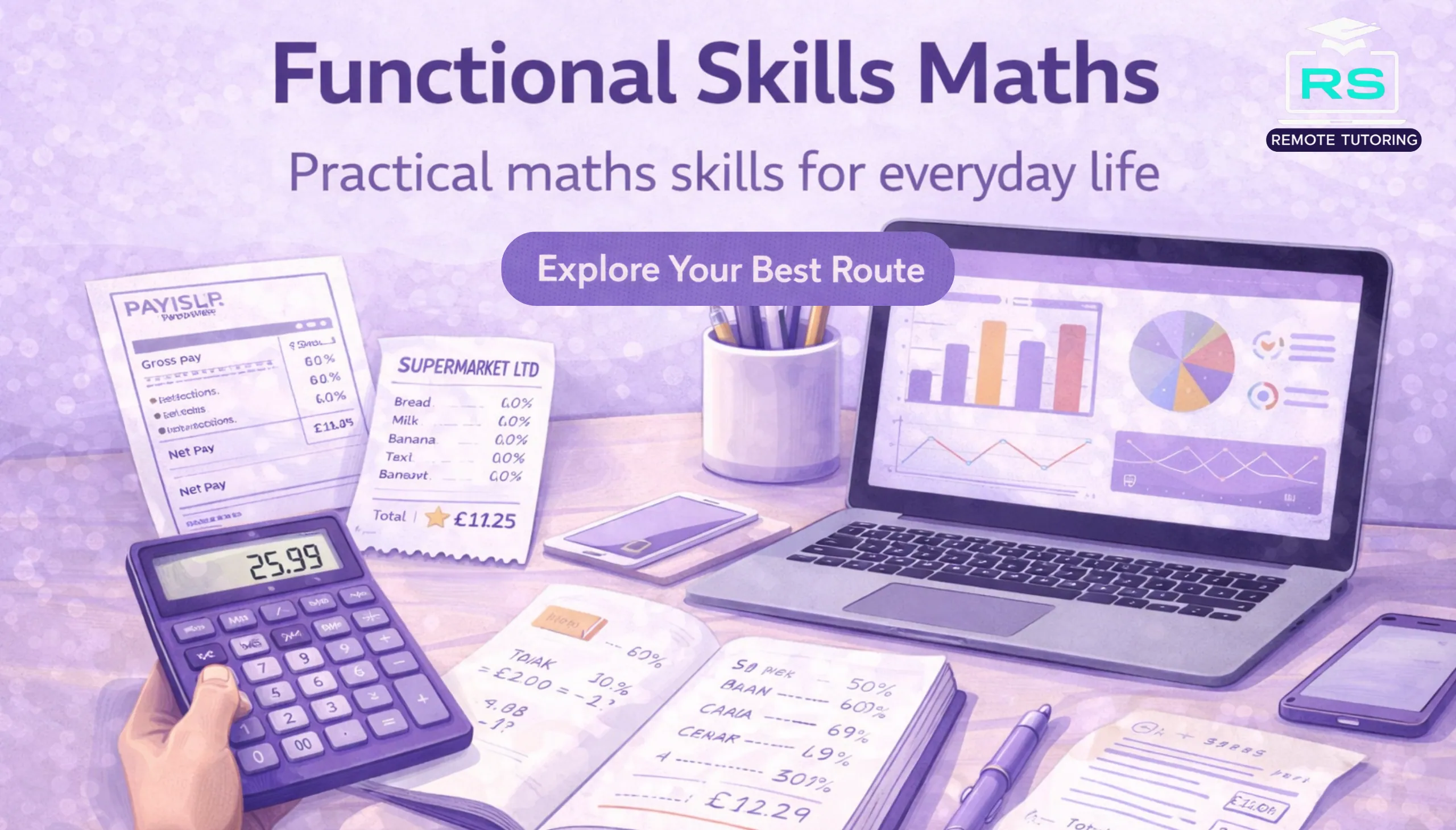
Modern Britain thrives on numeracy. From managing household budgets to analysing data at work, confidence with numbers is essential. Yet thousands of adults and young people in the United Kingdom leave school without a standard GCSE grade in mathematics. Functional Skills Maths bridges that gap by providing practical, real‑world maths qualifications recognised by employers, colleges and apprenticeship providers.
These courses are designed for everyone who needs to build or refresh their numeracy skills, whether you’re 16 or 60. In this guide you’ll learn what Functional Skills Maths is, how the different levels map to GCSE grades, who should consider it, how the exams work and why it’s an increasingly important qualification across the UK.
Jump to Section
What is Functional Skills Maths?
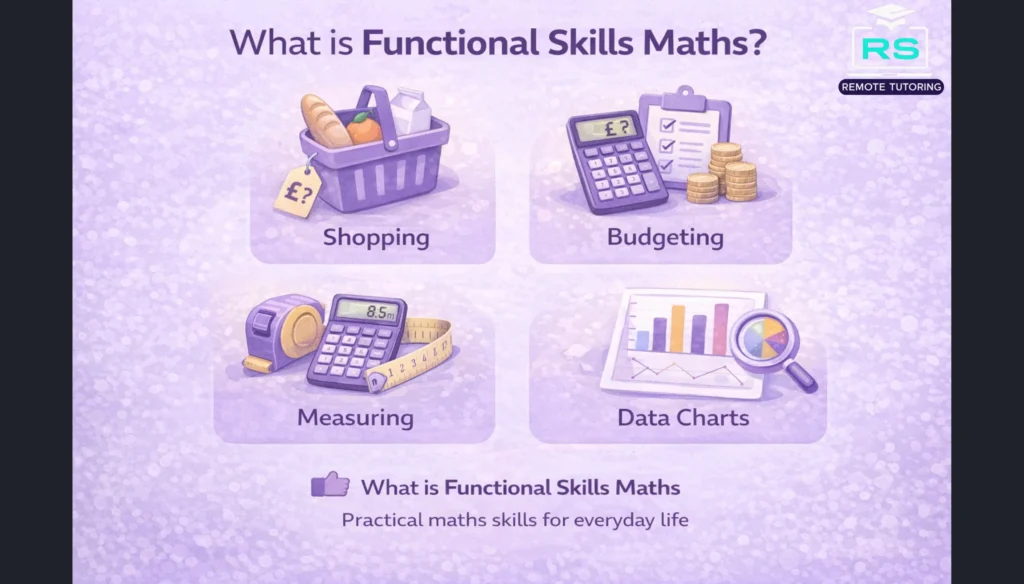
Functional Skills qualifications were introduced by the UK government to give learners practical skills for everyday life and work. The official subject content for Functional Skills Maths states that the purpose is to help learners gain confidence, fluency and a positive attitude to maths while developing ability to solve real‑life problems.
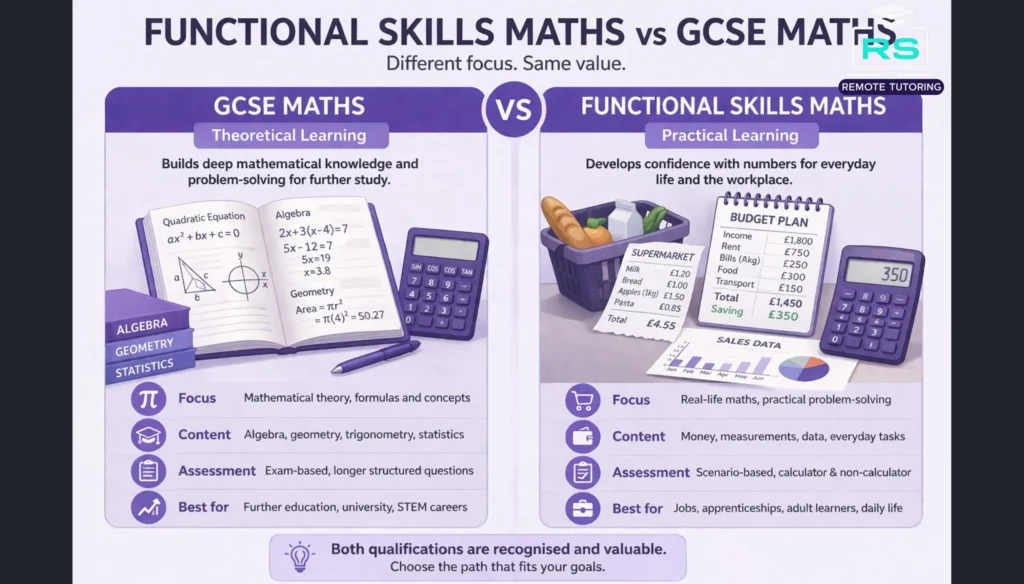
Unlike GCSE maths, the focus is not on abstract theory but on using numbers to handle shopping bills, interpret pay slips, calculate measurements and interpret data, all of which are needed in most jobs and daily tasks. National Numeracy explains that Functional Skills Maths, English and ICT qualifications are equivalent to GCSEs and aimed at adults; they teach skills needed in daily life and the workplace.
How does Functional Skills differ from GCSE maths?
The main differences lie in content and delivery:
- Practical orientation: Functional Skills Maths is built around scenarios such as splitting a restaurant bill, budgeting for a trip or interpreting a graph. Stonebridge training notes that functional courses focus on real‑life tasks like measuring ingredients or calculating change.
- Time commitment: Functional Skills courses typically require about 55 hours of study whereas GCSE maths courses require around 100 hours. This makes functional courses more accessible for adults with busy lives.
- Assessment style: Functional Skills assessments are scenario‑based with non‑calculator and calculator sections. Learners answer questions set in everyday contexts rather than lengthy theoretical problems.
- Purpose: Functional Skills aims to provide competence for work and life, while GCSE forms the foundation for further academic study or careers in science, engineering or computing.
Levels and GCSE equivalency
Functional Skills Maths qualifications are offered at several levels:
Entry Levels (Entry 1, 2 and 3)
These are foundation courses covering basic number skills, recognising coins, simple measurements and interpreting simple charts. They build confidence for learners who have been out of education or have very low numeracy. Learners normally progress through Entry 1 to Entry 3 before moving to Level 1.
Level 1
Level 1 is roughly equivalent to GCSE grades 2–3 (E–D). National Numeracy explains that Level 1 demonstrates a basic standard of maths needed for many jobs. Courses at this level cover:
- Number: arithmetic with whole numbers, fractions, decimals, percentages and ratios.
- Measure, shape & space: using units of measurement, time, perimeter and area, and understanding properties of shapes.
- Handling data: collecting and presenting data in charts and tables, calculating averages and interpreting probability.
Level 2
Level 2 is considered equivalent to a GCSE grade 4 (a standard pass). It is required for many job roles, apprenticeships and college courses. As Pass Functional Skills notes, Level 2 emphasises practical tasks and scenario‑based assessments. At this level you must demonstrate that you can:
- Apply percentages, fractions and ratios to solve real‑world problems (e.g., working out discounts or tax).
- Use formulas for area, volume and speed.
- Work with time, timetables and schedules.
- Collect, analyse and compare data sets using charts and statistical measures.
Level 3 and beyond: Do they exist?
You may have heard of Functional Skills Level 3. At present there is no widely offered Level 3 qualification in Functional Skills Maths; Level 2 is the highest level under the current framework. Learners who achieve Level 2 and wish to study further can progress to GCSE maths or other Level 3 qualifications such as Core Maths, T Levels or vocational courses.
Therefore, while some training providers might refer informally to “Level 3 skills”, there is no official Functional Skills Maths Level 3 certificate recognised by awarding bodies.
Who should take Functional Skills Maths?
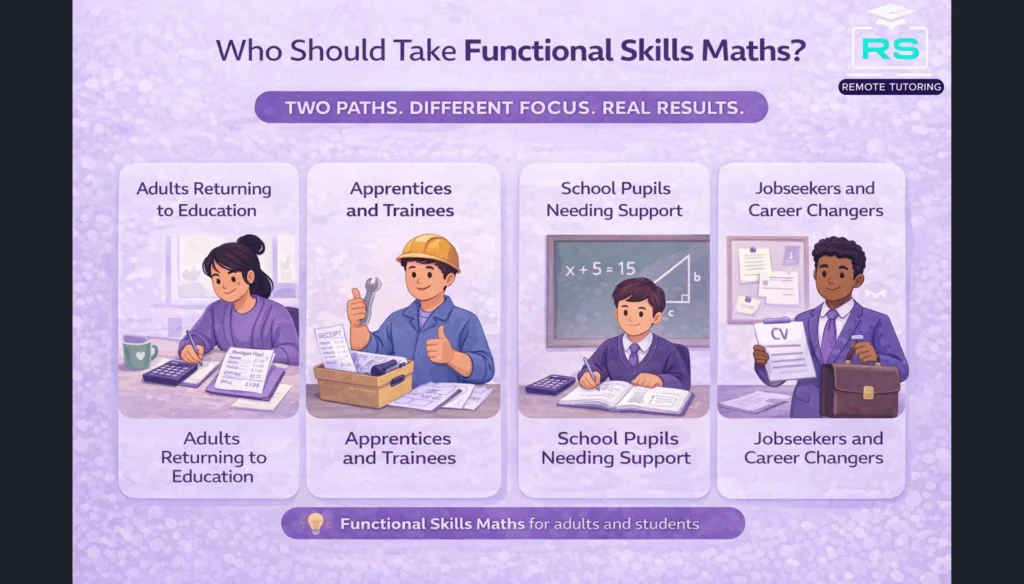
Functional Skills Maths is designed for a wide range of people:
- Adults returning to education: Many adults who did not achieve a GCSE grade 4 at school use Functional Skills to gain a recognised equivalent qualification. Pass Functional Skills notes that these courses are more accessible and flexible than GCSEs.
- Apprentices and trainees: Many apprenticeships require maths qualifications. National Numeracy explains that Level 1 covers the basics needed for many jobs, while Level 2 is required for higher‑level roles.
- School pupils needing a stepping stone: Some schools use Functional Skills alongside GCSEs to provide extra support for learners who struggle with maths, allowing them to gain confidence and achieve a qualification while still working towards a GCSE.
- Non‑native English speakers: Because the qualification focuses on practical tasks, it can be a useful entry point for learners whose first language isn’t English, especially when combined with Functional Skills English and ICT.
- Jobseekers and career changers: If your chosen career path requires numerical skills, Functional Skills Maths can help you meet entry requirements and demonstrate competence to employers.
Eligibility and funding
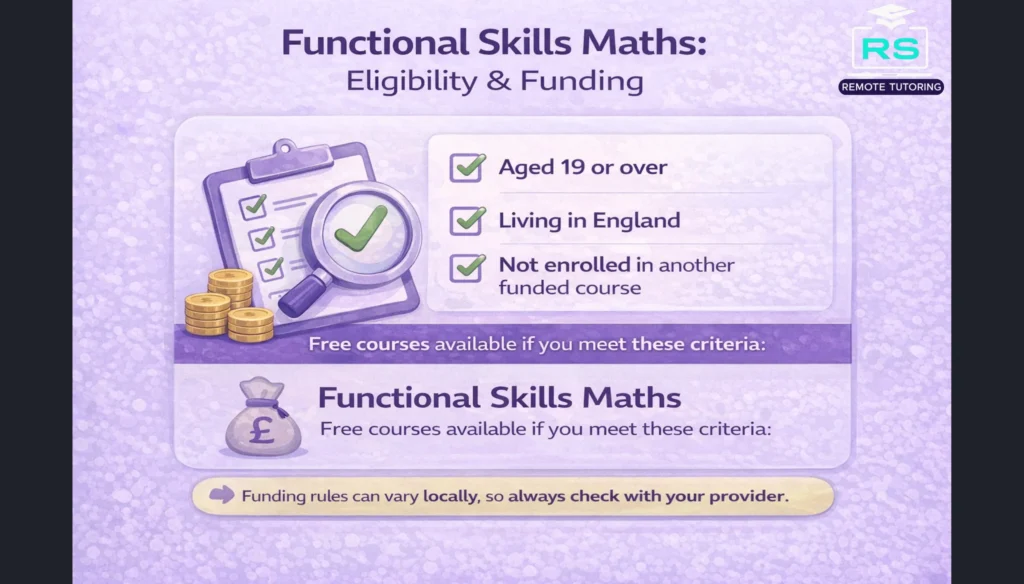
The Functional Skills UK course provider lists specific eligibility criteria for government‑funded courses. To enrol for free you must typically be:
- Aged 19 or over.
- Living in England (funding may differ in devolved nations).
- Not currently enrolled on any other government‑funded course.
Different providers may have additional requirements, such as receiving unemployment benefits or living in a specific region. If you don’t meet funding requirements, courses are still available for a fee (around £450 for a self‑paced course).
Importantly, Pearson, one of the largest awarding bodies, confirms that there are no set age limits for taking Functional Skills tests; centres should consider learners’ maturity and readiness. That means teenagers, adults and older learners can all sit Functional Skills Maths.
How the assessment works
Functional Skills Maths exams are designed to mimic real‑life situations. A typical assessment consists of two papers:
- Non‑calculator section: You solve problems without a calculator, testing mental arithmetic and estimation skills.
- Calculator section: You tackle more complex scenarios requiring a calculator.
The Functional Skills UK course description notes that the maths curriculum covers number, measure, shape and space, and handling data. You learn to:
- Perform arithmetic with whole numbers, fractions, decimals and percentages.
- Calculate perimeter, area, volume and convert between units.
- Use timetables, scales and properties of shapes.
- Collect, organise and interpret data using graphs and tables.
Assessments are on demand; you can book your test when ready, and results often arrive within two weeks. According to our expert tutors at RS Remote tutoring, courses last around 55 hours and require 100 % attendance. After passing both sections, you receive a certificate from the awarding body.
Why Functional Skills Maths is important in the UK
Enhancing employability
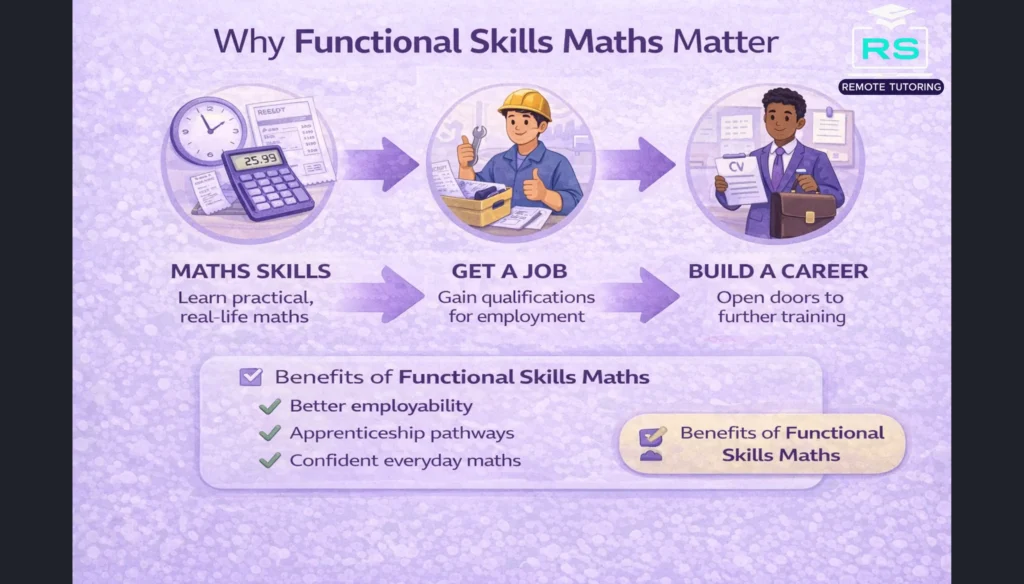
Employers across the UK increasingly value numeracy skills. National Numeracy highlights that Level 1 and Level 2 Functional Skills qualifications cover the maths needed for most jobs and demonstrate a good standard of numeracy. Many employers accept a Level 2 Functional Skills certificate as evidence of meeting minimum maths requirements.
Meeting apprenticeship and further‑study requirements
Apprenticeships often require a Level 2 maths qualification. If you didn’t achieve a GCSE grade 4 at school, Functional Skills Maths Level 2 provides an accessible alternative that satisfies the entry requirement. It also opens doors to further study, such as vocational courses, foundation degrees or teacher training programmes.
Supporting everyday life
Whether you’re managing your finances, calculating mortgage repayments or helping your children with homework, practical maths skills matter. Functional Skills courses build confidence in using numbers day‑to‑day and encourage a positive attitude to maths.
Providing a pathway for adult learners
Many adults feel daunted by the prospect of returning to the classroom. Functional Skills classes are shorter, friendlier and more flexible than GCSE courses. This makes them ideal for people juggling work, family and other responsibilities. They’re also typically assessed through pass/fail rather than a numerical grade, making the process less intimidating.
A stepping stone for languages and other learning
While this guide focuses on maths, people often ask about studying languages like French, Spanish or German alongside numeracy. The Foreign Service Institute (FSI) categorises French and Spanish as Category I languages requiring around 600 to 750 class hours, making them relatively easy for English speakers compared with German, a Category II language requiring more time.
Just as you choose a language level based on your goals, you should choose your maths qualification based on your career plans and confidence. Functional Skills courses provide a flexible, accessible way to build numeracy before tackling more advanced qualifications.
Choosing the right level and provider
To choose the right level, take a diagnostic assessment offered by most colleges and training providers. This identifies your current skills and suggests an appropriate starting point. When selecting a provider, consider:
- Accreditation: Ensure the course is delivered by a recognised awarding body such as Pearson (Edexcel), City & Guilds, NCFE or Open Awards.
- Support: Decide whether you prefer tutor‑led classes or self‑study. Live courses offer structure and higher pass rates, while online courses provide flexibility.
- Funding: Check eligibility criteria (age, residency, benefits) and confirm whether your chosen provider offers free courses.
- Progression opportunities: Ask about support for progressing to GCSE or other qualifications if you plan to continue studying.
Preparing for the Functional Skills Maths exam
Improving your numeracy skills takes practice. Here are some strategies:
- Complete past papers: Many providers publish past papers for Level 1 and Level 2. Working through these papers helps you familiarise yourself with question formats and time management. For Level 1 and Level 2, include both calculator and non‑calculator sections.
- Use everyday scenarios: Practise calculating shopping discounts, reading timetables or comparing phone tariffs. Functional Skills assessments use similar situations.
- Learn key formulas: Memorise simple formulas for area, circumference, volume and percentages. Even though calculators are allowed on one paper, understanding the formulas helps you set up problems correctly.
- Develop mental maths: Strengthen your ability to estimate and check answers without a calculator. This is essential for the non‑calculator section.
- Consider online resources: Free resources from National Numeracy and other charities offer interactive exercises and diagnostic tests.
Pro tips
- Balance your study with revision of English and ICT Functional Skills if you also need these qualifications. Learning maths often improves problem‑solving skills across subjects.
- Don’t rush the exam booking. Make sure you’ve completed sufficient practice and can confidently tackle both sections before sitting the test.
FAQs
These questions capture the most common queries learners search online.
What is functional maths in the UK?
Functional maths refers to the Functional Skills Maths qualification, a practical maths course that teaches the numeracy needed for everyday life and work. It focuses on real‑world problem‑solving rather than abstract theory and is available at Entry Levels 1–3, Level 1 and Level 2. Level 2 is equivalent to a GCSE grade 4.
Do I need GCSE if I have Functional Skills?
Not always. Many employers, colleges and apprenticeship providers accept Functional Skills Maths Level 2 as an alternative to GCSE Maths. However, some competitive university courses and professions such as engineering or science, may still require GCSE or higher‑level maths. If in doubt, check the entry requirements for your chosen pathway.
Is functional maths easier than GCSE maths?
Functional Skills Maths is generally considered more accessible because it focuses on practical tasks and requires fewer study hours. The assessments use everyday contexts, making them easier to relate to. GCSE maths explores more complex algebra, geometry and statistics and is essential for further academic study.
Is functional maths equal to GCSE maths?
Is functional maths equal to GCSE maths?Functional Skills Maths Level 2 is equivalent to a GCSE grade 4, the standard pass. Level 1 is equivalent to grades 2–3. While equivalent for many purposes, the qualifications differ in content and learning focus.
Can you get a job with Functional Skills?
Yes. Employers frequently list Level 1 or Level 2 Functional Skills Maths as a minimum requirement for roles such as administration, retail, healthcare and apprenticeships. National Numeracy notes that Level 1 demonstrates the basics needed in many jobs, while Level 2 shows a good standard of maths.
How do I prepare for a Functional Skills test?
Start by taking a diagnostic assessment to identify gaps. Then practise using past papers, online resources and real‑life scenarios such as budgeting or measuring. Focus on understanding why you perform certain steps rather than simply memorising procedures. Joining a tutor‑led course can also provide structure and support.
Are Functional Skills just pass or fail?
Yes. Functional Skills Maths assessments are graded on a pass/fail basis. Unlike GCSE, you do not receive a numerical grade. Exam boards determine pass marks for each paper after each assessment series.
What are the benefits of having Functional Skills maths?
Functional Skills Maths improves your confidence with numbers, opens doors to employment and further training, and equips you with practical skills for everyday life. It’s flexible, accessible and widely recognised across the UK. For adults returning to study, it’s a manageable way to gain a valued qualification without committing to a full GCSE.
Conclusion
Functional Skills Maths offers a flexible, practical route to essential numeracy skills for people across the United Kingdom. With no minimum age limit and levels ranging from Entry 1 to Level 2, it provides a stepping stone for young learners, adults and career changers alike. Level 2 is equivalent to a GCSE grade 4, satisfying many employers’ and colleges’ entry requirements. By focusing on real‑world tasks and building confidence, Functional Skills Maths helps learners overcome maths anxiety, improve job prospects and manage everyday situations. If you’re ready to take the next step, explore local providers and start your journey toward mathematical confidence today.
Ready to boost your numeracy skills and unlock new opportunities? Whether you’re aiming for a promotion, planning an apprenticeship or simply want to feel more confident with numbers, Functional Skills Maths could be the key. Contact our team in the UK today to find out which level is right for you, explore funding options and enrol on a course that fits your lifestyle.

Raja specializes in Physics and Maths, with over 5 years of experience. He offers KS2, KS3, and GCSE Science and Maths lessons. He graduated from one of the top universities in the UK.