
If you attend secondary school in the United Kingdom, chances are you’ll sit your GCSEs with one of three major exam boards: AQA, Pearson Edexcel or OCR. Headlines like “Which GCSE board is the easiest?” flood forums and search engines every year, yet few guides separate myth from fact. All boards follow Ofqual’s national curriculum and assessment objectives, so differences lie mainly in exam style, support resources, grade boundaries and subject emphasis. This GUIDE unpacks those differences and gives students clear, practical advice to help them choose confidently.
Jump to Section
Understanding GCSE Exam Boards in the UK
What exam boards are there?
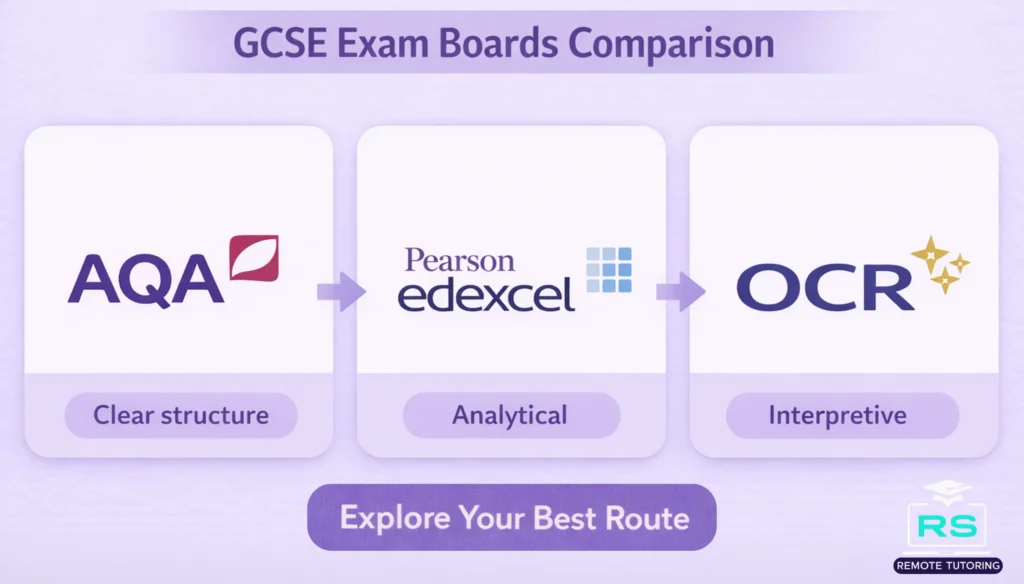
Five awarding bodies set GCSEs in the UK. AQA, Edexcel and OCR dominate in England, while WJEC is used widely in Wales and CCEA in Northern Ireland. Each board produces syllabuses, exam papers and mark schemes that must meet national standards. They all work to the same assessment objectives, recall of techniques (AO1), reasoning & interpretation (AO2) and problem‑solving (AO3) and they each issue grades on the 9–1 scale. Although the subject content is almost identical across boards, the way it is presented and assessed can differ.
- AQA (Assessment and Qualifications Alliance): The largest GCSE exam board, used for over half of entries in England. AQA is popular for English, Sciences and Humanities.
- Edexcel (Pearson Edexcel): Part of Pearson plc and widely used for Maths, Sciences and Business. Edexcel also offers International GCSEs (IGCSEs) for overseas learners.
- OCR (Oxford, Cambridge and RSA): Linked to Cambridge University Press & Assessment, offering a wide range of subjects including niche topics like Classical Civilisation.
- WJEC (Welsh Joint Education Committee): Predominantly used in Wales; considered the most academically rigorous, with fewer top grades.
- CCEA (Council for the National Curriculum, Examinations & Assessment): Used in Northern Ireland.
Which board does London use?
London schools almost exclusively choose AQA, Edexcel or OCR. Students generally have no say in the decision; the subject department picks an exam board based on teaching preferences, resource availability and timetables. However, private candidates or home‑educated students in London can select their board when registering through an approved exam centre.
Comparing Exam Format and Structure
Number of papers and marks
GCSE Maths and most other subjects are assessed by three 90‑minute papers. AQA and Edexcel each award 80 marks per paper, totalling 240 marks. OCR differs: its papers are worth 100 marks each (300 in total), allowing more opportunity for method marks. WJEC and CCEA follow structures similar to AQA and Edexcel but may vary slightly by subject.
Sequence of calculator and non‑calculator papers
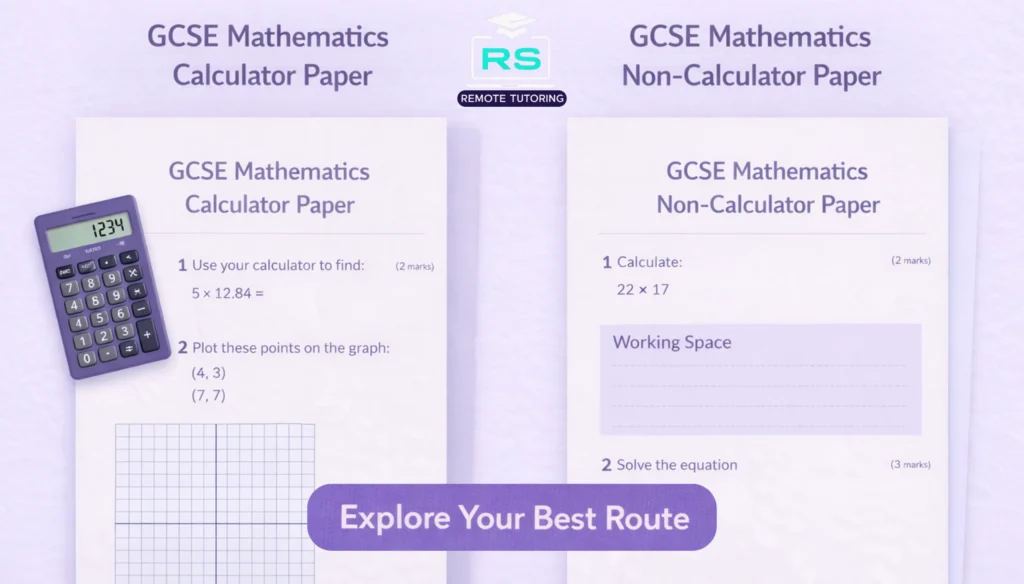
AQA and Edexcel place the non‑calculator paper first, followed by two calculator papers. OCR flips the order: Paper 1 is a calculator paper, Paper 2 is non‑calculator, and Paper 3 returns to calculator. The position of the non‑calculator exam influences revision scheduling, students who prefer tackling arithmetic without a calculator early may favour AQA or Edexcel.
Exam style and question presentation
- Multiple‑choice questions: AQA includes a handful of 1‑mark multiple‑choice questions at the start of its papers. These can build confidence but require careful practice. Edexcel and OCR seldom use multiple choice, opting instead for structured response questions.
- Working space: AQA provides lined answer spaces to guide students’ workings. Edexcel and OCR leave blank space, expecting students to organise their own layout.
- Question wording: AQA examiners tend to write straightforward questions with clear progression from easy to difficult. Edexcel questions are often data‑heavy and require multi‑step problem solving. OCR questions are wordier and demand interpretation and extended responses.
Grade boundaries and perceived difficulty
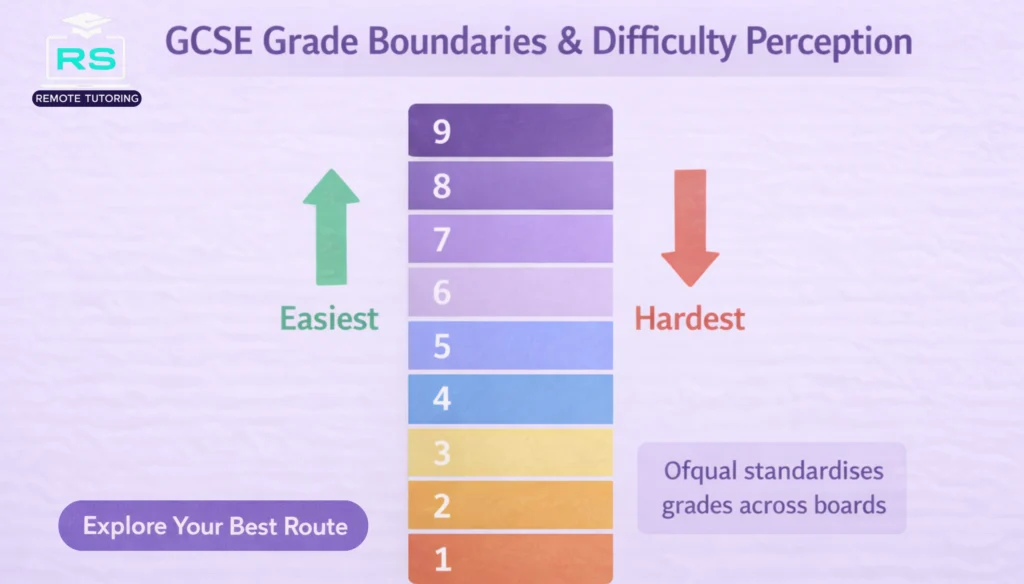
Grade boundaries vary annually based on exam difficulty. In the summer 2019 series, the foundation tier OCR paper had lower grade boundaries than AQA and Edexcel, reflecting its 300‑mark structure. For the higher tier, Edexcel set lower boundaries up to grade 6. This does not mean those boards are inherently easier. Ofqual standardises grade outcomes across boards but it can affect how many marks are required to reach a grade. Students should review recent grade boundaries for their chosen board.
Assessment objectives and syllabus content
All boards must allocate similar weightings to assessment objectives (AO1, AO2, AO3). The Department for Education specifies the same subject content for each board. Differences lie in how the specification is presented: AQA and OCR organise topics into user‑friendly tables (e.g., Basic/Foundation/Higher) while Edexcel lists topics in bold to identify higher‑tier content.
Exam Board Comparison: Strengths, Subjects and Styles
AQA: Clear Structure and Accessible Papers
- Popularity & scope: More than half of GCSE entries in England are with AQA. It offers a comprehensive subject range, especially strong in English, Sciences, Geography and creative subjects.
- Assessment style: AQA uses straightforward questions, clear mark schemes and predictable structures. Multiple‑choice questions at the start help students build confidence.
Best for Students who like clarity, consistency and a gradual increase in difficulty. AQA exams suit learners who prefer accessible language over complex context and want extensive past‑paper resources..
Edexcel: Analytical and Globally Recognised
- Reach & subjects: Widely used across England and internationally via IGCSEs. Strong reputation for Mathematics, Sciences and Business.
- Assessment style: Edexcel exams are often data‑driven and require strong analytical and problem‑solving skills. Some papers include creative elements such as historical context in English literature.
Best for Students who excel at applied learning and want globally recognised qualifications. The board’s structured exams benefit those comfortable with multi‑step problems and real‑world applications.
OCR: Interpretive and Critical Thinking
- Subject variety: OCR offers a wide range of subjects, including niche options like Classical Civilisation and Computing.
- Assessment style: OCR papers can be wordier and may require extended responses and interpretation. This suits students who enjoy essay‑based subjects and critical analysis.
- Best for Learners who thrive on reasoning and interpreting information in varied formats. OCR is often favoured for History, Computer Science and subjects that value critical thinking.
WJEC & CCEA: Regional Boards
- WJEC: Used mainly in Wales; includes context‑rich questions and a reputation for rigorous marking. Fewer students achieve top grades compared with AQA or OCR, leading to perceptions of being the hardest board.
- CCEA: The board for Northern Ireland. Follows similar structures to AQA and Edexcel but may have its own specification details.
Costs: Exam Entry Fees by Board
When registering as a private candidate, costs vary by board and subject. According to a 2024–25 fee guide, the average entry fee per subject is around £48 for AQA, £52 for Edexcel and £53 for OCR. Fees increase for subjects with practical components or coursework, such as sciences, art and PE. International GCSEs (IGCSEs) typically cost between £170 and £400 per subject. Schools often cover these fees for enrolled students, but private candidates should budget accordingly.
Additional costs to consider
- Exam centre fees: Centres charge administrative fees, which may range from £20–£50 per paper. London centres tend to be more expensive due to overheads. Book early to secure a convenient location.
- Late entry fees: Registering after the normal deadline can double or triple entry costs. Avoid late fees by contacting your exam centre at least six months before the exam.
- Revision resources: Past paper workbooks, guides and tutoring services add to costs. AQA and Edexcel provide extensive free resources; OCR offers alternative papers and interactive scheme‑of‑work tools.
Pro Tip: When budgeting for private exams, factor in travel expenses to exam centres in London. Consider sitting your exams during spring or summer when daylight hours and public transport are more reliable.
How to Choose the Right GCSE Exam Board
Making a decision about exam boards can feel overwhelming, but focusing on your individual needs and circumstances simplifies the process. Here are key considerations:
1. Assess your learning style
- If you appreciate clarity, structured progression and accessible language, AQA’s straight‑forward question style may suit you.
- If you excel at data analysis and problem‑solving or aim to take IGCSEs, Edexcel’s analytic approach might be a better fit.
- If you enjoy extended writing, interpretation and critical thinking, OCR’s wordier papers could appeal.
2. Consider your subject strengths and future plans
- AQA is often recommended for English, Geography and creative subjects.
- Edexcel is popular for Maths and Sciences, and its IGCSE offerings make it attractive to internationally minded students.
- OCR shines in History, Computer Science and essay‑based subjects.
- WJEC is known for challenging exams; choose it if you want to stretch yourself academically.
3. Look at resources and support
Each board provides a suite of free and paid resources. Edexcel offers gold/silver/bronze papers to scaffold revision, and shadow papers that mirror past exams. OCR has interactive scheme‑of‑work builders and alternative papers. AQA provides extensive past papers and mark schemes. Use the board’s resources to practise exam‑specific question styles.
4. Check exam centre availability and timetables
For private candidates, ensure your preferred board is available at a nearby London exam centre. Boards have identical exam dates for core subjects but may differ slightly for options. If mixing exam boards, verify that timetables do not clash.
5. Discuss with teachers or tutors
Teachers choose boards based on their expertise and teaching resources. Discuss with them why a particular board is used and whether it suits your strengths. If you are unhappy with the board, speak to your head of department early, switching boards mid‑course is difficult and may require catching up on different specifications.
6. Factor in costs and budgeting
Entry fees differ slightly across boards. If cost is a primary concern, AQA may offer slightly lower fees, but the difference is modest. Consider travel costs to exam centres and revision resource expenses.
7. Think about long‑term goals
Universities and employers treat grades from all boards equally. Choose the board that allows you to perform at your best and develop skills relevant to A‑level or vocational plans. If you’re considering international study, Edexcel’s IGCSE may add flexibility.
Which GCSE Exam Board Is Easier?
Understanding the myth
All exam boards are regulated by Ofqual, meaning a grade 7 with AQA is equivalent to a grade 7 with Edexcel or OCR. Standards and grade distributions are closely monitored to ensure fairness. Therefore, there is no objectively easiest board. That said, students’ perceptions of difficulty vary:
- AQA is perceived as more straightforward: Students often find its clear structure and multiple‑choice questions accessible. This can make AQA feel easier if you prefer clear signposting and predictable question progression.
- Edexcel can be more analytical: Edexcel’s data‑driven questions require strong problem‑solving. This can be challenging but beneficial for high achievers.
- OCR is interpretive and essay‑like: OCR papers demand reading and interpreting complex scenarios. This suits students who enjoy reasoning and extended responses.
- WJEC is viewed as the hardest: Evidence shows fewer students achieve top grades with WJEC due to rigorous marking.
Choose the board whose style matches your strengths and revision preference. Practise past papers from your board; familiarity with format reduces stress and improves performance. If your school uses a different board from your preference, focus on mastering that specification rather than worrying about perceived difficulty. Success comes from preparation, not switching boards.
Expert Tutors Advice & Seasonal Considerations

- Exam season: GCSE exams usually run from mid‑May to late June, with GCSE resits in November. London’s late spring and early summer offer milder weather and longer daylight hours, making travel to exam centres less stressful.
- Transport & travel: Plan routes to exam centres using Transport for London. Avoid strikes by checking travel updates. For winter resits, allow extra time for delays.
- Study venues: London libraries (e.g., British Library, Southbank Centre) offer quiet spaces. Coffee shops with stable Wi‑Fi can provide change of scenery.
- Local tutoring: If you need extra support, consider London‑based tutoring services that specialise in your chosen exam board. Many offer one‑to‑one sessions online and in person.
- Weather & wellbeing: Use daylight hours for study sessions to enhance mood; schedule revision breaks in local parks during warmer months. In colder months, ensure you have comfortable indoor study spaces.
FAQs
Is AQA or OCR harder?
Both boards are standardised, but they differ in style. OCR papers are often wordier and require interpretation and extended responses, which some students find more challenging. AQA uses clear, structured questions with some multiple‑choice options. Ultimately, difficulty depends on your strengths: if you prefer straightforward questions, AQA may feel easier; if you enjoy interpreting contexts, OCR may suit you.
Which GCSE board is the easiest?
There is no official easiest exam board. Ofqual ensures that a grade 7 in one board equals a grade 7 in another. Many students perceive AQA as easier due to its clear structure and multiple‑choice questions. However, Edexcel suits analytical learners and OCR suits interpretive learners. Choose based on your learning style.
Is OCR or Edexcel easier?
Edexcel tends to be data‑driven and requires multi‑step problem solving. OCR involves varied question types and extended writing. Some students find Edexcel’s clear steps easier; others prefer OCR’s real‑world context. Practise both styles if you have a choice.
What is the difference between AQA, Edexcel and OCR?
• AQA: Largest board; straightforward papers with clear progression; strong in English, sciences and humanities.
• Edexcel: Widely used; analytical, data‑heavy questions; strong in maths, sciences and business; offers IGCSEs.
• OCR: Wide subject choice; wordier papers; critical thinking and extended responses.
All follow the same Ofqual’s national curriculum, but their question styles and resources differ.
Is AQA and Edexcel the same content for science?
Yes. The Department for Education sets the same science content across boards, and each board must meet the assessment objectives AO1‑AO3. Differences lie in question style and presentation.
Which exam board is the easiest for GCSE English?
Many teachers find AQA’s English language and literature specifications more accessible because of their clear structure and extensive resources. That said, Edexcel and OCR also offer strong English qualifications. Focus on practising past papers from the board you’re assigned.
What exam board did my school use?
Ask your teacher or exams officer; they keep records of which board set each subject’s exams. If you’ve finished school and need to know for job or university applications, contact your school’s admin office. Boards will not typically provide this information directly.
What is OCR?
OCR (Oxford, Cambridge and RSA Examinations) is one of the main GCSE exam boards. It is part of Cambridge University Press & Assessment. OCR offers a wide range of subjects and emphasises critical thinking.
Is AQA or Edexcel harder for maths?
Neither board is officially harder; however, AQA includes some multiple‑choice questions and a clear progression of difficulty, which some students find more manageable. Edexcel is known for analytical, multi‑step questions. Choose based on your strengths and practise past papers accordingly.
What is the easiest exam board for GCSE?
No single board is easiest. AQA may feel easier to students who prefer clarity and straightforward questions. Edexcel suits analytical learners, while OCR suits those who enjoy extended responses. WJEC is often seen as the hardest due to rigorous marking.
How do GCSE exam boards differ in syllabus and workload?
Boards follow the same syllabus but present content differently. AQA and OCR use tables to signpost basic, foundation and higher content; Edexcel lists topics and uses bold font to identify higher‑tier topics. Workload is similar across boards, though the style of practice may differ, AQA emphasises clear progression, Edexcel emphasises problem‑solving, and OCR emphasises interpretation.
Conclusion
Choosing an exam board should not be about finding the “easiest” option, but rather the best fit. All boards adhere to national standards and deliver comparable grades. The differences lie in exam style, resources, grade boundaries and subject focus. Start by identifying your strengths, do you thrive on clear, structured questions or enjoy solving complex, data‑driven problems? Consider your future plans: AQA is great for humanities and arts, Edexcel excels in maths and sciences, and OCR supports essay‑based subjects. Factor in costs, available resources, and travel to exam centres.
Ready to choose your GCSE exam board or need help interpreting specifications? Our experienced tutors in the UK can guide you through AQA, Edexcel or OCR syllabuses, create tailored revision plans and help you master exam techniques. Contact us today to book a free consultation and secure your path to GCSE success

Raja specializes in Physics and Maths, with over 5 years of experience. He offers KS2, KS3, and GCSE Science and Maths lessons. He graduated from one of the top universities in the UK.