
Getting a 9 in GCSE Maths is every student’s dream. Not only in one subject but every student wants to slay in the whole GCSE process, but the process is time consuming and demands a lot of success and patient. Maths is the subject which is often associated with difficulty. Most students hesitate to talk about GCSE maths as the syllabus seems like a huge rock to cover, But these are all the myths. Undoubtedly most students find it difficult not because the subject is hard to tackle but because the key interest areas of students are difficult. Getting a grade 9 is not about being naturally good at maths, but it is whole about consistency and strategic preparation.
Every year students fall short of grade 9 not because they lack the finest ability to tackle the purest difficult subject but because they prepare and revise ineffectively, misunderstands how marks are awarded and in most cases there is the high probability of problem solving skills.
The guide will explain what separates grade 9 students from grade 7 or grade 8 and how you can bridge the gap with structured approach and right guidance.
Jump to Section
Understanding what Grade 9 actually means?

Grade 9 does not actually reflect full marks or students’ high intellectual ability but it reflects students’ key abilities of focus and consistency. Grade 9 in mathematics suggest;
- Exceptional conceptual understanding.
- Strong mathematical reasoning.
- Consistent accuracy under pressure.
- Ability to tackle a lot of finest problems.
Grade 9 is basically awarded to the most intellectual and highest achieving students and basically to stretch the 5 or 6 % candidates. GCSEs papers mostly include questions including
- Multiple topics
- Questions often requiring deep analysis and interpretation
One key thing should be noted that students should make it clear that they are not revising for maths but how to master how GCSE maths tests actually maths.
A complete Road map for getting 9 in GCSE Maths
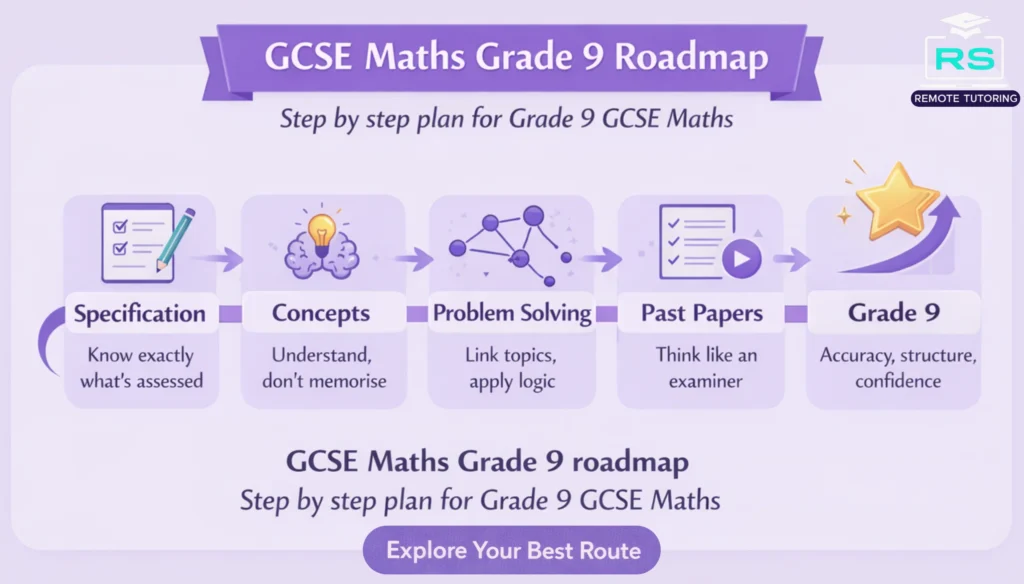
The following guide will break down the most important areas to focus on and what actually builds up to make a grade 9 in GCSE Maths.
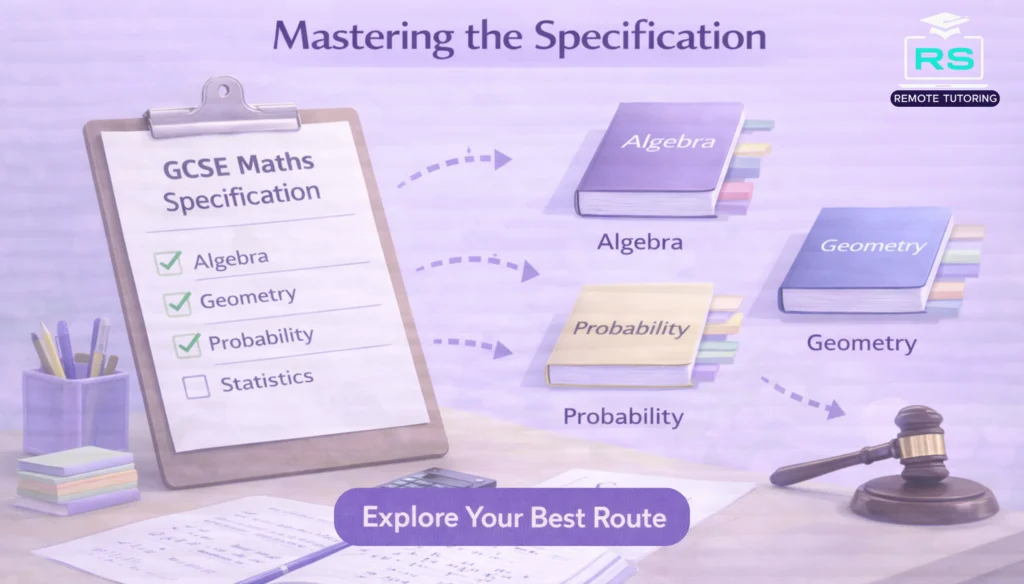
Mastering the GCSE Exam Specification:
The most crucial and finest step is to understand clearly what GCSE demands. Students pay a lot of hard work but still miss marks not because of efforts but because of ineffectively revising and considering everything as a whole. GCSE demands not everything but everything done in a strategic and smarter way. What is actually needed by students is;
- Downloading the authentic and official specification.
- Categorises the topics into
- Secure
- Weak
- Grade 7- 8 only
Grade 9 most important topics include
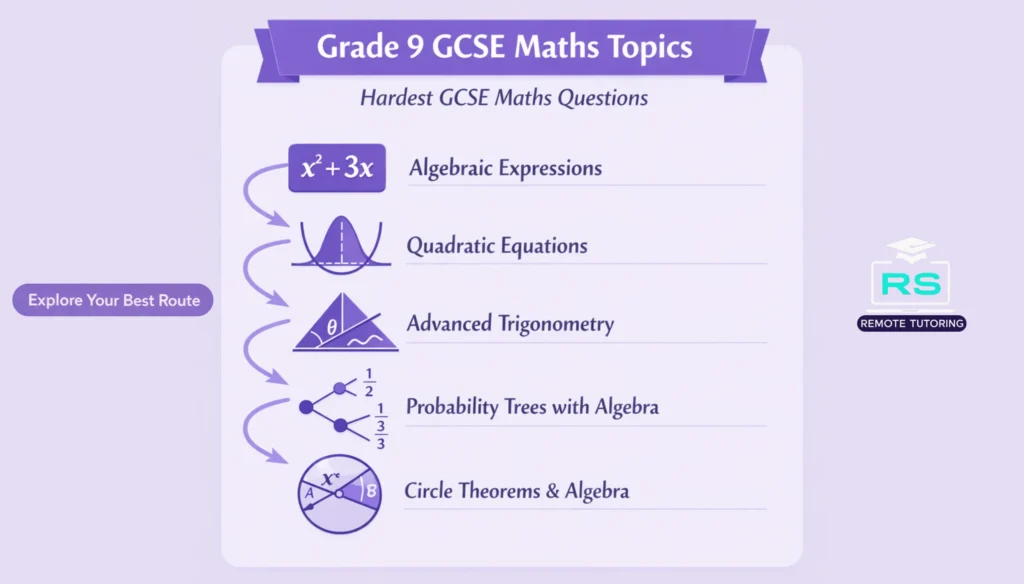
- Algebraic expressions
- Quadratic equations
- Advanced trigonometry
- Probability trees with algebra
- Circle theorems combined with algebra
Being gripped at these topics saves one from failing.
Work on Building Conceptual Understanding rather than speed:
A common mistake that usually students rush up in is working on time management and speed rather than building strong roots in the subject. The key difference between grade 9 student and other student is that \
- They understand the logic behind the formula rather than cramming the whole solution
- They can derive the results with rigorous practice
- Work smartly by understanding the structures.
For Example; instead of memorising the quadratic formula ; grade 9 student
- Understand the completing square method
- Recognise when factoring is faster
- Identify when the discriminant explains the graph.
The in depth explanation allows flexibility to adapt to every unfamiliar question that can be asked in the exam.
Learning How marks are awarded:
Maths is quite the subject encapsulating the methodological approach rather than the theoretical one. The key distinction of grade 9 student is that ;
- They write full algebraic steps
- Structure solutions clearly
And the examiners reward only to those navigating the following steps
Correct setups
- Logical progressions
- Accurate notations
Understanding the indepth marks rewarding strategy can work as the formulate ladder for achieving Grade 9.Correct ideas with poor structure can lose the marks. A well-structured answer with the minor error can still score high.
Rigorous Practice for Grade 9 Problem Solving Question:
GCSE questions are rarely direct. Because they test
- Linking multiple topics
- Interpreting unfamiliar contexts
- Mathematical reasoning.
In order to gain well reputable success in mathematics
- Practice only higher tier question
- Use past papers, Examiners reports and the specified topics that can be asked in multiple ways in the exams.
A well proven strategy is that
After practising the question ask yourself the following question;
- Why this question was difficult
- How could this appear differently
- What could be the examiner strategy for marking this question?
This reflection is what separates the high achievers.
Use Past Papers strategically:
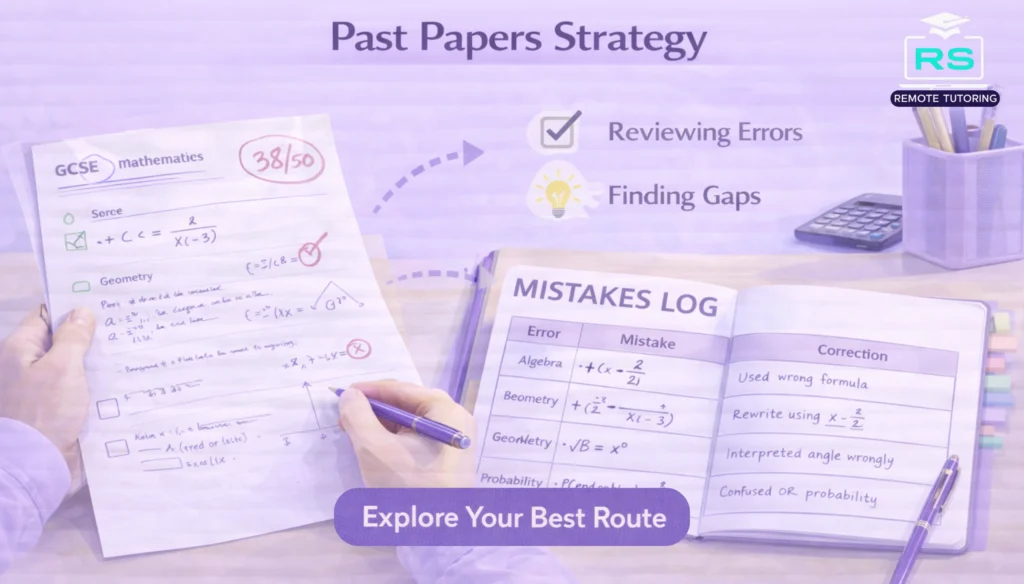
Most students use the past papers without thoroughly gaining and learning from them. Past papers are utmost obligatory for understanding the what and how the examiner asked the question.
The best guide for achieving the highest grade is focusing on following steps
- Attempt past papers under timed conditions
- Create a mistake log
- Mark the questions using official marking scheme
- Rewrite the full solutions for every mistake.
Fluency is utmost important:
Students achieving grade 9 are not slow or procrastinate but they work faster and smarter. Rushing does not save time but also creates a lot of fuss that is difficult to tackle. Strong fluency is utmost necessary that ensure;
- Time saving for harder questions
- Minimise the careless mistakes
- Reduces the cognitive loads.
Two ensure such a smooth fluency in exams and to shine as the top achiever daily rigorous practice of
- Fractions
- Algebraic equations
- Quadratic equations
- Surds
- Standard forms
- Percentage
Is utmost necessary to achieve the higher tier success.
Use Targeted Revision Time Table:
Scheduled timetable is very much necessary for ensuring smooth Maths revision before the final exam phase. A strong timetable include:
- Regular exam practice
- Prioritising the weaker topics
- Revising not vaguely but smartly and efficiently.
An effective timetable includes, for example;
- 40% Problem solving
- 30% Conceptual understanding
- 20% Past papers practice
- 10% mistakes analysis
Using such timetables and splitting the work will ensure smooth flow of preparation because quality beats quantity.
GCSE Maths Tutor making the Difference:
GCSE Maths Tutors are the fine guiding star that makes up the difference in the preparation of the top students.
A good tutor
- Identifies the weak areas that needs the focus
- Improves mathematical communication
- Provide Grade 9 level questions
- Guides the examiners thinking
FAQS
Is a calculator disadvantageous?
No, but over-reliance can slow you down. Mental fluency is key.
Should I memorise formulas?
Understand them first. Memorisation without understanding limits problem-solving ability.
How many hours a week should I revise for a Grade 9?
Typically 6 to 8 focused hours, increasing closer to exams. Quality matters more than volume.
Is a Grade 9 possible without being “naturally good” at maths?
Yes. Grade 9 is about strategy, depth, and consistency but not talent.
Final Thought
Getting a Grade 9 in GCSE Maths is not about last-minute cramming or luck. It is the result of intentional practice, examiner awareness, and deep understanding.
Students who achieve a 9:
- Think like mathematicians
- Write like examiners expect
- Practise with purpose
If you approach GCSE Maths with the right strategy, a Grade 9 is absolutely achievable and often closer than you think

Raja specializes in Physics and Maths, with over 5 years of experience. He offers KS2, KS3, and GCSE Science and Maths lessons. He graduated from one of the top universities in the UK.