Choosing your General Certificate of Secondary Education (GCSE) subjects is one of the first major academic decisions most UK students make. These qualifications mark the end of Key Stage 4 and provide the bridge to A‑levels, T‑levels, apprenticeships or vocational training. A good set of GCSE grades can also broaden your career choices and improve your prospects in the UK’s competitive job market.
By 2026 there are roughly sixty GCSE subjects to choose from, but only a handful are compulsory. The rest allow you to customize your education based on your interests and future goals. This guide gives you the complete GCSE subjects list, explains which subjects are compulsory, explores emerging options like the new Natural History GCSE, and provides tips on choosing the right number of subjects.
Jump to Section
What are GCSEs and how many should you take?
GCSEs are Level 2 qualifications taken mainly by pupils aged 15 to 16. They serve three purposes: assessing learning at the end of Key Stages 3 and 4, providing a gateway to further study and apprenticeships, and demonstrating literacy and numeracy skills to employers. Most students sit between eight and ten GCSEs; schools often cap the total at around twelve to avoid overload.
The absolute minimum to progress comfortably to A‑levels or other post‑16 pathways is five GCSEs including English, maths and science. Some schools require English Literature and a language or humanity as part of the core. Choosing around nine subjects offers a balance of breadth and depth, keeping your future options open.
Core versus optional GCSE subjects
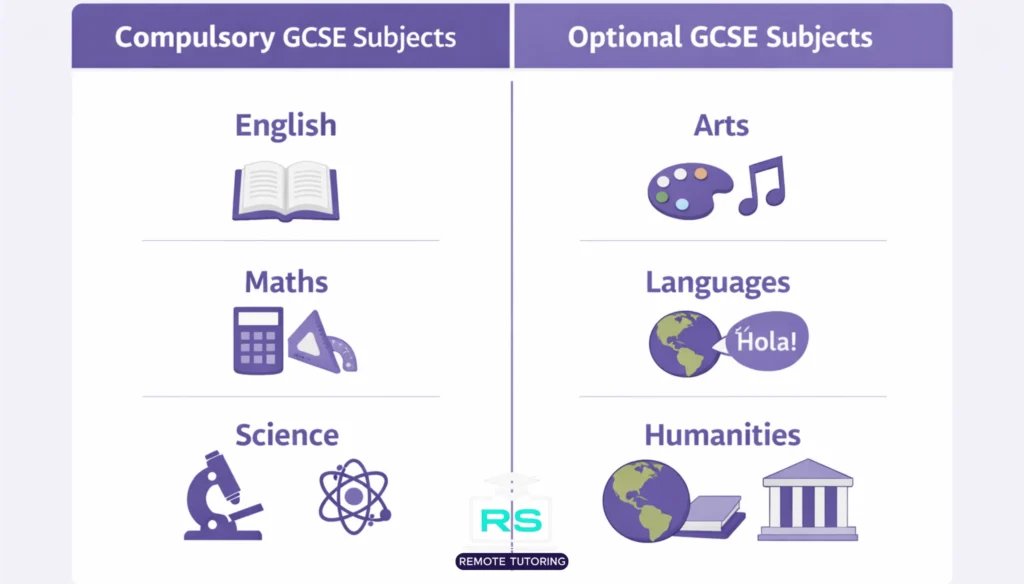
The national curriculum divides GCSEs into core (compulsory) and foundation (optional) subjects.
Compulsory GCSE subjects
All students across England must study the following core subjects:
- English Language is mandatory everywhere.
- Mathematics is compulsory and essential for most careers.
- Science is Offered as Combined Science (worth two GCSEs) or Triple Science (Biology, Chemistry and Physics as separate GCSEs).
Many schools also treat English Literature as core. In Wales, Welsh is compulsory instead of a modern language. In Northern Ireland, students must study Learning for Life and Work alongside English, maths and science.
Foundation (optional) GCSE subjects
The remaining subjects, approximately sixty, are optional. Students choose from these to suit their interests and career aspirations. Schools encourage taking at least one subject from each of the following groups to keep options open:
- Humanities: History, Geography, Religious Studies (RS) or Citizenship.
- Languages: French, German, Spanish, Italian, Mandarin, Urdu and others.
- Creative and Arts: Art & Design, Music, Drama, Dance, Photography, Textiles.
- Technology and Computing: Design & Technology (D&T), Food Preparation & Nutrition, Engineering, Computer Science.
- Social Sciences and Business: Economics, Business, Sociology, Psychology, Media Studies.
- Physical Education and Wellbeing: PE (which may be non‑examined in some schools), Sports Science.
Compulsory requirements within optional choices
Most schools require at least one humanities (History or Geography) and one modern foreign language. For example, Leigh Academy Mascalls insists that students take English Language, English Literature, Mathematics, Combined Science and either Geography or History, while Physical Education and PSHRE lessons are non‑examined. At Prior Park College in Bath, the core curriculum includes English, Mathematics, Core RE and PSHE, and students typically study nine GCSEs, around 70 % of which they choose themselves. The combination of required and elective subjects varies by school, so always consult your school’s options booklet.
Full list of GCSE subjects in 2026 (categorized)
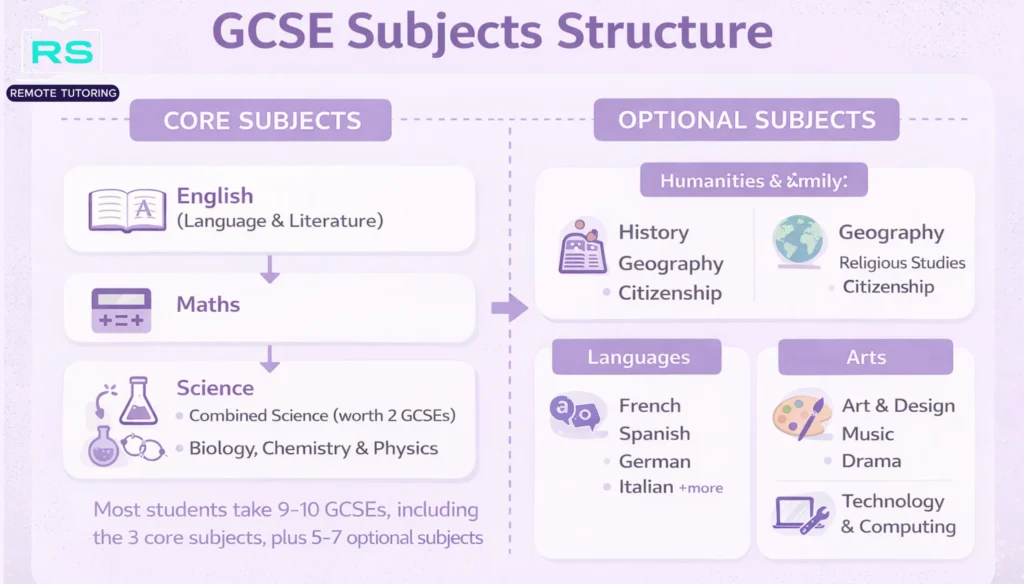
Below is a categorized list of GCSE subjects available in 2025–26. While not every school offers every subject, this list reflects the range across exam boards. Bolded entries denote some of the most popular choices.
Sciences
- Combined Science (Double Award), counts as two GCSEs.
- Biology, Chemistry, Physics (Triple Science).
- Astronomy, Geology, Environmental Science (offered by select boards).
Mathematics
- Mathematics
- Further Mathematics, usually taken by high‑achieving students.
- Statistics.
English & Languages
- English Language, English Literature.
- Classical languages: Latin, Greek, Ancient History.
- Modern foreign languages: French, German, Spanish, Italian, Mandarin Chinese, Arabic, Urdu, Bengali, Polish, Portuguese, Russian, Punjabi and Turkish.
Humanities and Social Sciences
- History, Geography.
- Religious Studies (Philosophy & Ethics).
- Citizenship Studies, Sociology, Psychology.
- Economics, Politics (offered by some independent schools).
Business & Computing
- Business Studies, Enterprise & Marketing.
- Accounting, Economics.
- Computer Science.
- Information and Communications Technology (ICT – though phased out, still available in some boards).
Design & Technology and Engineering
- Design & Technology (with specialisms like Product Design, Graphics, Textiles, Resistant Materials).
- Food Preparation & Nutrition.
- Engineering, Electronics.
- Construction and the Built Environment (vocational).
Creative & Performing Arts
- Art & Design (fine art, graphics, photography, textiles, 3D design).
- Music, Drama, Dance.
- Film Studies, Media Studies.
- Performing Arts, Theatre Studies (available under BTEC or OCR National qualifications but often taken alongside GCSEs).
Physical Education and Sport
- Physical Education (PE): Sometimes non‑examined but can be taken as a GCSE.
- Sports Science, Health & Fitness.
Vocational and Technical Awards
In addition to GCSEs, many schools offer Level 1/2 vocational qualifications like BTEC Tech Awards and OCR Cambridge Nationals in Child Development, Health & Social Care, Travel & Tourism, Digital Media and Engineering. These qualifications count towards the 2026 performance tables and are taken alongside GCSEs. They provide practical learning but still require written assessments.
New and emerging subjects of GCSE
- Natural History: In March 2025 the Department for Education confirmed the launch of a GCSE in natural history. Education minister Catherine McKinnell said the qualification aims to equip young people “to understand and respect the natural world and contribute to the protection and conservation of the environment”. Campaigners hope it will include fieldwork opportunities to study local wildlife.
- Digital literacy and online assessment: From 2026 some exam boards are trialling digital GCSEs, with computer‑based tests in English and mathematics. In 2025 the government introduced formula sheets for maths, physics and combined science exams to reduce rote memorisation. These changes emphasise reasoning and problem‑solving.
How to choose your GCSE subjects
Selecting optional subjects can be daunting. Here are practical steps to guide your decision:
- Know your strengths and interests. Choose subjects you enjoy and are confident in. Careerpilot notes that at 14 you can decide between arts, design & technology, humanities and modern languages; you should select subjects you like and find out which ones you might need later.
- Consider future pathways. If you’re thinking about medicine, you’ll need strong grades in science and maths. Aspiring engineers should consider physics and design & technology. For humanities or law, history and a language are advantageous. The number of GCSEs you take and their grades affect entry to competitive sixth‑form courses and universities.
- Balance your workload. Remember that each GCSE requires about 120 hours of revision. Taking more than twelve subjects can lead to stress and lower grades. Aim for eight to ten subjects for a balanced portfolio.
- Check school requirements. Some schools mandate a language or a humanities subject. Others require Religious Education or PSHE. Always read your school’s options booklet carefully.
- Seek advice. Talk to subject teachers, older pupils, careers advisors and your family. They can offer insight into workload and exam style. Many schools, like Prior Park College, tailor timetables around individual strengths.
- Keep options open. Taking a broad range ensures you don’t close off future pathways. For instance, even if you love arts, taking a science or computing subject could open STEM courses later. Conversely, scientists benefit from an essay‑based subject like history or a language.
Comparing modern foreign languages: French, Spanish and German
Languages sit at the intersection of core skills and cultural enrichment. Many students wonder which language is easier to learn: French, Spanish or German. Here’s a comparison to help you decide.
Difficulty and linguistic features
According to the U.S. Foreign Service Institute (FSI) rankings, French and Spanish are Category I languages for English speakers, requiring about 600–750 classroom hours (24–30 weeks) to achieve proficiency. German is classified as Category II because of its case system and different word order, requiring slightly more study time. German grammar is logical but involves four cases and three genders, which can be challenging at first; however, its verb conjugation and word formation are consistent, making rules easier once learned.
Number of speakers and usefulness
- Spanish: Around 560 million people speak Spanish worldwide. It is the second most studied language globally and official in 20 countries. Spanish pronunciation is straightforward because words are spelled the way they sound.
- French: An estimated 321 million people are French speakers worldwide. French is the only language besides English spoken on all continents, making it useful for international business, diplomacy and travel.
- German: There are about 130 million German speakers globally. Germany has Europe’s largest economy and strong engineering, finance and manufacturing sectors. Learning German opens opportunities to study or work in Germany, Austria or Switzerland.
GCSE exam difficulty
A government analysis of grade standards found that GCSE French and German are among the five hardest subjects, whereas Spanish is closer to average. This means that achieving a top grade in Spanish may be slightly easier than in French or German, though personal interest and teaching quality matter more than statistics.
Choosing a language
- For ease of learning, many students choose Spanish because of its regular pronunciation and grammar. Several student forums state that Spanish is easier to get a high grade in.
- For cultural interest, choose the language that resonates with your hobbies, French for fashion, art and cuisine; German for engineering and research; Spanish for travel across Latin America.
- For career potential, consider sectors: French is valuable in international organisations, hospitality and diplomacy; German is advantageous for engineering, automotive and finance careers; Spanish is useful in customer service, tourism and global marketing.
GCSE subjects for medicine and other careers
If you already have a career in mind, certain GCSE subjects will provide a stronger foundation:
- Medicine or health careers: Aim for high grades in Biology, Chemistry, Physics and Mathematics. Take English to hone communication skills. Some medical schools prefer applicants who have studied a language or humanities subject to demonstrate breadth.
- Engineering and technology: Focus on Physics, Mathematics and Design & Technology or Computer Science. Taking Further Maths can be beneficial for future A‑level studies.
- Law and humanities: Prioritise History and English Literature; Latin can be useful for understanding legal terminology. A language like French or German adds an international dimension.
- Creative industries: Choose Art & Design, Music, Drama, Media Studies or Photography. Ensure you still take core subjects to keep options open.
Grades and exam reforms: understanding GCSE results
The 9 to 1 grading scale
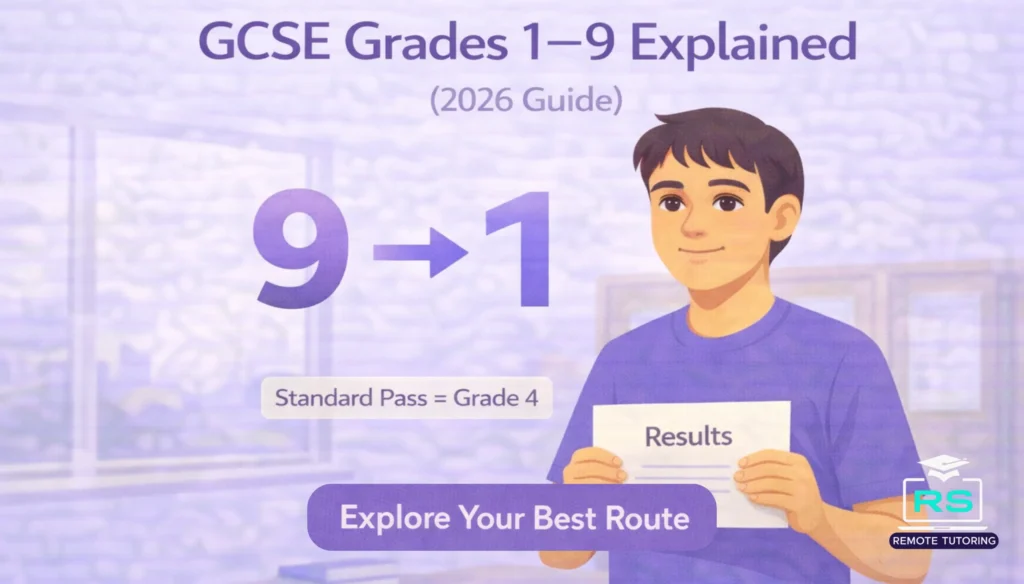
Since 2017, GCSEs in England use a 9 to 1 grading scale, where 9 is the highest grade. A Grade 4 is considered a standard pass, roughly equivalent to the old Grade C, while Grade 5 is a strong pass. Grades 7 to 9 correspond to the old A/A* and are considered very good. A Grade 7 is not bad; it equates to an old A and demonstrates high proficiency. Schools and colleges often require Grade 4 or 5 in English and Maths for entry, while competitive sixth‑forms may ask for Grade 7 in specific subjects.
Grade boundaries and fairness
Ofqual’s analysis shows that French and German are graded more leniently than some subjects because they are statistically more difficult. When planning your GCSE portfolio, do not be deterred by perceptions of difficulty, choose subjects that play to your strengths.
Recent reforms
From 2025 onward, formula sheets for mathematics, physics and combined science exams help students focus on problem‑solving rather than memorisation. The government is also piloting digital exams in English and maths, which may become mainstream by 2026. New subjects such as Natural History reflect growing emphasis on environmental literacy.
Tips for balancing your GCSE workload
- Prioritise quality over quantity. Opting for 8 to 10 GCSEs allows you to aim for high grades while maintaining a healthy study‑life balance.
- Create a revision timetable early. Spread your revision over the two‑year course to avoid last‑minute cramming. Each subject merits around 120 hours of study.
- Use school resources. Take advantage of lunchtime and after‑school clubs, subject clinics and online resources. Schools like King’s School provide cross‑curricular projects and one‑to‑one support to nurture individual strengths.
- Stay healthy. Adequate sleep, exercise and breaks improve retention and reduce exam stress.
- Ask for help when needed. Teachers, parents and tutors can offer guidance if you struggle with workload or subject choices.
Frequently asked questions
What are the 12 GCSEs?
Twelve GCSEs usually include the core subjects (English Language, Mathematics and Combined or Triple Science) and around nine optional subjects. Examples might include History, Geography, French, Art, Design & Technology, Computer Science, and a BTEC or OCR National. Taking twelve subjects requires excellent time management and is generally recommended only for high‑achieving students; schools often cap the maximum at around 12.
What are the five hardest GCSEs?
Difficulty varies between students, but a government analysis identified French, German and physics among the most challenging subjects. Mathematics and Chemistry are also traditionally demanding because they require abstract reasoning and problem‑solving. Remember that difficulty should not deter you if you enjoy and are motivated by a subject.
Is a Grade 7 at GCSE bad?
Not at all. Grade 7 on the 9 to 1 scale roughly equates to an old Grade A and represents a high level of proficiency. Most sixth‑form colleges and universities regard Grade 7 as an excellent result. Even for competitive courses like medicine, grades of 7–9 in the sciences and maths are considered strong.
How many subjects are in GCSE Year 11?
In Year 11 most students are preparing to sit eight to ten GCSE subjects. The exact number depends on the school’s timetable and the student’s choices. Some may sit fewer (minimum five) if they have learning difficulties or vocational preferences, while highly academic students may take up to twelve.
What are the nine GCSE subjects?
A typical nine‑subject package includes the core trio (English, maths and science) plus six optional subjects. A balanced example is English Language, English Literature, Mathematics, Combined Science, History, Geography, French, Art & Design and Computer Science. Students aiming for sciences may substitute Triple Science (three GCSEs) and drop one humanities subject.
Is a Grade 4 in GCSE bad?
A Grade 4 is a standard pass, equivalent to a low C under the old grading system. It is not “bad”, but it may limit options for A‑level courses or university courses requiring higher grades. Achieving at least a Grade 5 (strong pass) is preferable if you plan to pursue academic courses beyond age 16.
Conclusion
Choosing your GCSE subjects is both exciting and challenging. By understanding the GCSE subjects list, recognising which are compulsory, and exploring optional choices, you can build a portfolio that plays to your strengths and keeps your future wide open. With new subjects like Natural History emerging and exam reforms shifting the focus to problem‑solving and digital skills, GCSEs in 2026 are evolving to meet the needs of a changing world.
Use the tips above to balance your workload, seek advice, and select a combination of subjects that will serve you well into A‑levels, university and beyond. Ultimately, the best choices are those that inspire you, stretch your abilities and align with your long‑term goals.
Ready to plan your GCSE journey? Our experienced tutors and advisers can help you craft the right GCSE subjects list for your ambitions. Whether you need support with science, languages or humanities, we offer tailored guidance so you can excel. Contact us today to schedule a free consultation and start building your future.

Raja specializes in Physics and Maths, with over 5 years of experience. He offers KS2, KS3, and GCSE Science and Maths lessons. He graduated from one of the top universities in the UK.