GCSEs are one of the most important academic milestones for students in the United Kingdom. Whether you are a parent who is trying to support their child or a student preparing for your future, understanding What is GCSE and how it work can make the whole process feel less challenging.
GCSE Guide Table of Content
What is GCSEs and Who Takes Them?
GCSE stands for General Certificate of Secondary Education. These qualifications are opted by students in England, Wales, and Northern Ireland at the end of Key Stage 4, in Year 11 when students are around 15 to 16 years old.
This is a main assessment for secondary school students and a key stepping stone to A Levels, apprenticeships, college, or vocational courses.
Why Are GCSEs Important?
- University entry: Most universities in the UK consider GCSE grades, especially in English and Maths.
- Career prospects: Employers look at GCSE results, for roles requiring numeracy or communication skills.
- Future choices: GCSEs influence the A-levels or other post 16 options you can choose.
When Are GCSE Exams Held in 2025?
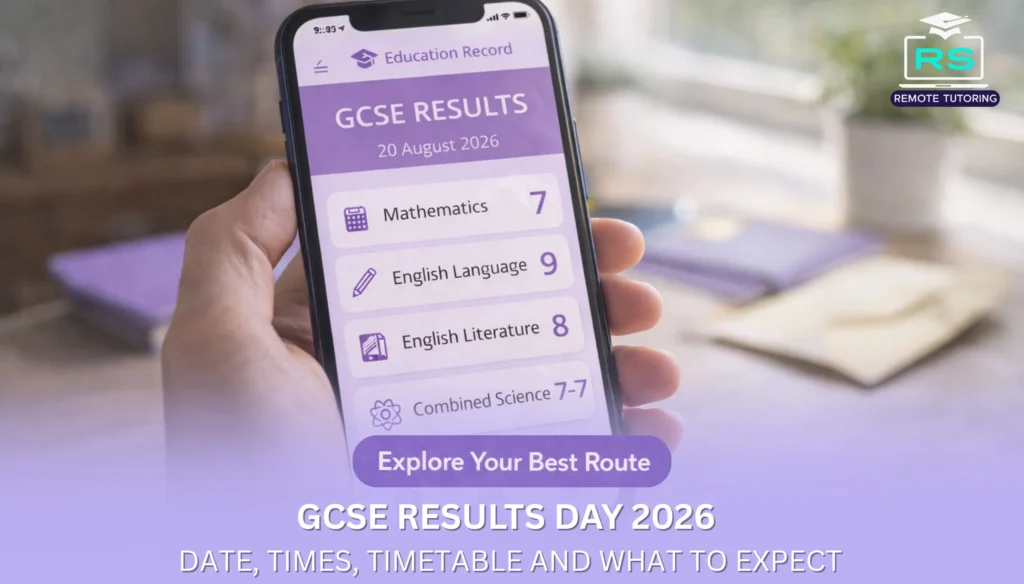
GCSE exams typically begin in May and run through June, with exact dates depending on subject and exam board. Results are released in August 2025.
How Many GCSEs Subjects Students Take?
Most students can take 8 to 10 GCSEs subjects. Some take more or fewer, it depends on the school or special educational requirements of the student.
GCSE Core Subjects vs Optional Subjects
Core GCSE subjects (compulsory for most students)
- English Language and Literature
- Maths
- Science (Combined or Triple: Biology, Chemistry, Physics)
Optional GCSE subjects (vary by school and may include)
- Geography or History
- Languages (French, Spanish, etc.)
- Art, Music, Drama
- Computing, Business Studies, PE
How to Choose GCSE Subjects: Tips for Students and Parents
- Balance interest and practicality, pick subjects which you are interested in.
- Think ahead, consider what A levels or university courses you might want later.
- Ask for advice, talk to teachers and career advisors.
- Know requirements, some schools require to choose at least one humanities and one language subject.
How Are GCSEs Assessed?
Assessment methods include:
- Written exams: Most common method.
- Non-exam assessments (NEA): Coursework, practicals, or spoken assessments.
Subjects like Art, Drama, and PE often include practical work. Spoken language in English is assessed separately and reported as pass/fail.
How GCSEs Exams are Graded (GCSE Grading System)
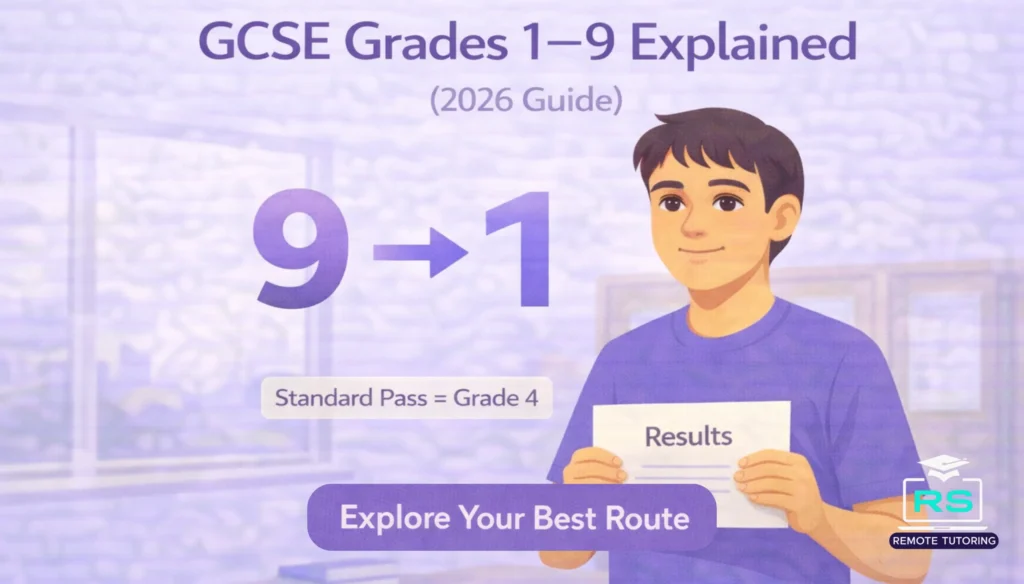
The current GCSE grading system uses numbers instead of letters:
- 9 is the highest grade (equivalent to A*)
- 7 is roughly equal to an A
- 4 is considered a “standard pass” (equal to a C)
- 1 is the lowest passing grade
A grade 5 is strong pass, while grade 4 is standard pass. Anything below 4 is considered as failed.
What Happens If You Don’t Pass?
Do not worry, students can resit English and Maths in November or following year. Schools and colleges offer support, and there is option to choose vocational or apprenticeship routes.
What to Do After Passing GCSEs Exam in UK
Once GCSEs are done, students can choose:
- A-Levels (usually 3 to 4 subjects)
- T-Levels or BTECs (more vocational)
- Apprenticeships (earn while you learn)
- Sixth form or college
GCSE Exam Boards in UK
There are several exam boards that provide and mark GCSE exams:
- AQA (Assessment and Qualifications Alliance)
- OCR (Oxford, Cambridge and RSA)
- Edexcel (Pearson)
- WJEC (Welsh Joint Education Committee)
Each board have slightly different syllabuses and paper formats, so it is important to know which one your school uses.
How to Prepare for GCSEs
-
Start preparing early, begin revision at least 3 to 6 months before exams.
-
Make timetable and plan study schedule weekly.
-
Use active methods like flashcards, past papers, quizzes.
-
Stay healthy, regular sleep, balanced diet, and breaks.
Parental Support Tips for GCSE Exams
- Create good study space at home.
- Set routines and help children with time management.
- Encourage, do not pressure. Check with child regularly.
- Talk to teachers if child is struggling.
How Is GCSE Progress Measured Before Exams?
Most UK schools use:
- Mock exams: They are held in Year 11 to simulate real exam conditions.
- Predicted grades: Based on in class performance and teacher assessments.
- Progress reports: Sent to parents each term highlighting strengths, weaknesses, and attendance of Child.
- Target grades: Schools set minimum targets based on national benchmarks or student ability.
Understanding this can helps parents intervene early with GCSE tutoring or extra help if needed.
Frequently Asked Questions About GCSEs
Can students take GCSEs earlier than Year 11?
Yes, high performing students may sit certain GCSEs (like Maths or foreign language) early, mostly in Year 10 depending on school policy and students readiness.
Are GCSEs same across England, Wales, and Northern Ireland?
No. While GCSEs are offered in all three regions, grading systems and exam boards differ. For example, Wales and Northern Ireland still use A to G grades*, while England uses 9 to 1 grading system.
How many GCSEs can students take?
Students can take 8 to 10 GCSEs, including core subjects and few optional ones based on their interests or career goals.
Can Private Student take GCSEs or home-schooled student?
Yes. Private candidates can register at exam centre independently of school. This is common for home educated students or those repeating subject.
Are online GCSE tutors effective for exam preparation?
Yes. Online GCSE tutoring offers personalised, flexible, one on one support, perfect for filling learning gaps, building confidence, and improving exam strategies.
GCSE Understanding Importance
GCSEs are major academic milestone but they are just one part of journey. With right information, preparation, and support, both parents and students can approach GCSE Exams with confidence.
If you need expert help, RS Remote Tutoring offers qualified UK tutors to support your child through every stage of their GCSE preparation.

Raja specializes in Physics and Maths, with over 5 years of experience. He offers KS2, KS3, and GCSE Science and Maths lessons. He graduated from one of the top universities in the UK.

20 Comments
[…] GCSEs are broader academic qualifications covering: […]
[…] awarding bodies that set GCSEs are AQA, Pearson Edexcel, OCR, WJEC/Eduqas and CCEA are regulated by Ofqual, so the exam window is […]
[…] GCSEs are the hardest and toughest exams students face for the first time. Most students align their future goals with the GCSEs good grades, It is important to note why the GCSEs are most challenging. […]
[…] GCSE is basically the standardised academic qualification, the set of designed rules , a key important certificate the student earns during the initial years of the education that is the biggest reason that companies and employers seek the GCSE as the most prominent tool for accessing students ability.However, GCSE grades are not the indicator of the student’s key intelligence abilities , learning abilities or deep imparted knowledge but these reflects the students performance under the specific set of circumstances and under the timid condition. […]
[…] in the preparation and also works as one of the most successful practical strategies for reducing GCSE exam […]
[…] GCSE represents the first experience for the children, as this is the first step towards their career growth. The pressure not only comes from the exam itself but also through the word GCSE symbolises the career and future tied to the GCSE. This makes the situation more anxious and stressful. […]
[…] Grade boundaries are very much essential for the smooth conduct of the examination. Understanding GCSE grade boundaries is the most important phase for parents, learners and instructors before the […]
[…] GCSEs (General Certificate of Secondary Education) represent the first formal qualification stage in the UK. Achieving strong grades opens doors to A‑levels, vocational courses and apprenticeships. Universities and employers increasingly look beyond headline grades to the specific subjects students have taken. […]
[…] GCSEs (General Certificates of Secondary Education) are academic qualifications studied in England, Wales and Northern Ireland. They usually span two years, from Years 10 and 11 in the UK schooling system culminating in external exams. Assessment is heavily exam‑based, though some subjects may include controlled assessments or practical coursework. […]
[…] addition of Coursework at GCSEs and A-levels depends upon students and parents, and it is thoroughly intentional. It aligns with […]
[…] around them. In the fast-paced world, where environmental know-how is essential for everyone, GCSE falls perfectly at this moment. Students opting for this subject gain crucial knowledge in the […]
[…] whether to follow the International General Certificate of Secondary Education (IGCSE) or the General Certificate of Secondary Education (GCSE), you’re not alone. Both qualifications are recognised by universities and employers around the […]
[…] GCSE coding demands conceptual clarity , analytical thinking and readable codes, the essential skills requiring practice not memorization. […]
[…] GCSE stands for General Certificate of Secondary Education. Pupils in England, Wales and Northern Ireland typically study for these qualifications in Years 10–11 and sit the exams at the end of Year 11. Each subject is graded from 9 (highest) to 1, with a grade of 5 regarded as a strong pass. Exams usually take place in May and June, but coursework and mock exams often start earlier in the year. […]
[…] GCSEs (General Certificate of Secondary Education) represent the first formal qualification stage in the UK. Achieving strong grades opens doors to A‑levels, vocational courses and apprenticeships. Universities and employers increasingly look beyond headline grades to the specific subjects students have taken. Following recent A‑level reforms, entry requirements for competitive degree programmes often specify minimum GCSE grades or certain subjects, particularly in English and maths. Even if university seems a long way off, thinking ahead now will keep your options open. […]
[…] for skimmers: If you only have a minute, jump to the sections on the minimum number of GCSEs, the average range, and the maximum load to get a quick […]
[…] GCSEs, there is no November resit window for A‑levels. Save My Exams points out that if you need to […]
[…] GCSEs are subject-by-subject qualifications that mark the end of Key Stage 4 in secondary school. You usually study them over two years and sit the exams in May – June of Year 11. […]
[…] group classes and one‑to‑one lessons: Students can join interactive group courses for GCSE and A‑level, or book private sessions for targeted support. Group sizes are capped to maintain […]
[…] a GCSE can feel daunting, but it’s also an opportunity to improve your grades and open up new academic […]