Hardest and Easiest GCSE Subjects: Expert Tutor Advice for Students

Choosing GCSE options can feel like one of the first big decisions in your academic life. Friends, teachers and parents will have opinions about which subjects are “easy” or “hard”. Data from the exam regulator and online guides show that some GCSEs see more grade 9s than others, but statistics can be misleading because schools often restrict certain subjects to high‑achieving students. Perceptions of difficulty also vary: some students find problem‑solving subjects like Physics exhilarating, while others prefer essay‑based topics like History. Ultimately, the hardest GCSE is the one that doesn’t suit your skills and interests. This guide combines official data with insights from our experienced tutors to help students make informed choices. We examined the hardest and easiest GCSE subjects, reviewed factors that affect difficulty, discussed exam boards and grading, and shared strategies to succeed. Whether you are aiming for triple sciences or creative arts, you’ll find tips to build confidence and achieve top grades. Factors That Affect GCSE Difficulty Before looking at lists, it’s important to understand why a subject might seem easy or hard. Tutors and exam boards agree that several factors influence perceived difficulty: Top 10 Hardest GCSE Subjects (with Expert Tutors’ Tips) While difficulty is subjective, exam data and tutor experience highlight a handful of GCSEs that students often find challenging. Use this list as a starting point, but remember your strengths and career goals. 1. Further Mathematics Further Maths extends the standard Maths GCSE into advanced algebra, calculus and trigonometry. Exams combine multiple‑choice questions, structured problem‑solving and extended responses. Many students find the pace demanding because it requires a deep understanding of concepts and quick calculations under pressure. Pro tips: Take Further Maths only if you love Maths and plan to pursue STEM A‑levels. Practise past papers, master algebraic manipulation, and use London’s Maths clubs or online communities for peer support. 2. Physics Physics combines mathematical calculations and theoretical concepts. Abstract topics like electromagnetism and quantum theory require strong analytical skills. Many students struggle to visualise forces and interpret data quickly during exams. Tutor’s Advice: Build a solid Maths foundation and develop problem‑solving strategies. Attend practical sessions at local science centres to visualise concepts. Use diagrams and annotate formulae to aid understanding. 3. Chemistry Chemistry tests both theory and practical application. Students must switch between calculations, data interpretation and recalling chemical properties. Understanding topics like chemical bonding and stoichiometry can be challenging. Pro tips: Create concept maps of reaction types and practise balancing equations. Participate in lab practicals if possible. For London home‑educated students, weekend workshops at the Royal Institution can offer hands‑on experience. 4. English Literature English Literature exams require deep analysis of texts, themes and characters. The challenge lies in memorising quotations and writing coherent essays under time pressure. How to Prepare: Read set texts early and annotate them. Practise timed essays and plan arguments using point‑evidence‑explain structures. Explore London’s theatres and libraries to develop a richer understanding of literature. 5. Modern Foreign Languages (French, Spanish, German) Language GCSEs assess reading, writing, listening and speaking. Students must switch between tasks quickly and think on their feet during speaking exams. Pronunciation and grammar accuracy can be difficult without regular practice. Pro tips: Surround yourself with the language, watch films, listen to podcasts, and find conversation partners. Many community centres in London host language exchanges. Consistent practice is key. 6. History History demands extensive memorisation and analytical essay writing. Students must recall events, dates and interpretations, then construct persuasive arguments in essays. What we advise: Create timelines and mind maps of periods. Practise source analysis and exam‑style essays. Visit London’s museums to contextualise events and bring history to life. 7. Computer Science Computer Science combines theoretical concepts like algorithms and data representation with practical programming. Students must develop logical thinking and understand abstract topics such as binary systems. Pro tips: Start programming early using languages like Python. Break problems into smaller tasks. Join coding clubs or hackathons in London to practise with peers. 8. Biology Biology covers a wide range of topics, from cells to ecosystems. It requires strong memorisation of terminology and the ability to apply concepts to unfamiliar scenarios. Pro tips: Use flashcards and diagrams to learn processes like photosynthesis and respiration. Combine reading with fieldwork, London’s Kew Gardens and wetlands offer real‑life examples of ecology. 9. Mathematics Although mandatory and widely taken, Maths appears in lists of hard subjects due to its cumulative nature. Concepts build on each other, and exam questions often require multi‑step problem-solving. According to Ofqual data summarised by MyTutor, Maths is among the top ten hardest GCSEs. How to prepare: Practise regularly and master each skill before moving on. Translate word problems into mathematical expressions. Use London’s Maths circles and tutoring centres for extra help. 10. Art and Design/Design & Technology Creative subjects may seem straightforward, but they require consistent coursework and portfolio development. Art & Design and Design & Technology rank among the hardest GCSEs due to the workload and assessment criteria. Students must balance creativity with technical precision and time management. Pro tips: Start projects early and keep a sketchbook of ideas. Visit galleries, like the Tate Modern, for inspiration. Learn to manage deadlines and document your process for coursework. Top 10 Easiest GCSE Subjects to Get a 9 Ease of achieving a top grade can depend on school selection and student motivation. According to our internal research, done by our expert tutors, the subjects below had the highest proportion of grade 9s. However, easier does not mean effortless; success still requires dedication. 1. Chemistry, Biology & Physics Surprisingly, the separate sciences top the list of easiest subjects for grade 9s, with chemistry leading at 14 % of entries achieving the highest grade. This is partly because many schools only enter their strongest science students. Why they feel easy: Students selected for triple sciences often enjoy science and receive more teaching hours. Clear syllabuses and structured exam questions help high achievers score well. Pro tips: For everyone else, these subjects still require regular revision
Homeschooling GCSEs – Private Candidate Guide 2026

Homeschooling a teenager through their GCSEs can feel dificult. There is no requirement in UK law for home‑educated children to sit GCSEs, yet most families choose these qualifications because they form the foundation for A‑levels, apprenticeships and university admissions. The rise of flexible work and personalised education has made homeschooling a popular choice across London. Parents appreciate the freedom to craft a curriculum that reflects a child’s interests, pace, and wellbeing, while still meeting the expectations of British universities and employers. This guide walks you through every step of homeschooling GCSEs from deciding whether to take them, to choosing subjects and exam boards, finding an exam centre, registering as a private candidate, selecting study resources, planning revision and exam day. Do Home‑Educated Students Need GCSEs? Legally, home‑educated young people do not have to take GCSEs. Families may craft their own programmes or follow alternative qualifications like functional skills. However, GCSEs remain the UK’s most widely recognised benchmark at age 16. Universities, colleges and many employers still expect applicants to have passes in English and mathematics. Taking at least five subjects also keeps options open for future study. If your child intends to return to a mainstream school for sixth form or apply to universities in the UK or abroad, GCSEs or equivalent IGCSEs are highly advisable. What we Advice: Some local further education colleges accept students without GCSEs into Level‑2 courses, but these often lead back to GCSE study. Planning early ensures your child isn’t limited later. Why Homeschool GCSEs? Homeschooling for GCSEs offers several advantages: London context: Being based in London means access to world‑class museums, science centres and historical sites. Field trips to the British Museum or the Royal Observatory can enrich subjects like History or Physics. Don’t forget to factor travel times into your schedule, peak hour traffic and Tube strikes can disrupt plans, so check Transport for London updates when booking visits or exam days. GCSE vs IGCSE: Which Is Better for Homeschoolers? Two main qualifications are available to private candidates: GCSEs GCSEs(General Certificate of Secondary Education) are designed primarily for UK schools. They used to include coursework, but reforms mean many subjects now rely on final exams. Some exam boards still offer practical assessments (coursework) in subjects like Art or Design. IGCSEs IGCSEs (International GCSEs) are offered by boards such as Cambridge International and Edexcel. They were originally created for international schools and often have fewer or optional coursework components. Many home educators prefer IGCSEs because they allow private candidates to sit exams without needing school‑supervised coursework. According to home‑education advisors, IGCSEs and GCSEs are considered equivalent by universities and employers. Decision factors: Choosing Subjects and Exam Boards How Many GCSEs Should You Take? Most young people take between 7 and 10 GCSEs at school. Home‑educated students often sit fewer due to cost and time. Experts recommend at least five subjects to keep post‑16 pathways open. The typical core is: Selecting Optional Subjects You can add subjects that reflect your child’s interests and career goals. Options include Economics, Computer Science, Business, Psychology, Sociology, Music, Art and more. Some subjects with heavy coursework (Art & Design, Food Technology) require supervised assessments and may be challenging for private candidates. Check exam board specifications before committing. Exam Boards Explained The UK’s major exam boards for GCSEs and IGCSEs are: Pro tip: When choosing a board, download the specification for each subject. Check for coursework, practical requirements and the exam code. Write down the specification code, you’ll need it when registering with an exam centre. Finding Exam Centres in London and Registering Step‑by‑Step Registration London‑specific guidance: London offers many exam centres, including independent schools in boroughs like Hampstead, Hammersmith, Barnet and Croydon. Parking and public transport vary; when choosing a centre, consider proximity to Tube lines (e.g., Northern line, Central line), as early‑morning delays can cause stress. Some centres charge extra for London overheads – compare quotes. Exam Fees and Tutor Charges Exam entry fees range from £150 to £300 per subject. Additional administration charges can include invigilation, secure postage of papers, and certificate postage. Travelling to a centre and parking can add up. Books, revision guides and equipment (e.g., graphing calculators for Maths) also contribute to costs. Local authorities rarely fund private candidates, so budgeting is essential. Money‑saving tips: Study Options: Self‑Study, Online Courses and Tutors Homeschooling GCSEs doesn’t mean doing it alone. Choose the mix of resources that suits your family’s lifestyle and budget. Self‑Study Many learners succeed through independent study with textbooks, exam specifications and past papers. This method works well for self‑motivated students and costs less. Online GCSE Courses An increasing number of organisations offer structured online courses tailored for home‑educated students. They supply video lessons, tutor feedback and exam practice. Look for accredited providers that follow your chosen exam board’s syllabus. Some even include virtual classrooms, which help learners stay accountable. Hire a Private GCSE Tutor Private tuition provides one‑to‑one support in challenging subjects. Tutors may visit your home or teach online. When selecting, check qualifications and ask whether they have experience with private candidates. Free & Low‑Cost Resources Creating a Timeline and Revision Plan Start Early Begin planning at least 18 months before the exam series. If your child starts Year 9 in September 2024, aim to choose subjects and exam boards by spring 2025 and begin coursework or exam preparation soon after. A typical timeline looks like this: Building a Revision Schedule Break down each subject’s syllabus into weekly chunks. Allocate more time to topics your child finds challenging. Use a planner or digital calendar to mark lessons, revision sessions and mock exams. Remember to schedule breaks and physical activity. Home learners need movement to stay alert. Revision tips: GCSE Exam Day Preparation Logistics Book travel arrangements well in advance. If the centre is across London, consider staying nearby the night before to avoid rush‑hour stress. Check Transport for London for any planned engineering works on the Tube or national rail strikes. Have a backup route. What to Bring on GCSE
GCSE Resit Policy: Key Facts for Parents and Students
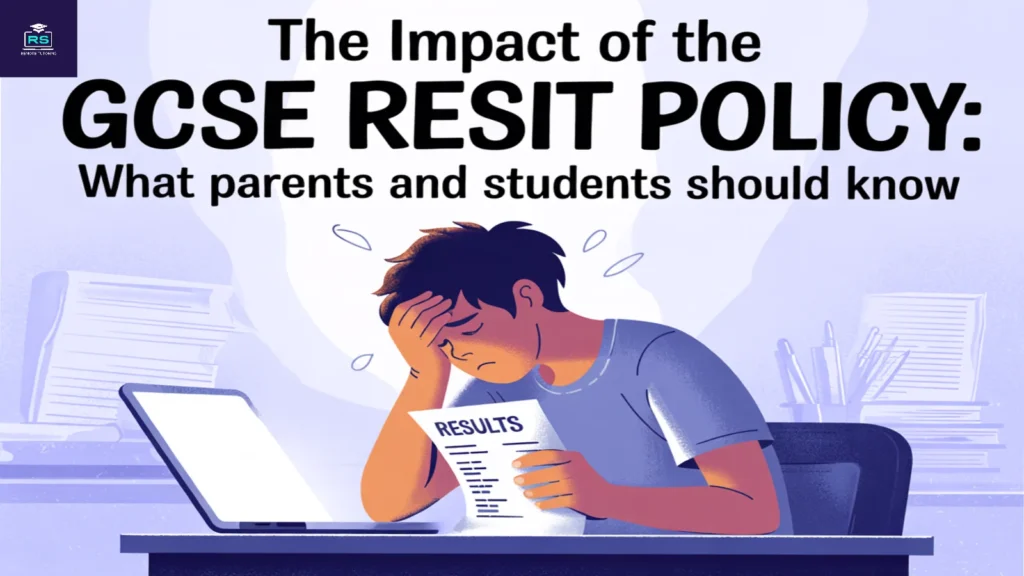
We often hear a lot from students about the stressful week they had exams going on, whether the students are appearing in GCSEs or any other exams. Studying for an exam is exhausting and at the same time a challenging task. A stressful environment is often linked with the preparation week, but you know what the quiet, fun fact is, the pressure which is created after bearing this exhausting week. Pressure often increases when results do not turn out to be the way expected that. Every Year, Students fall short of the expected grades in GCSEs and the highest failing ratio in delves in the most reputable subjects, nothing more than the two corner pillars, English and maths, losing themselves directly hit by the GCSE Resit Policy. For many of the newbies, the strategy is quite confusing, and they often feel themselves on the verge of discomfort and discouragement. But what does this actually mean for the students? How is it really impactful, and how do parents navigate the challenges in this phase with their child? What is the GCSE Resit Policy? The GCSE Resit policy is the framework, composed of the rules which describe how students who do not actually achieve a minimum Grade 4 in English and Maths continue studying these subjects and again attempt the exam. This Policy submerges the students aged from 16 up to 18 already gaining full-time education, facilitating that learners often encompass fundamental skills before moving ahead. Under this Existing framework: The Policy implies the future career prospects as both subjects are considered the most important life skills. Regardless of the rules, Policy implies and gives a fair, leading chance to the students to encounter the standards rather than criticising the students for their low performance. Why the GCSE Resit Policy is Important GCSE resit policy holds significant importance, and it truly matters in practical life. It matters in several ways, such as: Given these lifelong significant effects, policymakers make up the most fundamental point, stating that giving students a chance to reappraise in English and Maths. But reappearing and reviving an exam is not easy; students often struggle, especially those who have already faced disadvantages. When these Resits Are Held Re-exams are held twice a year: The Effects of Resit Policy On Students As mentioned before, appearing in exams is quite a challenging task. The following impacts are outbrusted Growing Academic Pressure The notion of resitting an exam is an overwhelming task; students mostly drown in the world of fear and anxiety. The idea of studying again adds more to the stress level, exhaustion and self-doubt. To add fuel, Reappearance is not the punishment but a path towards nurturing skills that are essential for lifelong achievements. These results are also necessary for students. The average performance rate of students is significantly better than the first attempt as they realise more of the exam style and patterns. Learning through Repetition: We often hear that practice makes a man perfect, the same like rigorous practice and consistency are the ultimate key to success. Most Students lacked formal practice during their first attempt, which adversely affects them. The Reappearing period gives them enough time to cope with their mistakes, identify the areas needing more attention and conceptual clarity and improve the subject through maturity and proper focus. Gateway for long-term career opportunities Resitting in English and Maths, the corner pillars of the GCSE unlock the doors for various opportunities, if passed with flying colours: The Effects Of Resit Policy On Parents Parents often struggle more financially and emotionally when supporting a child through GCSE resits. Understanding this framework helps them reduce stress and guide their children’s prospects. Supporting the Child Emotionally: Students often feel ashamed and demotivated for not achieving the desired grade. This is the duty of parents to support them emotionally and motivate them. Parents play a crucial role in uplifting their child’s morale, encouraging confidence and getting them back on track. Successful students often quote that their reappearing year was the transformation in their journey, as it taught them consistency and resilience. Identifying the Right Guide Each student is different from every other. Traditional classroom teaching methods may not work for everyone. Identifying the right support system is utmost necessary, which usually parents do. Parents often find alternative methods, such as: Online tutoring has become a widely accessible tool because it allows students to learn at their own pace through personalised training. Time Management Resit students get themselves trapped with new coursebooks during their revision. Parents can help them tackle these tasks through What should Students Know Before appearing The following should be kept in mind before resitting in Exam: Resits are not a failure. Many students feel ashamed, but this is just a structured second attempt. Most of the students achieved grade 4 after appearing. Smart Study Schedule Benefits a lot: Strategic revision includes: What Parents Should Know: Resits are not only an option. If the child achieved less than a grade, the functional skills courses are also very demanding. Repeated Failure leads to a damaging personality in a Child Parents should be aware of the fact that repeated failure shatters children’s personality and adversely affects their emotional well-being. Institutions often default to GCSE. FAQS Final Thoughts Resit policy is not just a framework but a life-changing opportunity for those who want to regain their desired grades. While the initial phase is quite challenging for both students and parents but the system gives them a pathway for better prospects With the right support, especially through structured and organised remote tutoring, students can turn their resits into the gateway for unlimited access to opportunities. RajaRaja specializes in Physics and Maths, with over 5 years of experience. He offers KS2, KS3, and GCSE Science and Maths lessons. He graduated from one of the top universities in the UK.
Why Students are Choosing Computer Science and Business Studies at GCSE (2026-2027)

The most important notion that circulates among students is choosing the right subject that not only facilitates them in future but also relates to their area of expertise. As GCSE options for the academic year 2026-2027, students are much more inclined towards Computer Science and Business Studies. Both subjects are valuable choices in terms of skills, practicality, and advanced career opportunities, but students often find themselves torn between Computer Science and Business Studies when taking GCSE exams. Let’s Get into why students are weighing these career options and why understanding Computer Science vs Business studies helps your child to make the right decision. Why Choose Computer Science in GCSE The world continues to expand rapidly, and the ultimate shift from theoretical to digital world deepens the students’ core foundation, treating computer science not just as a subject but as a pathway that unlocks logical thinking, problem-solving, technology and unlocking the digital world from coding to understanding the interaction between computer hardware and software. Reasons Why Computer Science is a smart choice for GCSE students: Asking a teenager to go out without taking their mobile phone is quite a challenging task, but as far as studying is concerned, opting for computer science is far more than a convenience The following are the reasons that make computer science a more feasible choice for students Highly Advanced Career Opportunities: The earning ratio of graduates in computer skills is higher than that of people earning in related fields. The digital industry offers a stable pathway for career growth and is ultimately rewarding on a financial basis. Problem-Solving Skills: Digital Skills enhance students’ capabilities to solve problem-solving tasks. It can be seen from the following example: a 3-year-old student crafts a recommendation book engine simply through her unconditional love for reading, which in turn boosts her confidence and also gains creativity in the process. Creative and Engaging Learning: Programming is not merely a tool, but it’s fun at the same time. Watching a program works gives a sudden discharge of accomplishment enzyme, which also sparks creativity and makes learning enjoyable. Better decision-making kills: Having an ultimate knowledge of computer skills nurtures students’ decision-making skills. It also facilitates students in understanding how society is being influenced by technology, making informed decisions as innovators and future leaders. Why Business Studies Appeal: A Practical Knowledge for the Real World Business studies operates by teaching students how businesses work, often dealing with topics such as management, finances, entrepreneurship and marketing, enriching students’ prospects both in education and future goals. Business studies is an ideal option for those who have a curious mind about operating companies and are ready to learn economic and management principles. Why Students Choose Business Studies Here are the reasons why students choose business studies Choosing Business studies helps students to develop strong communication skills, teamwork and problem-solving skills, utmost essential for future career prospects. As business studies is a vast field encompassing finance, marketing and entrepreneurship, it unlocks the career pathways for the respective units. As students are exposed to many demanding skills in today’s world, this helps them to learn how companies make informed decisions, operate and manage teamwork and work efficiently, by generating valuable output. Computer Science VS Business Studies: Which is the better option for students appearing in GCSE 2026-2027 Selecting from two options is always a daunting task, and when it comes to choosing subjects, the choice for one usually depends on the interest and also on the career goals they want to pursue. There is a simple technique for making the right choice. Firstly, clearly think about what matches your personal interests and then relate it to your future pursuit. If the student is deeply inclined towards a technical field and innovation, the ideal choice is Computer Science.e If the student is interested in a leadership role, the economy, a nd he/she should study Business studies. The fun part is that many students are now opting for the combination of these two subjects. The amalgam of technology and business imparts knowledge in both areas, preparing students for advanced careers in tech-driven business environments. Making the Informed Right Choice GCSE is more than just an exam; a fine tool for the future growth of the student. From programming to the leading business ventures, choosing the right direction can unlock creativity, career success and passion. If the student has a curious mindset, reading to unlock the world of coding GCSE computer science is the right choice. But if they are more interested in starting business ventures or curious about how companies operate, they should go for Business Studies. At RS remote tutoring, we specialise in shaping students to achieve high grades in both subjects. From Programming Challenges to Business Ventures, we are committed to providing an engaging environment which is fun and creative in the same way. Take the first step, Book a 1-on-1 Free Consultation with our tutor to find out how we can help your child to excel in both Computer Science and Business Studies. RajaRaja specializes in Physics and Maths, with over 5 years of experience. He offers KS2, KS3, and GCSE Science and Maths lessons. He graduated from one of the top universities in the UK.
PYTHON CODING CHALLENGES FOR GSCE STUDENTS AND WAY FORWARD

Python, the most significant pillar and the heart beat of GCSE computer science, evolved with challenges as the technical world shifts from theory to the practical and digital skills , coding becoming the utmost essential these days.The Challenges the students faced strengthen their logical algorithm and problem solving skills, preparing them for logical reasoning the foremost priority of GCSE examination. Python coding challenges eventually holds a significant place in the board exams as the exam builds upon the structure of computational thinking, problem solving and real world application.Understanding and practicising these challenges requires consistency for the students aiming to pursue higher grades in the upcoming GCSE. Common Mistakes in clearing a GCSE Knowing the ideas but jotting it down is difficult as for writing students same in the case of python learners , most students are aware of the basics but fail to optimize that knowledge into a code. Here is what they often struggle; The wall of limited confidence: Mini errors lead to big frustration, with every small mistake they recognize themselves as they are not capable enough to tackle the coding game. This is what might be called that they are not ready enough to break the wall of fear and anxiety surrounding them. Transforming ideas into reality As most writers fail to write the exact feelings the same as students fail to sabotage their mind mapping into exact python wording. Lack of continuous Practice Heavily relying on class notes and instructor lectures and not heavily practising leads to the failure , one of the biggest reasons which is often dealt as for granted. Concepts Vs clarity GCSE coding demands conceptual clarity , analytical thinking and readable codes, the essential skills requiring practice not memorization. Why coding Challenges matter for GCSE students Understanding the depth of GCSE These challenges integrate consistency booster in the students that navigate the practice of loops , algorithms and file handling essentially required for exams. Integrating Confidence booster Coding Challenges inculcate confidence with pressure as the GCSE exam requires correcting errors, writing codes within stipulated time. These Challenges helps to handle pressure in fun possible ways Improving Problem Solving Skills The questions are asked totally of untold scenarios , which can only be tackled through rigorous practice that coding helps to generate in the students. How these Challenges Fosters building necessary skills Targeted Skills helps students: Why students should learn Python Coding Challenges Nurturing Skills through Realistic scenarios Just like writers practice rigorously GCSE students practice which helps them to foster and sharpen their algorithmic thinking. This task helps them to tackle how to cope with python challenges. Break task into manageable steps Learning and Support Through collaborative learning students can share feedback and find solutions which help them to accelerate independently. But students should engage themselves in the right challenges and right guidance. Where Expert Remote Tutors Differ The students journeys is marked by rigorous toiling and learning, at this level individual mentorship is very much necessary: All in all smart tutoring makes the challenges into the strength. Widely Acknowledged Platforms for Python Practice (2026 guide) Students needs to unlock these platforms for python practice and navigate the challenges: Challenges that students faced and Can be tackled through Right Guidance These tasks helps to foster real world application while also builds students for handling exams. Pointers for success in Python coding challenges Roadmap for students preparing for GCSE 2026 The learning atmosphere is changing day after day. Students who excel in python will get benefited in many ways such as: FAQs Closing thoughts GCSE students tackling with python challenges helps them to navigate the far of anxiety, breaking the wall of pressure and uplifting it through confidence and practice with fun and meaning activities. Whether student is struggling for high grades the simple key phenomenon for success is Practice rigorously, think rationally, Go for guidance where needed and keep moving forward. RajaRaja specializes in Physics and Maths, with over 5 years of experience. He offers KS2, KS3, and GCSE Science and Maths lessons. He graduated from one of the top universities in the UK.
How to Prepare for GCSE Exams in One Month
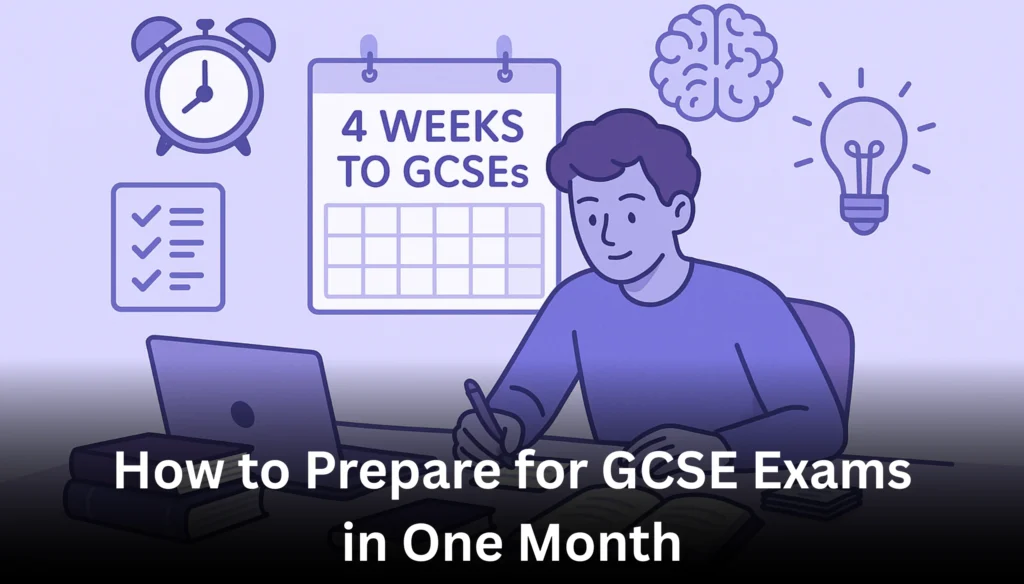
Exam season in the United Kingdom can be daunting, especially when you realise you’ve got only one month before your GCSEs begin. May and June are the traditional GCSE Exams months, and with over 10 subjects to juggle, it’s easy to panic. The good news is that, even with just four weeks left, you can still lay a solid foundation for success if you plan your time carefully, use the right revision techniques and take care of yourself. Our guide draws on proven strategies from teachers and educational resources to provide a week‑by‑week plan, pro tips for the students in the UK. Understanding GCSEs and the One‑Month Timeline What are GCSEs? GCSE stands for General Certificate of Secondary Education. Pupils in England, Wales and Northern Ireland typically study for these qualifications in Years 10–11 and sit the exams at the end of Year 11. Each subject is graded from 9 (highest) to 1, with a grade of 5 regarded as a strong pass. Exams usually take place in May and June, but coursework and mock exams often start earlier in the year. Is One Month Enough? Ideally, revision should begin months in advance; a school revision guide notes that proper revision isn’t something you can do in the few nights before the exams. You should constantly be reviewing material and planning. However, if circumstances mean you have only four weeks left, disciplined planning and focused study can still make a difference. You need to prioritise the most essential topics, practise under exam conditions and pay attention to physical and mental health. Building a Realistic One‑Month Revision Schedule A revision timetable helps you organise your study time and avoid feeling overwhelmed. Personalised timetables keep you on track, allow you to schedule rest days and break down subjects into manageable chunks. Below is a four‑week plan that incorporates advice from North Notts College, Sidcot School and other sources. Week‑by‑Week Plan Week Focus Key Actions (short phrases) Week 1 Assess & Plan List all exams and dates; identify each subject’s topics; note strengths and weaknesses; create a personalised revision timetable with daily slots; gather notes and textbooks. Week 2 Master Core Content Use revision techniques like flashcards, mind maps and past papers; focus on difficult topics; practice solving questions for Maths and Sciences; summarise notes with colours and symbols. Week 3 Practice & Exam Technique Complete timed past papers under quiet exam conditions; join or form study groups to quiz each other; review mark schemes and identify gaps; mix subjects to avoid fatigue. Week 4 Consolidate & Rest Focus on “yellow” topics (moderately challenging) and revisit factsheets; simulate exam conditions; revise subjects in the order they appear on your timetable; allow extra rest, ensuring you get 7–8 hours of sleep. How to Create Your Timetable Pro Tip: Use London’s long summer daylight to your advantage. In May and June, the sun rises around 5 a.m. and sets after 9 p.m, giving you plenty of natural light for early morning study sessions and evening walks to clear your head. Effective Revision Techniques Mix Up Revision Methods Variety keeps your brain engaged. North Notts College recommends using multiple techniques like flashcards, mind maps, practice papers and teaching others to reinforce learning. Sidcot School also advises combining flashcards, colour‑coded notes, mind maps, past papers and study groups. Flashcards: Perfect for memorising formulas, definitions and dates. Write the topic on one side and the key fact on the other. This technique is particularly useful for Maths, creating cards for geometry formulas (e.g., volume of a pyramid = ⅓ × base area × height). Mind Maps: Use coloured pens to link ideas and themes, especially for subjects like English or History. Colour‑coding aids memory and makes revision more engaging. Past Papers & Mark Schemes: Practising with past papers helps you familiarise yourself with question formats and timing. Mark your answers using official mark schemes to understand what examiners expect. Teaching Others: Explaining concepts to friends or family members reinforces your own understanding. Digital Tools: Apps like Quizlet, Senec, or Gojimo provide interactive quizzes and are available wherever you have your phone. Active Learning Strategies Passive reading isn’t enough. Instead: Subject‑Specific Tips Mathematics GCSE Maths questions fall into three categories: facts you must know (e.g., key formulas), processes you must be able to do and problems you must work through. To tackle each: Sciences Make sure you know which tier (Foundation or Higher) you’re taking and use the correct exam board specification. Summarise key vocabulary and formulae for each topic and highlight them in your notes. Redo textbook exercises and use online resources for tough questions. Past papers are essential; mark them carefully and revisit weak topics. English & Humanities For English literature, create character and theme mind maps. Practice planning essay questions before writing; five minutes’ planning is worth thirty minutes of waffle. In History or Geography, prepare timelines or maps to connect events and locations, and practise writing concise answers. Looking After Your Health and Well‑Being Revision is important, but your physical and mental health directly affects how well you study. Sidcot School emphasises maintaining a balanced diet, getting sufficient sleep and taking regular screen breaks. Here are practical steps: FAQs RajaRaja specializes in Physics and Maths, with over 5 years of experience. He offers KS2, KS3, and GCSE Science and Maths lessons. He graduated from one of the top universities in the UK.
How Much Should You Pay for a GCSE Tutor in the UK?

Whether your child is preparing for the 2026 GCSEs or looking to catch up after an unexpected result, one of the first questions you’ll face is how much to budget for a GCSE tutor. With hourly rates ranging from £15 up to £60 and beyond, it’s easy to feel lost. This guide breaks down the cost of GCSE tutoring, explains the factors that determine price, and helps you decide how to invest wisely in your child’s education. As an online tuition provider, we also outline our own transparent pricing plans and why they offer great value. Why Invest in GCSE Tuition? GCSEs play a pivotal role in a young person’s academic journey. They act as a gateway to sixth‑form colleges, apprenticeships and even university applications. Strong grades in English, mathematics and science are particularly important. But beyond grades, personalised tuition can provide. While GCSE tuition isn’t the only route to success, many families find it a worthwhile investment especially when combined with self‑study and school lessons. The next step is understanding what that investment might cost. Average UK Tutor Rates Most parents have heard anecdotal figures about tutoring costs. To set realistic expectations, let’s look at typical UK prices. According to educational research and tutoring providers, the average hourly cost of a GCSE tutor is around £39 for face‑to‑face lessons and £31 for online sessions. However, the range is wide: It’s clear there’s no fixed “right” amount. Instead, your budget should reflect the tutor’s qualifications, your child’s needs and how often you plan to book sessions. Factors That Influence Tutoring Costs Why do some tutors charge £20 and others £80? Several factors influence rates: Tutor qualifications and experience Mode of tutoring: online vs in‑person Online lessons are generally cheaper. Without travel or venue costs, a tutor can offer lower hourly rates (typically £15–£40). Face‑to‑face sessions cost more (often £5–£10 extra per hour) due to travel and logistics. Some students prefer in‑person teaching for hands‑on activities or face‑to‑face interaction, but online platforms often include tools like virtual whiteboards and digital resources. Level of study and subject complexity GCSE tuition is usually cheaper than A‑level tuition because the content is less advanced. Maths and sciences may cost more than humanities, especially when triple science or higher‑tier maths is involved. Languages and arts subjects can vary depending on the tutor’s qualifications. Region and travel Tutoring in London and the South East tends to be more expensive than in other parts of the UK. One report notes the average hourly rate in Hampshire is around £39.56; London, Surrey and Manchester hover above £38. Rural areas may be lower, though travel costs can add up. Online tutoring helps level the playing field, as location matters less. Frequency and lesson length Booking regular weekly sessions often reduces the per‑lesson cost. For instance, some agencies or tutors offer discounts for block bookings. Longer sessions (90–120 minutes) may cost more per session but offer better value per hour. Additional services or materials If a tutor provides detailed progress reports, exam papers, tailored homework or recorded sessions, these extras may justify a higher rate. Likewise, agency or platform fees can affect your total cost. Understanding these factors helps you evaluate whether a quoted rate is reasonable and how it fits within your budget. Budget‑Friendly Tips for Tutoring There’s no need to break the bank for tutoring. Here are ways to manage costs without compromising quality: Subject‑Specific and Regional Variations Maths and Science: These often command higher rates because they are core subjects that students must pass. Qualified teachers with exam‑board experience are in high demand. Languages: Rates vary widely. Mandarin and other less‑commonly taught languages can exceed £70 per hour, while French or Spanish may be in the mid‑range. Humanities and Arts: English, history and geography generally cost less than STEM subjects. However, hiring a tutor who specialises in creative writing or literature can still warrant a higher fee. Location: London and the South East see the highest rates. Northern England, the Midlands and rural areas tend to be cheaper. Online tuition smooths these differences, providing access to tutors nationwide. Setting Your Budget: A Step‑by‑Step Approach Our Flexible Pricing Plans At RS Remote Tutoring, we believe quality tuition should be affordable, flexible and tailored to each student. That’s why we offer three clear plans: Monthly Plan (Paid Upfront) Sessions per week Cost per lesson Monthly total Key features 1 lesson/week £25 per lesson £100 per month Live 1‑to‑1 tutoring; free 30‑min trial; progress feedback every 4 lessons; flexible scheduling; homework help; optional session recordings; cancel anytime 2 lessons/week £23 per lesson £184 per month All of the above, with extra practice time 3 lessons/week £21 per lesson £252 per month Ideal for intensive revision or multiple subjects Why choose this plan? It’s perfect for families who want flexibility without a long‑term commitment. You can adjust or cancel monthly based on your child’s progress and exam schedule. Term Plan (3 Months) Sessions per week Cost per lesson Term total Key features 1 lesson/week £24 per lesson £288 total Live 1‑to‑1 tutoring; free 30‑min trial; monthly progress reports & goal tracking; priority scheduling; homework & exam prep guidance; mid‑term feedback meeting; optional recorded sessions; end‑of‑term performance review 2 lessons/week £22 per lesson £528 total As above, with double the lesson time 3 lessons/week £20 per lesson £720 total Intensive support across multiple subjects This plan rewards commitment. It provides structured feedback, priority scheduling and additional guidance to prepare for mocks or final exams. Yearly Plan (Best Value) Sessions per week Cost per lesson Annual total Key features 1 lesson/week £23 per lesson £1,104 total Dedicated long‑term tutor; free 30‑min trial + one free revision session per term; detailed term‑wise progress reports; top‑priority scheduling; continuous homework & exam support; optional recorded lessons; parent–teacher consultations; custom learning plan aligned with school syllabus; performance‑based rewards & certificate 2 lessons/week £21 per lesson £2,016 total As above, with more regular contact 3 lessons/week £19 per lesson £2,964 total Best for students seeking a major
What Happens If You Fail a GCSE? Options Explained (2026 Guide)
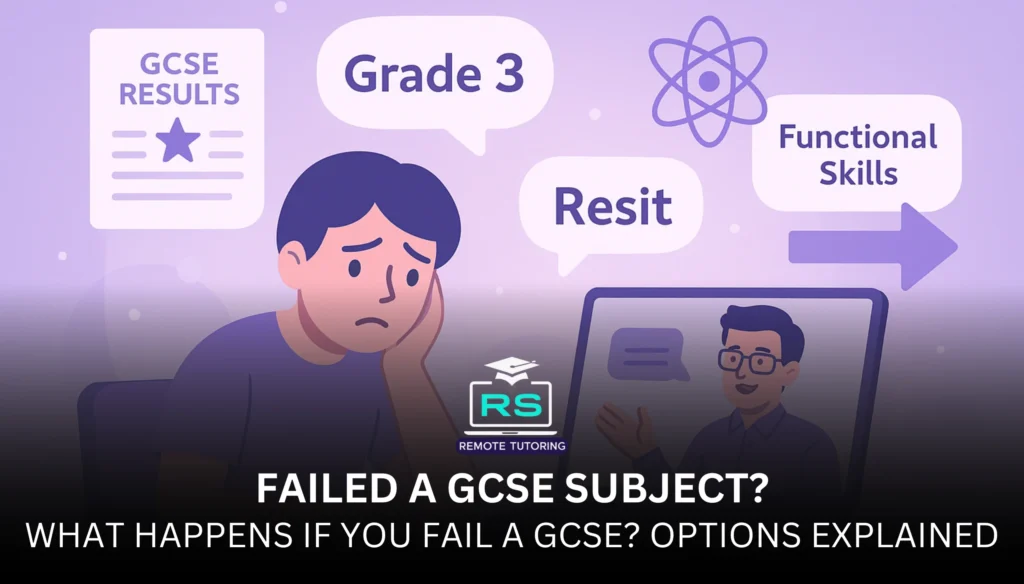
Failing a GCSE can feel overwhelming, but it doesn’t mean your prospects are doomed. In the UK, GCSEs are stepping stones to A‑levels, T levels, apprenticeships and employment, so knowing what happens if you fail a GCSE and what you can do next is most crucial. This guide will show you what constitutes a fail, how schools and exam boards handle low grades, and all the options available for students and parents. Understanding GCSE Grades and What Counts as a Fail Before exploring options, it’s important to understand how GCSE grading works. In England, grades range from 9 (highest) to 1 (lowest). A grade 4 is considered a standard pass, and a grade 5 is a strong pass. Anything below grade 4 (i.e., grades 1–3) is technically a fail, particularly in core subjects such as English and maths. In Wales and Northern Ireland, the A*–G scale still applies, where a grade C (or C* in Northern Ireland) is the standard pass. How many GCSEs do you need? Most students take nine or ten GCSEs, although the minimum required for post‑16 study is usually five GCSEs at grade 4/C or higher, including English and maths. Colleges and sixth forms often demand at least four to five passes to enrol, and some A‑level subjects require a grade 5 or above in the same GCSE. Failing one GCSE may not stop you progressing, but failing multiple core subjects can limit your options. Core vs optional subjects English language and maths are compulsory across England and Wales, and you will normally study science (single, double or triple award). If you fail English or maths (grade 3 or below), you must continue studying them until you achieve a grade 4 or an equivalent qualification. Schools also require at least one humanities (history or geography) and sometimes a language, but failing these does not carry mandatory retake requirements. Immediate Impact of Failing a GCSE Entry to sixth form or college A typical sixth form entry requirement is five GCSEs at grade 4 (C) or higher, including English and maths. If you miss one pass grade, speak to the sixth form or college; many institutions are flexible and may let you start A‑levels or vocational courses while resitting the failed GCSE. However, failing more than one key subject can disqualify you from certain courses or mean starting at Level 2 instead of Level 3. Progression to apprenticeships and employment Employers and apprenticeship providers often expect passes in English and maths. Many Level 2 or Level 3 apprenticeships require at least two GCSEs, and some include additional training to help you achieve the required level. For entry‑level jobs and apprenticeships, failing a GCSE may not be a deal‑breaker, but you will still need to improve your skills to progress. What about your exam certificates? When you retake GCSEs, both your original and retake grades appear on your results transcript. For personal use (e.g., UCAS applications), you can use the highest grade achieved; retaking a GCSE does not erase your original grade. Schools and college performance tables count only the first attempt, but for your own prospects, you can keep the better mark. Options After Failing a GCSE Failing a GCSE is frustrating, but there are multiple paths forward. The right choice depends on which subject you failed, your career ambitions, and how you prefer to learn. 1. Resit the GCSE Exam Resitting means taking the same GCSE exam again. This is mandatory for maths and English if you achieved a grade 3 or below. For other subjects, resits are optional. 2. Retake the GCSE alongside another course If you want to progress to Level 3 courses (A‑levels, T levels or BTEC Nationals) but failed a key subject, many colleges allow you to retake your GCSE alongside your new course. This is common for maths or English. You attend lessons for your main course and have extra classes to prepare for the resit. Balancing both can be challenging, so plan your study timetable carefully. 3. Take Functional Skills qualifications Functional Skills qualifications in English and maths are often accepted by employers and apprenticeship providers as equivalents to GCSE passes. They focus on practical application (e.g., budget calculations, professional communication). This option is particularly useful if you struggle with GCSE exam techniques or need a faster route to meet apprenticeship entry requirements. However, not all universities accept functional skills as equivalent to GCSEs, so check your intended progression. 4. Explore equivalent Level 2 qualifications You can switch to vocational or technical qualifications at Level 2. Options include: These qualifications allow you to continue progressing without repeating an entire GCSE year. They may provide a more practical learning approach and can lead to Level 3 qualifications or apprenticeships. 5. Start an apprenticeship or traineeship Apprenticeships and traineeships are “earn‑while‑you‑learn” options that combine paid work with training. There are over 670 high‑quality apprenticeships in fields ranging from digital marketing to engineering. Entry requirements vary; some employers accept applicants without GCSE passes if they are willing to take functional skills alongside the job. If you enjoy hands‑on learning and want to enter the workplace, this path may suit you. 6. Appeal your GCSE result If you believe your exam grade is wrong, you can appeal. Appeals must be lodged through your school or exam centre. The exam board will review the marking and can adjust your grade. Be aware that your grade could be lowered as well as raised. Appeals are free for grades 1–3 in English and maths, but may cost if you simply want to improve your pass. 7. Consider distance or online learning If attending a local college is difficult, consider online GCSE courses. Many providers (including RS Remote Tutoring) offer live classes or recorded lessons with tutor support. They allow you to study at your own pace and retake exams as a private candidate, which is ideal for students who need flexibility or live far from exam centres. Preparing for Your GCSE Resits If you decide to resit, planning and
How to Choose Your GCSE Subjects in 2026

Selecting the right GCSE subjects is one of the first big decisions students make during their secondary‑school journey. Your choices can shape what you study in Years 10 and 11, influence which A‑levels you go on to take and even affect the university courses or careers you pursue later on. With changes to the curriculum on the horizon and a growing emphasis on digital skills and wellbeing, knowing how to choose your GCSE subjects wisely in 2026 is more important than ever. This guide distills expert advice from teachers, tutors and examiners to help students and parents navigate their options with confidence. Why GCSE subject choices matter GCSEs (General Certificate of Secondary Education) represent the first formal qualification stage in the UK. Achieving strong grades opens doors to A‑levels, vocational courses and apprenticeships. Universities and employers increasingly look beyond headline grades to the specific subjects students have taken. Following recent A‑level reforms, entry requirements for competitive degree programmes often specify minimum GCSE grades or certain subjects, particularly in English and maths. Even if university seems a long way off, thinking ahead now will keep your options open. Core subjects versus options Every student is required to take a set of core GCSEs. These core subjects include English, maths and science. Some schools also insist on a modern foreign language or a humanities subject (history or geography) as part of the English Baccalaureate (EBacc). Beyond the core, you’ll choose several optional subjects. These are what give you freedom to explore interests such as art, drama, technology or an additional language. How many GCSEs should you take? You must study at least five GCSE subjects, but most students take between eight and ten. A smaller number could restrict your A‑level choices later on, while taking too many can overload your timetable. A good rule of thumb is to prioritise quality over quantity: choose a broad, balanced set that reflects your strengths and ambitions without stretching you too thin. Timelines: when decisions are made Schools typically ask students to start thinking about their GCSE options during Year 9. At some schools decisions are finalised towards the end of that year, though some may ask for choices as early as Year 8. It’s important to check your school’s deadlines and attend any GCSE option evenings. Use Year 9 to experiment with different subjects, talk to teachers and discover what you enjoy. Factors to consider when choosing your subjects Your interests and strengths One of the biggest indicators of success is how interested you are in a subject. Think about: What am I genuinely curious about? Do you look forward to science experiments or writing essays? Do numbers make sense to you or do you prefer creative tasks? What comes naturally? Subjects that align with your strengths will feel less like a chore. How do I learn best? Practical subjects like music or design suit tactile learners; humanities subjects appeal to those who enjoy discussion and reading. Ask yourself the questions highlighted by experts: What am I interested in? What is the work like? Which A‑levels do I need for my future career? Do I want to go to university? Which courses suit how I learn?. Be honest with yourself and don’t choose a subject solely because friends are taking it. Future goals and university entry Some degree paths have very specific GCSE requirements. Medicine, dentistry and veterinary science often demand high grades in double or triple science, maths and English. For GCSE sciences, you will need to decide between a triple award (separate GCSEs in biology, chemistry and physics) or the double award (combined science). The triple route covers the three sciences in greater depth and is favoured by students considering scientific or medical careers. Humanities degrees may look for GCSEs in subjects such as history or a language, while creative courses might value art or design technology. Even if you have no firm career plans, choosing a balanced mix of academic and creative subjects will keep your options open. Universities pay close attention to English and maths, so aiming for at least a grade 4 (‘standard pass’) in these is essential. Some universities ask for grade 5s or higher in key subjects. School offerings and timetabling Availability varies between schools. A particular GCSE may not be offered if there are too few students interested or if specialist facilities are lacking. Some schools teach only double science, while others provide a wide range of languages and arts options. If your school doesn’t offer a subject you want, explore alternatives such as: Bear in mind that optional subjects often run in blocks. Two subjects in the same block cannot be taken together, so you may need to prioritise. Balance between coursework and exams Not all GCSEs are assessed in the same way. Some are entirely exam based, while others include coursework or controlled assessments. If you thrive under exam pressure, subjects like maths and languages may suit you; if you prefer ongoing projects, consider art, design & technology or media studies. Choose a mix that plays to your strengths and spreads your assessment load across the year. Understanding the core GCSE subjects English Language and Literature English is split into Language and Literature. Both are compulsory at most schools. English Language focuses on communication skills like reading, writing, speaking and listening, while Literature explores novels, plays and poetry. Strong English skills are vital for all careers; they also underpin essay‑based A‑levels and university courses. Mathematics Maths is another core subject and a fundamental requirement for many careers. It develops problem‑solving, logical thinking and numeracy skills. GCSE maths is tiered: Foundation covers grades 1–5 and Higher covers grades 4–9. The higher tier includes more algebra, geometry and statistics, so choose based on your confidence and potential. Employers and universities often require at least a grade 4 in maths; some competitive courses expect grade 6 or higher. Science Students can choose between Double Award (also known as Combined Science) and Triple Award. Both are compulsory pathways,
How to Prepare for GCSE 2026 Exams Online – Expert Guide
GCSE exams in 2026 run across May and June, with the first paper scheduled for 4 May 2026 and the final paper on 26 June 2026. Results will be released on 20 August 2026. The move towards digital exams means that many assessments will still look familiar but will be taken on a screen, with features such as bookmarking questions, entering special characters via a toolbar and no internet access. To succeed, students need a structured online revision plan, access to high‑quality digital resources, regular practice with past papers and emerging digital formats, and a focus on wellbeing. This guide walks you through everything you need to know to prepare for GCSE 2026 exams online. Why prepare for GCSE 2026 exams online? The 2026 cohort sits their exams during a period of rapid change. The introduction of digital assessments means that some subjects may be tested on a computer. At the same time, students will sit the conventional written papers across a tight six‑week window. Preparing online helps learners adapt to both formats. It enables them to access interactive resources, practice typing responses, take mock exams under realistic conditions, and receive targeted feedback from remote tutors. In this guide we explore the exam schedule, show you how to build a flexible online revision timetable, recommend subject specific digital resources, explain how to practise with past papers and on‑screen assessments, and provide wellbeing strategies. Whether you’re a student or a parent supporting a learner, this article will help you prepare for GCSE 2026 exams with confidence. Understand the GCSE 2026 exam landscape Before you dive into revision, it’s important to know what you’re working towards. Key dates for GCSE 2026 exams in England Staying on top of provisional timetables is vital. Exam boards release draft schedules months in advance, allowing you to plan revision around exact paper dates, entry deadlines and internal assessment due dates. Always confirm final dates with your school in case of changes. Digital exams – what is changing? AQA, Pearson and other boards are piloting digital exams in selected subjects from 2026. According to AQA, digital exams will largely replicate traditional papers, students will see the same questions, but presented on a screen. They can bookmark pages, return to questions, and use toolbars for special characters. Internet access, spell check and auto‑correct are disabled. The marking process and roles of examiners and invigilators remain unchanged. Digital exams offer several benefits: If your subject will be sat on screen, practise using the exam boards’ digital demos. They mimic question navigation, input fields and timer functionality and help you become comfortable before the big day. Exam boards and tiers Most GCSE subjects are offered by multiple exam boards. For 2026 the main boards in England are AQA, Edexcel (Pearson) and OCR. Each board covers the same subject content but uses different question styles and mark schemes, so it’s important to know which board you will sit. Many subjects also have two tiers: Ask your teacher or tutor which tier you will take. Choosing the right tier ensures your revision matches the level of difficulty you will encounter. Build an effective online revision timetable An organised study plan is the cornerstone of effective exam preparation. Digital tools make it easier than ever to map out your time and track progress. Start early and set realistic goals Begin revising at least three to six months before your exams. For the 2026 series this means starting no later than late 2025 or January 2026. Early revision prevents last‑minute cramming and provides ample time to identify gaps. Break your goals down into weekly and daily targets. For example: Use digital planning tools Try these online tools to organise your revision: Pro tip: Don’t overschedule. Aim for 45‑minute study sessions with 10‑minute breaks. Incorporate days off and leisure time to avoid burnout. Revision quality is more important than quantity. Balance subjects and priorities Spend more time on challenging subjects or those with higher grade weightings. Identify topics you struggle with and allocate extra sessions. Equally, maintain regular review of subjects you find easier to keep knowledge fresh. A balanced timetable reduces anxiety and ensures no subject is neglected. Effective online revision techniques for GCSE 2026 Not all study methods are equal. The following techniques are proven to boost retention and exam performance when preparing for GCSE 2026 exams online. Active recall and spaced repetition Passive reading or watching videos has limited impact. Active recall involves retrieving information from memory. Use flashcards, self‑quizzing apps, or write down everything you know about a topic without looking at notes. Combine this with spaced repetition, reviewing information at increasing intervals to strengthen long‑term memory. Interleaving and mixed‑topic practice Rather than revising one topic at a time, interleave different topics within a study session. For example, spend 20 minutes on algebra, then 20 minutes on geometry and 20 minutes on probability. Mixing topics improves your ability to switch thinking quickly, which mirrors exam conditions where questions move across themes. Practice under timed conditions Simulating exam conditions builds familiarity with the pressure of limited time. Set a timer for the same length as the real exam paper. Sit in a quiet room, remove distractions and complete the paper without pausing. Afterward, mark your answers and review errors. Use mark schemes and examiner reports Exam boards publish mark schemes and examiner reports after each exam series. Mark schemes show how points are allocated and highlight keywords or phrases that earn marks. Examiner reports explain common mistakes and how top answers look. Reading these after marking your practice papers helps you refine technique. Make the most of digital resources The internet offers a vast range of interactive tools for GCSE revision: Pro tip: Avoid multitasking during digital study. Close unnecessary tabs, silence notifications and use full‑screen mode to maintain focus. Subject‑specific preparation online strategies Each GCSE subject requires a tailored approach. Here’s how to prepare effectively for the major subjects tested in 2026. Mathematics Mathematics is assessed in three papers: one