Understand how GCSEs are graded can feel confusing, especially when the phrase “grade boundaries” starts appearing around results day. Grade boundaries are the minimum number of marks students need to achieve a particular grade in each subject. They convert raw exam scores into the 9‑1 grades used in England. The boundaries change every year because exam papers vary in difficulty; if a paper is harder, boundaries fall, and if a paper is easier, they rise. In this guide,e we demystify the process for 2026, summarise typical raw marks by exam board and subject, and answer common questions about next summer’s grade boundaries.
Jump to Section
What Are GCSE Grade Boundaries?
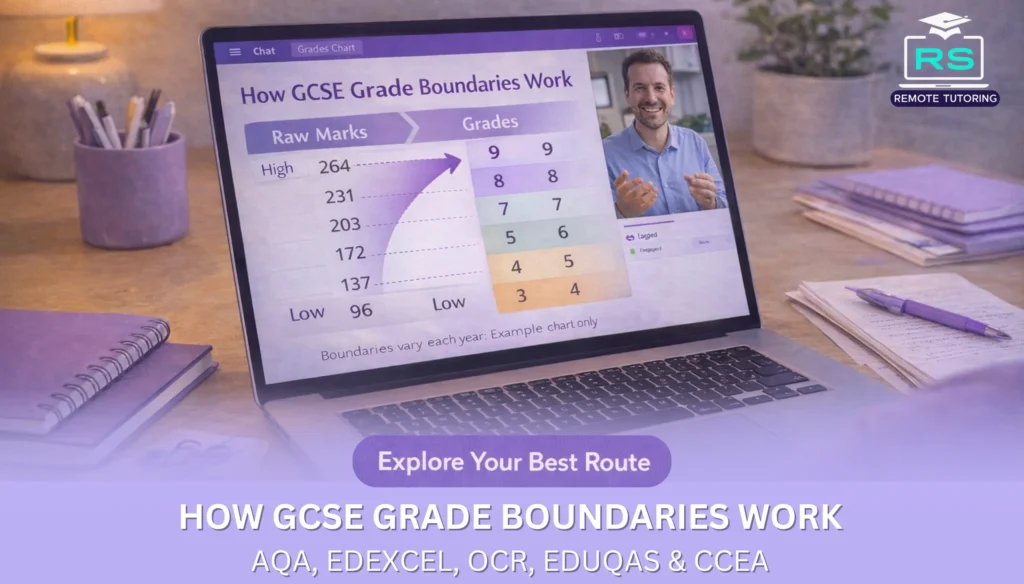
Grade boundaries are set by exam boards after all the papers have been marked. During a process called awarding, senior examiners review the overall performance of the student cohort and compare the papers with those from previous years. They adjust the mark thresholds to reflect the difficulty of each paper, ensuring that students aren’t unfairly penalised or advantaged. This process helps maintain consistency from year to year, so a grade 7 in 2026 represents the same standard of achievement as a grade 7 in previous years.
The grading system uses numbers 9 to 1 instead of the old A* to G grades. Grade 9 is the highest, grade 4 is a standard pass (comparable to the bottom of old grade C), and grade 5 is a strong pass (roughly top of old C/low B). Grade 1 is equivalent to the bottom of the old G. For subjects like Combined Science, students receive two adjacent grades (for example, 9-9, 9-8, 8-8, etc.), reflecting that the qualification counts as two GCSEs.
How Grade Boundaries Are Set
- Marking completed: Examiners finish marking all scripts.
- Statistical analysis: Boards analyse how students performed on each paper relative to past years, controlling for variables such as prior attainment.
Awarding meetings: Senior examiners (chaired by Ofqual for major subjects) agree the mark thresholds for each grade. They compare sample scripts with those from prior years to ensure that a grade 7 in 2026 is comparable to a grade 7 previously. - Approval: Ofqual reviews the proposals to ensure fairness; adjustments are made if necessary.
- Publication: Grade boundaries are published at 08:00 on GCSE results day (Thursday 20 August 2026). They are not available before results day and cannot be predicted precisely.
Why Do Grade Boundaries Change?
Exam boards design papers to a similar level of difficulty each year, but small variations in difficulty are inevitable. To keep standards consistent, grade boundaries shift up or down to reflect those differences. For example, if a maths paper is harder than expected, the mark needed for a grade 4 may drop to ensure that the same proportion of students achieve a standard pass. Conversely, an easier paper may see boundaries rise.
When Are Grade Boundaries Released?
Grade boundaries are usually published on the morning of results day. In 2026, GCSE results day falls on Thursday, 20 August 2026, and boards such as AQA, Edexcel, OCR, Eduqas, and CCEA will release their boundaries at 08:00. Students receiving results in January (resits or vocational awards) can check boundaries on the relevant release dates (for example, OCR releases January results on 11 March and 19 March 2026).
Will GCSE Grade Boundaries Be Higher in 2026?
Because grade boundaries depend on exam difficulty and how students perform, it’s impossible to say whether they will be higher or lower than in 2025. After the disruptions of the pandemic, boards aim for stability and comparable outcomes. Historical data show that boundaries typically vary by only a few marks year‑to‑year; for instance, the difference between a grade 5 boundary in maths may be within 5 to 10 marks between series. The best strategy is to focus on understanding the specification and practising past papers rather than worrying about boundaries.
Formula and Equation Sheets for 2026
In response to pandemic learning disruptions, the Department for Education decided that students do not need to memorise formulae or equations for GCSE maths, physics and combined science in 2025 to 2027. Candidates will be provided with formula sheets for these subjects. This support material will continue for the May/June and November 2026 exams. It may make some questions slightly easier, but grade boundaries will adjust accordingly.
Understanding Grade Boundaries by Exam Board
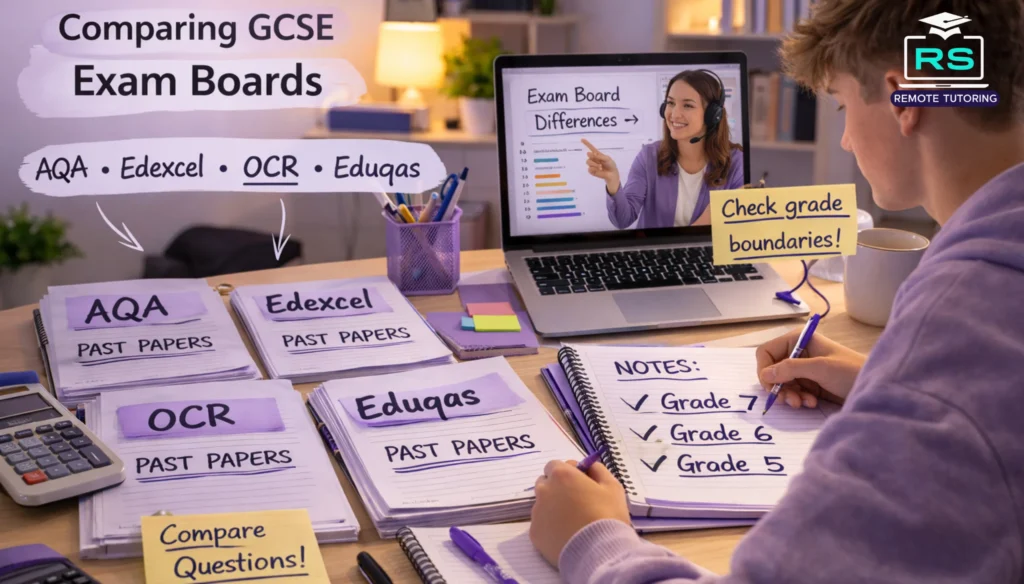
Below we summarise typical raw mark thresholds based on the 2025 summer series, which provides a useful benchmark for 2026. Remember that boundaries may shift slightly in 2026, but these examples illustrate the range of marks typically needed for each grade. For simplicity, we show boundaries for GCSE Maths, English Language and Combined Science. (All marks are out of 240 unless otherwise noted.)
AQA Grade Boundaries (2025 Benchmark)
| Subject & Tier | Grade 9 | Grade 8 | Grade 7 | Grade 6 | Grade 5 (Strong Pass) | Grade 4 (Standard Pass) | Grade 3 | Notes |
| Maths (Higher) | 219 | 191 | 164 | 130 | 96 | 63 | 46 | Out of 240. |
| Maths (Foundation) | 188 | 160 | 119 | 79 | 39 | — | — | Boundaries for grades 5–1 (grade 4 approx 79). |
| English Language | 131 | 121 | 111 | 100 | 95 | 86 | 78 | Out of 160. |
| Combined Science (Trilogy) Higher | 314 | 274 | 238 | 203 | 168 | 133 | 108 | Out of 420 (two equal marks across two papers). |
| Combined Science (Trilogy) Foundation | 258 | 228 | 198 | 168 | 138 | 108 | 78 | Students receive a double grade (e.g., 6-6). |
Why choose AQA? AQA is the largest exam board. Its papers use straightforward language and a clear progression of difficulty. The board offers a broad range of subjects and provides detailed specifications and plentiful past papers.
Edexcel Grade Boundaries (2025 Benchmark)
| Subject & Tier | Grade 9 | Grade 8 | Grade 7 | Grade 6 | Grade 5 | Grade 4 | Grade 3 | Notes |
| Maths (Higher) | 217 | 186 | 156 | 121 | 87 | 53 | 36 | Out of 240. |
| Maths (Foundation) | 175 | 144 | 105 | 67 | 29 | — | — | Grade 4 ~67 marks. |
| English Language (Specification A) | 148 | 135 | 122 | 110 | 96 | 82 | 68 | Out of 160 (approx values). |
| Combined Science (Higher) | 311 | 273 | 236 | 200 | 165 | 128 | 97 | Out of 420. |
| Combined Science (Foundation) | 263 | 233 | 202 | 171 | 140 | 109 | 78 | Out of 420, grades were awarded as pairs (e.g., 5-5). |
Why choose Edexcel? Edexcel, part of Pearson, is known for structured exam papers and clear mark schemes. It offers a wide subject range and runs international GCSEs (IGCSEs). Maths, sciences and business are particular strengths. Questions often involve data analysis and require careful interpretation.
OCR Grade Boundaries (2025 Benchmark)
OCR papers are marked out of 300 for maths rather than 240. We provide scaled marks to compare with other boards.
| Subject & Tier | Grade 9 | Grade 8 | Grade 7 | Grade 6 | Grade 5 | Grade 4 | Grade 3 | Notes |
| Maths (Higher) | 258 | 212 | 166 | 126 | 86 | 47 | 28 | Raw marks out of 300. |
| Maths (Foundation) | 224 | 191 | 151 | 112 | 74 | 36 | 14 | Grade 4 ~112 marks (scaled). |
| English Language | 145 | 133 | 122 | 108 | 95 | 83 | 72 | Out of 200. |
| Combined Science (Gateway Science) | 370 | 332 | 292 | 252 | 213 | 174 | 135 | Out of 450, boundaries were scaled to account for more papers. |
Why choose OCR? OCR offers a wide subject range, including classics and computing. Its assessments emphasise critical thinking and real-life scenarios, with longer questions that test analytical skills. Some students find OCR papers wordier; however, they suit those who enjoy extended responses and deeper analysis.
Eduqas/WJEC Grade Boundaries (2025 Benchmark)
Eduqas is the English arm of WJEC (the Welsh Joint Education Committee). Boundaries typically align closely with AQA and Edexcel.
| Subject & Tier | Grade 9 | Grade 8 | Grade 7 | Grade 6 | Grade 5 | Grade 4 | Grade 3 | Notes |
| Maths (Higher) | 196 | 155 | 115 | 85 | 56 | 27 | 12 | Out of 240. |
| Maths (Foundation) | 141 | 111 | 81 | 51 | 21 | — | — | Grade 4 ~51 marks. |
| English Language | 130 | 118 | 106 | 94 | 83 | 71 | 60 | Out of 160 (approx values). |
| Combined Science (Double Award) | 286 | 254 | 220 | 188 | 157 | 125 | 93 | Out of 420. |
Why choose Eduqas/WJEC? Eduqas papers balance structured and extended questions and often include context-based problems. They are particularly popular in Wales but also available in England.
CCEA Grade Boundaries (Northern Ireland)
CCEA is the exam board for Northern Ireland. Its GCSEs still use the A–G* grading scale, though some subjects also offer the 9‑1 system. Typical 2025 boundaries for maths (A*–G) were:
| Grade | Boundary (Higher, out of 200) | Boundary (Foundation, out of 200) |
| A* | 178 | – |
| A | 160 | 160 |
| B | 132 | 130 |
| C | 104 | 103 |
| D | 80 | 77 |
| E | 56 | 53 |
CCEA grade boundaries are released on the same results day as other boards. Although the letter system differs, universities and employers treat CCEA results as equivalent.
Combined Science Grade Boundaries (AQA Example)
GCSE Combined Science awards two grades (e.g., 6 to 5). For the AQA Trilogy qualification in 2025, grade boundaries were as follows (out of 420):
| Grade Pair | Boundary | Equivalent to |
| 9‑9 | 314 | Two grade 9s |
| 9‑8 | 274 | High grade 9 and grade 8 |
| 8‑8 | 238 | Both grade 8 |
| 8‑7 | 203 | Lower grade 8 and grade 7 |
| 7‑6 | 168 | Grade 7 and Grade 6 |
| 6‑6 | 133 | Two grade 6s |
| 6‑5 | 108 | Grade 6 and Grade 5 |
Similar boundaries apply across other boards; check official tables on results day for precise numbers.
Which Exam Board Is Easiest?
No exam board is inherently easier; all boards are regulated by Ofqual and follow the same national standards. Differences lie in assessment style and question wording. For instance:
- AQA: Straightforward language and clear progression; good for students who prefer step-by-step progression.
- Edexcel: Structured questions with plenty of practice materials; strong for maths and sciences.
- OCR: Wordier questions that emphasise real‑world contexts; suit students who enjoy deeper analysis.
- Eduqas/WJEC: Balanced mix of structured and contextual tasks; often chosen in Wales.
At the end, success depends on preparation rather than the exam board. Choose the board your school offers, practise with board‑specific past papers, and focus on understanding the specification.
2026 Grade Boundary Prediction and Tips
While we cannot predict exact boundaries, we can offer practical advice:
- Work towards a safety margin: Aim for at least 5 to 10 marks above the grade boundary from the previous year. If you target a grade 5, practise until you consistently score around 100 marks on practice papers.
- Focus on strong topics first: Secure marks in topics you know well, then tackle weaker areas. For foundation maths, mastering number, ratio and proportion (which make up half the paper) can ensure a comfortable grade 4.
- Practise board‑specific past papers: Each board has its own style, so use official past papers to familiarise yourself with question formats.
- Use formula sheets effectively: In 2026 maths and science exams, formula sheets will be provided. Practise using them to save time and reduce mental load.
- Check grade boundaries on results day: Don’t rely on leaked numbers. Official boundaries are published at 08:00 on 20 August 2026.
Frequently Asked Questions (FAQs)
Will 2026 GCSE grade boundaries be higher?
Grade boundaries are set after marking and reflect the difficulty of the papers. If papers are easier, boundaries may rise; if harder, they may fall. Historical data show that boundaries typically vary by only a few marks year‑to‑year. Students should focus on preparation rather than predicting boundaries.
What grades do students need for GCSEs in 2026?
GCSEs in England use the 9‑1 grading system. Grade 9 is the highest, grades 7 to 9 correspond broadly to the old A*/A; grade 5 is a strong pass (top of old C/low B); grade 4 is a standard pass (bottom of old C); grade 1 corresponds to the old G.
Are GCSEs changing in 2026?
The core structure of GCSEs is not changing; however, formula and equation sheets will continue for GCSE maths, physics and combined science in 2026 and 2027. This means students don’t need to memorise formulas but should practise using the provided sheets.
Is 90 % a grade 9 in GCSE?
Not necessarily. Grade 9 boundaries vary by subject and board. For example, in AQA Maths 2025, 219 marks out of 240 (about 91 %) were needed for a grade 9, but other subjects may require lower percentages. Grade 9 marks typically lie around the top 5 % of the cohort.
What are the grade boundaries for maths in 2026?
The exact 2026 boundaries will be released on 20 August 2026. Based on 2025 benchmarks, grade 4 in maths required around 63 marks (AQA), 53–67 marks (Edexcel), or 47–51 marks (OCR/Eduqas). Grade 9 required around 217–219 marks (out of 240) for AQA and Edexcel, and 258 (out of 300) for OCR.
Will grade boundaries be different across boards for the same subject?
Yes. Although all boards follow national standards, differences in assessment style mean grade boundaries vary. For maths, Edexcel’s grade 9 boundary in 2025 was 217 marks, while AQA’s was 21,9 and OCR’s (scaled to 300 marks) was 258. These variations ensure fairness relative to the difficulty of each board’s papers.
Are AQA grade boundaries the same for A Level and GCSE?
No. Grade boundaries for A Levels use grades A*–E and are set separately. They cannot be compared directly to GCSE boundaries. AQA publishes separate PDFs for A Level and GCSE boundaries; check the board’s results pages.
How are combined science grade boundaries calculated?
Combined science papers are marked with a higher total (e.g., 420 marks for AQA Trilogy) and awarded a double grade like 6‑6. Grade boundaries correspond to two adjacent single grades. For instance, in 2025, AQA’s 6‑6 boundary was 133 marks.
How do I check my exam board?
Your school or college selects exam boards for each subject. The board’s name appears on your entry forms and exam timetable. If you’re unsure, ask your teacher or exam officer.
What subject is usually the last GCSE exam in 2026?
The summer exam season runs from early May to late June. Historically, some languages or specialist subjects appear last; exam timetables for 2026 will confirm the final subject. Check each board’s official timetable when published.
Conclusion
Grade boundaries are an essential part of the GCSE assessment system, converting raw marks into grades that are fair and comparable across years. In 2026, boundaries will be released at 08:00 on results day (20 August 2026). While you can use 2025 data to set realistic expectations, the best way to achieve your target grade is through thorough preparation: learn the specification, practise past papers for your exam board, and make use of formula sheets provided in maths and science.
Ready to tackle GCSEs with confidence? Our expert tutors specialise in AQA, Edexcel, OCR and Eduqas courses. Whether you’re aiming for a grade 4 pass or pushing for top grades, we can tailor a study programme to your needs. Contact us today to book a free consultation and start preparing for success.
We hope this guide has clarified GCSE grade boundaries for 2026. Good luck with your studies!

Raja specializes in Physics and Maths, with over 5 years of experience. He offers KS2, KS3, and GCSE Science and Maths lessons. He graduated from one of the top universities in the UK.