When the UK reformed GCSEs in 2015 to 2017, familiar A*–G grades were replaced with numbers 9–1. The change caused confusion among parents and students, especially around what counts as a pass and how the new scale aligns with the old system. Understanding this grading system is crucial when setting expectations, planning revision, or retaking exams. This guide explains GCSE grades 1–9 equivalents, how grade boundaries work for different exam boards, and what marks typically achieve a standard pass. The focus is on the 2026 exam series, with London‑specific advice for results day.
Why the grading system changed
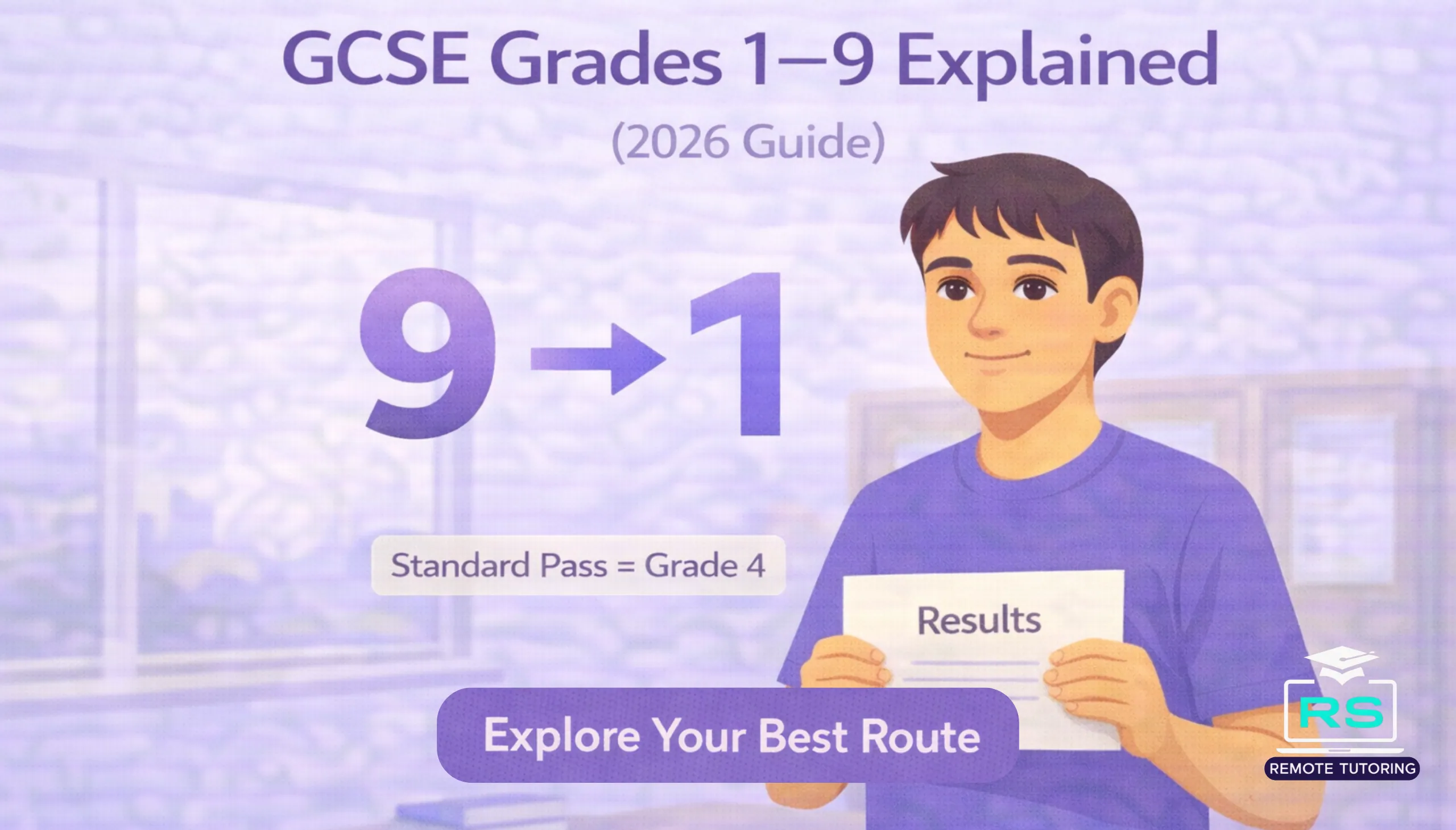
The government introduced the 9‑1 scale for several reasons. It distinguishes reformed GCSEs from pre‑2015 qualifications and provides finer discrimination at the top end. There are now three grades (9, 8 and 7) where there used to be two (A* and A), allowing universities and employers to identify exceptional performance more easily. Official guidance notes that the bottom of grade 7 is designed to align with the bottom of the old grade A, grade 4 aligns with the bottom of a grade C, and grade 1 aligns with the bottom of the old grade G. As a result, grade 4 is considered the minimum standard pass while grade 5 is labelled a strong pass.
Jump to Section
Understanding the 9‑to‑1 scale: mapping numbers to letters

The number scale does not translate directly to letters, but key alignment points make comparisons easier:
- Grade 9 – above A*: Awarded to a small fraction of students; it represents exceptional mastery well beyond typical A‑level entry requirements.
- Grade 8 – strong A to low A*: Equivalent to the top of the old A grade.
- Grade 7 – low A: The bottom of grade 7 matches the bottom of the old grade A.
- Grade 6 – high B: Aligns with the middle of the old B grade.
- Grade 5 – low B/high C (strong pass): Viewed as a strong pass and used by competitive sixth forms or apprenticeships.
- Grade 4 – low C (standard pass): Equivalent to the bottom of old grade C; the minimum benchmark for most apprenticeships and college courses.
- Grade 3 – D/high E: Represents a performance below the traditional pass level.
- Grades 2 and 1 – low E to F/G: The bottom of grade 1 aligns with the bottom of old grade G.
- U (ungraded): Awarded when there is insufficient evidence to assign a grade.
These alignments mirror other sources such as Ofqual and the Department for Education, which emphasise that a student who would have received at least a C under the old system should now receive at least a 4. A summary table is shown below:
| New grade | Old letter grade equivalent | Comments |
| 9 | Above A* | Highest grade, awarded to very few students |
| 8 | A*–A | |
| 7 | A | Bottom aligns with old A |
| 6 | High B | Middle of old B |
| 5 | Low B/High C | Strong pass |
| 4 | Low C | Standard pass |
| 3 | D/High E | Below pass |
| 2 | Low E/High F | |
| 1 | Low F/G | Bottom of grade 1 aligns with bottom of old G |
| U | Ungraded | Insufficient evidence |
Standard pass vs strong pass
The reformed system distinguishes between standard and strong passes:
- Standard pass (Grade 4): The minimum requirement to avoid compulsory resits in English and maths and to access most apprenticeships or Level 3 courses. Students who don’t achieve grade 4 in English and maths must continue studying these subjects until age 18. Grade 4 aligns with the bottom of a grade C.
- Strong pass (Grade 5): Equivalent to a high C or low B. Many sixth forms and competitive courses, particularly in London, ask for grade 5 or higher, viewing it as evidence of secure understanding. For example, top sixth-form colleges in the capital often require grade 5+ in English and maths for A‑level entry.
Achieving a strong pass improves options for higher‑level apprenticeships, selective sixth forms and certain university pathways, while a standard pass ensures students meet the minimum national benchmark.
Why grade boundaries vary
Grade boundaries are the minimum raw marks needed to achieve each numerical grade. Exam boards set these boundaries after all papers are marked, using statistical analysis and examiner judgement to ensure standards remain consistent. Boundaries change each year because paper difficulty and student performance vary. Since nearly all GCSEs are assessed by final exams rather than coursework, the raw marks required for a grade may differ significantly between boards and years. For example, in the 2025 GCSE maths series:
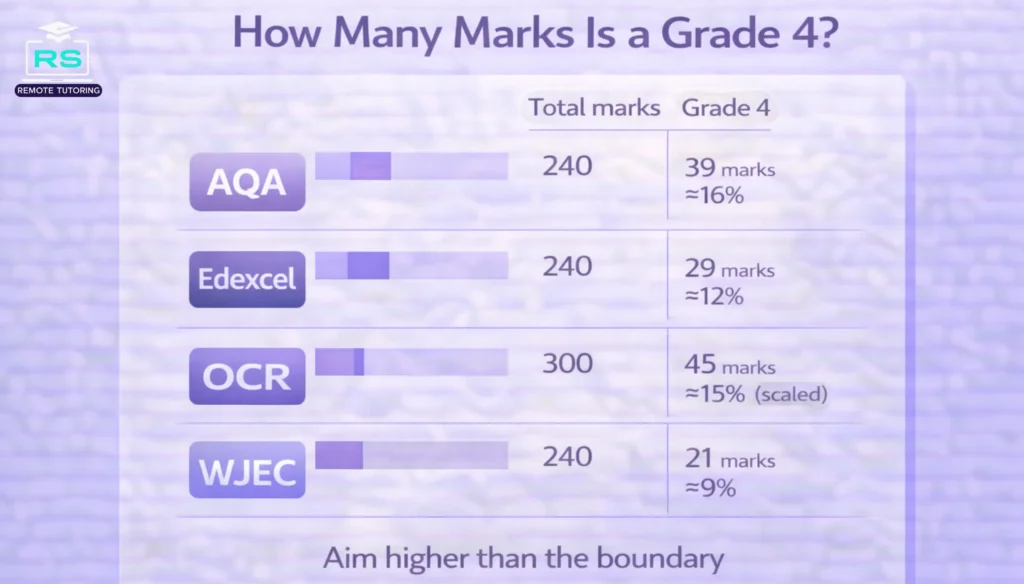
- Edexcel required 29 marks out of 240 for a grade 4 on the foundation paper – just over 12%.
- AQA required 39/240 marks for a grade 4 foundation – around 16%.
- OCR set foundation boundaries out of 300 marks; the grade 4 boundary scaled to 45/300 (15%).
- WJEC Eduqas needed 21/240 marks for a grade 4 foundation (about 9%).
Higher‑tier papers target a different distribution: half the marks aim at grades 9 to 7 and half at grades 6 to 4. Because grade 4 content represents only about 20% of a higher paper, grade boundaries at this level are often very low. In 2025, grade 4 on AQA higher required just 63/240 marks (about 26%).
Release of grade boundaries
Grade boundaries in 2026 are published on results day, never beforehand. For the 2026 summer exams, boundaries will be released on Thursday 20 August 2026. Students sitting November resits should expect boundaries on Thursday 15 January 2026 when resit results are announced. London schools usually receive electronic grade boundary tables from exam boards at 8:00 AM.
How many marks for a Grade 4 in GCSE maths?
A common question is “how many marks is a 4 in GCSE maths foundation?” The answer depends on the board and year, but recent boundaries give a useful guide. GCSE Grade in 2025:
- AQA foundation: Grade 4 boundary was 39 marks out of 240 (≈16%). Grade 5 required 79 marks (≈33%).
- Edexcel foundation: Grade 4 boundary was 29/240 (~12%).
- OCR foundation: Boundaries use 300 marks; grade 4 equated to 45/300 (~15%). Scaled to a 240‑mark scale, this corresponds to 36 marks.
- WJEC Eduqas foundation: Grade 4 boundary was 21/240 (~9%).
These low percentages reflect the exam paper design: half of foundation marks target grades 5–3, while the other half target grades 3–1. In higher tier, grade 4 boundaries can be similarly low because only a fifth of questions target grade 4.
Marks versus percentages
Because different boards use different total marks (e.g., OCR uses 300), it is more reliable to think in terms of percentages. Generally, achieving 15–20 % of the marks will secure a grade 4 on the foundation paper. However, the safe strategy is to aim higher. Strong performance across number, ratio and algebra topics increases the chance of achieving a strong pass or higher.
GCSE grade boundaries by exam board (2025 example)
| Exam board | Paper totals | Grade 4 boundary (Foundation) | Grade 4 boundary (Higher) | Notes |
| Edexcel | 240 marks | 29 marks (~12%) | 53 marks (~22%) | Boundaries show low thresholds for a pass; grade 5 required 87 marks. |
| AQA | 240 marks | 39 marks (~16%) | 63 marks (~26%) | AQA papers often have slightly higher boundaries than Edexcel. |
| OCR | 300 marks (scaled to 240) | 45/300 (≈36 scaled) | 69/300 (≈55 scaled) | Raw marks appear higher because OCR papers carry more marks. |
| WJEC Eduqas | 240 marks | 21 marks (~9%) | 27 marks (~11%) | Lowest boundaries among main boards. |
Note: These values are from the 2025 series and only provide guidance; 2026 boundaries may differ. Grade boundary tables for previous years are available on exam board websites once results are released.
GCSE grading systems across the UK
In England all GCSEs use the 9–1 scale. Elsewhere in the UK, different systems remain:
- Wales and Northern Ireland: Traditional A*–G grades continue for qualifications set by Welsh and Northern Irish boards. The Welsh system awards letter grades from A* to G; a C grade remains the standard pass. Northern Ireland uses both letter and number grades depending on the examining body. A conversion table shows that A* and A correspond to 9–7, B to 6–5, C to 4, and D–G to 3–1.
- CCEA (Northern Ireland exam board): In addition to letter grades, CCEA offers a numbered 9–1 option for some subjects. The board emphasises that grade C (letter) or 4 (number) is the standard pass. Students in London sitting CCEA papers (rare) should confirm which scale applies.
- Scotland: Scotland does not use GCSEs; National 5 exams have grades A–D and ‘No Award’. Roughly, a National 5 grade C is considered similar to GCSE grade 4; grade A corresponds to 7–9.
Combined Science double grades
GCSE Combined Science counts as two GCSEs. Students receive a double grade, such as 9‑9, 9‑8, 8‑8 down to 1‑1. There are 17 possible grade combinations. Combined Science is worth twice the UCAS points of a single GCSE. A double grade of 4‑4 is equivalent to two C grades and meets the standard pass benchmark for science. If one digit is lower than the other (e.g., 5‑4), universities and employers usually treat the pair together.
Grade equivalents for BTECs and other qualifications
Many students combine GCSEs with vocational qualifications. At Level 2, BTEC First certificates and diplomas are considered equivalent to GCSE grades. A BTEC Level 2 Distinction* is roughly equivalent to a grade 8.5/9; Distinction to grade 7; Merit to grade 5.5; Pass to grade 4; Level 1 Distinction to grade 3; Level 1 Merit to grade 2; and Level 1 Pass to grade 1.75. These equivalences help students and employers compare vocational results with GCSEs.
How GCSEs are graded: behind the scenes
- Marking: After exams, papers are anonymised and marked by trained examiners. Teachers mark non‑exam assessments (NEA) which then undergo moderation. External examiners mark all formal papers with detailed mark schemes.
- Setting grade boundaries: Senior examiners review student work at key grade thresholds and use statistical data (cohort prior attainment, previous years’ performance) to recommend boundaries. Boundaries ensure standards remain comparable year to year.
- Awarding grades: Exam boards convert raw marks to scaled marks (for boards with different totals) and apply grade boundaries to award each student a numerical grade. A formula ensures that approximately 20 % of grades 7–9 are awarded as grade 9, with grade 8 boundaries spaced equally between grades 7 and 9.
- Results day: Results slip displays grades for each subject and, for combined science, a double grade. Grade boundaries and mark-to-grade tables are published simultaneously.
Results day and seasonal advice
Results day in the UK traditionally falls on the third Thursday in August. In 2026 this will be 20 August. London schools normally open around 9:00 AM for students to collect results. Because results day coincides with the peak summer travel period, plan your journey:
- Transport: Public transport can be busy in August. Consider off‑peak trains or buses and allow extra time for travel. Driving into central London may be slower due to summer roadworks.
- Weather: August is typically warm (24–26°C) with occasional showers. Dress for sunshine but carry a light raincoat. Bring water if you’re waiting outside school.
- Celebrations and support: Many schools host informal gatherings for students to celebrate results. Some offer on‑site support from career advisers and local FE colleges. If you don’t achieve a desired grade, talk to staff immediately about options such as resits, remarking or vocational alternatives.
November resits results are released in mid‑January 2026. In London the January weather is cold and damp, so plan for shorter daylight and check Transport for London travel updates.
Tips for students and parents
- Aim beyond the pass mark: Because grade boundaries are low, achieving 50–60 % of marks will comfortably exceed a pass. This provides a cushion if papers are more challenging.
- Understand your exam board: Each board emphasises different content (e.g., OCR maths includes 300 marks). Check the specification and practise with past papers.
- Practise under timed conditions: Use mark schemes to understand how answers are awarded and where method marks can be earned.
- Track grade boundary releases: Keep an eye on exam board websites in August and January for grade boundary tables.
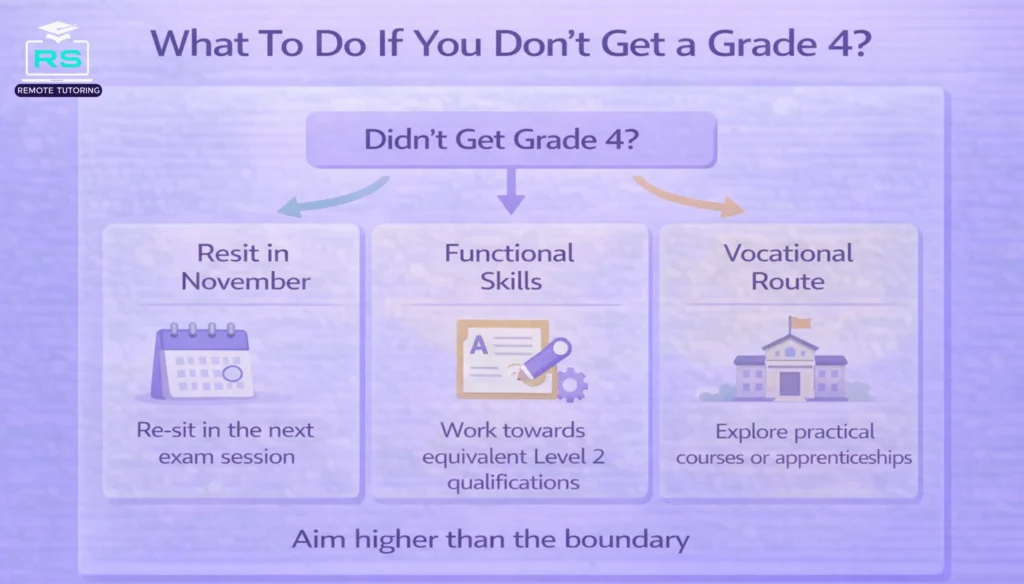
- Plan for resits: If you don’t achieve grade 4 in English or maths, resit in November. Some London colleges allow you to retake alongside vocational courses.
- Consider alternatives: Functional Skills Level 2 or BTEC Level 2 qualifications can provide an equivalent grade 4 for apprenticeships or employment.
Frequently Asked Questions
What percentage is a GCSE grade 1–9 (and how do grade boundaries relate to marks)?
Grades relate to percentages only indirectly because grade boundaries vary by exam board and year. In 2025, a grade 4 in maths required between 12–16 % of marks on foundation papers. Grade 5 boundaries were around 26–33 %. At the top end, grade 9 boundaries sat around 80–90 % for most boards.
What are GCSE grades 1–9 in the UK, and what does each grade mean?
England’s GCSEs are graded 9–1, with 9 the highest. Grade 7 equates to an old A, grade 4 equates to a C, and grade 1 aligns with a G. Wales and Northern Ireland still use A*–G for some qualifications. Scotland uses National 5s with A–D grades.
What are the GCSE grade 1–9 equivalents in letter grades (A–G) for 2023?
The mapping between number and letter grades has remained consistent since GCSE reforms were fully implemented in 2017. In 2023 the same comparability applied: 9 = high A*, 7 = A, 4 = C, 1 = G. Grade boundaries change each year but the grade scale stays the same.
What percentages do GCSE grades 9, 7, 5, and 4 usually require?
Grade percentages are approximate because boundaries vary. A rough guide from recent maths grade boundaries: grade 9 requires around 80–90 % of marks, grade 7 around 65–70 %, grade 5 around 40–50 %, and grade 4 about 20 %.
What is a grade 6 at GCSE equivalent to (letter grade / pass level)?
Grade 6 corresponds to a high B. It demonstrates strong understanding and is accepted by most A‑level courses and universities.
What is a grade 5 at GCSE equivalent to (letter grade / strong pass)?
Grade 5 represents a low B or high C and is considered a strong pass. Many sixth forms and some university courses require grade 5+ in English and maths.
What is a grade 1 at GCSE equivalent to, and what comes below it (U grade)?
Grade 1 aligns with the bottom of the old grade G. It is the lowest awarded grade; below this, a U is recorded.
What is a grade 9 at GCSE equivalent to, and how rare is it?
Grade 9 is above the old A* and represents exceptional performance. Only a small proportion (about 3–5%) of students achieve grade 9.
How are GCSE grades calculated, and who sets grade boundaries each year?
GCSEs are graded by exam boards after marking all scripts. Senior examiners set grade boundaries based on statistical evidence and sample scripts. Final grades are awarded once raw marks are converted to scaled marks and the boundaries applied. Grade boundary tables are published on results day.
How does Combined Science grading work (double award), and what do grades like 7–6 or 4–4 mean?
Combined science awards a double grade such as 9‑9 or 4‑4. It counts as two GCSEs and covers topics from biology, chemistry and physics. The 17 possible grade combinations run from 9‑9 down to 1‑1. A student with 7‑6, for instance, is considered to have two grades (one at 7, one at 6), both of which count in progress and attainment measures.
Conclusion
The switch from letter grades to the 9‑1 system was designed to provide clearer differentiation and ensure reformed GCSEs are recognised as more demanding qualifications. By understanding the mapping between number and letter grades, knowing how grade boundaries work, and preparing strategically, students can set realistic targets and avoid surprises on results day. For learners, planning travel and support on results day is just as important as preparing for the exams themselves. Whether you’re aiming for a standard pass or striving for top grades, use this guide to navigate the GCSE grading landscape confidently in 2026 and beyond.

Raja specializes in Physics and Maths, with over 5 years of experience. He offers KS2, KS3, and GCSE Science and Maths lessons. He graduated from one of the top universities in the UK.