
We have often heard that practice makes a man perfect. The well-proven saying is that without practice, nothing can be effective and cannot be achieved without fully committing to it. Rigorous practice is the key to success. When it comes to GCSE exam revisions, mock exams are often quoted as the ultimate fine-tuner successor of the GCSE. GCSE mock exams are more than just mere papers; they are the defining patterns that shape the preparation. Most students treat mock exams normally, missing the opportunities of identifying weaknesses, refining techniques and building confidence under a real-world exam environment.
The fine guide will elaborate on how to prepare for GCSE mock exams, analysing the revision strategies, exam timings, subject-specific techniques and after mock analysis.
Jump to Section
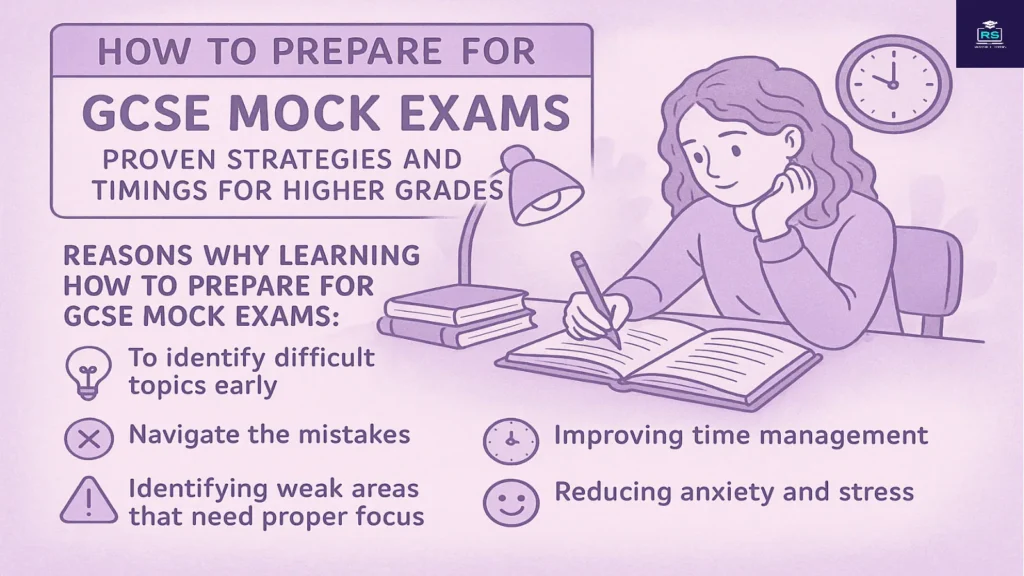
Reasons Why Learning how to Prepare for GCSE mock exams:
The first thing to clearly understand is actually understanding how to prepare for GCSE mock exams. Understanding is crucial, and this helps students
- To identify difficult topics early
- Navigate the mistakes
- Identifying weak areas that need proper focus
- Improving time management
- Reducing anxiety and stress
Mock gives real-time exposure to the GCSE exam environment, setting it as the most crucial stage for practice before exams.
A Step-by-Step Guide on How to Prepare for GCSE Mock Exams
If the question comes, that usually comes to the mind of students how to prepare for the GCSE mock exam. Here is the step-by-step guide that assists every learner in the revision phase.
Start Preparation Early
There is the wise saying, The sooner the better. The more you start early, the more potential grades you will achieve. One of the biggest mistakes that is often made by students is not starting their preparation at an early time, which can lead a failure in the end. For effective planning, an effective and formulated timetable is necessary. Create an all-revised timetable. The strategic and well-devised timetable should include the following.
- Also include the regular breaks for effective preparation
- It should be realistic and balanced.
- Should include a Revision of all subjects
- Prioritises the weaker topics
Refer to the GCSE Specified syllabus for GCSE Revision:
A key crucial element in how to prepare for the GCSE mock exam is practising and relying on what can be examined. This can only be done when a learner is totally aware of he specified syllabus. Download the specified syllabus from the UK Government website and use the syllabus as a checklist. This will ensure ;
- Smooth preparation
- Targeted Revision
- Better alignment with the tasks
Focusing on Active Revision Techniques
Traditional study methods are important, but now the world is shifting. The changing landscape involves the integration of modern tools. If the learner wants to truly seek the answer to how to prepare for the GCSE mock exam, then relying on passive learning and traditional methods won’t be enough. The active learning process should be integrated in order to achieve high. The high-impact vision method includes
- Using past paper questions
- Generating flashcards and using them for active memory recall
- SSelf-teachingthe concept
- Reading the topic in a high voice
The active recall method strengthens the memory and also helps to improve the exam performance ratio.
Effective Time Management:
Timing is the most crucial aspect, and this is the point where most students lack. Practising mock exams through effective time management is a crucial aspect of GCSE preparation. This is the focal point which improves time management when going for actual exams.
- The 1 mark 1 minute rule is utmost necessary, which states that you spend 1 minute for 1 mark and is usually used for MCQS.
- Another important dimension is that moving on if you are stuck, time wasting is not the right option.
This ensures over answering, and time is managed effectively. If students often feel pressurized during exams. The key dimensions could be
- Read the questions carefully to avoid anxiety and pressure
- Highlight the command words, the important ones that need to be answered.
- Answer the required number of Questions
- Leave 5 minutes for rechecking the exam
Specific Subjects GCSE mock exams preparation Tips and Tricks
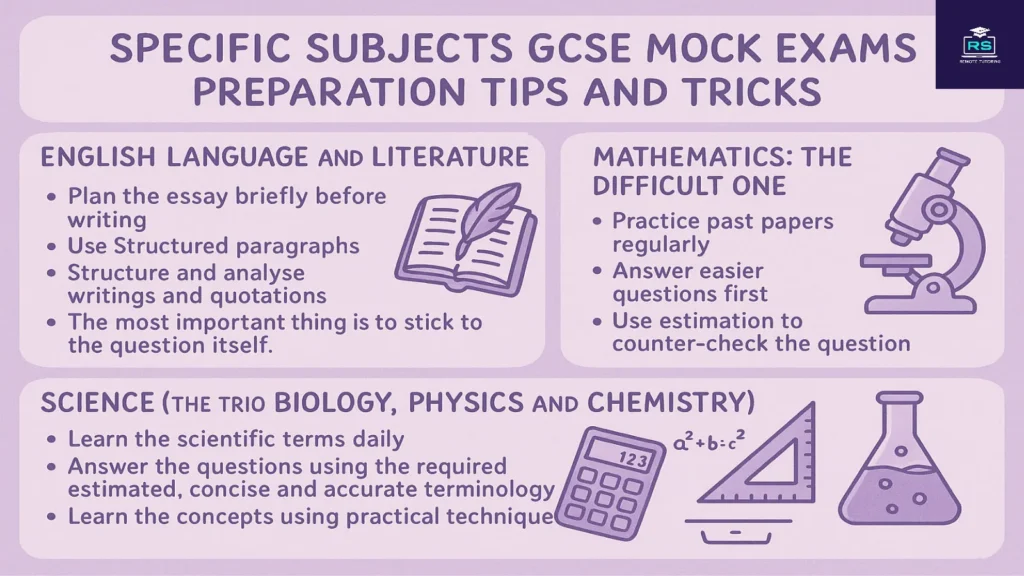
For the specific subjects such as English Language and Literature, Mathematics, and Science (the trio Biology, Physics and Chemistry) requires certain key techniques to make them study more effectively.
English Language and Literature
When learning how to prepare for GCSE mock exams for specific subjects, such as English. These things should be followed;
- Plan the essay briefly before writing
- Use Structured Paragraphs
- Structure and Analyse writings and quotations
- The most important thing is to stick to the question itself.
Mathematics: The Difficult One
For mathematics practice mock sessions;
- Practice past papers regularly
- Answer easier questions first
- Use estimation to counter-check the question
Science(the trio Biology, physics and Chemistry)
- Learn the Scientific terms daily.
- Answer the questions using the required estimated, concise and accurate terminology.
- Learns the concepts using practical techniques
Following the mentioned framework is really effective for learners who seek to prepare for GCSE mock exams.
Past Papers: the most Crucial Aspect:
Past papers are the backbone of how to prepare for GCSE mock exams. Practising past papers is the most effective trick that facilitates the learners in so many ways. But the most important thing is that the past papers should be used effectively and strategically.
- An effective strategy for past papers is that
- Complete the paper within the given time
- Identify the key areas to focus on
- Analyse the key patterns
- Check papers according to the official marking strategy described in the scheme.
The effective practice helps to build confidence and improve techniques.
What to do after GCSE mock exams:
Just making yourself aware of how to prepare for GCSE mock exams, it is foremost necessary to figure out what to do next. After analysing the result, it is very much necessary to ask yourself the following questions;
- Which topic lost the most marks?
- Not focusing on the question and reading it carelessly was the reason for lower performance?
- Were mistakes due to knowledge or timing? Did my exam stress affect the performance ratio?
Creating a long analysis report for every subject is very effective for better performance.
FAQS
How early should I start GCSE mock revision?
Revision should begin 4-6 weeks before GCSE mocks. This allows time for constant revision, exam practice and management improvement.
Are GCSE mocks ordered before GCSEs?
Mocks are often similar or slightly harder than GCSE’s actual exams. Difficulty levels often differ from school.
Can poor mock results be improved in finals?
Absolutely, poor mock results can improve the final grade, but if students use feedback from instructors and focus on the mistakes.
Conclusion
Learning how to prepare for the GCSE mock exam effectively is one of the smartest investments a student can make. With the right revision strategies, exam timing skills, and post-mock analysis, GCSE mock exams become a powerful stepping stone toward final success.
Treat your mocks seriously, revise strategically, and use feedback wisely, and you will walk into your real GCSE exams confident, prepared, and ready to achieve your best grades.
Raja specializes in Physics and Maths, with over 5 years of experience. He offers KS2, KS3, and GCSE Science and Maths lessons. He graduated from one of the top universities in the UK.