Every spring, millions of pupils across the UK prepare to sit their General Certificate of Secondary Education (GCSE) exams. These tests mark the culmination of Key Stage 4 and open the door to sixth‑form study, apprenticeships or vocational courses. Knowing exactly when the 2026 GCSE exams take place is crucial if you want to build a revision timetable, book holidays and avoid last‑minute stress.
In this comprehensive guide we explain when GCSE exams will run in 2026, how exam timetables are organised, what to expect in different subjects, entry deadlines, results day, GCSE reforms that will affect exam formats and how to prepare effectively. Whether you’re a pupil, a parent or a private candidate, this guide will help you navigate the exam season with confidence.
Jump to Section
When are the GCSE Exam Date in 2026?

The 2026 summer exam period is scheduled to run from the week beginning Monday 4 May 2026 and finish on Friday 26 June 2026. This window covers all written papers set by the main exam boards, AQA, Pearson Edexcel, OCR, WJEC/Eduqas and CCEA. The boards publish their full timetables each autumn, and individual schools issue personalised schedules to their students. Dates may change slightly in the months leading up to the exams, so always check the final timetable from your exam centre.
Note: The Joint Council for Qualifications (JCQ) exam timetable page is the official source for the latest GCSE schedules.
Key takeaways about the 2026 exam window:
- Start of exam period: Week commencing 4 May 2026, with many schools treating Monday 4 May as the first day of written assessments.
- End of exam period: The last written papers are expected on Friday 26 June 2026. A contingency day may be scheduled shortly afterwards in case of national disruption.
- Non‑exam assessments (NEAs): Practical tasks such as modern foreign language speaking tests and science practical experiments can be set before this window. Your school will arrange these earlier in the spring term.
Get Free 1-on-1 Online Session with Our 15 Specialized GCSE Tutors
- Clear guidance on what to study (and when)
- Mock practice tied to real exam dates
- Flexible online scheduling
Morning and afternoon exam sessions
All exam boards hold two sessions each day: a morning session starting at 09:00 and an afternoon session starting at 13:30. Schools must follow these start times, though they can vary by a few minutes for local arrangements. Some larger exams may run into the late afternoon. Occasionally a board will schedule an evening session for exams that cannot fit elsewhere, but this is rare.
Contingency days and national events
The Joint Council for Qualifications (JCQ) usually reserves contingency days toward the end of the exam period. These are additional days set aside in case a national or local event (for example, a national mourning period or widespread transport disruption) forces the rescheduling of an exam. Students must remain available until the final contingency day. Check your exam timetable for details.
How GCSE timetables are organised
Exam boards and their timetables
GCSEs are offered by several exam boards. Each board sets its own timetable, but they coordinate via the JCQ to avoid clashes for popular subjects:
- AQA: the largest board in England; publishes timetables and a searchable key dates calendar on its website. At the time of writing, AQA’s 2026 timetable hadn’t yet been released, but 2025 patterns indicate that exams will begin in early May and finish in late June.
- Pearson Edexcel: offers GCSEs and International GCSEs. Its Summer 2026 GCSE final timetable (available from schools and via the Pearson website) sets out dates for each subject. In 2025 the first paper for combined science was on 14 May and the last paper was on 21 June; the 2026 schedule will be similar.
- OCR: covers many GCSEs and some vocational equivalents. Its timetables typically mirror Edexcel’s window.
- WJEC/Eduqas: the board for Wales and some English schools; publishes final and provisional timetables on its website.
- CCEA: board for Northern Ireland; uses a mix of letter grades (A*–G) and the 9–1 scale for some subjects.
Each exam board releases its final summer timetable by the end of the preceding October. Schools and exam centres then create personalised schedules for each pupil, listing paper codes, dates, times and exam rooms. Candidates should always use the timetable given by their centre rather than generic schedules.
Example subject timing
Although the specific dates differ each year, the structure of GCSE exam date follows a familiar pattern. Here are typical timings for major subjects, based on recent exam cycles (note that 2026 may vary):
- Mathematics: Taken across three papers (Paper 1 Non‑calculator, Paper 2 Calculator and Paper 3 Calculator) spread over four weeks from early May to mid‑June. For example, in 2025 the non‑calculator paper took place around 14 May, and the final calculator paper was scheduled for 10 June
- English Language: Usually two papers for AQA/Edexcel/Eduqas, both in the second half of May. In 2025 the first paper was around 21 May and the second paper around 5 June.
- English Literature: Paper 1 tends to be in the first half of May and Paper 2 a week later
- Combined Science/Triple Science: Each science has two or three papers per discipline. Biology papers often appear in mid‑May and early June, chemistry in late May and mid‑June, and physics in late May and mid‑June. Practical endorsements may be assessed separately earlier in the year.
Humanities (History, Geography): Papers often appear between late May and mid‑June. - Modern foreign languages: Listening, reading, and writing papers are typically scheduled across late May and early June. Speaking exams are NEAs and occur in April or early May.
These patterns give you a rough sense of when subjects fall. You must consult the final timetable for exact dates.
Get Free 1-on-1 Online Session with Our 15 Specialized GCSE Tutors
- Clear guidance on what to study (and when)
- Mock practice tied to real exam dates
- Flexible online scheduling
Key dates and deadlines
Understanding the administrative calendar helps you avoid missed opportunities or penalty fees. Here are the main milestones for the summer 2026 GCSE series:
| Key event | Typical date range (2026) | Notes |
|---|---|---|
| Entries open | October 2025 | Schools start entering candidates with exam boards. Private candidates should register through an approved centre at this time. |
| Normal entry deadline | Early February 2026 | Schools and centres must submit final candidate entries. Late fees apply after this date. |
| Late entry/amendment deadline | March 2026 | Last chance to add or change entries (with additional fees). |
| Exams begin | Week beginning 4 May 2026 | First written papers (often for foreign language listening or smaller boards’ subjects). |
| Contingency day(s) | Late June 2026 | Reserved in case of national disruption; all candidates must remain available. |
| Results day | Thursday 20 August 2026 (provisional) | Schools receive results the day before. Students collect results from 08:00 on Thursday. |
| Post‑results deadlines | Late August/September 2026 | Deadlines for priority reviews of marking (for university applicants), access to scripts, and remarks. |
| Autumn resits | November 2026 | Resit window for English Language and Maths only. The entry deadline is early September. |
GCSE results day 2026
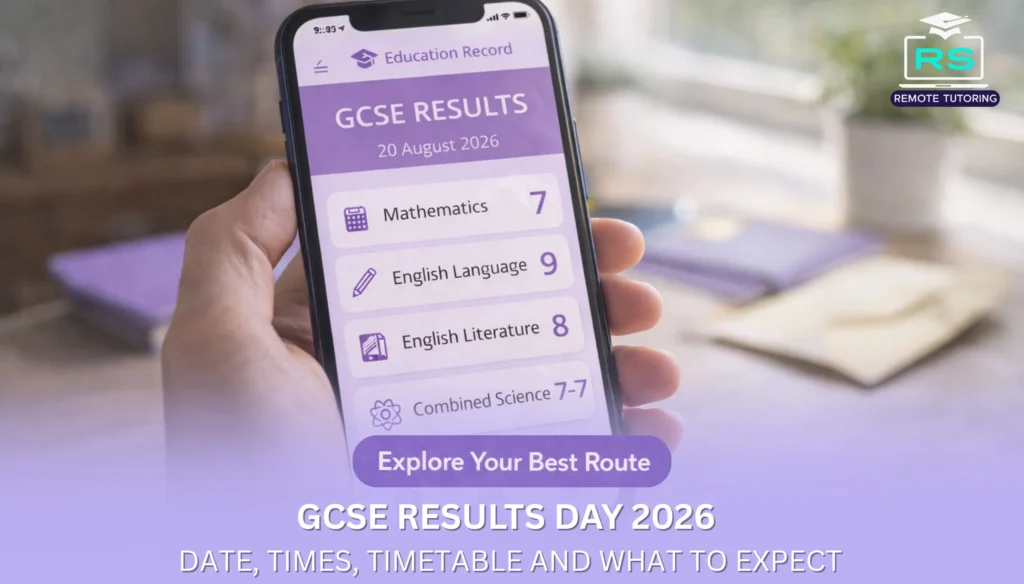
Results day is expected to be Thursday 20 August 2026 (the third Thursday in August). On this date, students can collect their provisional results from their school or log on to digital portals. Schools and colleges receive results a day earlier under embargo.
Shortly after receiving results, you should:
- Check your grades meet sixth‑form or college entry requirements.
- Log into UCAS Hub (if you’ve applied to a college with conditional offers).
- Consider priority reviews if you’re close to a grade boundary.
- If your grade is below a grade 4 in English or maths, plan to register for the autumn resit.
Reforms and changes affecting GCSE exams in 2026
Extension of formula and equation sheets
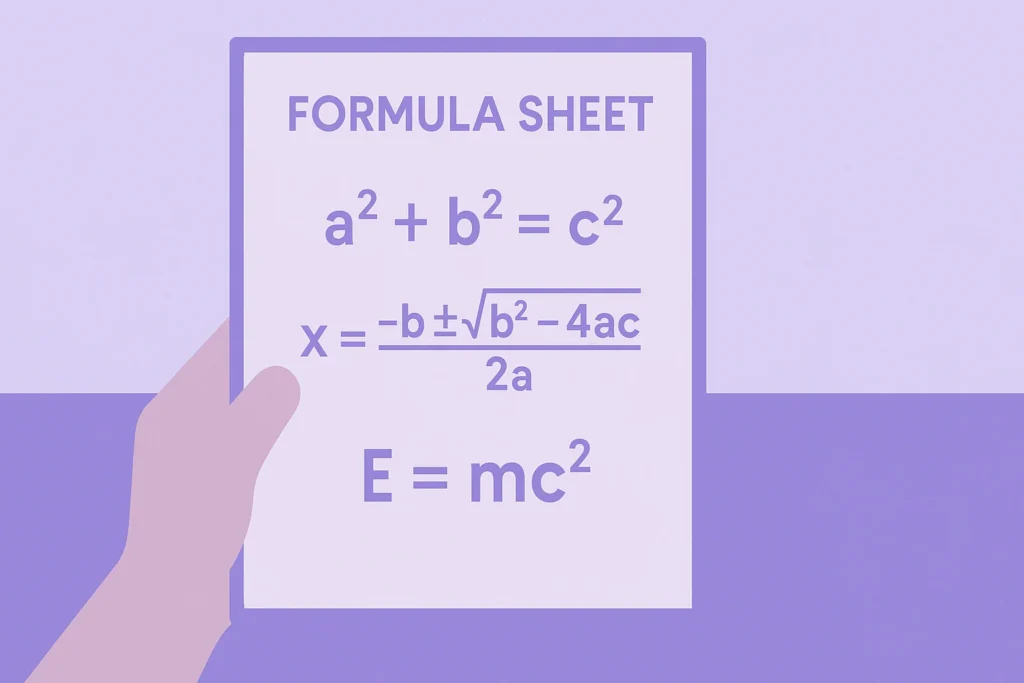
The COVID‑19 pandemic led to temporary changes in how GCSEs were assessed. One of the most significant modifications was the introduction of formula sheets in mathematics and equation sheets in physics and combined science exams. The UK government’s Department for Education (DfE) decided that students should not have to memorise formulae or equations for the 2025, 2026 and 2027 exam series. Instead, exam boards will provide these sheets in the exam booklets.
Note: Full details are outlined in Ofqual’s guidance on formula and equation sheets
A public consultation by Ofqual found that continuing the use of formula sheets levels the playing field for students whose education was disrupted and supports those with special educational needs. Students must still understand how to apply the formulas; memorisation is no longer assessed. If you are sitting maths, physics or combined science in 2026, practise using the formula sheet so you know where to find each equation quickly.
Digital exam trials
Exam boards are piloting digital assessments. Pearson Edexcel, for instance, has trialled online multiple‑choice science tests and aims to offer a fully digital English GCSE by 2027. However, digital exams will be optional, and the 2026 GCSEs will still be paper‑based for most subjects. Schools can opt into digital trials to support students who prefer typing or who need assistive technology. If your school participates, you’ll receive guidance and practice sessions.
Curriculum and assessment review
The government has begun a National Curriculum and Assessment Review, which is expected to recommend changes across GCSEs, A‑levels and vocational qualifications. The review aims to make the curriculum more coherent and reduce assessment pressure while maintaining standards. Possible outcomes include more modular exams, a mixture of coursework and exams, or a new qualification replacing GCSEs. The review is ongoing, so the 2026 exams will follow current structures.
Resits and mandatory conditions
Students who do not achieve a grade 4 (standard pass) in English Language or Mathematics must continue to study these subjects post‑16 and take a resit. Resits are offered in November each year. If you achieve grade 3 or below, you must retake until you obtain at least a grade 4 or an approved alternative qualification such as Functional Skills Level 2. Students are not required to resit other subjects, but you may choose to improve your grade.
How to prepare for GCSE exams: 3-month revision plan

Step 1: Build a long‑term roadmap (January to March 2026)
Although most pupils start revision in January, you can create a 3‑month plan that builds up your knowledge systematically:
- Audit your syllabus: Download the specification for each subject and highlight topics you’ve completed and those you still need to cover.
- Consolidate notes: Create concise notes or flashcards summarising key concepts, formulas and case studies. Tools like Quizlet or physical index cards work well for active recall.
- Plan your time: Allocate more time to subjects you find difficult. Many students use the traffic‑light system, label topics as green (confident), amber (needs some revision) or red (needs significant work).
- Use spaced repetition: Revise topics multiple times at increasing intervals to reinforce memory. This is far more effective than cramming.
- Set milestones: Aim to complete syllabus coverage by the end of March.
Step 2: Practise and apply knowledge (April 2026)
By April you should move from learning content to applying it:
- Past papers: Start working through past papers under timed conditions. Mark your answers using the mark scheme to understand how examiners award marks.
- Exam technique: Learn how to structure longer questions, how to manage time and how to use the formula sheet effectively for maths and science.
- Fill gaps: Identify topics where you consistently lose marks and revisit the theory. Ask teachers or tutors for clarification.
- Mock exams: Schools often run mock exams in April. Take them seriously; they reveal your exam stamina and highlight revision priorities.
Step 3: Refine and review (May 2026)
As exams approach:
- Condensed summaries: Reduce your notes to key points, quotes for literature, processes for science, dates for history.
- Practice under exam conditions: Sit full papers at the correct time of day to simulate the real exam and build mental endurance.
- Balance your load: Schedule rest and leisure to prevent burnout. Engage in exercise, sleep well and maintain a balanced diet.
- Group study: Revision with classmates can expose you to different perspectives and help you test each other’s understanding. However, avoid turning group work into social time.
- Exam-day rehearsals: Prepare your bag, equipment (black pens, calculators, ID) and exam timetable so there are no surprises on the day.
How remote tutoring can help
For many pupils, independent revision is challenging. Remote Tutoring provides personalised one‑to‑one tutoring delivered by qualified UK teachers via video call. Here’s how it supports your GCSE preparation:
- Targeted help: Tutors identify weak areas and tailor sessions to your needs, perfect if you struggle with algebra, a Shakespeare play or balancing chemical equations.
- Structured planning: We help you build a revision timetable and hold you accountable through regular lessons.
- Expert feedback: Practise exam questions and receive detailed feedback to improve technique.
- Confidence building: A supportive mentor reduces anxiety and boosts your motivation.
- Flexible scheduling: Lessons fit around your school commitments.
Book a free consultation on our RS Remote Tutoring to find out how we can help you achieve your target grades.
Get Free 1-on-1 Online Session with Our 15 Specialized GCSE Tutors
- Clear guidance on what to study (and when)
- Mock practice tied to real exam dates
- Flexible online scheduling
What happens on exam day?
Arriving and equipment
Aim to arrive at school at least 30 minutes before your exam starts. Check the seating plan displayed outside the exam hall. You must bring:
- Black pens (not gel pens), pencils and erasers.
- Ruler, protractor, compass for maths and science papers.
- Calculator for calculator papers (with memory cleared) and design technology.
- Transparent pencil case and a transparent water bottle without labels.
- Student ID or candidate number.
Leave electronic devices, including mobile phones, smart watches, headphones, and revision notes in your bag outside the exam hall. Possession of unauthorised materials can result in disqualification.
During the exam
- Listen carefully to the invigilator’s instructions.
- Fill in your candidate details on the front of the paper.
- Read each question thoroughly. Underline command words (describe, evaluate, compare) so you know what the examiner expects.
- Allocate your time proportionally to marks available. If you’re stuck, move on and come back later.
- For maths and science, refer to the formula/equation sheet when needed, but make sure you understand which formula to apply.
- Check your answers if you have time left. Correct obvious mistakes and add details to secure additional marks.
Non‑exam assessments (coursework and practicals)
Many GCSE subjects include non‑exam assessments (NEAs). These are completed under supervised conditions in school and contribute to your final grade. Examples include:
- Spoken language assessment (English Language): Pupils present a short talk and answer questions. The result (Pass, Merit, Distinction) appears on the certificate but doesn’t affect the grade. It is usually scheduled in March or April.
- Science practical endorsements: Combined science and single sciences include required practical activities assessed in written papers, but teachers may also assess practical work to ensure skills.
- Art & Design: Students develop a portfolio of work (60% of the grade) and an externally set assignment (40%). Schools internally mark the portfolios and send samples to exam boards for moderation.
- Design & Technology / Food Preparation: Pupils produce design portfolios or dishes for tasks set by the board.
- Modern foreign language speaking tests: Teachers conduct speaking assessments and send recordings to exam boards. These tests often take place in April, ahead of the written exams.
Because NEAs take place outside the main exam window, plan your time carefully. Completing coursework early will free up revision time later.
Frequently asked questions
When exactly do GCSE exams start and finish in 2026?
The summer 2026 series is scheduled from week commencing Monday 4 May to Friday 26 June 2026. Always check your exam centre’s timetable for exact dates.
Are there GCSE exams on bank holidays?
Exams are not normally scheduled on bank holidays (e.g., Early May Bank Holiday, Spring Bank Holiday) because schools are closed. If the government schedules an extra bank holiday, the JCQ will adjust the timetable or use contingency days.
Do I need to memorise formulas for maths and physics in 2026?
No. The Department for Education has decided that formulae and equation sheets will be provided in GCSE maths, physics and combined science exams until at least 2027. You still need to understand how to use them.
Is a GCSE resit compulsory?
If you achieve grade 3 or below in English Language or Mathematics, you must resit the subject until you obtain at least a grade 4 or a recognised alternative (such as Functional Skills). Resits for other subjects are optional.
When is GCSE results day 2026?
It is provisionally Thursday 20 August 2026. Schools receive results the previous day under embargo and distribute them to pupils on the morning of results day.
How long should I revise each day?
Quality matters more than quantity. During peak revision (April–May), aim for 3–4 hours per evening on weekdays and 4–5 hours at weekends, broken into focused sessions of 45–60 minutes with short breaks. Adjust this depending on your workload and mental stamina. This article on effective study habits provides additional ideas on maintaining concentration and avoiding burnout.
What if I’m ill or have an emergency on the day of an exam?
Contact your school immediately. The exam board may arrange a special consideration or allow you to sit the paper later that day. For long‑term illness, you may be awarded an adjusted grade based on other papers or reschedule for the following series.
Where can I find the syllabus for my GCSE subjects?
Exam boards publish specifications on their websites. These documents list topics, assessment objectives, and coursework requirements. Reviewing the specification ensures you know exactly what will be assessed. For example, AQA and Edexcel both have comprehensive downloads in their subject sections. A good starting point is Ofqual’s subject-level conditions, which outlines the structure for each subject.
Conclusion: Plan early and seek support
The GCSE exam period is a marathon, not a sprint. By knowing the exam window (4 May – 26 June 2026), understanding subject timings, and planning your revision months in advance, you can reduce stress and increase your chances of success. Stay informed about reforms, like formula sheets and digital exams and don’t forget that your practical coursework and speaking assessments are just as important as the final written papers.
At RS Remote Tutoring, we’re here to help you every step of the way. Whether you need clarification on a tricky algebra problem, help interpreting a Shakespearean soliloquy or strategies for tackling a long‑answer question in biology, our experienced tutors can tailor sessions to your needs. Book a free consultation today and let’s work together to achieve your goals.
Raja specializes in Physics and Maths, with over 5 years of experience. He offers KS2, KS3, and GCSE Science and Maths lessons. He graduated from one of the top universities in the UK.



10 Comments
[…] United Kingdom. It covers provisional and final schedules, board‑specific deadlines, the summer 2026 timetable for comparison, and even explores the perennial question of which language is easier to learn, […]
[…] managing time is the utmost responsibility of the students aiming for the GCSE exams. The GCSE exam is not just the name of hard work but it often involves a blend of consistency, […]
[…] child. Parents should know that teachers are here to guide and prepare learners according to the GCSE exam schedule. The role of parents should be to promote a stress-free and pressure-free environment so that […]
[…] gives real-time exposure to the GCSE exam environment, setting it as the most crucial stage for practice before […]
[…] exams, left students with so much pressure before the actual toiling week began, obviously the exam season. GCSE revision encompasses tons of subjects, piles of notes, high expectations of parents and the […]
[…] The most important notion that circulates among students is choosing the right subject that not only facilitates them in future but also relates to their area of expertise. As GCSE options for the academic year 2026-2027, students are much more inclined towards Computer Science and Business Studies. Both subjects are valuable choices in terms of skills, practicality, and advanced career opportunities, but students often find themselves torn between Computer Science and Business Studies when taking GCSE exams. […]
[…] Challenges inculcate confidence with pressure as the GCSE exam requires correcting errors, writing codes within stipulated time. These Challenges helps to handle […]
[…] vital. Exam boards release draft schedules months in advance, allowing you to plan revision around exact paper dates, entry deadlines and internal assessment due dates. Always confirm final dates with your school in […]
[…] Working through genuine exam questions and seeing improvement over time boosts self‑belief. By GCSE exam day you’ll feel more prepared and less anxious because the format feels […]
[…] are students juggling multiple subjects, but the pressure to achieve high grades often mounts as exam season approaches. In recent years, online tutoring has become a popular option for those seeking extra support. But […]