There’s no universal rule, but most parents turn to a GCSE tutor when they notice persistent gaps in understanding, declining confidence, or mounting exam pressure. Hiring a tutor isn’t just about boosting grades; it’s about providing personalized guidance that helps your child master challenging concepts, adapt to new syllabuses, and regain enthusiasm for learning. Understanding when, and how, tutoring can make a difference is key to supporting your child through the most critical years of secondary school.
Jump To Section
Why this guide matters
As a parent, you want the best for your child. You may wonder: Is hiring a tutor necessary? How do I know if my child needs extra help? Should I invest in tutoring now or later? With GCSE reforms continuing through 2026, such as the introduction of formula and equation sheets in maths and science and subtle updates to English and Religious Studies assessments, it’s important to understand how these changes impact your child’s learning. Our tutors at RS Remote Tutoring have guided hundreds of students through these shifting standards. This guide combines our experience with official information to help you decide whether tutoring is right for your family.
Understanding the GCSE landscape in 2026
Before considering tutoring, it helps to grasp the current exam environment. GCSEs are high‑stakes exams taken at age 16 in England, Wales and Northern Ireland. They assess knowledge across subjects including maths, English, science, languages, humanities, arts and technology. Exam boards such as AQA, Edexcel (Pearson), OCR and WJEC design specifications and mark schemes, while regulators like Ofqual and Qualifications Wales oversee fairness.
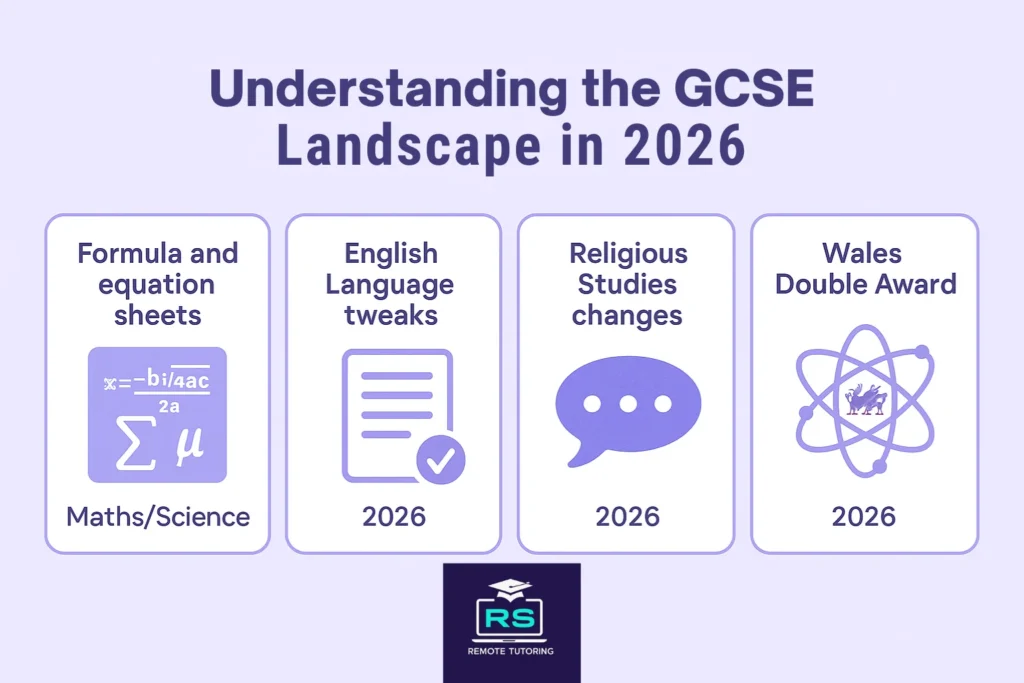
The 2026 exam cycle will bring minor specification changes rather than major reforms. Notably:
- Formula and equation sheets continue: Students sitting maths, physics and combined science in 2025–2027 will receive formula and equation sheets to reduce memorisation and encourage problem solving. These sheets are published at the start of the academic year.
- English Language tweaks: AQA has clarified question wording for Paper 1 and Paper 2 to improve accessibility, without changing the marks or assessment objectives.
- Religious Studies changes: AQA’s specification A introduces a new 6‑mark question and modifies wording for 4‑mark questions, affecting exam timing and planning.
- New science qualifications in Wales: An interdisciplinary “The Sciences” double award GCSE launches in 2026, spreading assessment across Years 10 and 11.
These updates place more emphasis on applying knowledge than rote learning. Students must learn to interpret exam questions carefully, apply formulas correctly, and weave sources into arguments, skills that can be honed with the help of a tutor.
Signs your Child May Benefit from a GCSE Tutor
Every child is different, and there’s no single rule for when to hire a tutor. Nevertheless, there are common warning signs that indicate a need for personalised support. Below we outline several red flags. If two or more resonate, tutoring may be worthwhile.
1. Persistent gaps in understanding
Drop in test scores. If your child’s marks in maths, science or English have dipped significantly across multiple assessments, even after extra study. It may signal a conceptual gap. For example, some students struggle with the jump from algebraic manipulation to problem-solving in higher-tier maths, or from basic scientific facts to applying formulas under exam conditions. A tutor can quickly diagnose these gaps and revisit fundamentals.
Confusion around new exam requirements. With the introduction of formula sheets and question rewording, students may misinterpret exam tasks. If your child looks at a past paper and doesn’t know where to start, they may need guided practice.
2. Declining confidence and motivation
Loss of enthusiasm. Does your child avoid homework or exhibit negative self-talk (“I’m just bad at maths”)? Persistent frustration can lead to a fixed mindset. A tutor provides a safe space for questions and helps rebuild self-belief through small wins.
Fear of asking questions. In crowded classrooms, some students shy away from raising a hand. One-to-one tutoring allows them to ask anything without judgment, encouraging active participation.
3. Homework struggles and procrastination
Difficulty starting tasks. Students often struggle to organise revision for lengthy subjects like English Literature. They may procrastinate or produce superficial notes. A tutor can introduce structured revision strategies, such as retrieval practice, mind mapping and exam‑style essay planning.
Incomplete assignments. If your child regularly submits homework late or incomplete, they may need help breaking tasks into manageable chunks. A tutor can teach time management and accountability.
4. Poor exam technique
Misreading questions. Examiners report that many marks are lost because students misinterpret command words or fail to address all parts of a question. Tutors teach students to annotate questions, identify verbs like “analyse” and “evaluate,” and plan answers accordingly.
Running out of time. Does your child leave questions blank or rush through the final sections? Tutors can provide timed practice, showing how to distribute minutes per mark and when to move on.
5. Transition points (Year 9 and Year 10)
Choosing options in Year 9. Students select GCSE subjects at the end of Key Stage 3. If your child is uncertain about science triple award versus combined science or unsure how to cope with the demands of a language GCSE, a tutor can provide an introductory overview and help them make informed choices.
Start of Year 10. The first term often exposes weaknesses when students encounter new topics like trigonometry, essay comparison or complex chemical equations. Early intervention prevents gaps from widening.
6. Preparation for mocks and final exams
Mock results indicate a risk. Mocks are typically sat in Year 10 or early Year 11. They highlight areas needing improvement. If your child underperforms, there’s still time to intervene with targeted support.
Approaching final exams. Four to six months before the GCSEs, many students benefit from structured revision schedules and targeted past paper practice. A tutor can help devise a plan and hold them accountable.
7. External factors
Health or personal challenges. Illness, family changes or mental health issues can disrupt learning. Tutors provide gentle re-entry and support catch‑up lessons.
Interest in moving up a grade. Some students performing at grades 6–7 aim to jump to an 8 or 9. A tutor can challenge them with higher-level questions and exam techniques, especially in subjects with stretch content like mathematics or English Literature.
When tutoring may not be necessary
Tutoring isn’t always the answer. Consider these scenarios:
- Your child is self-sufficient and thriving. If they consistently score well, enjoy independent study and demonstrate strong exam technique, extra tutoring might create unnecessary pressure.
- Temporary dips in performance. A short drop after a busy term may not warrant long-term tutoring. Discuss with teachers first; often targeted feedback and school intervention suffice.
- Over-scheduling concerns. If your child already balances numerous extra-curricular activities, adding weekly tutoring sessions could lead to burnout. Evaluate whether there’s adequate downtime for rest and hobbies.
In these cases, you might consider periodic check-ins with a tutor (monthly or pre-exam) rather than weekly sessions.
When to start working with a tutor
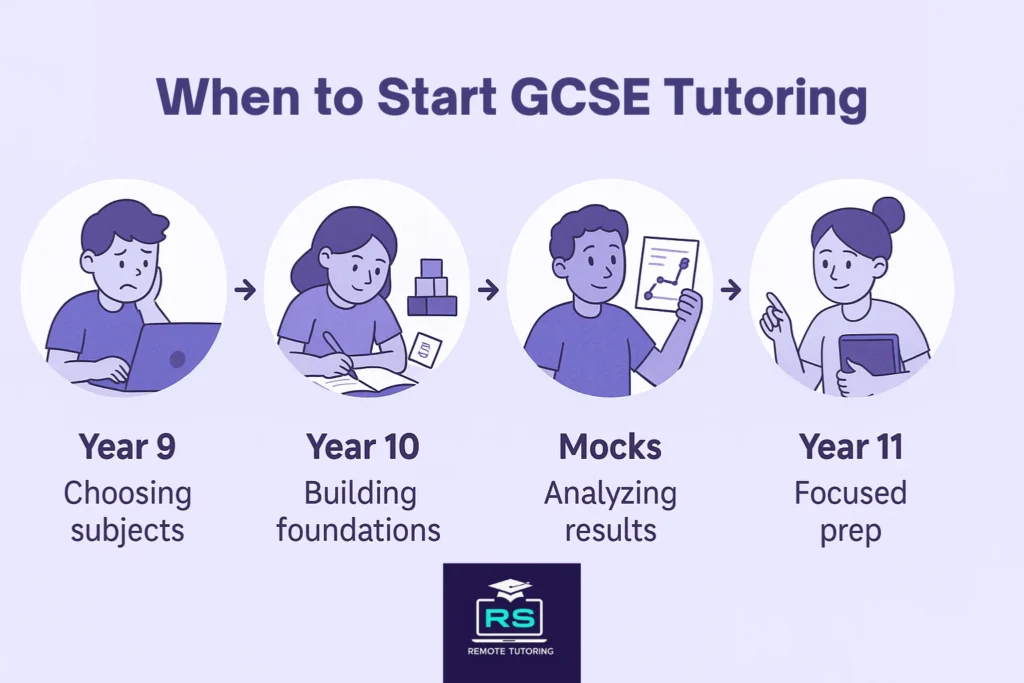
Deciding when to hire a tutor depends on your child’s unique needs and goals. Here are some guidelines:
Early in Key Stage 4 (Year 10)
This is the ideal time to lay strong foundations. Students are introduced to GCSE topics such as advanced algebra, Shakespearean analysis and chemical equations. Hiring a tutor now helps prevent confusion and fosters good study habits.
Pro tip: Aim for at least 6-12 months of consistent tutoring before exams for maximum impact.
After mock exams
Mocks reveal which topics need attention. Hiring a tutor right after results ensures your child has enough time to address gaps. Tutors can analyse mock papers and create targeted revision plans.
Leading up to the exam (Year 11)
If your child only begins tutoring in spring of Year 11, sessions should focus on exam technique, timed practice and confidence building. Although the timeframe is shorter, high-intensity tutoring (2–3 sessions per week) can still produce significant improvements.
During the summer between Year 10 and Year 11
Summer tutoring allows students to consolidate Year 10 learning and preview upcoming topics. It’s particularly helpful for students taking triple science or higher-tier maths, as it reduces stress when term starts.
Choosing the right GCSE tutor
Finding a good tutor is as important as deciding to hire one. Here’s what to look for:
Qualifications and subject expertise
Select a tutor who is qualified in the specific GCSE subject. Many of our tutors are UK‑qualified teachers with subject specialisms. For example, Mark Robinson teaches maths and physics, while Emily Johnson covers English Language and Literature. Qualified teachers understand the exam board specifications and assessment objectives.
Exam board familiarity
Different boards set slightly different tasks. A good tutor must know the mark schemes and style of your child’s board (AQA, Edexcel, OCR, WJEC). For instance, our tutors incorporate the latest English Language clarifications and the new 6‑mark Religious Studies questions.
Teaching style and rapport
Your child should feel comfortable and motivated. Look for tutors who explain concepts clearly, encourage questions and adapt lessons to your child’s learning style. We offer a free consultation to assess fit.
Track record
Ask for testimonials or case studies. A reliable tutor should provide examples of previous students’ progress, such as grade improvements and confidence boosts. At RS Remote Tutoring, we track each student’s growth through regular feedback and progress reports.
Logistics: online vs in-person
Online tutoring offers flexibility and access to a wider pool of qualified tutors. Our online platform includes interactive whiteboards, shared documents and session recordings, enabling students to revisit lessons. In-person tutoring may suit younger students who benefit from physical presence. We encourage parents to consider their child’s concentration levels, commute times and the availability of local subject specialists.
How tutoring supports specific GCSE subjects
Mathematics
GCSE maths emphasises problem solving and reasoning. Students often struggle to apply formulas and methods, especially under timed conditions. A tutor helps by:
- Breaking down topics into manageable steps and building a strong algebraic foundation.
- Providing targeted practice with past paper questions and mark schemes.
- Teaching exam strategies, such as when to skip and return to questions and how to utilise the formula sheet effectively.
- Offering higher-tier challenges to students aiming for grades 7–9.
English Language and Literature
English requires careful reading and structured writing. Tutors support students by:
- Teaching annotation skills to identify themes, tone and language features.
- Guiding essay planning using frameworks like PEE (Point–Evidence–Explain) and AFOREST (Alliteration, Facts, Opinion, Rhetorical questions, Examples, Statistics, Three).
- Clarifying new question formats, such as the multi-choice and single-effect questions on AQA’s Paper 1.
- Encouraging wider reading to broaden vocabulary and cultural context.
Sciences (Physics, Chemistry, Biology or Combined Science)
Science exams demand conceptual understanding and application. Tutors assist by:
- Explaining complex processes (e.g., electrolysis, genetic inheritance) with diagrams and analogies.
- Practising calculation questions using the formula/equation sheets.
- Helping students interpret data, draw graphs and evaluate experiments.
- Guiding revision for practical skills and extended response questions.
Humanities and social sciences
History, geography and Religious Studies involve large volumes of information and evaluation. Tutors help by teaching memorisation techniques (timelines, flashcards), essay structuring and source analysis. They also teach students how to reference religious or historical sources effectively, particularly with the new 6‑mark RS questions.
Modern foreign languages
Language GCSEs emphasise vocabulary, grammar and cultural context. Tutors can:
- Reinforce pronunciation and phonics for the new MFL specification (particularly important after reforms that emphasise dictation and reading aloud).
- Practise speaking and listening through conversation.
- Provide vocabulary retrieval strategies and writing feedback.
How our tutors personalise learning
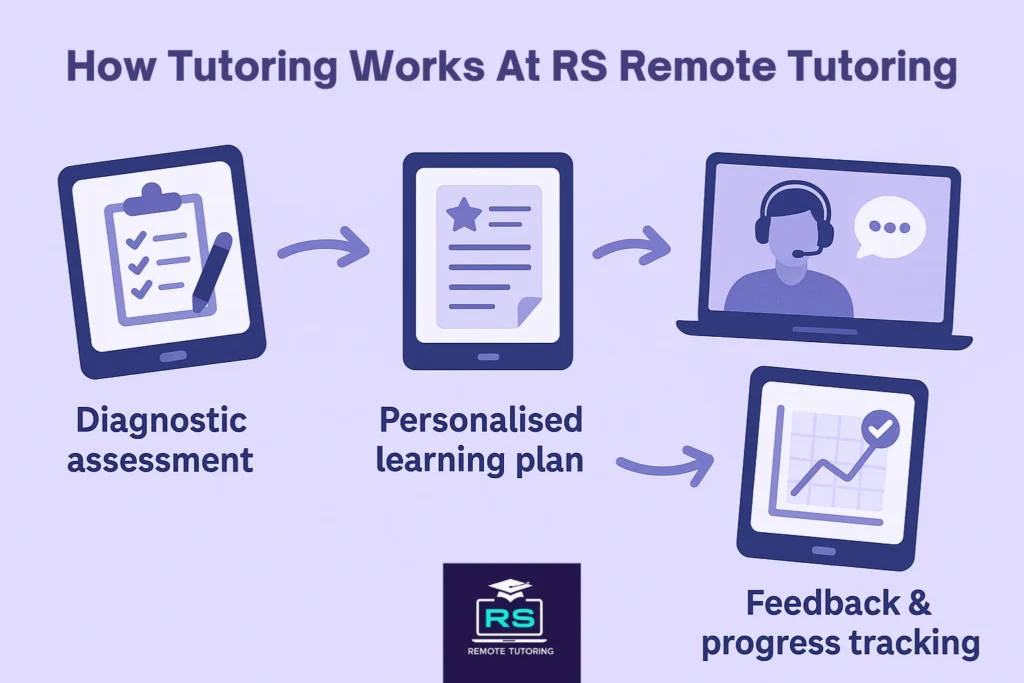
At RS Remote Tutoring we believe in a personalised approach. Here’s how we tailor sessions:
- Diagnostic assessment: We start by assessing your child’s strengths and weaknesses. In mathematics, this might involve a baseline test covering number, algebra and geometry. In English, we review a past essay for structure and language analysis.
- Individual learning plan: We align our plan with your child’s school curriculum and exam board. If they’re preparing for the new science syllabus, we incorporate the latest specifications.
- Regular feedback: After each session, we share feedback with your child and (with permission) with parents. This includes what went well, what needs improvement, and homework to reinforce learning.
- Progress tracking: We maintain a record of marks on practice questions and track improvements over time. This helps adjust focus areas.
- Confidence building: Tutors celebrate small achievements. As Mark Robinson notes, “Helping a student realise they can solve a problem they once found impossible is the most rewarding part of my job.”
Pro tips for parents supporting GCSE learners
Hiring a tutor is only part of the equation. Parents play a crucial role. Here are some suggestions:
- Create a dedicated study space. A quiet, well-lit area with minimal distractions helps your child focus.
- Establish a study routine. Encourage consistent study times with breaks. Spread sessions across subjects to maintain variety and avoid burnout.
- Provide resources. Ensure your child has access to textbooks, revision guides, past papers and digital tools. Encourage them to use official formula sheets and sample papers.
- Monitor progress, not perfection. Praise effort and improvement rather than just grades. Celebrate small wins to build motivation.
- Stay informed about exam changes. Read school newsletters and exam board announcements. Understanding the latest specification changes ensures you can support your child effectively.
- Encourage self-care. Adequate sleep, exercise and social time are essential. Students who look after their wellbeing perform better academically and emotionally.
Frequently asked questions (FAQs)
How far in advance should I start looking for a tutor?
Start at least six months before major exams to allow time for diagnosis, teaching and practice. For Year 10, it’s beneficial to begin early to build foundations.
Is group tutoring effective?
Group tutoring can be cost-effective and beneficial for peer support. However, one-to-one tutoring provides personalised attention, which is crucial for addressing specific weaknesses.
What if my child doesn’t gel with the tutor?
Chemistry matters. Arrange a trial lesson or introductory chat to ensure your child feels comfortable. If it doesn’t work, don’t hesitate to switch tutors.
Will tutoring guarantee higher grades?
Tutoring significantly boosts understanding and exam technique but cannot guarantee a certain grade. Success still depends on the student’s effort and commitment. In our experience, students who engage fully often improve by one to three grades.
Can a tutor help with study skills and organisation?
Absolutely. Tutors teach time management, note-taking, and revision strategies as part of their sessions.
Support your child’s success
Recognising the signs that your child needs support is the first step; taking action is the next. Whether they struggle with equations, essay planning or exam confidence, personalised tutoring can make all the difference. At RS Remote Tutoring, we specialise in online GCSE tutoring across English, maths, science and humanities. Our UK-qualified tutors stay updated on specification changes and tailor lessons to each student.
Ready to see if tutoring is right for your child? Book a free consultation to discuss your child’s needs. We’re here to help them succeed, no matter where they start.

Raja specializes in Physics and Maths, with over 5 years of experience. He offers KS2, KS3, and GCSE Science and Maths lessons. He graduated from one of the top universities in the UK.