If you’re a student, parent or teacher in the United Kingdom trying to decide whether to follow the International General Certificate of Secondary Education (IGCSE) or the General Certificate of Secondary Education (GCSE), you’re not alone. Both qualifications are recognised by universities and employers around the world, yet they differ in syllabus focus, assessment styles and availability. Getting this decision right can open doors to A‑levels, apprenticeships and university, so it’s worth taking the time to understand how each path works.
In this guide, we have discussed IGCSE vs GCSE, the origins of both qualifications, compared their structures, highlighted the differences and dispelled myths like “Is IGCSE harder than GCSE?”
Jump to Section
What is the GCSE?
The General Certificate of Secondary Education (GCSE) is the UK’s standard qualification for pupils aged 14 to 16. It was introduced in 1988 and replaced the old O‑Level and CSE exams. The GCSE forms “the foundation of a student’s academic profile” and is typically studied over two years during Years 10 and 11 (Years 11–12 in Northern Ireland). Students usually take between 9 and 12 subjects, including core subjects such as English Language and Literature, Mathematics and Science.
Key features of GCSEs
- Curriculum and content: GCSE syllabus follow the English National Curriculum, emphasising British history, literature and cultural contexts. For example, GCSE English Literature mandates the study of Shakespeare and other classic British writers.
- Exam boards: The main awarding bodies are AQA, Pearson Edexcel, OCR, WJEC/Eduqas and CCEA. Schools choose which board suits their teaching style and students; each board offers slightly different coursework and exam formats.
- Assessment methods: GCSEs traditionally use a mixture of coursework and exams, though many subjects now rely heavily on final exams.
- Grading system: In England, GCSEs have moved from A*–G to a 9–1 scale, where 9 is the highest grade. Wales and Northern Ireland still use the A*–G system in some subjects.
- Exam sessions: Main exams take place in May/June, with resits available in November.
Why GCSEs matter
- Gateway to A‑levels and apprenticeships: GCSE results often determine entry to sixth‑form colleges and apprenticeships. Many A‑level courses require at least grade 5 (high C) in relevant GCSE subjects.
- University and employer recognition: Universities worldwide accept GCSEs as the UK’s standard qualification. Some degree courses have specific GCSE requirements, for example, a minimum grade in Mathematics or English.
Pro tip: Choose your exam board wisely. AQA papers often emphasise essay writing, whereas Edexcel papers may lean more on data response. Ask your teachers which board aligns with your strengths and verify which boards are accepted by your chosen sixth‑form or college.
What is the IGCSE?
The International General Certificate of Secondary Education (IGCSE) was launched more than three decades ago by Cambridge Assessment International Education. It was designed to give overseas students access to a qualification “of the same standard as GCSE”. Today, exam boards such as Cambridge and Pearson Edexcel offer IGCSEs worldwide, including in many UK independent schools.
Key features of IGCSEs
- International focus: IGCSE syllabi are built from the ground up for a global audience, using international case studies and examples. For instance, a geography module might compare London with Mumbai or Dubai, and IGCSE English Literature offers texts from Nigerian writer Chinua Achebe or Caribbean poets.
- Subject range: Cambridge IGCSE offers over 70 subjects, including languages such as Arabic, Chinese, French, Spanish, Japanese, Greek and Urdu. This range gives students more flexibility when tailoring their curriculum.
- Assessment methods: IGCSEs are primarily exam‑based. Many subjects offer a choice between core and extended papers, catering to different ability levels. Some syllabi include coursework, but it is less common than in traditional GCSEs.
- Grading: Cambridge IGCSE traditionally uses A–G* grades, while Pearson Edexcel offers the 9–1 scale.
- Exam sessions: IGCSE exams can be taken in May/June, October/November and, for some subjects, January or March. This flexibility is particularly useful for distance learners and students needing to retake papers.
Why do schools choose IGCSEs
Independent schools often opt for IGCSEs because they perceive them to be more academically rigorous and internationally oriented. The reduced coursework requirement makes IGCSEs appealing for home‑schooled students and distance learners. Moreover, UK universities, including Oxford and Cambridge, accept IGCSEs as equivalent to GCSEs.
Pro tip
IGCSEs suit globally mobile families. If you anticipate relocating, the international curriculum and flexible exam sessions can make transitions smoother. Students in countries like Singapore, Malaysia, Italy or the United States also sit IGCSEs, so it’s easier to transfer credits between schools.
Key Differences: GCSE vs IGCSE
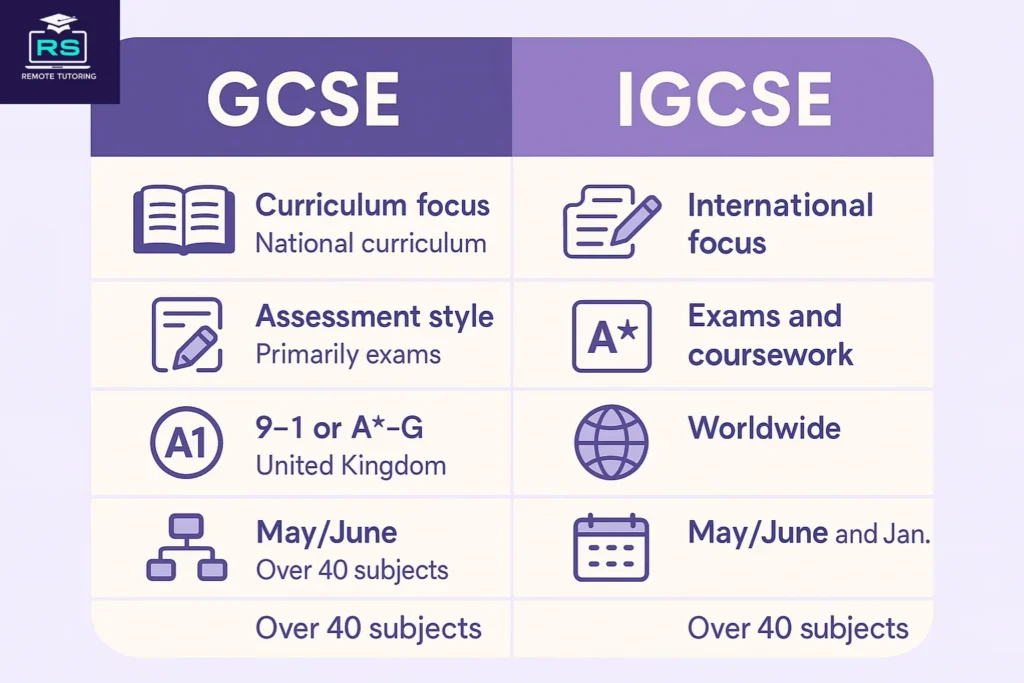
To understand which qualification fits you best, look at the distinctions in curriculum content, assessment methods, grading and availability. Although both are considered equivalent by universities and employers, the differences may suit some learners more than others.
Curriculum and subject focus
- National vs global perspective: GCSE courses follow the English national curriculum and are steeped in the British cultural context. For example, GCSE English literature requires studying Shakespeare and other classic British writers. In contrast, IGCSE English allows a broad selection of international texts.
- Subject choice: IGCSEs offer a wider range of subjects than GCSEs. Students can study global languages or niche subjects such as Computer Science or Business Studies. GCSEs still cover traditional core subjects but may have fewer optional languages.
- Local landmarks and case studies: GCSE Geography often focuses on UK examples such as the Thames barrier, the Lake District or Hadrian’s Wall, while IGCSE Geography uses comparative case studies like London vs Shanghai or São Paulo.
Assessment methods and coursework
- Exams vs coursework: Historically, IGCSEs were viewed as more difficult because they relied almost entirely on final exams. Recent reforms mean GCSEs now also lean heavily towards exams. However, some GCSE subjects (e.g., Art and Design or Design & Technology) still include coursework or controlled assessments, which can benefit students who prefer project‑based work.
- Tiers and flexibility: Many IGCSE subjects offer core and extended papers, enabling students to select a level that matches their ability. GCSEs generally have higher and foundation tiers in Mathematics and Science, but not across all subjects.
- Practical and oral components: Cambridge notes that IGCSE assessments include oral, practical and problem‑solving tests. Coursework options are available in certain IGCSE syllabi, giving teachers some flexibility.
Availability and exam sessions
- Where you can take them: GCSEs are primarily available in England, Wales and Northern Ireland, whereas IGCSEs can be sat in 150+ countries, including but not limited to the UK.
- Exam timings: GCSEs run the main exam period in May/June, with limited resits in November. IGCSE boards typically hold sessions in May/June and October/November, and some boards offer additional sessions in January or March. This means a student who performs poorly in June could retake an IGCSE paper a few months later rather than waiting an entire year.
- Distance‑learning flexibility: Because IGCSEs require less coursework and have multiple exam windows, they’re more flexible for remote learners or students studying outside formal schools.
GCSE and IGCSE Grading systems
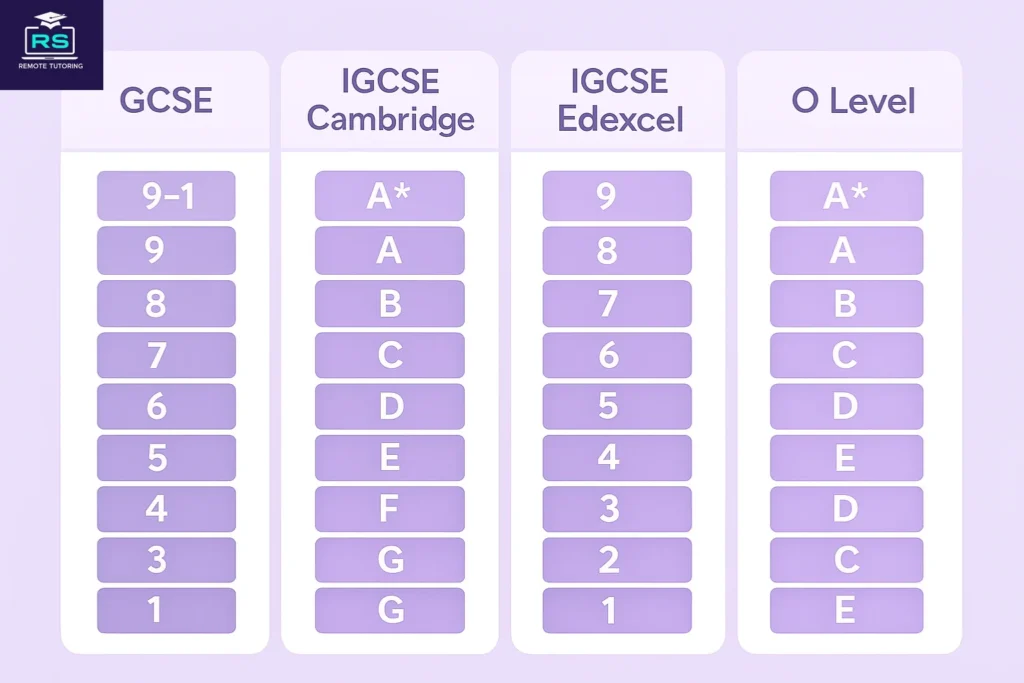
The grading systems for GCSE and IGCSE differ:
| Qualification | Grading Scale | Notes |
| GCSE (England) | 9–1 (9 is highest) | Equivalent to A* (grade 8/9) to G (grade 1). Some GCSEs in Wales/Northern Ireland still use A*–G. |
| IGCSE (Cambridge) | A*–G | Core and extended tiers offer grades from C to G and A* to C. |
| IGCSE (Pearson Edexcel) | 9–1 | Aligns with the GCSE scale; widely used in UK private schools. |
| Cambridge O Level (for comparison) | A*–E | Fewer coursework options and more localised syllabuses. |
Recognition and university acceptance
Both GCSEs and IGCSEs are recognised equally by universities and employers. Leading universities, including Oxford, Cambridge and the Russell Group, explicitly state that they make no distinction between the two qualifications. Students should focus on achieving high grades rather than worrying about which qualification looks better on an application.
Difficulty and perception
Many people ask whether IGCSEs are harder than GCSEs. Historically, IGCSEs were considered more rigorous because they relied on final exams, while GCSEs included coursework. After recent GCSE reforms reducing coursework, the gap has narrowed. Difficulty varies by subject and personal strengths: for example, IGCSE Mathematics sometimes includes additional topics like set theory, while GCSE Maths may place more emphasis on statistics. In reality, success in either qualification depends on good study habits, effective revision and quality teaching rather than inherent difficulty.
Pro tips for choosing between GCSE and IGCSE
- Consider your plans: If you plan to study abroad or may relocate, IGCSE’s international recognition and flexible exam sessions could be advantageous.
- Think about learning style: Students who thrive under pressure and prefer a clear assessment at the end may prefer IGCSE. Those who like continuous assessment or creative coursework may find GCSEs more comfortable.
- Check school or college offerings: Not all schools offer both qualifications. In the UK, state schools mostly deliver GCSEs, while independent schools may offer IGCSEs in certain subjects.
- Talk to teachers and advisors: Guidance counsellors and subject teachers can provide insight into which qualification suits a student’s strengths and career aspirations.
- Plan logistics: If you’re an external candidate, choose an exam centre within a reasonable travel distance. Use apps like Google Maps or National Rail Enquiries to calculate travel times to centres in cities such as Liverpool, Bristol or Leeds. Leave early during peak exam months (May–June) to avoid rush‑hour delays on roads.
How to Choose Subjects in GCSE and IGCSE
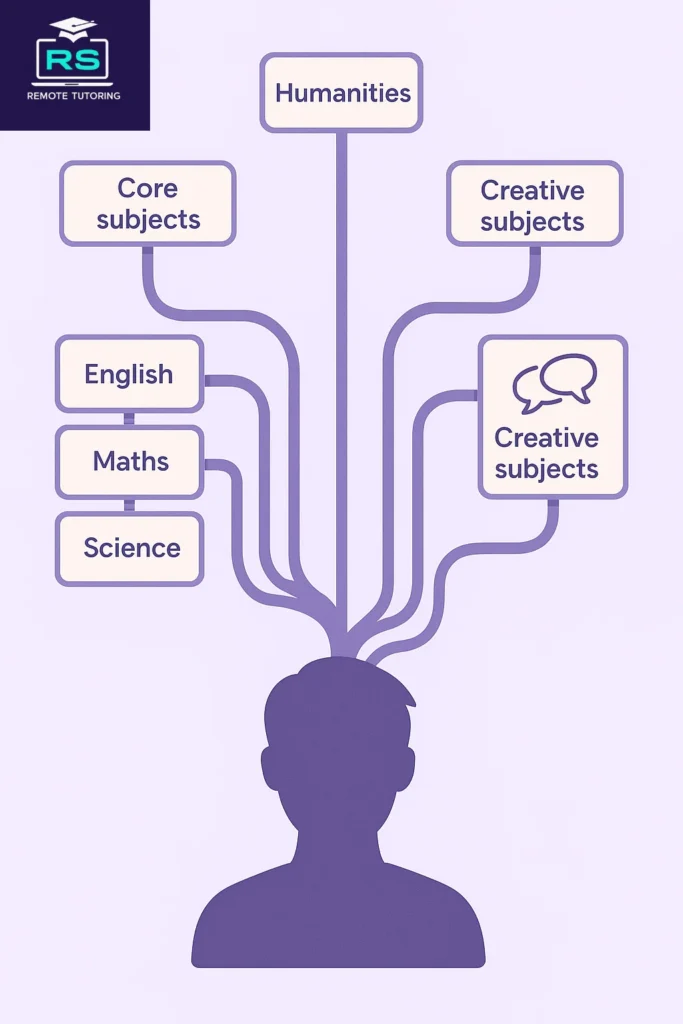
Whether you take GCSEs or IGCSEs, subject choices play a crucial role in shaping your academic profile. Here’s a roadmap:
Core subjects
Both qualifications require English, Mathematics and Science. In England, most students take Combined Science (worth two grades) or separate sciences (Biology, Chemistry and Physics). IGCSE students can choose between combined and coordinated science or single sciences; each route is recognised equally by universities.
Languages and humanities
For GCSEs, languages such as French, German or Spanish are common, and some schools offer Urdu or Mandarin. IGCSEs provide a wider language selection. Humanities options include History, Geography, Religious Studies and Sociology.
Creative and vocational subjects
Options like Art & Design, Music, Drama, Food Technology and Business Studies enable learners to explore creative or entrepreneurial interests. Ask about assessment methods; for example, GCSE Art heavily weighs coursework, whereas IGCSE Art may emphasise exam portfolios.
Local tip for UK students
When selecting subjects, consider proximity to fieldwork sites. GCSE Geography often involves field trips; schools in Yorkshire might visit the North York Moors, while those in Cornwall may study coastal erosion along the South West Coast Path. IGCSE fieldwork can be more flexible; you might compare urban regeneration in Manchester with rural changes in Norfolk. In either case, comfortable shoes and waterproof clothing are essential. British weather is unpredictable, especially in October and November exam seasons.
IGCSE vs GCSE: Decision Framework
Use the following framework to decide which qualification aligns with your needs. Rate each factor from 1 (low importance) to 5 (high importance) for your situation:
- International mobility: Are you likely to relocate or study abroad?
- Learning style: Do you prefer final exams (IGCSE) or a mix of coursework and exams (GCSE)?
- Subject availability: Does your chosen school offer the subjects you want in each qualification?
- Exam timetable flexibility: Do you need multiple exam sittings due to travel or personal circumstances?
- University aspirations: Do your target universities have specific subject or grade requirements?
- Personal interest: Which curriculum (UK‑centric vs global) excites you more?
- Travel logistics: How far will you need to travel to exam centres, and at what time of year?
Record your scores and discuss them with a teacher or careers adviser. This exercise can clarify which pathway aligns best with your goals.
Differences Between IGCSE and O Level
Many families in South Asia or Africa compare the Cambridge O Level with the IGCSE. Cambridge International states that the two qualifications are equivalent grade for grade. However, there are notable differences:
- Grading range: IGCSE awards grades A–G*, whereas O Level grades range from A to E*.
- Coursework options: IGCSE offers coursework in many subjects, allowing teachers to contribute to assessment. O Level provides fewer coursework options and focuses on reading and writing skills.
- Local versus international focus: O Level syllabuses may be tailored to local needs, such as minority languages. IGCSE syllabuses are developed to meet international standards and encourage problem‑solving and practical skills.
- Tiered papers: IGCSE offers core and extended tiers for some subjects, whereas O Level typically has a single tier.
In summary, both qualifications lead to A‑levels and are recognised by universities, but IGCSEs generally provide a broader international perspective and more assessment flexibility. Families in Pakistan or India might opt for O Levels if local syllabuses better suit regional university requirements.
IGCSE vs A‑Level
Parents often wonder how IGCSE compares to A‑levels. These are not alternative qualifications but consecutive stages in the British system:
- Age group: IGCSEs are for students aged 14 to 16, while A‑levels are for 16 to 18.
- Subject breadth: IGCSE students typically take 5 to 10 subjects, providing a broad base. A‑level students narrow their focus to 3 to 4 subjects, diving deep into areas linked to their university or career aspirations.
- Curriculum depth: IGCSEs offer foundational knowledge across disciplines, whereas A‑levels explore topics in greater depth and require more independent study.
- Assessment style: IGCSE assessments combine exams, coursework and practical components. A‑levels are predominantly exam‑based with essay‑style questions and extended problem‑solving.
- University recognition: A‑levels form a crucial part of university applications. IGCSEs prepare students for A‑levels but are not sufficient for direct entry to most degree courses.
Transition from IGCSE to A‑Level
Most students in the UK complete IGCSEs or GCSEs and then progress to A‑levels. If you’ve taken IGCSEs abroad and plan to study A‑levels in the UK, check that your subject combinations align with sixth‑form entry requirements. For example, A‑level Physics typically requires at least a grade 6 (high B) in GCSE/IGCSE Physics and Mathematics.
Which exam boards offer IGCSEs and GCSEs
- GCSE boards: AQA, OCR, Pearson Edexcel, WJEC/Eduqas, CCEA.
- IGCSE boards: Cambridge Assessment International Education and Pearson Edexcel. Some boards (e.g., OxfordAQA) also offer International GCSEs.
Pro tip: Ask whether your preferred sixth‑form or university has any preferences, although most institutions accept all boards.
Which is better: GCSE or IGCSE?
Neither is inherently better. Universities and employers view both as equivalent. The right choice depends on your goals:
- Take GCSEs if you prefer a curriculum rooted in British history and literature, need coursework opportunities or plan to stay in the UK for further study.
- Take IGCSEs if you want flexibility in exam dates, plan to move internationally or enjoy studying global texts and examples.
Frequently Asked Questions (FAQs)
Is IGCSE harder than GCSE?
There is no definitive answer. Historically, IGCSEs were perceived as harder because they relied more on final exams, while GCSEs included coursework. Since GCSE reforms reduced coursework, both qualifications are considered similar in difficulty. The difficulty you experience depends on the subject, exam board and your learning style.
Is IGCSE harder than GCSE Mathematics?
IGCSE Mathematics sometimes includes topics such as sets and functions, whereas GCSE Maths may focus more on statistics. However, the core concepts (algebra, geometry, trigonometry) are the same. Success in either qualification comes down to practice, understanding underlying concepts and learning to apply them under exam conditions.
What’s the difference between IGCSE and O Level?
Both qualifications are equivalent. O Level has a narrower grading range and fewer coursework options, often tailored to local contexts. IGCSE offers more subjects, core and extended papers and a global outlook.
What’s the difference between IGCSE and A Level?
IGCSEs are taken at ages 14 to 16 and provide broad foundational knowledge. A‑levels are studied at ages 16 to 18 and involve a narrower but deeper focus, often forming the main basis of university entry.
Can I take both GCSE and IGCSE at the same time?
Yes. Many independent schools offer a mix of GCSEs and IGCSEs, selecting whichever qualification best suits each subject. External candidates can also choose a combination, for example, taking IGCSE Physics and GCSE English. Just ensure exam timetables don’t clash and check subject progression requirements for sixth‑form.
How do universities in the UK treat IGCSEs?
Universities, including Oxford and Cambridge, accept IGCSEs as equivalent to GCSEs. Entry requirements often specify grades rather than qualification types. For example, Medicine at a Russell Group university might require at least grade 6/B in GCSE or IGCSE Mathematics and grade 6/B in English Language.
Seasonal Advice and Local Travel Tips
Spring and Summer exam season (May–June)
GCSE and IGCSE exams primarily take place during late spring and early summer. Daylight hours are long, with sunrise around 05:00 and sunset after 21:00 in southern England. Temperatures usually range from 15–25 °C, but sudden showers are common.
Use extended daylight to revise outdoors. Revising in parks like Hyde Park (London) or Strathclyde Country Park (Glasgow) can reduce stress.
Autumn and winter sessions (October–November)
IGCSE candidates taking the autumn session must contend with shorter days and colder weather. In London, sunset occurs around 16:00 in November.
Stay warm, maintain a healthy diet rich in seasonal produce (e.g., root vegetables, apples) and adjust your revision schedule to make the most of daylight.
January and March sessions
Some Pearson IGCSEs and Indian exam zones offer sessions in January and March. Weather varies: January in the UK is cold and wet, while March begins to warm slightly. Plan accordingly.
Conclusion
Both the GCSE and IGCSE are respected qualifications that open doors to A‑levels, universities and careers. The GCSE grounds students in the UK national curriculum, while the IGCSE offers a broader international lens and flexible assessment schedule. Recognising that there is no universally “better” option, only what is best for you. We empower students and families to make informed decisions. By considering factors such as subject availability, assessment style, international mobility and personal learning preferences, you can choose the qualification that aligns with your ambitions. Whichever path you take, consistent study, effective revision and a supportive environment will be key to success.

Raja specializes in Physics and Maths, with over 5 years of experience. He offers KS2, KS3, and GCSE Science and Maths lessons. He graduated from one of the top universities in the UK.
2 Comments
I want to know that which one is batter ,and about scholarship too
Hoorya, thank you for your interest. We’d be happy to assist you and guide you based on your goals. One of our tutors will get in touch with you shortly to discuss the best option for you, along with scholarship opportunities.