Homeschooling a teenager through their GCSEs can feel dificult. There is no requirement in UK law for home‑educated children to sit GCSEs, yet most families choose these qualifications because they form the foundation for A‑levels, apprenticeships and university admissions. The rise of flexible work and personalised education has made homeschooling a popular choice across London. Parents appreciate the freedom to craft a curriculum that reflects a child’s interests, pace, and wellbeing, while still meeting the expectations of British universities and employers.
This guide walks you through every step of homeschooling GCSEs from deciding whether to take them, to choosing subjects and exam boards, finding an exam centre, registering as a private candidate, selecting study resources, planning revision and exam day.
Jump to Section
Do Home‑Educated Students Need GCSEs?
Legally, home‑educated young people do not have to take GCSEs. Families may craft their own programmes or follow alternative qualifications like functional skills. However, GCSEs remain the UK’s most widely recognised benchmark at age 16. Universities, colleges and many employers still expect applicants to have passes in English and mathematics. Taking at least five subjects also keeps options open for future study. If your child intends to return to a mainstream school for sixth form or apply to universities in the UK or abroad, GCSEs or equivalent IGCSEs are highly advisable.
What we Advice: Some local further education colleges accept students without GCSEs into Level‑2 courses, but these often lead back to GCSE study. Planning early ensures your child isn’t limited later.
Why Homeschool GCSEs?
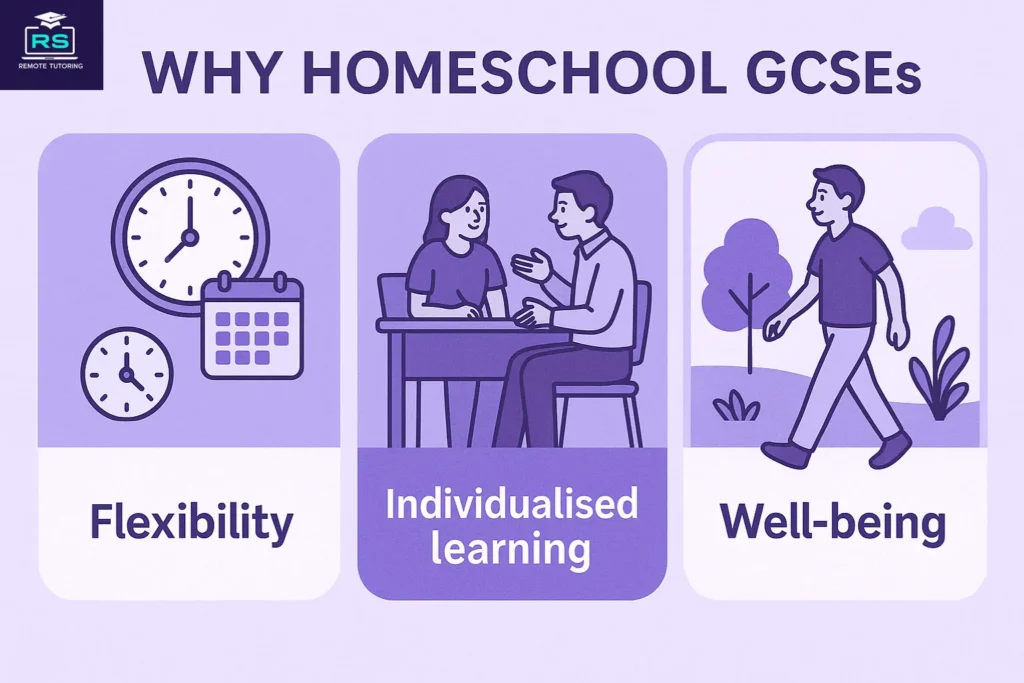
Homeschooling for GCSEs offers several advantages:
- Flexibility in curriculum and pace. Your teenager can go deep into subjects they love or spend more time on challenging topics. Many families choose less common subjects like Astronomy, Latin or Classical Civilisation, which might not be available in local schools.
- Individualised learning environment. One‑to‑one teaching means immediate feedback and tailored support. Students who are shy, neurodiverse or have health conditions often thrive without the noise and pressure of a classroom.
- Opportunity to focus on well‑being. Home education allows for balanced routines, outdoor learning in London’s parks, volunteering projects and travel during off‑peak times, offering richer life experiences.
London context: Being based in London means access to world‑class museums, science centres and historical sites. Field trips to the British Museum or the Royal Observatory can enrich subjects like History or Physics. Don’t forget to factor travel times into your schedule, peak hour traffic and Tube strikes can disrupt plans, so check Transport for London updates when booking visits or exam days.
GCSE vs IGCSE: Which Is Better for Homeschoolers?

Two main qualifications are available to private candidates:
GCSEs
GCSEs(General Certificate of Secondary Education) are designed primarily for UK schools. They used to include coursework, but reforms mean many subjects now rely on final exams. Some exam boards still offer practical assessments (coursework) in subjects like Art or Design.
IGCSEs
IGCSEs (International GCSEs) are offered by boards such as Cambridge International and Edexcel. They were originally created for international schools and often have fewer or optional coursework components. Many home educators prefer IGCSEs because they allow private candidates to sit exams without needing school‑supervised coursework. According to home‑education advisors, IGCSEs and GCSEs are considered equivalent by universities and employers.
Decision factors:
- Coursework requirements. If your child thrives on coursework or practical assessments, GCSEs might suit them. For subjects like English Literature or History, GCSEs can still involve controlled assessments. If you wish to avoid coursework due to complexity or cost, choose IGCSEs.
- Exam timing. GCSE exams are mainly held in May/June, with resits in November. IGCSEs offer additional sessions in January and sometimes November, giving more flexibility.
- Subject availability. IGCSEs offer a broad range of languages and global subjects, including Urdu, Japanese and World Literature.
- Recognition. Both qualifications are accepted by universities and employers as equivalent; there is no “better” option.
Choosing Subjects and Exam Boards
How Many GCSEs Should You Take?
Most young people take between 7 and 10 GCSEs at school. Home‑educated students often sit fewer due to cost and time. Experts recommend at least five subjects to keep post‑16 pathways open. The typical core is:
- English Language: Essential for all further study and many jobs.
- Mathematics: Required for sixth form, apprenticeships and university.
- Science: Often combined (two GCSEs) or separate Biology, Chemistry and Physics.
- A humanity such as History or Geography.
- A modern foreign language like French, Spanish or Arabic.
Selecting Optional Subjects
You can add subjects that reflect your child’s interests and career goals. Options include Economics, Computer Science, Business, Psychology, Sociology, Music, Art and more. Some subjects with heavy coursework (Art & Design, Food Technology) require supervised assessments and may be challenging for private candidates. Check exam board specifications before committing.
Exam Boards Explained
The UK’s major exam boards for GCSEs and IGCSEs are:
- AQA: Offers a wide range of GCSEs and emphasises engaging assessment materials. Some centres accept private candidates for AQA subjects.
- Edexcel (Pearson): Provides both GCSEs and IGCSEs, including 9–1 graded international GCSEs. Popular for Maths and Science.
- OCR: Offers GCSEs and Cambridge Nationals; some subjects have coursework.
- Cambridge International: Runs IGCSEs globally with sessions in May/June and October/November.
- WJEC/Eduqas: Welsh board with GCSEs; some are accessible to private candidates.
Pro tip: When choosing a board, download the specification for each subject. Check for coursework, practical requirements and the exam code. Write down the specification code, you’ll need it when registering with an exam centre.
Finding Exam Centres in London and Registering

Step‑by‑Step Registration
- Identify possible centres. Use the exam board websites or the Joint Council for Qualifications (JCQ) directory to search for exam centres that accept private candidates. Some local secondary schools, independent schools, adult education colleges and private tuition centres in London take external candidates. Always phone or email first; policies differ and spaces fill quickly.
- Contact multiple centres. Ask about fees, subject availability, registration deadlines and any access arrangements for SEND (special educational needs and disabilities). Success Academies’ guide recommends contacting more than one centre because fees and administrative requirements vary.
- Confirm the specification code. Provide your chosen exam board and specification code. Some centres only offer particular boards (for example, Edexcel for Maths and AQA for English).
- Submit registration forms and payment. Most centres require booking by mid‑February for the summer exam series. Some may accept late entries with extra charges up to mid‑April. For IGCSE January sessions, register by early October.
- Arrange any access adjustments. If your child needs extra time, a reader or scribe, speak to the exam centre early. You’ll need supporting evidence (e.g., educational psychologist report).
London‑specific guidance: London offers many exam centres, including independent schools in boroughs like Hampstead, Hammersmith, Barnet and Croydon. Parking and public transport vary; when choosing a centre, consider proximity to Tube lines (e.g., Northern line, Central line), as early‑morning delays can cause stress. Some centres charge extra for London overheads – compare quotes.
Exam Fees and Tutor Charges
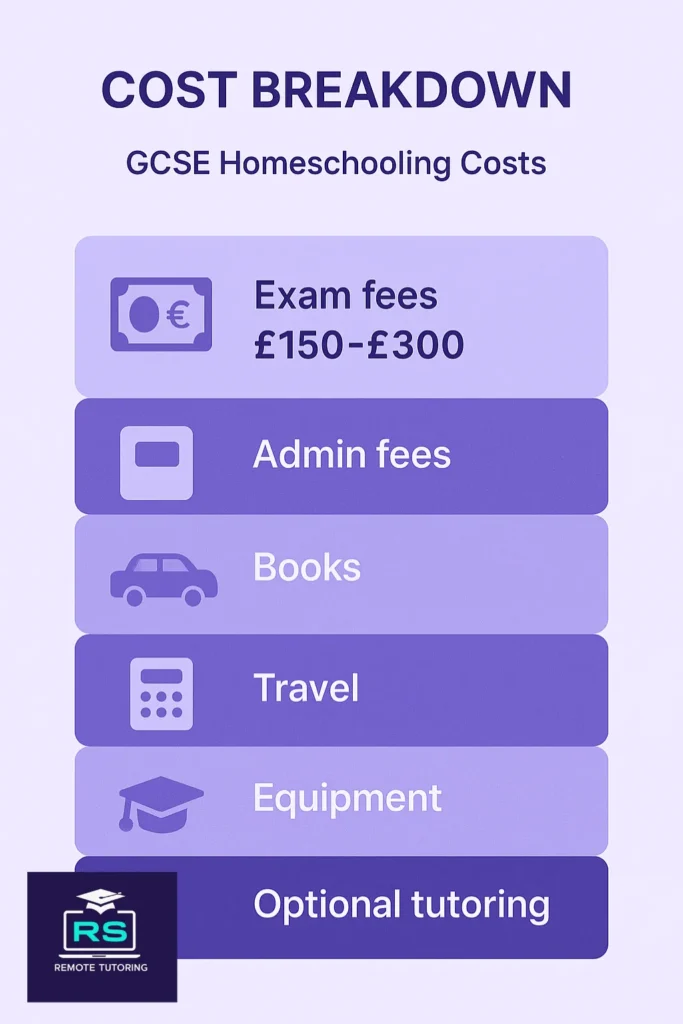
Exam entry fees range from £150 to £300 per subject. Additional administration charges can include invigilation, secure postage of papers, and certificate postage. Travelling to a centre and parking can add up. Books, revision guides and equipment (e.g., graphing calculators for Maths) also contribute to costs. Local authorities rarely fund private candidates, so budgeting is essential.
Money‑saving tips:
- Buy textbooks second‑hand or borrow from libraries.
- Use free revision resources online (see below).
- Group your child’s exams at one centre to negotiate reduced fees.
- Plan travel by public transport, Oyster cards are cheaper than driving and parking in central London.
Study Options: Self‑Study, Online Courses and Tutors
Homeschooling GCSEs doesn’t mean doing it alone. Choose the mix of resources that suits your family’s lifestyle and budget.
Self‑Study
Many learners succeed through independent study with textbooks, exam specifications and past papers. This method works well for self‑motivated students and costs less.
Online GCSE Courses
An increasing number of organisations offer structured online courses tailored for home‑educated students. They supply video lessons, tutor feedback and exam practice. Look for accredited providers that follow your chosen exam board’s syllabus. Some even include virtual classrooms, which help learners stay accountable.
Hire a Private GCSE Tutor
Private tuition provides one‑to‑one support in challenging subjects. Tutors may visit your home or teach online. When selecting, check qualifications and ask whether they have experience with private candidates.
Free & Low‑Cost Resources
- Past papers and mark schemes. Download from exam board websites. Practising under timed conditions builds exam technique.
- Study groups. Join local home‑education networks in London via social media or meet‑ups to share resources and support.
- Museums & cultural outings. Incorporate trips to the Natural History Museum, Science Museum or Imperial War Museum to bring subjects to life.
Creating a Timeline and Revision Plan
Start Early
Begin planning at least 18 months before the exam series. If your child starts Year 9 in September 2024, aim to choose subjects and exam boards by spring 2025 and begin coursework or exam preparation soon after. A typical timeline looks like this:
- 18–24 months before exams: Research subjects and boards; order textbooks; plan schedule.
- 12 to 18 months before: Start teaching content; book exam centre; register for first subject if you plan to sit some early.
- 6 to 12 months before: Complete syllabus; incorporate past papers; identify weak areas.
- 3 months before: Focus on exam technique; practise timed papers; adjust revision plan.
- 1 month before: Final review; organise exam day logistics.
Building a Revision Schedule
Break down each subject’s syllabus into weekly chunks. Allocate more time to topics your child finds challenging. Use a planner or digital calendar to mark lessons, revision sessions and mock exams. Remember to schedule breaks and physical activity. Home learners need movement to stay alert.
Revision tips:
- Use active recall: write flashcards or teach the topic to someone else.
- Implement spaced repetition: revisit material at gradually increasing intervals.
- Practise exam questions in exam conditions, no notes, timed and using only allowed equipment.
- Review mark schemes to understand how examiners award points.
GCSE Exam Day Preparation
Logistics
Book travel arrangements well in advance. If the centre is across London, consider staying nearby the night before to avoid rush‑hour stress. Check Transport for London for any planned engineering works on the Tube or national rail strikes. Have a backup route.
What to Bring on GCSE Exam Day to Center
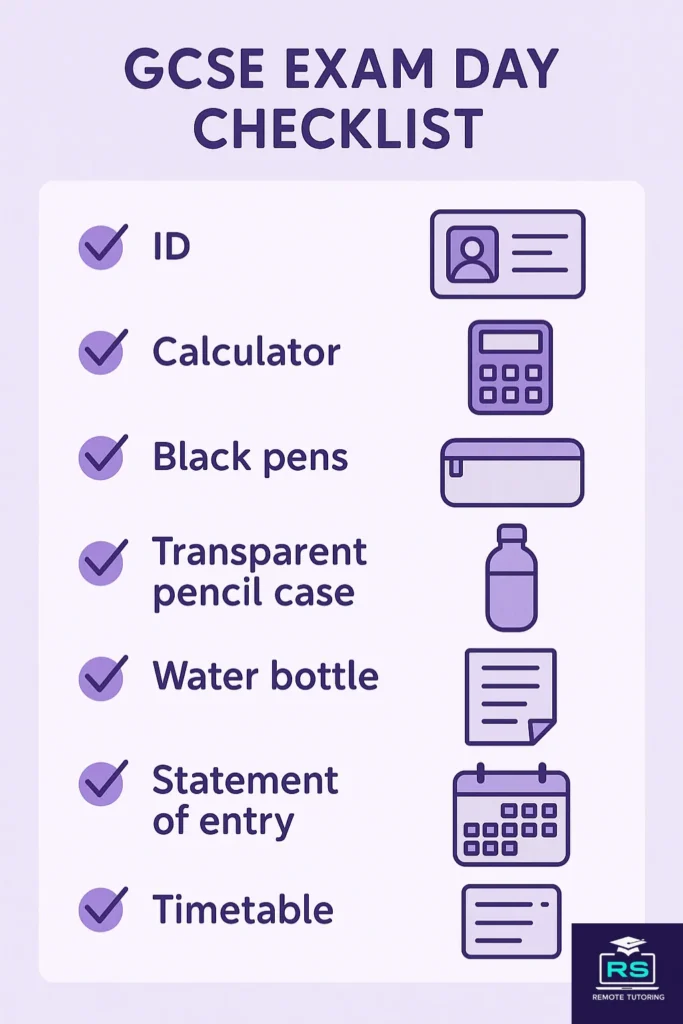
- Photo ID (passport, driving licence or another accepted document).
- Exam equipment: black pens, pencils, eraser, ruler, calculator (for Maths or Science), protractor and compass.
- Transparent pencil case and water bottle (label removed).
- Exam statement of entry and the exam timetable provided by the centre.
On the Day
Arrive at least 30 minutes early to allow time for security checks. Eat a balanced breakfast (slow‑release carbohydrates like oats and a banana) and stay hydrated. Dress comfortably – exam halls can be chilly or warm. Remember to turn off mobile phones before entering the exam room. Listen carefully to the invigilator’s instructions.
Pro tip: Bring a spare calculator battery or pen in case of malfunction. Plan breaks between exams – pack snacks and water to maintain energy levels.
Results Day and What’s Next
GCSE and IGCSE results are typically released mid‑August. The exam centre will advise how to collect results – some email results, while others require collection in person with ID. Certificates arrive several weeks later; keep them safe, as employers and universities may ask for originals.
If your child’s results aren’t as expected, discuss options with the exam centre or a tutor. You can request a review of marking or retake the exam the following year. Many home‑educated students sit additional GCSEs while preparing for A‑levels, BTECs, apprenticeships or independent study. Celebrate achievements and plan the next steps.
FAQs
How much does homeschooling GCSEs cost?
Expect to spend £150–£300 per subject on exam fees, plus administration charges, textbooks, tuition and travel. Total costs vary depending on the number of subjects and study method.
Is homeschooling GCSE free?
Teaching your child at home can be done at no cost using library books and free online resources. However, sitting the exams requires paying exam centre fees. There is no government funding for most private candidates, though some charities offer grants.
What online GCSE courses are available?
Many platforms offer full GCSE courses with tutor support and graded assignments. Look for providers that are accredited and align with your chosen exam board. Courses range from self‑paced video lessons to live virtual classrooms.
Do you have to do GCSEs if you’re homeschooled?
No, homeschooling parents have no obligation to follow the national curriculum or exam system. GCSEs are recommended for students planning to pursue A‑levels, higher education or certain career paths.
How do I find exam centres that accept private candidates?
Search the JCQ directory or exam board websites for approved centres. In London, independent schools and adult education colleges often accept private candidates. Contact them directly to confirm availability and fees.
How do I register for a GCSE exam as a private candidate?
Choose your subject and specification, contact an exam centre, complete registration forms and pay the entry fee. Ensure you have the correct specification code and register before the deadline.
Where can I find GCSE exam centres near me?
The JCQ website lists centres by postcode. You can also ask local secondary schools and independent colleges. For Londoners, options exist in most boroughs, but spaces can fill quickly, book early.
Is GCSE Maths harder for private candidates?
Some find Maths challenging because it requires consistent practice and problem‑solving. However, with a structured study plan, past papers and, if needed, a tutor, home‑educated students often achieve excellent results.
After reading the guide, you may feel ready to begin homeschooling GCSEs. If you want personalised advice, consider booking a consultation with a qualified tutor who specialises in guiding private candidates. They can help you choose subjects, plan a study schedule and locate exam centres in London.
For structured online courses and live tutoring sessions, reach out to our London‑based homeschool tutors team. We offer flexible packages, from one‑off consultations to full two‑year programmes. Contact us today to give your child the best start on their GCSE journey.
Conclusion
Homeschooling GCSEs is a rewarding venture. With careful planning, the right resources and support, private candidates in London can achieve outstanding results while enjoying the flexibility and richness of home education. Start early, choose subjects wisely, register with a reliable exam centre and create a structured revision plan. Use London’s cultural assets to make learning engaging, and remember that there are many pathways to success beyond the exam hall. Whether your child pursues A‑levels, an apprenticeship or travels the world, a solid GCSE foundation will open doors. We hope this guide empowers you to navigate the process with confidence and clarity.
Raja specializes in Physics and Maths, with over 5 years of experience. He offers KS2, KS3, and GCSE Science and Maths lessons. He graduated from one of the top universities in the UK.