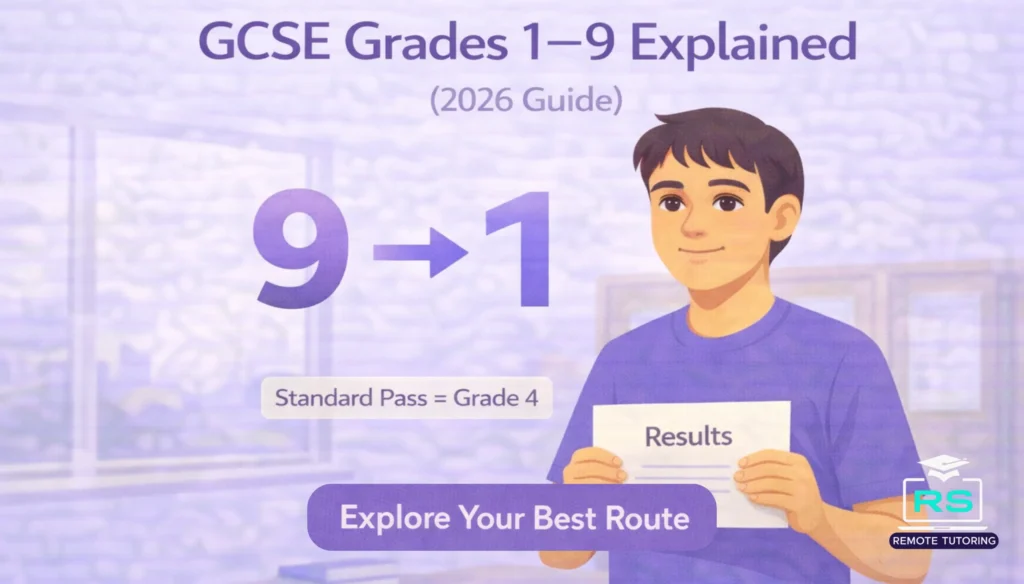

Passing GCSE Maths can feel like climbing a mountain, especially if you’re aiming for the all‑important grade 4, which counts as a standard pass under the 9 to 1 grading system. In the United Kingdom and particularly in a large, competitive city like London, success in GCSE maths opens doors to A‑levels, apprenticeships and further study. Whether you’ve struggled with numbers or you’re just looking for practical exam strategies, this comprehensive guide explains how to achieve that grade 4 pass. We draw on expert GCSE tutors advice, examiner insights and research to create a roadmap that exceeds anything you’ll find elsewhere.
Jump to Section
Understand GCSE Grade 4: What Does It Mean?
A grade 4 is officially a standard pass in GCSE maths. It is equivalent to a low C or high D in the old A to G grading system. On the foundation tier, a grade 4 lies near the upper end of the scale, meaning you must correctly answer roughly 40 to 60 % of marks to secure a pass. A grade 4 in mathematics is sufficient for most sixth‑form subjects and apprenticeships, although some courses require a grade 5 (a strong pass).
Students can sit either the foundation or higher tier exam. The foundation tier covers grades 1 to 5, making it ideal for those aiming for a grade 4; the higher tier covers grades 4 to 9, allowing for top marks but with more demanding content. There is no shame in choosing the foundation route. In fact, examiners have noted that many students who struggle with the higher tier end up ungraded. Talk to your teacher or tutor to determine which tier best suits your goals and abilities.
Is a Grade 4 a Weak Pass?
While grade 4 is often labelled a standard pass, it remains a significant achievement. Many employers and colleges accept grade 4 as evidence of functional numeracy, and it still qualifies you for most post‑16 programmes. If you’re aiming for STEM A‑levels or competitive sixth‑forms in London, targeting a grade 5 or higher is advisable. Otherwise, focus on achieving the secure grade 4 required for progression.
Know the Exam Structure and Choose the Right Tier
To pass GCSE Maths confidently, you must understand how the exam is structured and choose the right tier:
- Exam boards: There are three main exam boards: AQA, Edexcel and OCR. Each board’s papers look slightly different, but the content is similar. For example, AQA and Edexcel mark their maths papers out of 240 marks, whereas OCR marks out of 300. Discuss with your teacher which board you’re taking so you can practise with the correct past papers.
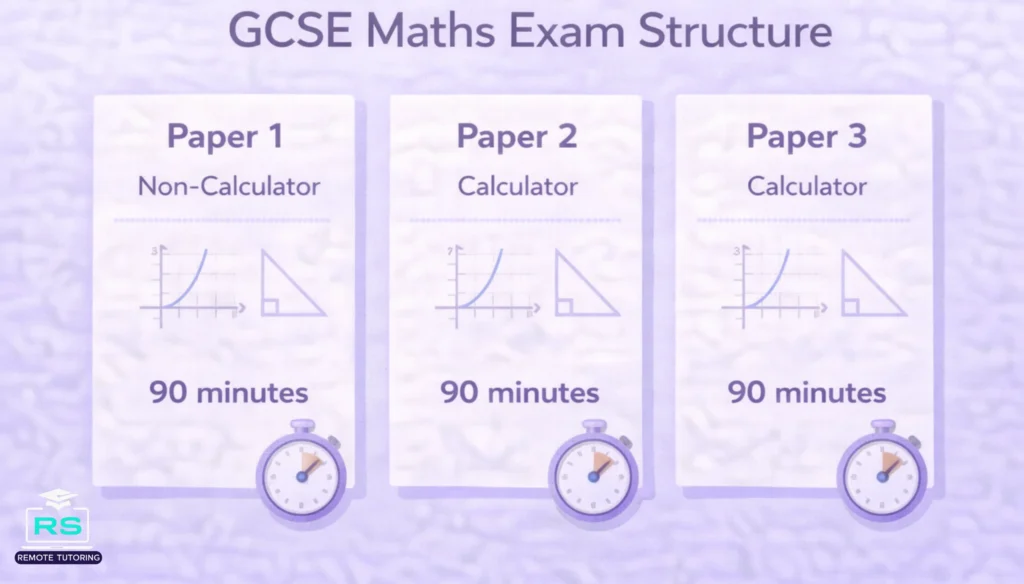
- Number of papers: GCSE maths consists of three papers: one non‑calculator paper and two calculator papers, each 90 minutes long. You must take all three papers to obtain an overall grade.
- Foundation vs higher tier: The foundation tier emphasises number, ratio, proportion and rate‑of‑change topics and awards grades 1 to 5. The higher tier includes all foundation content plus advanced algebra, functions and circle theorems and awards grades 4–9. Students aiming for grade 4 should usually sit the foundation paper to maximise their chance of success.
Decide Your Tier
Choosing between foundation and higher is a strategic decision. Experts recommend considering your predicted grades, confidence with algebra, and future goals. If you consistently score grade 6 or above in practice papers and wish to study A‑level maths, the higher tier might suit you. If your goal is to obtain a grade 4 or 5 and maths isn’t your strongest subject, the foundation tier is likely a better fit.
Set Goals and Plan Your Revision
Start Early and Make a Schedule
One of the biggest mistakes students make is leaving revision to the last minute. You should start preparing at least six months before the exam. According to education experts, creating a revision timetable early in Year 11 and gradually increasing your study time is critical. For example:
- Months 6 to 4 before exam (September–December): Study 20 minutes a day, focusing on core topics.
- Months 4 to 2 before exam (January to March): Increase to 30 to 40 minutes daily; complete practice questions and identify weak areas.
- Final 2 months (April to May): Do timed past papers twice per week and refine exam techniques.
Use SMART Goals
Setting SMART goals (Specific, Measurable, Achievable, Relevant, Time‑bound) provides structure and motivation. For instance, a specific goal might be: “Complete all number and ratio questions from a past paper within 90 minutes by 1 April, aiming for 60 % correct.” This level of detail keeps you accountable and ensures you track your progress.
Master the Basics: Focus on Foundation Content

A grade 4 requires solid knowledge of the basics. The foundation specification places heavy weighting on topics such as number, ratio, proportion and rates of change. To maximise marks, focus on mastering the following areas:
- Number skills: Fractions, decimals, percentages, prime factorisation, and calculations. Practise converting between fractions and percentages and using percentage change formulas.
- Ratio and proportion: Simplifying ratios, dividing quantities, scale drawings and maps, direct and inverse proportion problems.
- Algebra fundamentals: Solving linear equations, rearranging formulas, recognising simple graphs and plotting straight lines.
- Geometry basics: Perimeter, area and volume calculations, properties of shapes, angle facts, and basic trigonometry (sine, cosine, tangent on right‑angled triangles).
- Statistics and probability: Interpreting bar charts, pie charts, line graphs and calculating averages; understanding probability fractions and the probability scale.
Pro Tip: Use resources like Maths Genie or CorbettMaths 5‑a‑day to practise foundational questions daily; they cover every topic and build confidence.
Develop a Revision Routine and Use Quality Resources
Regular Practice Beats Cramming
Experts recommend daily practice rather than occasional marathon sessions. Commit to 20 to 30 minutes of maths each day for at least six months. Regular exposure prevents forgetting and helps topics stick. For example, solve 5 to 10 practice questions after dinner or on your commute.
Cover the Whole Syllabus
A common mistake is focusing only on favourite topics. To secure a grade 4, you must cover all six subject areas: number, algebra, ratio/proportion, geometry/measure, statistics and probability. Revision guides and websites such as Maths Genie or GCSE Bitesize provide checklists that help ensure no topic is missed. Reinforce each topic with practice questions and watch short video tutorials to build understanding.
Use Past Papers Wisely
Practise past papers after you’ve covered the entire syllabus. Doing them too early can be discouraging. Once you’re ready:
- Start with untimed papers to familiarise yourself with question styles and mark schemes.
- Progress to timed exams under exam conditions. A grade 4 requires efficient time management, so practise completing papers within 90 minutes.
- Mark your work using official mark schemes, identify errors and revisit those topics.
Many exam boards provide free past papers. Ensure you choose the correct board (AQA, Edexcel or OCR) and the right tier.
Build Exam Technique with Examiner Insights
An examiner’s perspective can boost your marks. Former examiners emphasise the following tips:
- Keep your handwriting neat and work down the page. Examiners mark hundreds of scripts and may misinterpret messy work.
- Cross out work neatly with a single line; you can still receive method marks for crossed‑out attempts.
- Avoid writing obviously incorrect workings. If your working contradicts your answer, you may receive zero marks.
- Always show your working to gain follow‑through marks. Even if your final answer is wrong, full working can earn most of the marks.
- State answers clearly, especially for linear equations, and avoid embedding them within calculations.
- Give probability answers as fractions, decimals or percentages, never use words unless instructed.
- Don’t round mid‑question; examiners accept a range of answers for multi‑stage questions but it’s safest to keep numbers exact.
These small habits make a big difference in borderline grade cases.
Build Confidence and Problem‑Solving Skills
High Expectations and Contextualised Learning
Education researchers emphasise that students should set high expectations, believing they can achieve a pass, even if they’ve struggled before. Teachers and parents can help contextualise maths by relating it to real‑life situations, such as budgeting for London transport, calculating travel times or understanding discounts in shops. This relevance helps concepts stick and shows the practical value of maths.
Take Baby Steps and Build Resilience
Break down complex problems into small, achievable steps, gradually increasing difficulty. For example, when tackling algebra, start with single‑step equations, then progress to simultaneous equations and simple quadratics. Encourage yourself to combine topics such as ratio and probability to develop problem‑solving resilience.
Use a Variety of Resources
Different resources appeal to different learning styles:
- Textbooks and revision guides provide clear explanations and practice questions.
- Video tutorials (e.g., on YouTube or exam board websites) explain concepts visually, which can be helpful for geometry or graph topics.
- Flashcards and apps like Anki help you memorise formulae and key facts.
- Maths clubs and study groups offer peer support. Join or create a study group at your school or local library in London. Working with peers can make revision less daunting.
- Tutoring: If you struggle with particular topics, consider hiring a tutor. Many London‑based tutors offer one‑to‑one or small‑group lessons tailored to grade 4 targets. This personalized guidance can boost confidence and fill gaps.
Exam Day Strategies: Perform Under Pressure
When exam day arrives, stay calm and follow these strategies:
- Prepare the night before: Pack your equipment (two pens, pencil, eraser, ruler, scientific calculator, compass and protractor). Check your exam timetable and leave yourself plenty of travel time. London’s public transport can be unpredictable, so plan alternative routes.
- Eat and hydrate: Have a balanced breakfast or snack. Slow‑release carbohydrates (porridge, wholemeal toast) and fruit will help maintain energy levels.
- Arrive early: Aim to be at the exam centre at least 30 minutes before the start time. This reduces anxiety and allows time for last‑minute checks.
- Read every question carefully: Many students lose marks by misreading questions. Underline key words and identify the topic before attempting.
- Plan your time: Each paper is 90 minutes. Allocate a few minutes to read through the paper, then roughly 1 to 2 minutes per mark. If you’re stuck, move on and return later.
- Attempt all questions: There’s no negative marking. Even if you’re unsure, write down your method or make an educated guess.
- Show all working: As emphasised by examiners, clear working earns method marks. Use the answer line only when you’re confident.
- Check answers: If time permits, revisit tricky questions. Ensure you’ve given probabilities as numbers and simplified fractions where necessary.
- Stay calm: Deep breathing and positive self‑talk can help manage exam nerves. Remember, you’ve prepared well.
Revision Plan: Four‑Week Intensive for Last‑Minute Learners
Some students find themselves only a month away from the exam. While cramming isn’t ideal, an intensive four‑week plan can help you secure a grade 4 if you are disciplined:
- Week 1 – Foundations: Review number skills (fractions, decimals, percentages), ratio and proportion. Use revision guides and complete 20 basic questions daily. Identify any gaps.
- Week 2 – Algebra & Graphs: Practise solving linear equations, drawing straight‑line graphs, interpreting coordinates and rearranging formulas. Use online video tutorials for tricky concepts.
- Week 3 – Geometry & Measures: Focus on area, perimeter, volume, angle rules, symmetry and basic trigonometry (right‑angled triangles). Practise with exam‑style questions.
- Week 4 – Statistics, Probability & Exam Skills: Revise averages, charts, and the probability scale. Then complete two full past papers under timed conditions. Analyse your mistakes and focus on exam technique.
This four‑week plan is a condensed version of the 12‑week structure recommended by tutors. If possible, start earlier for a more relaxed pace.
Seasonal Advice and London‑Specific Tips
- Exam season: GCSE maths exams typically take place in May/June, with resits offered in November. Avoid booking holidays during these months and plan your maths revision schedule accordingly.
- Daylight and weather: Winter months in London have shorter days and colder weather. Use daylight hours wisely, consider studying in natural light to maintain focus, then switch to warm indoor study spaces when it gets dark.
- Travel considerations: London’s transport network is busy. On exam days, check for TfL disruptions or strikes. Leave early and have an alternative route in mind.
- Local resources: Take advantage of local libraries (like the British Library in St Pancras or Southwark’s Canada Water Library) for quiet study spaces. Many London boroughs offer free tutoring programmes or revision workshops in community centres.
FAQs
How can I pass GCSE maths quickly?
Passing quickly depends on your current level. If you’ve studied the course and just need to consolidate, follow the four‑week intensive plan above. Focus on high‑weight topics (number, ratio, proportion) and practise exam questions daily. Use official mark schemes to check your work and focus on exam technique.
What skills do you need to achieve a grade 4 in GCSE maths?
You need strong number fluency, the ability to manipulate ratios and proportions, competence in basic algebra, an understanding of geometry (perimeter, area, volume) and confidence with simple statistics and probability. You also need good exam technique: reading questions carefully, showing working and managing time effectively.
Is a grade 4 a pass?
Yes. Grade 4 is considered a standard pass, equivalent to a low C in the old system. Many sixth‑forms, colleges and employers accept it. However, some courses require a grade 5 or higher. Always check entry requirements.
Is grade 4 a weak pass?
Grade 4 is not a “weak” pass; it is a minimum threshold that demonstrates foundational mathematical competence. Nevertheless, for competitive courses or careers in engineering, science or finance, achieving a higher grade (5–7) will strengthen your applications.
How do I pass Maths GCSE Foundation?
Follow the advice in this guide: focus on the core topics, practise daily, use past papers, and develop strong exam technique. Foundation papers award marks for clear working and method, so show all steps. Aim to answer 40–60 % of the questions correctly to secure grade 4.
Can I pass GCSE maths in four weeks?
It’s challenging but possible if you commit to a structured four‑week plan (see above). Assess your starting point, focus on core content, complete past papers and seek help when stuck. Avoid distraction and prioritise your studies during this period.
What should I revise for GCSE Maths Foundation?
Concentrate on number operations, fractions, percentages, ratio/proportion, basic algebra, geometry (including Pythagoras and trigonometry), basic graphs, statistics and probability. Use exam board specification lists to tick off topics and ensure you cover everything.
Is foundation maths hard to pass?
Foundation maths is designed to be accessible. However, it still requires effort. Many students find that regular practice, clear understanding of the basics and following exam techniques ensure success. Most candidates who dedicate time to revision and practise past papers achieve at least a grade 4.

Raja specializes in Physics and Maths, with over 5 years of experience. He offers KS2, KS3, and GCSE Science and Maths lessons. He graduated from one of the top universities in the UK.