The jump from Year 10 to GCSE Year 11 can feel daunting, especially when you’re faced with two full physics papers and a long list of formulae. AQA GCSE Physics (8463) is one of the most popular physics courses in England and is widely taken by students across London and the wider UK. With new exam timetables and support materials being announced for 2025‑2027, many parents and students are asking: What do the 2026 physics exams look like? and How can past papers and the equation sheet help me succeed?
This comprehensive guide explains the structure of the AQA GCSE Physics exam, demystifies the equation sheet, and shows you how to make the most of past papers. We’ll also answer common questions about the 2026 exam series and provide practical revision tips tailored to students in London and across the UK.
Jump to Section
Overview of the AQA GCSE Physics Exam
Exam Structure: Paper 1 and Paper 2
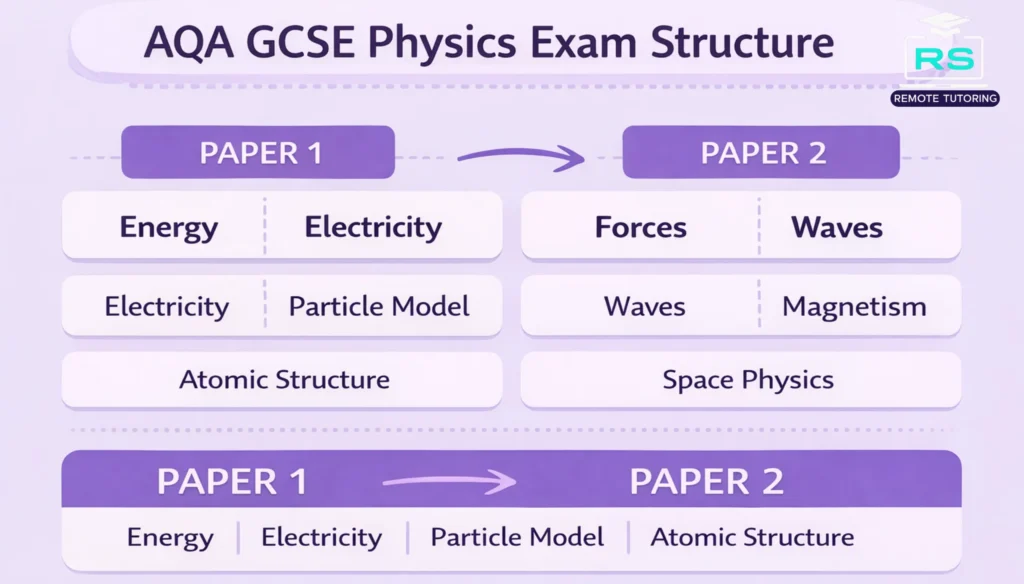
AQA Physics (course code 8463) is split into two equally weighted papers. Each paper lasts 1 hour 45 minutes, is available in both Foundation and Higher tier, and carries 100 marks, representing 50 % of the GCSE. The papers are structured as follows:
- Paper 1 assesses Topics 1 to 4: Energy, Electricity, Particle model of matter, and Atomic structure.
- Paper 2 assesses Topics 5 to 8: Forces, Waves, Magnetism and electromagnetism, and Space physics. Questions may link back to energy and electricity concepts from Paper 1 because these ideas underpin much of the course.
Both papers use a mix of multiple‑choice, structured, short answer and open response questions. Students must sit both papers in the same tier (Foundation or Higher). Each exam includes a section with calculation questions, which is where the equation sheet comes into play.
Foundation vs Higher Tiers
- Foundation tier awards grades 1 to 5 (with grade 5 as the highest). It contains straightforward questions and emphasises recall and application. If you’re targeting a grade 4 or 5, Foundation can be a safer route.
- Higher tier awards grades 4 to 9 and is designed for students aiming at grade 6 or above. It includes more challenging topics (such as Space physics and the more demanding parts of Waves and Forces) and requires strong mathematical skills.
Knowing which tier you’re sitting helps tailor your revision: Higher tier students should master algebraic rearrangements and be ready for extended calculations, while Foundation tier students should focus on core concepts and effective use of the equation sheet.
What Is the AQA GCSE Physics Equation Sheet?
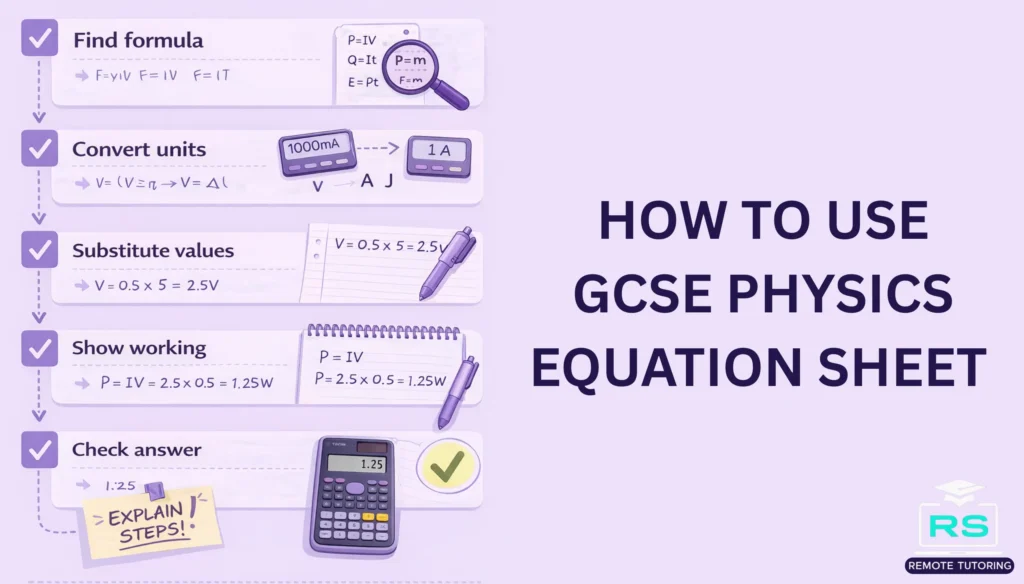
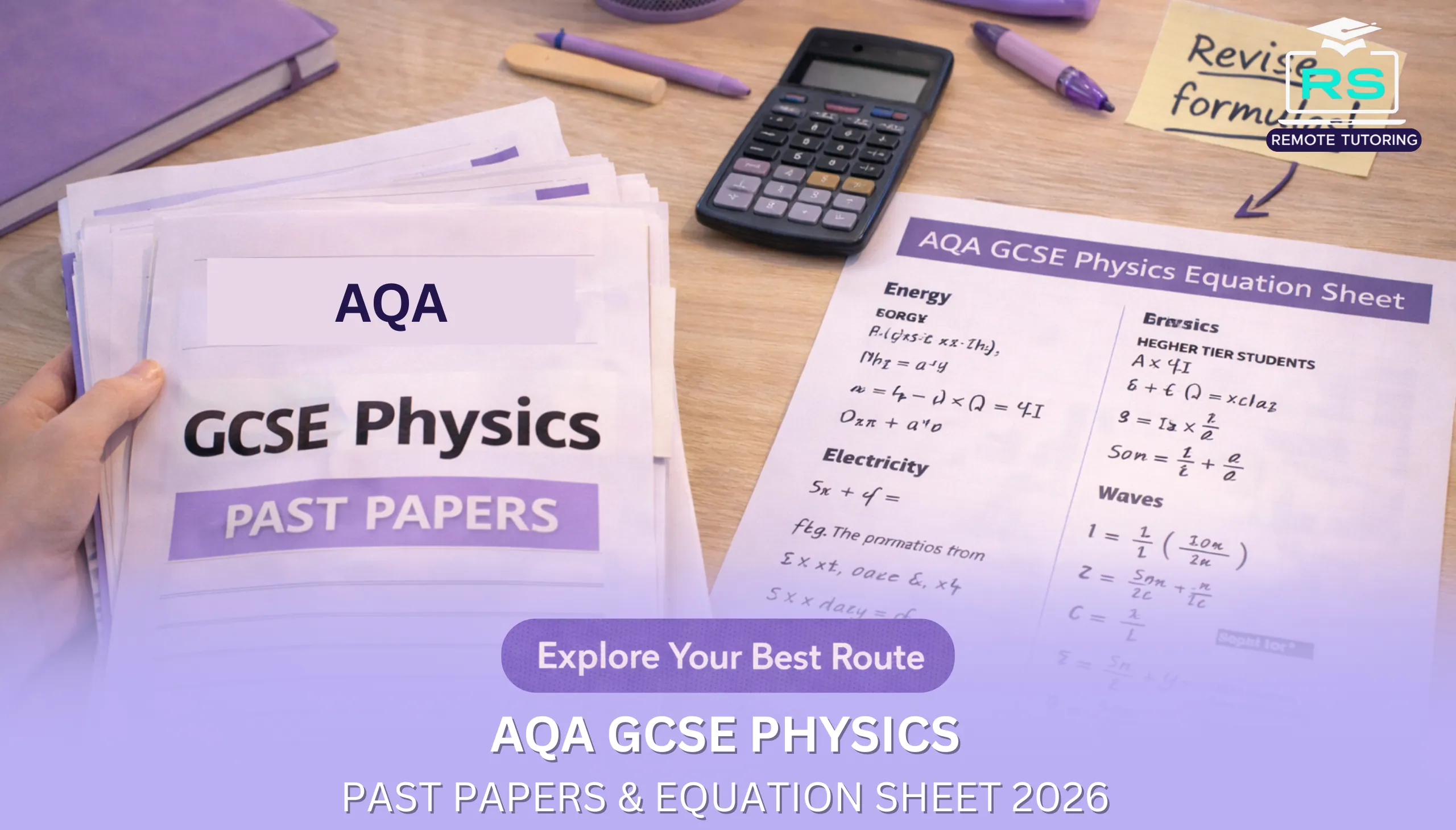
AQA provides an equation sheet for GCSE Physics and Combined Science exams. This document lists selected physics equations in both words and symbols and indicates which equations apply only to Higher tier (shown in bold).
The equation sheet is not a complete formula list: it covers the more challenging equations that students often find hard to remember. You still need to know many basic equations and all relevant units by heart. However, the sheet means you don’t have to memorise every formula, instead, you must learn how to use them.
What’s on the Equation Sheet?
According to AQA’s guidance:
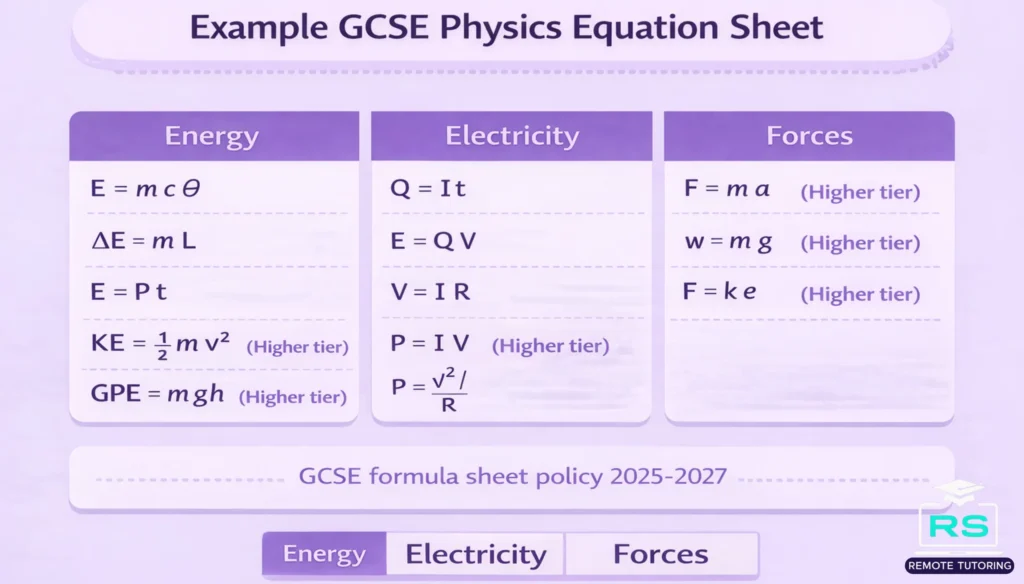
- The sheet is two pages long and printed in a clear format with labelled rows.
- Equations are grouped by topic, making it easier to find the right formula during the exam.
- Equations printed in bold are for Higher tier only; Foundation students can ignore them.
- You will use the same sheet for both papers, so familiarity matters.
2025–2027 Update: Formula Sheets Included!
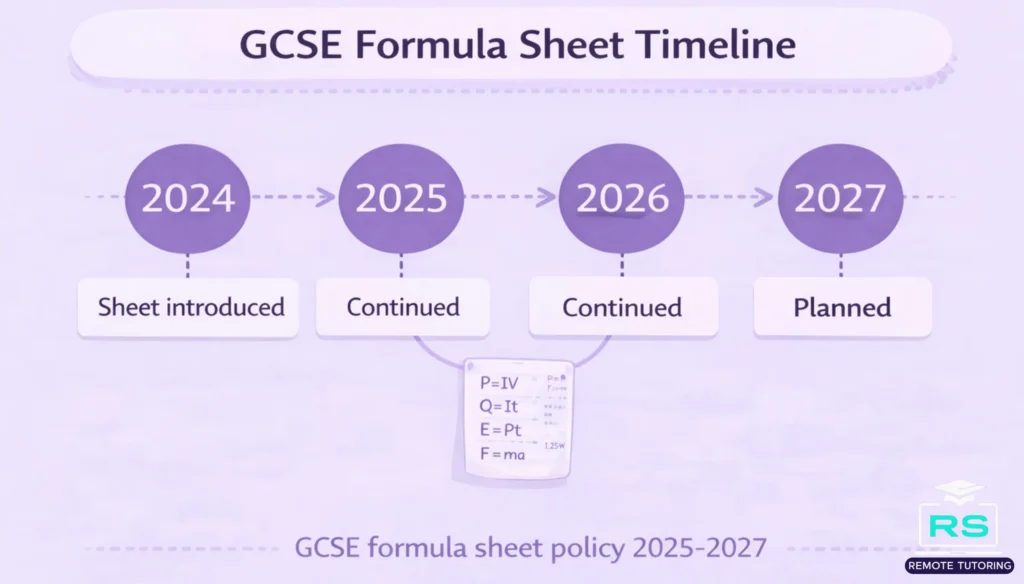
After the disruption caused by school closures, the Department for Education decided that students taking GCSE Physics and Combined Science do not need to memorise formulae. As a result, full equations and formulae sheets will be provided in the 2025, 2026 and 2027 exams. AQA confirms that the 2025 sheet remains the same as the one used in 2024 and will be continued through 2026. This applies to:
- GCSE Physics (8463) Paper 1 and Paper 2
- Combined Science: Trilogy (8464) Physics papers 1 and 2
- Combined Science: Synergy (8465) physics papers.
This support will remain until at least 2027, so you can confidently use the published equation sheet for revision and practice.
Why Provide an Equation Sheet?
AQA and Ofqual stress that physics is about applying concepts, not rote learning. The equation sheet aims to:
- Reduce the burden on memory, letting students focus on understanding relationships and solving problems.
- Encourage deeper conceptual learning; the examiner wants to see how you apply equations, not whether you can recite them.
- Help students of all backgrounds access the exam more fairly during a period of educational disruption.
Keep in mind that the equation sheet doesn’t include units; you must still know them, and you should be comfortable rearranging formulae.
How to Use the AQA Equation Sheet Effectively
Having the equation sheet is an advantage only if you know how to use it. Here are pro tips drawn from educational experts and examiners:
- Familiarity is key: spend time with the sheet during revision. Pin a copy above your desk, and annotate it (for revision at home) so you know where each equation lives. You cannot take annotated sheets into the exam hall, but familiarity will save valuable time.
- Practise during mocks: incorporate the sheet into all practice papers. The more you use it, the more you’ll automatically reach for the right formula.
- Understand each equation: don’t just look for a matching symbol. Make sure you can explain what each term represents (e.g., P=IV means electrical power equals current times voltage). This will help you spot which formula to use even if the question words things differently.
- Beware of units: the sheet doesn’t list units, so check that you convert quantities to standard units (e.g., volts, amps, joules) before calculating.
- Don’t waste time searching: know the layout so you can quickly find the equation you need. If you forget where something is, use the structure: energy equations are near the top, electricity equations mid‑sheet, and mechanics formulas near the end.
- Write all workings on the exam paper: the examiner will not mark anything written on the equation sheet. Show your calculations clearly to earn method marks.
- Higher tier students: note the equations printed in bold; these may include the Lens formula, Transformer equation or other advanced relationships not required on Foundation papers.
Why Past Papers Are Your Best Friend
What Are Past Papers?
Past papers are previous exam papers published by the exam board. They come with mark schemes and, in some cases, model answers and video solutions. They provide an authentic taste of exam format, question style and difficulty.
For AQA Physics, there are two main sets of past papers:
- Paper 1 past papers, covering Topics 1 to 4 (Energy, Electricity, Particle model of matter, Atomic structure).
- Paper 2 past papers, covering Topics 5 to 8 (Forces, Waves, Magnetism and electromagnetism, Space physics).
These are available for both Foundation and Higher tiers, typically from the 2018 to 2024 exam series, plus specimen papers and practice sets. Many revision sites also offer model answers and video solutions, which are invaluable for understanding how marks are awarded.
How to Use Past Papers
- Start Early: Begin with past paper questions topic by topic as you finish each unit. For example, after studying electricity, attempt past questions on circuits. Use the equation sheet from the start so you become comfortable with it.
- Simulate Exam Conditions: Once you complete all topics, sit full papers under timed conditions. Use the equation sheet and a non‑programmable calculator. This helps build stamina and time management.
- Check and Reflect: Mark your answers using official mark schemes. Pay attention to common mistakes. If you lost marks for missing units or rounding incorrectly, note this.
- Analyse Your Weak Areas: Keep a record of topics you find challenging (for example, momentum or space physics) and revisit those lessons. Use targeted revision to improve.
- Review Model Answers: Compare your workings to model answers. Notice how the solution is structured: examiners like clear steps, correct units and final statements.
- Focus on Application: Don’t just copy mark schemes. Practise explaining your reasoning. Many long‑answer questions require you to describe how a physical principle applies (e.g., conservation of energy), so practice writing structured explanations.
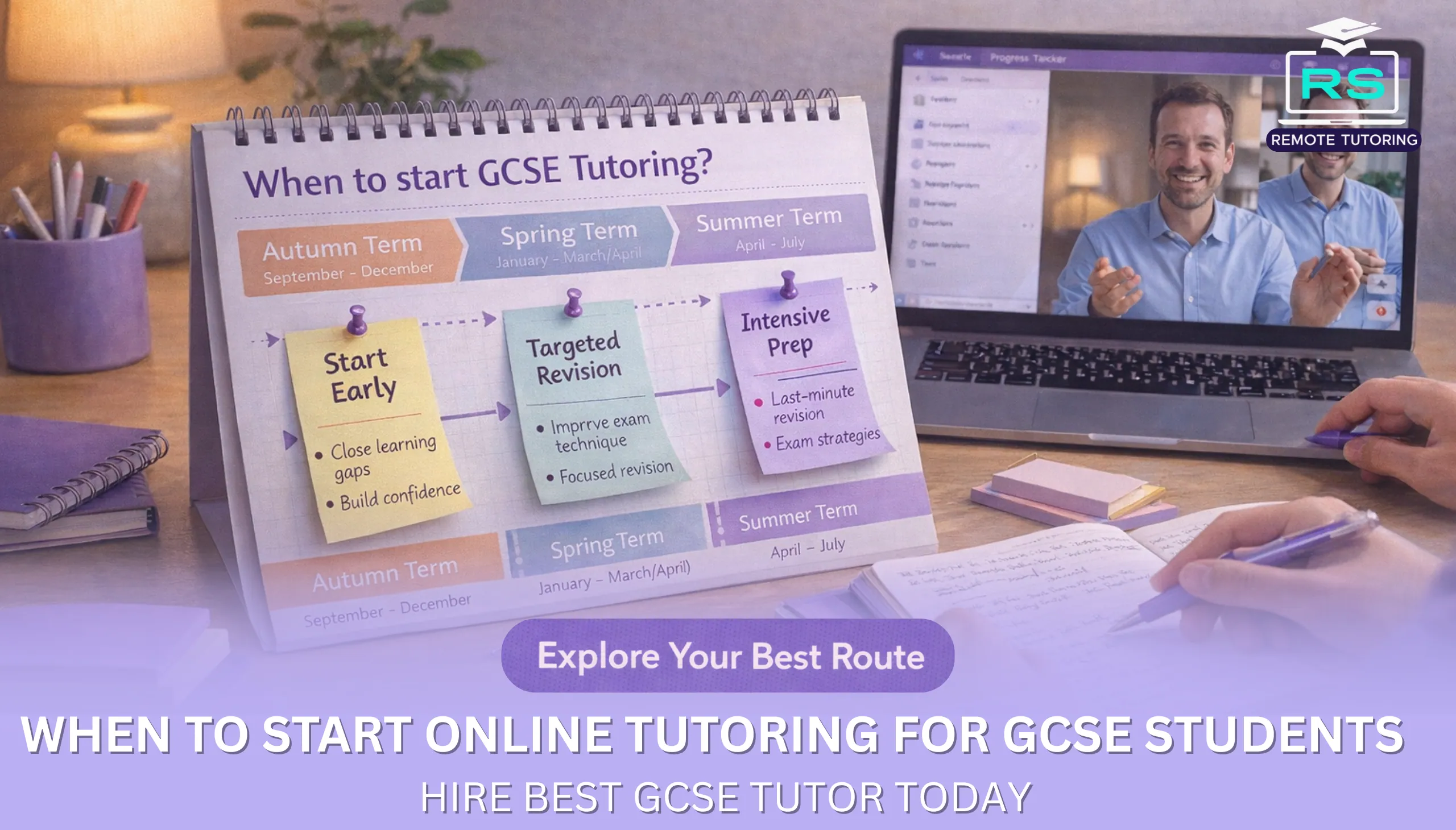
- Plan With London’s Timetable: In London, GCSE exams typically take place in May and June. Many schools run mock exams in January or February. Use autumn and winter months for topic revision and targeted past‑paper practice, and spend spring doing full mocks. During the April half‑term, London’s libraries and tutoring centres often run revision workshops, take advantage of these if you can.
Also Read Our Other Guide on How to Use GCSE Past Papers to Maximise Your Score
Revision Strategies for AQA Physics 2026
Create a Revision Plan
Divide your revision into three phases:
- Foundation Phase (September–December): Consolidate classwork, summarise notes for each topic and create flashcards. Practise low‑stakes quiz questions to build recall.
- Practise Phase (January–March): Focus on past paper questions by topic. Use the equation sheet and check the mark scheme to build exam technique. Identify tricky formulae and practise rearranging them.
- Mock & Mastery Phase (April–June): Sit complete papers under timed conditions. Review your marks, refine your exam techniques and revisit any weak topics. Use the equation sheet in all practice sessions.
Focus on High‑Yield Topics
Based on examiner reports and mark patterns, some topics yield more marks:
- Energy & Electricity: Appear on both papers. Know how to calculate power, energy transfer and efficiency. Understand energy diagrams and Sankey charts.
- Forces & Motion: Understand Newton’s laws, acceleration, momentum and resultant forces. Practice calculations with F=ma and p=mv.
- Waves & Electromagnetism: Learn wave properties, the wave equation (v=fλ), electromagnetic spectrum and uses. Understand electromagnetic induction and transformer equations (Higher tier).
- Particle Model & Atomic Structure: Understand states of matter, specific heat capacity, latent heat and nuclear structure. Learn about Rutherford’s scattering and radioactive decay.
Make sure you also cover smaller topics like Space physics (only Physics Separate, not Combined), which often forms a few high‑mark questions.
Use Multiple Revision Resources
- School resources: Class notes, textbooks and teacher worksheets remain the core resources.
- Interactive resources: Use online simulations to visualise waves, circuits and forces.
- Tutoring: Consider local tutoring in London or online sessions for personalised support. A tutor can help you practise using the equation sheet effectively and explain complex concepts in simple terms.
Stay Healthy During Revision
Balance is important. Schedule breaks, exercise and sleep. In London, take advantage of daylight hours by revising with natural light, especially in spring when the sun returns. Use winter evenings for quieter study sessions and keep a warm drink on hand.
Also Read Our Other Guide on GCSE Online Revision Best Practices | Hybrid Study Support
Frequently Asked Questions
AQA GCSE Physics Past Papers Paper 2: Where Can I Find Them?
Past papers for AQA Physics Paper 2 (covering Forces, Waves, Magnetism and Space physics) are available from the exam board and authorised revision providers. They include question papers, mark schemes and sometimes model answers. Use them to practise under timed conditions and identify topics that need more work.
AQA GCSE Physics Past Papers by Topic: Do They Exist?
Yes. Topic‑specific past paper questions allow you to target your revision. They group past questions from multiple years into categories such as Electricity or Waves. Practising these can help you master each area before attempting full papers.
Are AQA GCSE Physics Past Papers With Answers Worth Using?
Absolutely. Mark schemes and model answers show you exactly how marks are awarded. Reviewing them helps you understand how to structure answers, the importance of units and how to show working clearly.
Can I Download AQA GCSE Physics Past Papers as PDFs for Free?
Yes. Past papers, mark schemes and specimen papers are freely accessible from exam board websites and some revision platforms.
Are Past Papers From 2020 to 2024 Still Relevant for the 2026 Exams?
Yes. The specification remains largely unchanged. Papers from 2020 onwards cover the same topics and question styles. They are excellent for practice, although grade boundaries may differ from year to year.
Will Students Get the AQA GCSE Physics Equation Sheet in 2026?
Yes. Students sitting AQA GCSE Physics (8463) or Combined Science (8464/8465) in 2026 will receive a printed equation sheet as an insert in both Papers 1 and 2. You do not need to memorise the standard formulae, but you must know how to use them.
Where Can I Download the AQA GCSE Physics Equation Sheet PDF?
AQA publishes the official equation sheet on its website. Make sure you use the version for the correct exam year; the 2025 sheet will be used for the 2026 exams.
Does the AQA GCSE Physics Equation Sheet Include All Formulas?
No. The equation sheet contains only selected equations that AQA believes students may struggle to recall. You must still learn basic equations and units and be able to rearrange formulas.
Is the Equation Sheet the Same for Physics and Combined Science?
The layout and many equations are similar, but the Combined Science equation sheet contains fewer equations and omits some of the more complex formulas found in the Separate Physics sheet. Always use the sheet that matches your course.
What Is the Primary Role of an Equation Sheet in Physics Exams?
The equation sheet is designed to support recall, not replace understanding. Its purpose is to reduce memorisation and allow students to focus on interpreting and applying physical relationships.
Is It Worth Getting a Tutor for GCSE Physics?
If you find physics challenging or want to maximise your grade, a physics GCSE tutor can help. Tutors provide personalised explanations, help you master formulae, and offer exam techniques tailored to your goals. A tutor is particularly useful if you’re aiming for Higher tier grades or need help with complex topics.
What Are the Benefits of Online Physics Tutoring?
Online tutoring provides flexibility and access to expert tutors regardless of location. Sessions can be recorded for review, and interactive tools make visualising abstract concepts easier. For busy London students, online tutoring can fit around sports, music or part‑time work.
What Skills Are Gained From Using Past Papers?
Practising past papers improves time management, question interpretation, and the ability to apply equations under pressure. It also builds exam confidence and helps you learn how examiners award marks.
Does AQA Have an Equation Sheet for Maths GCSE?
Yes. AQA provides a formula sheet for GCSE Maths papers from 2025 to 2027. Like the physics sheet, it lists essential formulae but does not include all formulas or units. Students sitting maths in 2026 will receive this sheet with their exam papers.
Is There an AQA Physics Equation Sheet for A‑Level?
No. AQA A‑Level Physics requires students to memorise formulae; there is no separate equation sheet. The support materials apply only to GCSE and Combined Science courses.
Conclusion and Next Steps
AQA GCSE Physics in 2026 is about understanding the exam structure, knowing how to use the equation sheet, and practising with past papers. The equation sheet reduces memorisation, but success comes from deep comprehension and application. Start early, revise systematically and make use of all available resources.
Ready to boost your physics grade? We offer a complete set of AQA past papers, model answers and revision notes, plus expert online tutors based in London and around the UK. Contact us today to book a free consultation and download your 2026 equation sheet. With the right support and practice, you’ll approach exam day with confidence.

Raja specializes in Physics and Maths, with over 5 years of experience. He offers KS2, KS3, and GCSE Science and Maths lessons. He graduated from one of the top universities in the UK.