Your A‑level choices can open doors to exciting university courses and careers or unintentionally close them. A-Level Subjects After GCSE, many students feel overwhelmed by the sheer number of subjects and conflicting advice. In this guide, we demystify the process of choosing A‑level subjects, explore the best and worst combinations, and answer the questions students frequently ask. Whether you have a clear career goal or are still undecided, this article will help you make informed choices for the 2026 academic year and beyond.
Jump to Section
Why your A‑level choices matter
The subjects you choose at A‑level shape your future options. A‑level selection can impact which university courses you can apply to. Certain degrees require specific subjects. For example, a pharmacy degree needs chemistry plus at least one of biology, maths or physics, while some English degrees require either English Language or Literature. Choosing the right combination now can therefore keep your pathways open for medicine, law, engineering, psychology or other competitive courses.
It’s also important to remember that A‑levels are significantly harder than GCSEs. You’ll be expected to work more independently and master more demanding material. Most students take three subjects because universities typically base offers on three A‑levels; although some ambitious students take four, the workload increases substantially. Picking subjects you enjoy and excel in will make the transition smoother and give you the best chance of success.
Core principles for choosing your A‑level subjects
Career and study advisors agree on three guiding principles:
- Choose subjects you enjoy and believe you will do well in: Careerpilot emphasises that you should select subjects you enjoy, think you will excel at, and that will help you get where you want to go. If you dislike a subject now, it will be harder to stay motivated when the workload increases.
- Research degree and career requirements: Some university courses require specific A‑levels. Check entry requirements on UCAS or university websites and avoid subjects that universities list as ‘non‑preferred’.
- Keep your options open if you’re unsure: If you don’t yet have a career in mind, choose a balanced combination of subjects that keeps doors open. Facilitating subjects (see below) are widely accepted by universities and give you flexibility.
Facilitating subjects and why they matter
‘Facilitating subjects’ are A‑levels that are highly regarded by universities and appear frequently in entry requirements. Careerpilot notes that these include Mathematics, English Literature, Physics, Biology, Chemistry, History, Geography and modern or classical languages. Choosing at least one or two of these subjects can help you meet a broad range of degree requirements and keep your options open.
However, some universities publish lists of subjects they consider ‘less effective preparation’. The London School of Economics, for example, has a list of non‑preferred subjects, while the University of Sheffield publishes a list of preferred subjects. This doesn’t mean you should avoid creative or vocational subjects entirely, but ensure that your other choices meet entry requirements.
Entry requirements and minimum grades
To enrol on A‑level courses you usually need at least five GCSEs at grades 9 to 4 and grade 6 in the subjects you want to study. Schools and colleges may have their own policies, but most look for at least a grade 6 or 7 in GCSE subjects you intend to continue. If you’re considering a subject not offered at GCSE (such as psychology or law), strong grades in related subjects (e.g., English or history) will help demonstrate aptitude.
Best A‑level combinations and what to avoid
There is no one‑size‑fits‑all answer, but here are some proven combinations and common pitfalls:
STEM pathways
If you’re aiming for medicine, engineering or other science degrees, universities often require or recommend Mathematics, Chemistry, Biology or Physics. For medicine and dentistry, chemistry is essential and biology is usually required or recommended. For engineering, maths and physics are must‑haves, while further maths is an advantage but not always essential. Computer science degrees often require maths and sometimes physics.
Avoid: choosing only one science if you may apply for a STEM degree later. Careerpilot advises that if you’re taking a science A‑level, you should consider whether you need to take another science or maths to support scientific careers.
Humanities and social sciences
Degrees in law, politics, economics, history or English typically require at least one essay‑based subject. A common combination is English Literature, History and Politics. Economics degrees may require maths. Geography pairs well with subjects like biology or economics if you are interested in environmental science or international relations.
Avoid: choosing only practical subjects without an essay‑based subject if you want to keep your humanities options open. Universities look for evidence of analytical and writing skills.
Creative and performing arts
If you’re passionate about art, drama, music or design, you should include these subjects. However, complement them with at least one facilitating subject such as English or History to keep academic routes open. Creative industries often value a combination of artistic skills and academic rigour.
Avoid: taking multiple creative subjects without any facilitating subject. Some universities may not accept combinations like Art, Photography and Media Studies for traditional academic courses.
Business, finance and economics
For business or finance degrees, Mathematics is advantageous and sometimes essential. Economics, Business Studies and Politics make a strong trio. Many universities accept both Business Studies and Economics, though Careerpilot cautions that some universities might not like combinations of very similar subjects. If you choose one, pair it with maths or a humanities subject.
Avoid: choosing Business Studies and Economics together if your target universities list them as overlapping subjects or non‑preferred combinations.
Languages and linguistics
Modern languages (French, Spanish, German, Mandarin) and classics (Latin, Greek) open doors to careers in translation, international relations, law and business. They pair well with humanities subjects and with subjects like politics or history.
Avoid: dropping languages too soon if you are interested in international careers. Language proficiency is a valuable skill that can differentiate you in the job market.
If you don’t know what you want to do
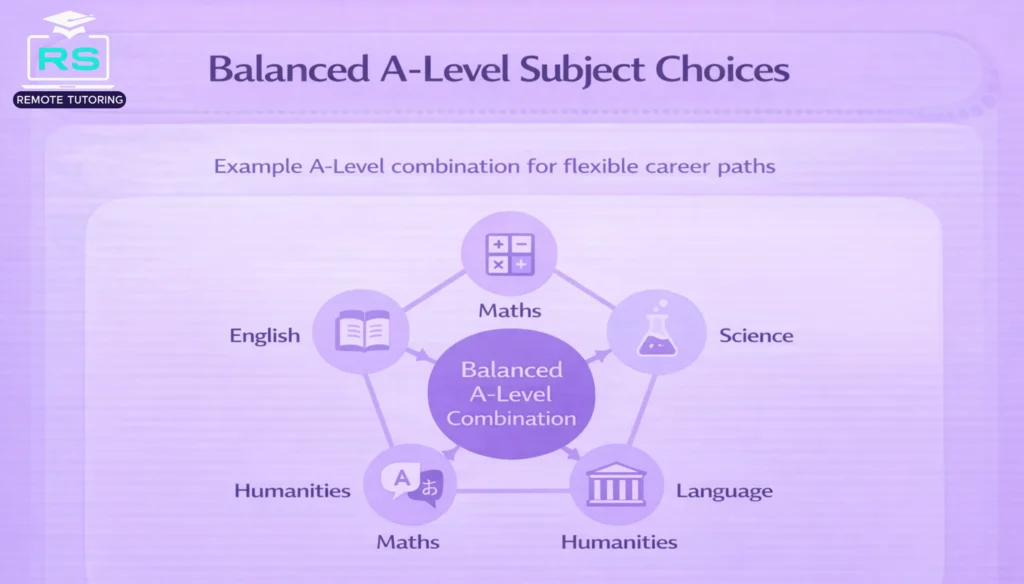
Many students have no specific career plan at 16. To keep your options open, choose a mix of subjects across different disciplines. For example:
- Mathematics is widely respected and useful in science and social sciences.
- English Literature provides strong analytical and writing skills.
- A science (Biology or Chemistry) maintains eligibility for science degrees.
- A humanities subject (History or Geography) develops critical thinking and essays.
- A language (French, Spanish, German) broadens cultural horizons.
You’ll need to pick only three or four, but using this template helps ensure you cover different skill sets and keep doors open. You could also explore Core Maths or an Extended Project Qualification (EPQ) to demonstrate independent research.
Worst A‑level combinations
There’s no formal list of forbidden subjects, but certain combinations are less favoured:
- Overlapping subjects: Choosing two very similar courses like Business Studies and Economics, or Media Studies and Film Studies, may be viewed as lacking breadth.
- Too many new subjects: Taking multiple subjects you haven’t studied before can be overwhelming and risky. Balance new interests with subjects you’re already strong in.
- All ‘soft’ subjects: If you take only subjects considered less academic (e.g., Photography, Media Studies and Dance), you may limit your options for competitive degrees.
- Ignoring Maths: Many degrees, including psychology, economics and geography, use quantitative skills. Not taking maths when you have the ability can restrict options.
The role of AS‑levels and independent study
AS‑levels (advanced subsidiary) are qualifications taken after one year of study. Oxford College notes that AS‑levels carry 40% of an A‑level’s UCAS points and can influence your predicted grades. Under the new system in England, AS grades do not count towards your final A‑level grade, but they still matter. They can help you decide whether to continue a subject to full A‑level or drop it after Year 12. Independent study increases at A‑level; you’ll typically have fewer classroom hours (3–5 subjects rather than 10–12 at GCSE), so time management becomes crucial.
How to choose your A‑levels: a step‑by‑step guide
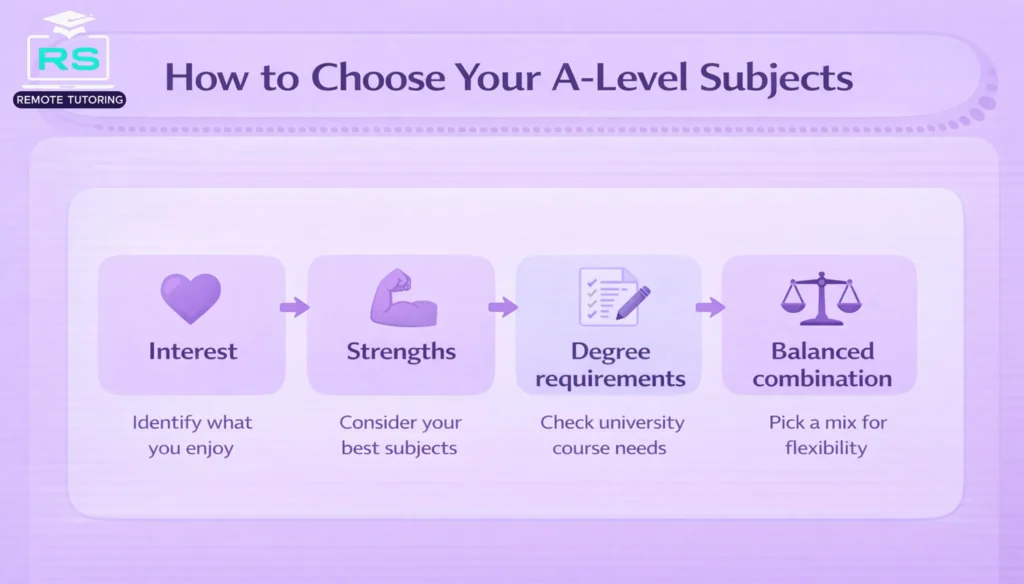
- Reflect on your interests and strengths: Identify subjects you enjoy and those you excel in at GCSE. Think about your favourite topics and whether you enjoy practical work, problem solving or essay writing.
- Research career pathways and degree requirements: Use UCAS search, university websites and career guides to find out which A‑levels are required for your desired career. If you’re undecided, check which subjects keep options open, such as facilitating subjects.
- Consider subject combinations: Choose a balanced mix that suits your interests and future plans. Avoid overlapping subjects and ensure you have at least one facilitating subject.
- Consult teachers and advisors: Speak to your teachers and careers advisors for honest feedback about how you’re likely to perform. They can advise if your subject choices are realistic and whether additional support (e.g., a maths booster course) is necessary.
- Check entry requirements and restrictions: Some schools require grade 6 or 7 in the GCSE subject to continue at A‑level. Confirm that your school offers your chosen subjects and whether there are timetable clashes.
- Attend open days and taster sessions: Many sixth forms and colleges run open evenings where you can experience sample lessons and ask questions. Use these to gauge whether you’ll enjoy the course.
- Think about workload and wellbeing: Taking four A‑levels can be intense; most universities only require three. Prioritise depth of understanding over quantity and maintain a balanced life.
Our Tutors UK‑specific and seasonal advice
In the UK, Year 11 students typically choose their A‑levels during the autumn and spring terms. Application deadlines for sixth form colleges often fall between January and March, so research your options early. Attend open days in autumn to meet teachers and explore facilities. Winter evenings offer time for reflection and online research; use spring to finalise your choices and complete application forms.
Weather can also affect your study routine. Darker evenings in the UK from October to February mean you should plan revision during daylight hours to stay energised. By May and June, daylight lasts until late evening, which is ideal for exam revision. Balance study with outdoor breaks to maintain mental health.
Frequently Asked Questions
What 3 A‑levels go well together?
The best trio of A‑levels depends on your interests and career goals. Popular combinations include Maths, Physics and Chemistry for engineering and science degrees; English Literature, History and Politics for humanities or law; Biology, Chemistry and Psychology for medicine or life sciences; and Mathematics, Economics and Politics for business and economics. Choose a combination that balances your strengths and keeps future pathways open.
What GCSEs did Kate Middleton get?
The specific GCSE results of public figures are rarely published in detail. The Princess of Wales (formerly Kate Middleton) attended Marlborough College and achieved strong GCSEs and A‑levels before studying at the University of St Andrews. However, exact grades are considered private and are not publicly confirmed.
What are the best subjects to choose for A‑level?
‘Best’ depends on your ambitions. Facilitating subjects such as Mathematics, English Literature, Physics, Biology, Chemistry, History, Geography and languages are widely accepted by universities. Pair these with subjects you enjoy and those required for your intended degree. For STEM careers, prioritise maths and sciences; for humanities, choose essay‑based subjects; for creative careers, include art, music or drama alongside a facilitating subject.
What subjects do Russell Group universities prefer?
Russell Group universities value facilitating subjects because they prepare students for a wide range of degrees. These include Maths, Further Maths, English Literature, Biology, Chemistry, Physics, History, Geography and modern or classical languages. However, they also welcome applicants with strong grades in subjects like Economics, Politics, Psychology and Music. Check individual university requirements for your chosen course.
Which A‑levels do universities not like?
Universities rarely blacklist subjects, but some have lists of ‘non‑preferred’ or ‘less effective’ subjects. These can include General Studies, Critical Thinking or overlapping subjects like Media Studies combined with Film Studies. The London School of Economics, for example, publishes a list of non‑preferred subjects. Always consult university websites and ensure at least one or two of your choices are facilitating subjects.
What are the 5 hardest A‑levels?
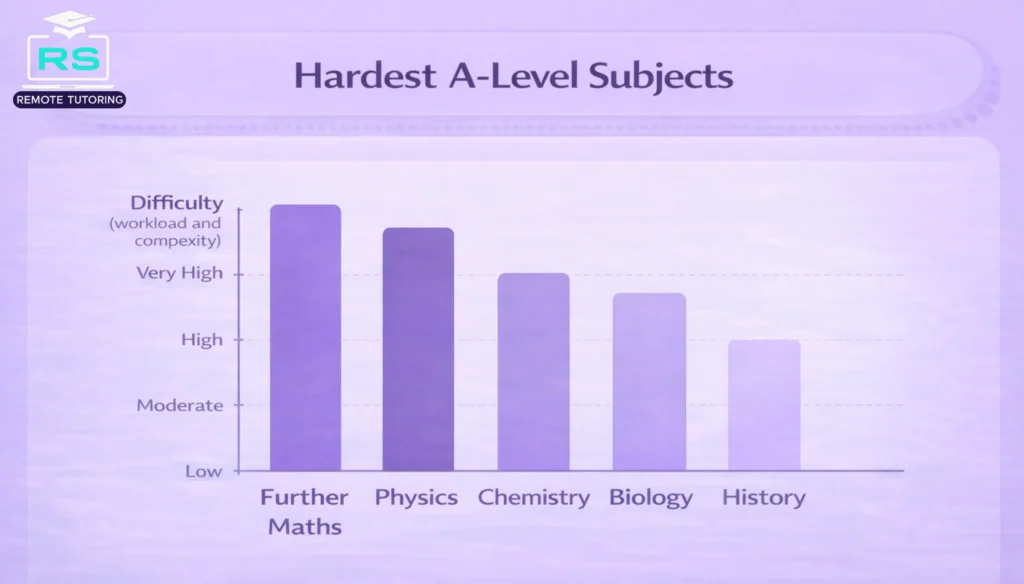
Difficulty is subjective, but many students and teachers consider Further Mathematics, Physics, Chemistry, Biology and History among the hardest A‑levels. These subjects require rigorous problem‑solving or extensive reading and essay writing. The workload and complexity of content make them challenging, but choosing subjects you enjoy will make them more manageable.
Which combination is the hardest in A‑level?
Combinations that involve three of the toughest subjects. For example, Further Mathematics, Physics and Chemistry or Further Mathematics, Physics and Biology are widely regarded as some of the hardest. They demand strong mathematical ability and time management. Combining demanding subjects with a creative or essay‑based subject can provide balance.
What are the three easiest A‑levels?
There is no universally easy A‑level; difficulty depends on your strengths. Some students find Sociology, Religious Studies and Media Studies more accessible due to straightforward content and fewer technical demands. Others might find languages or art easier if they have natural aptitude. Ultimately, the easiest subjects will be those you enjoy and understand well.
Final Thoughts
Choosing the right A‑level subjects is a big decision. If you’re uncertain, contact our experienced academic advisors for a free consultation. We’ll help you explore your strengths, career goals and university requirements to build a personalised A‑level plan for the 2026 intake.

Raja specializes in Physics and Maths, with over 5 years of experience. He offers KS2, KS3, and GCSE Science and Maths lessons. He graduated from one of the top universities in the UK.