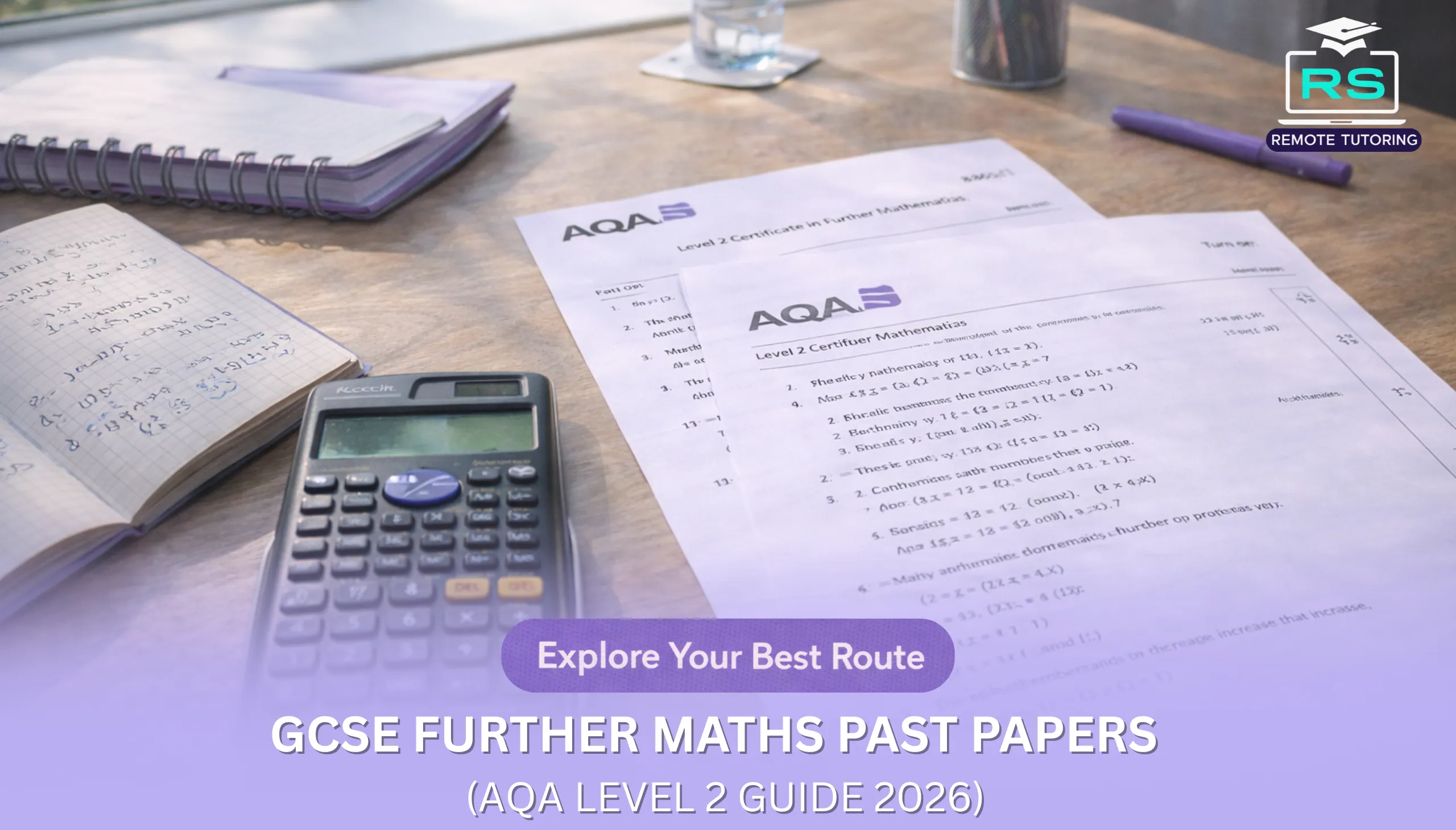
GCSE Further Maths is a unique qualification: it sits between the standard GCSE and AS‑level Maths, providing stretching material for students who relish algebra, trigonometry and calculus. In the United Kingdom, the AQA Level 2 Certificate in Further Mathematics (exam code 8365) is the most common programme, though Edexcel and OCR also offer additional maths courses. Success in this subject can open doors to A‑level further maths, competitive sixth‑form places and STEM careers. This guide covers deep into further maths GCSE past papers, shows you how to use them effectively, and explains everything you need to know for the 2026 exam cycle.
Jump to Section
Why Further Maths matters and who should take it
Further Maths is optional for most GCSE students, but it is ideal if you:
- Already achieve high grades in GCSE Maths and enjoy challenging problem solving.
- Plan to study A‑level Mathematics, Further Mathematics, Physics or engineering.
- Want to strengthen your university or apprenticeship applications with an extra qualification.
The course covers advanced algebraic techniques, matrices, trigonometry, geometry, calculus and proof. It also introduces topics from AS‑level such as the binomial theorem, radians and transformations of functions. Because the syllabus is more demanding, exam questions can be more complex and require deeper reasoning. Therefore, practising with past papers is vital.
Why use past papers?
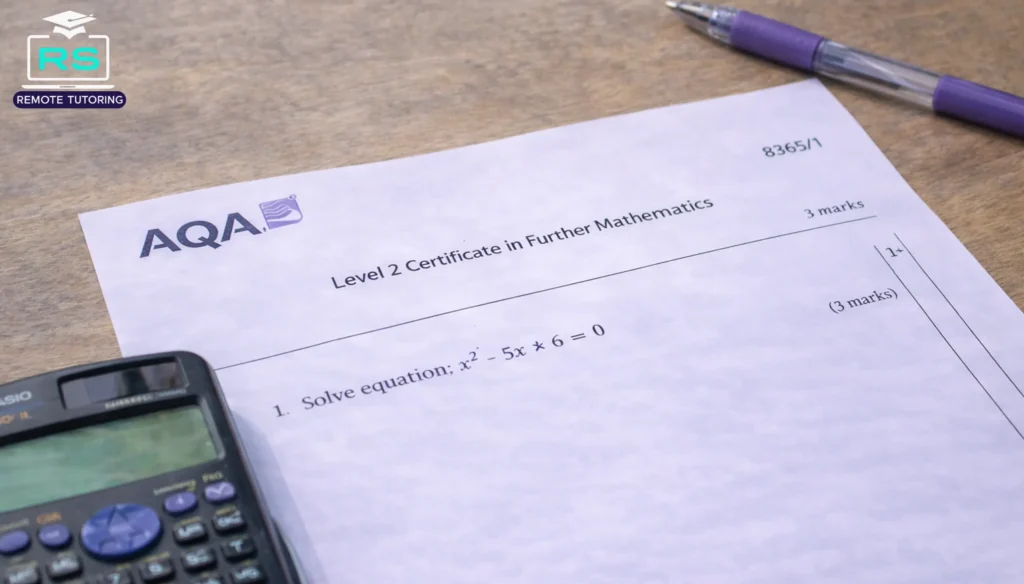
Past papers aren’t just about practice; they are diagnostic tools. Testing yourself with past papers helps you identify which topics need more revision. When you work through old papers, you discover:
- How examiners phrase questions and what level of detail is expected.
- Which areas (e.g., algebra, trigonometry, calculus) you struggle with most.
- How to manage time across two 80‑mark papers.
- How mark schemes allocate method marks and accuracy marks, enabling you to maximise partial credit.
By reviewing mark schemes and examiners’ reports, you can learn the exact reasoning behind solutions and avoid common mistakes. Past papers also familiarise you with the structure of the exam and reduce anxiety on test day.
Understanding the AQA Level 2 Further Maths qualification
Exam structure
AQA Level 2 Further Mathematics consists of two papers, each worth 80 marks:
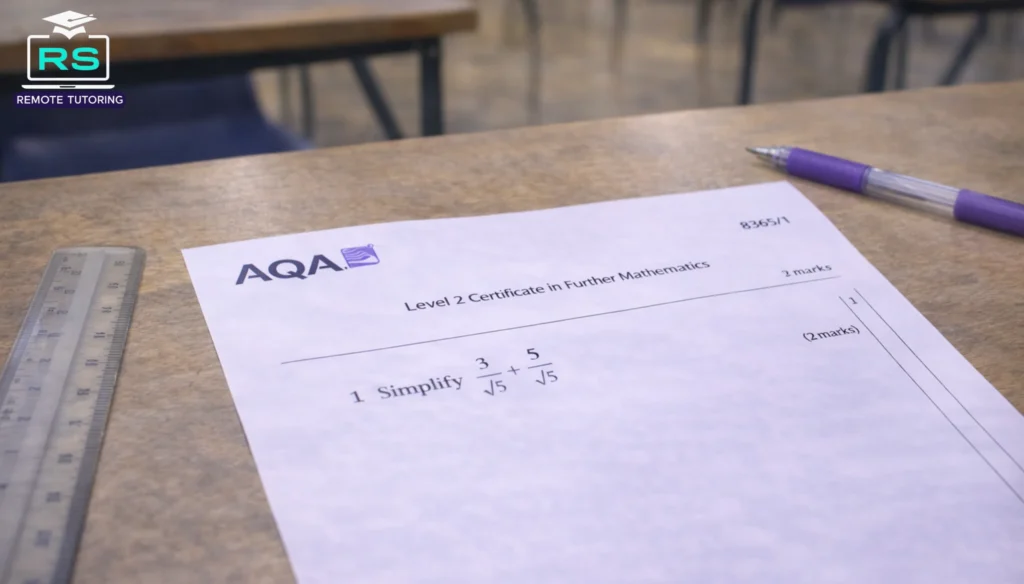
- Paper 1: Non‑calculator (8365/1): You must solve algebraic and trigonometric problems without a calculator. Topics include simultaneous equations, surds, algebraic fractions, trigonometric ratios, circle theorems and coordinate geometry.
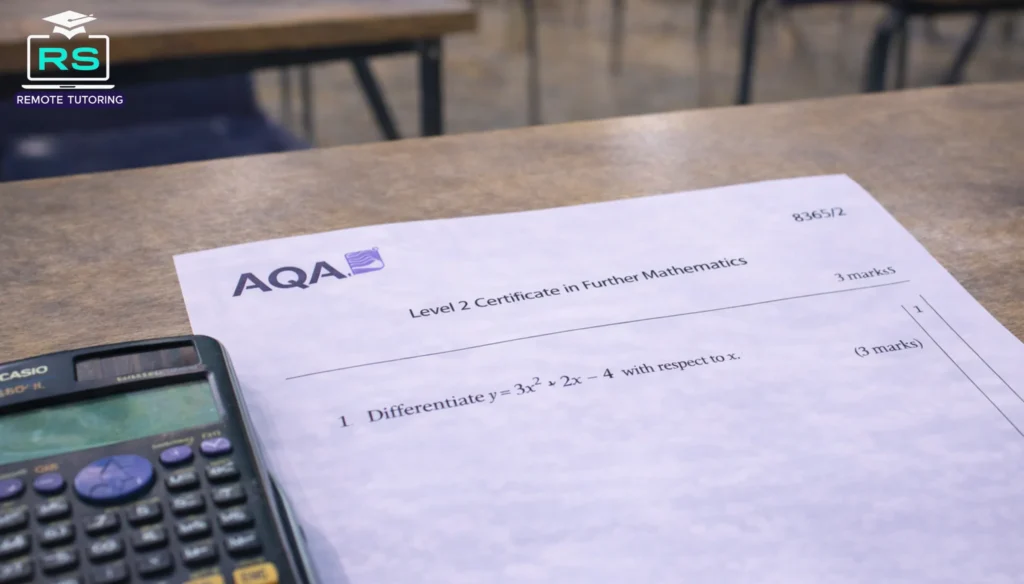
- Paper 2: Calculator (8365/2): You can use a scientific calculator. The paper covers quadratic sequences, matrices, transformations, calculus (differentiation and integration) and more advanced problem solving.
Each paper lasts 1 hour 45 minutes, and the overall qualification is graded from 9 to 4 (with 9 being the highest). Most schools teach Further Maths in Year 11 or as an after‑school course starting in Year 10.
Grade boundaries
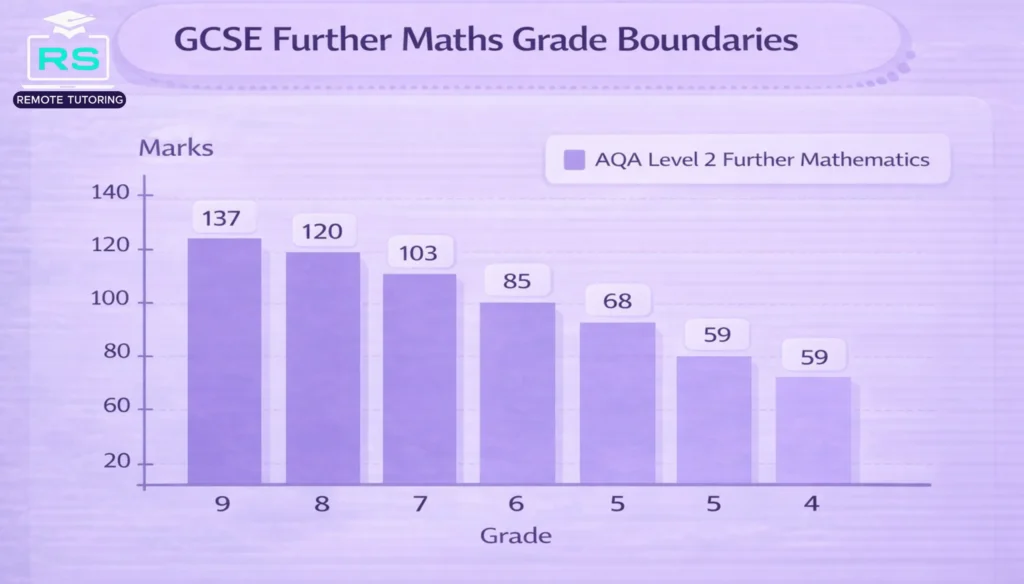
Grade boundaries vary slightly each year, depending on paper difficulty. AQA’s official boundaries for June 2023 show that out of a maximum 160 marks, a grade 9 required 137 marks, a grade 8 required 120, a grade 7 required 103, a grade 6 required 85, a grade 5 required 68 and a grade 4 required 59. Paper 1 boundaries were 68 for grade 8, 59 for grade 7 and 42 for grade 5, while Paper 2 boundaries were 69 for grade 8, 60 for grade 7 and 43 for grade 5.
Use these figures as a benchmark: in a typical year you might need around 86% for a grade 9 and around 40 to 45% for a grade 4. However, boundaries can shift slightly depending on the cohort and exam difficulty.
How to use Further Maths past papers effectively
Studying GCSEs past papers is not just about quantity; it’s about strategic practice. Here’s a step‑by‑step approach:
- Plan your revision schedule: Start with a diagnostic paper to identify strengths and weaknesses. Use your school’s revision timetable or create your own, ensuring you cover every topic across both papers.
- Learn the theory first: Review the specification and revision notes, ensuring you understand key concepts like quadratic functions, matrices, calculus and vector geometry.
- Attempt papers under timed conditions: Sit each paper in one sitting, following exam rules (no calculator for Paper 1, use a calculator for Paper 2). Use the same formulae and data sheet that you’ll get in the exam. If you find yourself running out of time, practise shorter tasks to improve speed.
- Mark your work with the mark scheme: After completing a paper, check each question against the mark scheme. Allocate marks for method and accuracy; be honest with yourself.
- Analyse your mistakes: Look up any unfamiliar techniques. If you lost marks for skipping steps, practise writing full solutions. Keep a notebook of errors and revisit it regularly.
- Use grade boundaries as motivation. Compare your score to the grade boundaries from previous years. Aim to consistently score above the grade you want. Remember that boundaries can vary; treat them as guides, not guarantees.
- Mix in predicted papers: Predicted papers are unofficial exams created by teachers and tutors to mimic upcoming papers. They’re useful for additional practice but remember they’re guesses, not leaks. Focus on official past papers first.
- Seek support: If a topic repeatedly causes difficulty, seek help from a teacher, tutor or online forum. You might also join a study group or enroll in revision courses.
Beyond AQA: Edexcel and OCR Further Maths
AQA’s Level 2 Certificate is the main Further Maths qualification in England, but there are other variants:
Edexcel Level 2 Further Mathematics (9FM0): Sometimes called “Additional Mathematics,” this qualification is targeted at high‑achieving GCSE students. It covers algebra, trigonometry, calculus and proof. Past papers are available from Edexcel’s qualification support pages. The exam comprises two papers similar to AQA’s: one non‑calculator and one calculator.
OCR Additional Mathematics (6993): This legacy course is no longer widely offered. Some independent schools still use OCR Additional Mathematics as a bridge to A‑level Maths. Past papers can be found through OCR’s resource finder and teacher forums.
If you are studying Edexcel or OCR further maths, always download the correct past papers and mark schemes. The topics and question styles are broadly similar to AQA but may emphasise different techniques, such as matrices or proof.
Exam preparation schedule for 2026
Autumn and Winter (September to December 2025)
- Review the specification and create a revision plan. Identify topics you haven’t studied before, such as calculus and matrices.
- Study new content in class and consolidate with notes. Use revision guides and online resources.
- Start practicing: complete the specimen papers and early past papers (e.g., 2021) to get a feel for the exam.
Spring (January to March 2026)
- Ramp up practice: do one past paper every two weeks. Work through each question fully; then mark it and review. Target your weakest topics with practice questions.
- Attend revision sessions or online courses offered by your school or local colleges. Many organisations run Easter revision courses in March and April.
- Use predicted papers if available to simulate the latest topics. However, don’t rely solely on these; past papers remain the most reliable indicator.
Exam season (May to June 2026)
- Final practice: in the month before the exam, sit a paper every week. Aim to replicate exam conditions and practise under timed constraints. Focus on endurance: each paper lasts 105 minutes.
- Review key techniques: revisit topics like algebraic fractions, transformations, matrices, trigonometric identities and basic calculus. Keep formulae, identities and the mark scheme criteria in mind.
- Take care of your well‑being. Keep a balanced routine with sleep, exercise and breaks. In the UK, May and June can have long daylight hours; schedule revision earlier in the day to avoid late-night fatigue.
- Exam day advice: arrive early at the exam centre; check the seating plan; ensure your calculator is allowed and in good working order; bring spare pens, pencils and a ruler; and keep calm. You’ll receive the formulae and data sheet with the paper.
Pro tips for success
Practise writing solutions clearly. Method marks require you to show working, especially in proofs and algebraic manipulation. Avoid skipping steps; write each line logically.
Understand the context. Many Further Maths questions are problem‑solving scenarios. Read the question carefully and decide which techniques apply.
Check units and accuracy. Round answers to the correct degree of accuracy. Write exact values where required (e.g., in terms of π).
Leverage mark schemes. For each paper, read the mark scheme to see what examiners expect. Note how marks are split between method and final answer.
Work with peers. Explaining solutions to classmates helps you solidify your own understanding. Consider forming a study group.
Frequently Asked Questions
What grade is 72% in Maths GCSE?
In recent years, a score of around 72% on a higher‑tier GCSE Maths paper has typically corresponded to a grade 7 or sometimes a low grade 8, depending on exam difficulty. For example, for AQA and Edexcel higher‑tier science papers, around 70–75% often sits near the grade 7/8 boundary. However, boundaries vary each year, so use the official grade boundary tables released on results day to know the exact grade.
How difficult is Further Maths in GCSE?
GCSE Further Maths is generally considered one of the most challenging GCSEs, as it introduces A‑level topics like differentiation, integration and matrices. The course is designed for high‑achieving students who have a strong grasp of standard GCSE Maths and enjoy abstract problem solving. Success requires dedication, thorough revision and regular practice with past papers and mark schemes.
How hard is it to get a * in Further Maths?
In the AQA Level 2 Certificate, the top grade is grade 9, equivalent to an old A*. Achieving a 9 means scoring close to 90% across both papers. Only a small percentage of candidates attain this grade. To reach it, you must master all topics, practise extensively, and minimise careless errors. Work through every past paper available and seek support on topics you find hardest.
How to get a 9 in GCSE Further Maths?
Achieving a grade 9 requires strategic revision: start early, learn every topic thoroughly, and practise under timed conditions. Use the mark scheme to understand how marks are awarded and aim to score full marks in topics you find easier to offset any lost marks in trickier questions. Target above 86% in your practice papers.
What are the 5 hardest GCSEs?
Opinions vary, but many students consider Further Maths, Physics, Chemistry, Computer Science and Foreign Languages among the hardest GCSEs. These subjects demand abstract reasoning, problem‑solving skills and a strong memory for definitions and formulae. Further Maths is particularly challenging because it covers A‑level content and requires high fluency in algebra and calculus.
What is the hardest maths in GCSE?
Within the standard GCSE Maths specification, topics like circle theorems, quadratic inequalities, trigonometric identities and vector geometry are often cited as the hardest. In the Further Maths GCSE, calculus and matrices are new topics that many students find challenging. Regular practice with past papers helps demystify these topics.
How many people get a 9 in Further Maths GCSE?
The exact percentage varies each year. Since Further Maths GCSE attracts high‑achieving students, the proportion of candidates awarded a grade 9 is higher than in standard GCSE Maths. In some cohorts, around 10–15% of entrants achieve a grade 9, though this can differ depending on paper difficulty and candidate numbers. Remember that grade boundaries change each year.
Conclusion
Ready to conquer Further Maths GCSE? Our expert tutors specialise in AQA Level 2 Further Mathematics and can help you master advanced topics, develop exam technique and maximise your grade. Book a free consultation today to discuss your goals and get tailored support for the 2026 exams.
Raja specializes in Physics and Maths, with over 5 years of experience. He offers KS2, KS3, and GCSE Science and Maths lessons. He graduated from one of the top universities in the UK.