
GCSE exams, the hardest exams often considered in the UK. Students appraising in the GCSEs are really concerned about the preparation and pay attention to every nitty gritty detail encompassing the exams strategy or the exam preparation. Not only the students but parents also show deep attention towards the students’ preparation and the extra guidance students are availing other than the school. But the question arises, despite the every successful attempt of the preparation phase;
How many hours should I study for the GCSE exam?
The question seems really simple but it is full of confusion, stress and even unnecessary pressure. It is often believed by most of the students that they should study long hours in order to achieve success, while other schools of thought ignore the actual value of time. But the ultimate truth lies somewhere in between.
Research in education and cognitive science shows that there is no fixed number of hours that guarantees the desired success students are preparing for.Instead, what matters most is how effectively the study hours are used. This can be whole one through structured and well organised planning
The following guide encapsulates all the necessary measures, explaining how many hours should a student preparing for GCSE in the UK study and how to use those hours strategically to gain the desired success.
Jump to Section
Understanding Why Studying More Hours Does Not Always Mean Better Results
One of the biggest fallacies is that Studying more hours is ultimately equal to better results.but this is not the solution of every problem In reality this approach highly backfires. Recent studies in the educationist field encapsulates that the more inclination towards passive revision such as re reading notes, or highlighting textbooks has very low retention rates. Students often feel productive but it’s not beneficial for long term use and the information is very little that actually sticks to the brain
Contrary to this, active revision techniques such as integrating flow charts, practising past papers are far more effective even if done for a few hours.
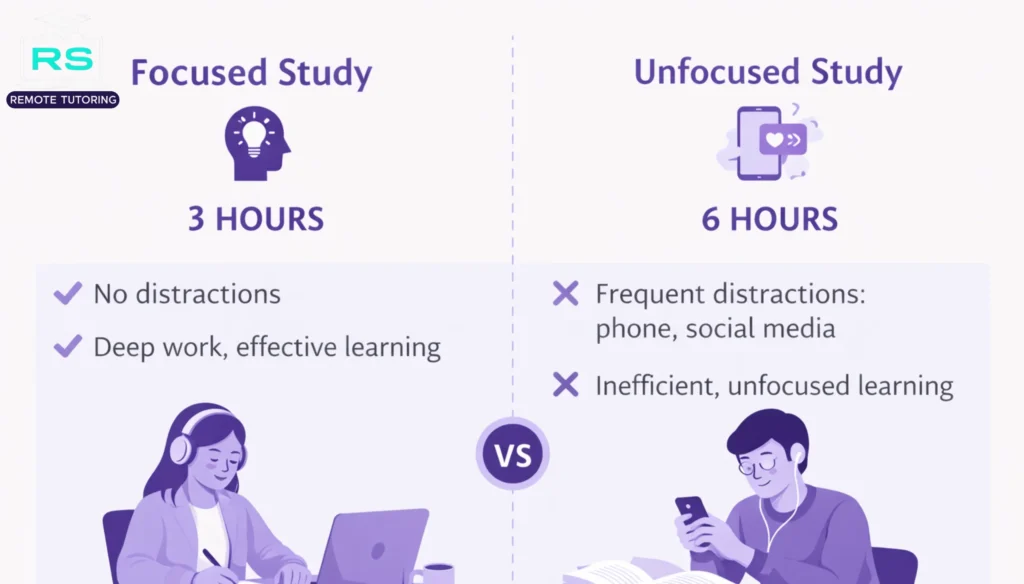
This clearly suggests that 3 focused hours are much more beneficial than 6 – 7 unfocused hours.
Most Recommended GCSE Study Hours
To answer the most persistent question, the following includes the deep and clear guidelines for the students appearing in GCSEs across the UK because the structured approach to revision is the ultimate key for the desired success.
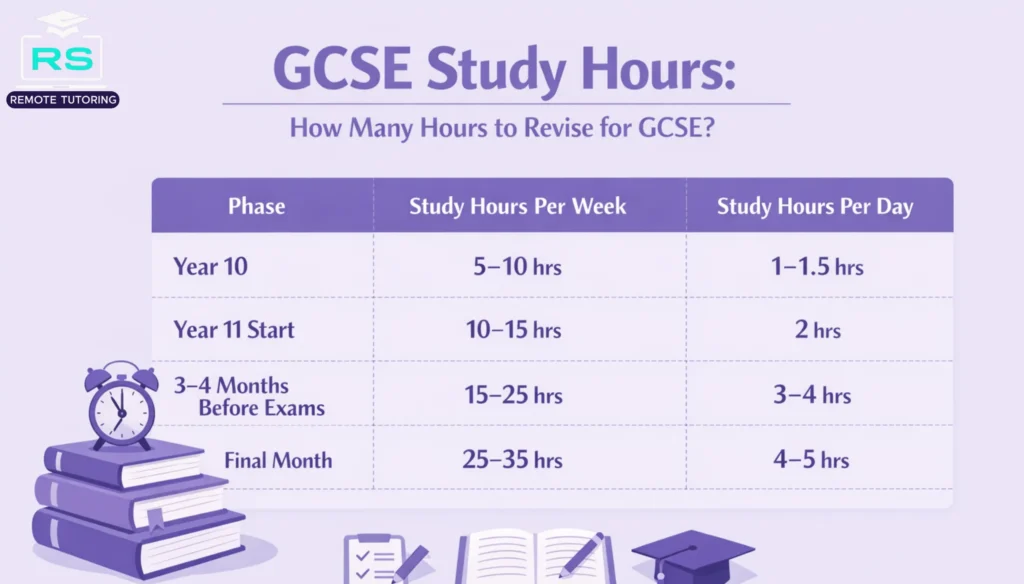
Year 10: Building the Strong Foundation
The early year is marked by the strong foundational phase. During this year the students should focus on understanding the concepts rather than fully dwelling themselves in the intense revision phase. The most recommended study time for the initial foundation phase is;
- 5–10 hours per week
- Around 1–1.5 hours per day
At this stage, students should focus on;
- Strengthen core subject knowledge
- Develop good study habits
- Avoid burnout from excessive pressure
Consistency matters a lot more than intensity.
Start of the Year 11
At the onset of the year 11, the year is marked by the starting of the structured revision phase. And during thai time period, the revision becomes more focused and intentional.
The most recommended study time during the crucial phase is;
- 10–15 hours per week
- Around 2 hours per day on weekdays
During the process Students should;
- Begin revising key topics
- Use active recall techniques
- Start solving basic past paper questions
Research in the areas suggest that the early revision reduces stress and improves long term memory retention.
3-4 Months Before the GCSE exams: The intense crucial Phase
Before the actual exams begin it is very important for the students to master each and every topic because the last 3-4 months are intensive for revision, and this is the phase where revision takes a serious turn. The most recommended study time is
- 15–25 hours per week
- Around 3–4 hours per day
At this stage should should
- Focus heavily on past papers
- Identify weak areas
- Practice exam techniques
This phase is critical because exam performance depends more on application than memorisation.
The Actual Peak Preparation Phase: Unlocking the Final Month
The final months are more demanding, but the months should be approached strategically. The most recommended study time for the final month is;
- 25–35 hours per week
- Around 4–5 hours per day
However, research warns against overloading:Studying beyond 5–6 hours daily leads to diminishing returns.
The focus should be on:
- Refining knowledge
- Reviewing mistakes
- Strengthening weak areas
During the Exams: Smart Maintenance Strategy
Managing time effectively during the exam time period is the ultimate concern of the students and it is even more demanding but the students’ stress is reduced to some extent. The most recommended study time during the exam season is;
- 2–4 hours per day
At this stage:
- Focus on light revision
- Review summaries and flashcards
- Avoid cramming new content
What Makes Study Hours More Effective?
After unlocking the exam revision hours, it is important to understand what makes the study hours more effective and preparation friendly. Furthermore, simply sitting at the desk is not enough. The effectiveness of study time depends on how the brain processes information.
The Focused Study Sessions
Research shows that concentration drops significantly after every 30-50 minutes. The ultimate solution to the concentration problem is the structured study blocks. This clearly means;
- 25–50 minutes of study
- 5–10 minute breaks
This improves both productivity and retention.
Active Revision Method:
One of the biggest mistakes that GCSE students make is heavily relying on passive revision methods, r reading notes, highlighting textbooks. These are often the low impact methods. The ultimate key that boost the revision process is the active revision method, which includes;
- Practice questions
- Flashcards
- Self-testing
Active recall strengthens memory pathways and improves exam performance.
Spaced Repetition: Study Less, Remember More
Instead of cramming everything, students should revise the topics over time. This means that
- Day 1 → Learn
- Day 3 → Review
- Day 7 → Test
This method reduces total study hours while improving long-term retention.
How Top Performers Actually Study
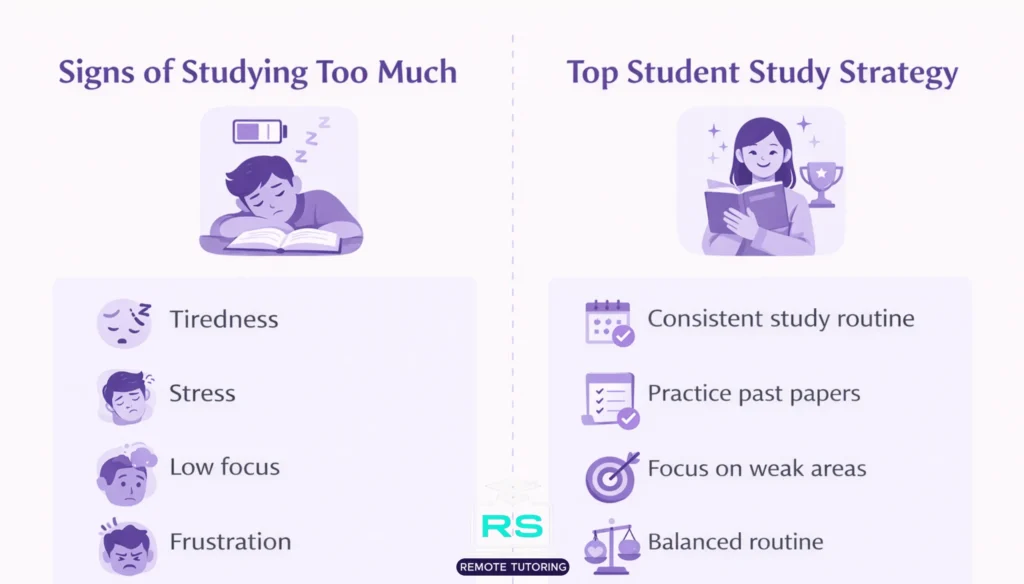
High achieving students do not study for hours Instead thy;
- Study consistently over month
- Focus on weak area
- Use past papers regularly
- Maintain balance to avoid burnout
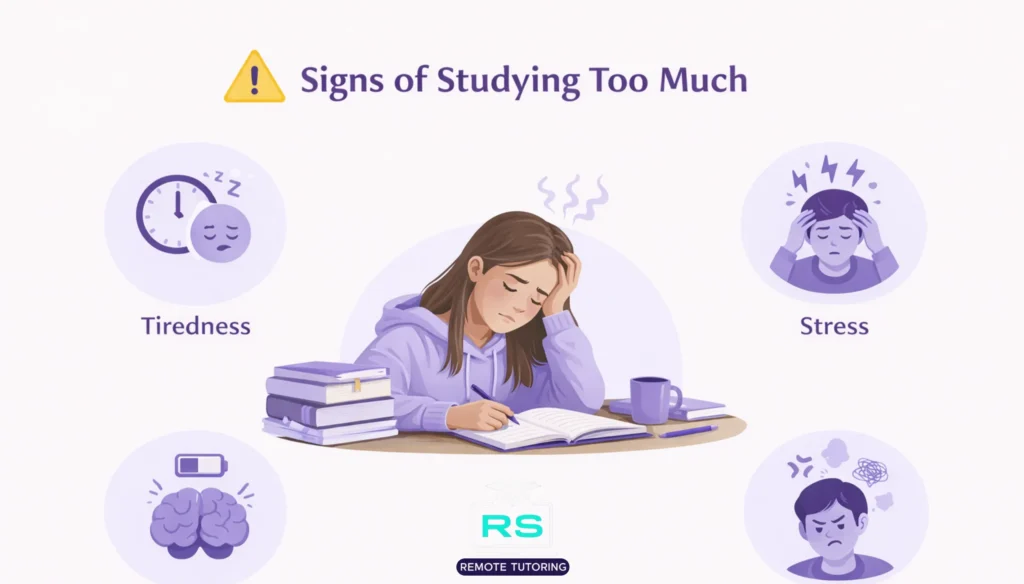
Signs revealing You Are Studying Too Much
Studying more isn’t always better. In fact, overstudying can harm performance.
Look out for:
- Mental exhaustion
- Difficulty concentrating
- Forgetting recently studied topics
- Lack of motivation
If these occur, it’s a sign to: Reduce hours and improve study methods.
Common Mistakes Students Make About Study Hours
Avoid these common pitfalls:
- Studying for long hours without breaks
Leads to burnout and low retention - Cramming before exams
Ineffective for long-term memory - Ignoring weak subjects
Creates gaps in performance - Passive revision methods
Gives false confidence
FAQS
Do top students study all day?
No, they focus on efficient and structured study sessions.
Is studying 6 hours a day too much?
Yes, unless it’s close to exams and includes proper breaks.
What is the best study method for GCSE?
Active recall, spaced repetition, and past paper practice.
Final Thoughts
So, how many hours should you study for GCSE?The truth is, success doesn’t come from studying the longest, it comes from studying the smartest.By combining the right number of hours with proven techniques like active recall, spaced repetition, and consistent revision, students can achieve top GCSE grades without burnout.
For parents and students alike, the goal should not be to maximise study hours, but to maximise learning efficiency.

Raja specializes in Physics and Maths, with over 5 years of experience. He offers KS2, KS3, and GCSE Science and Maths lessons. He graduated from one of the top universities in the UK.