
Changes to the 2026 GCSE syllabus will be incremental rather than a wholesale overhaul. Confirmed updates include continued use of formula and equation sheets in mathematics, physics and combined science through 2027, subtle tweaks to English Language and Religious Studies assessments, and the introduction of a new “The Sciences” double award in Wales from 2026.
Meanwhile, a longer‑term curriculum review is under way with talk of reducing content in several subjects and expanding breadth, but no sweeping reforms will be rolled out before 2026. We’ll decode what these changes mean for students and parents, look at how exam boards and governments design new specifications, and offer advice from teachers and expert tutors to help you prepare.
Jump to Section
A gentle note about tone and purpose
This guide is written with an aims to strike a balance between factual information and empathetic support. If you feel worried about changes to the syllabus, you are not alone. With clear information and a plan, we can turn uncertainty into an opportunity to learn and grow.
GCSE Syllabus Update 2025 – Is Your Child Ready?
- Understand the latest GCSE syllabus changes
- Personalised study roadmap for your child
- Expert guidance from our top UK GCSE tutors

Dr. Anna Müller
Physics Tutor

Daniel Evans
Computer Science Tutor

Olivia Brown
Science Tutor
Why do GCSE syllabuses change?
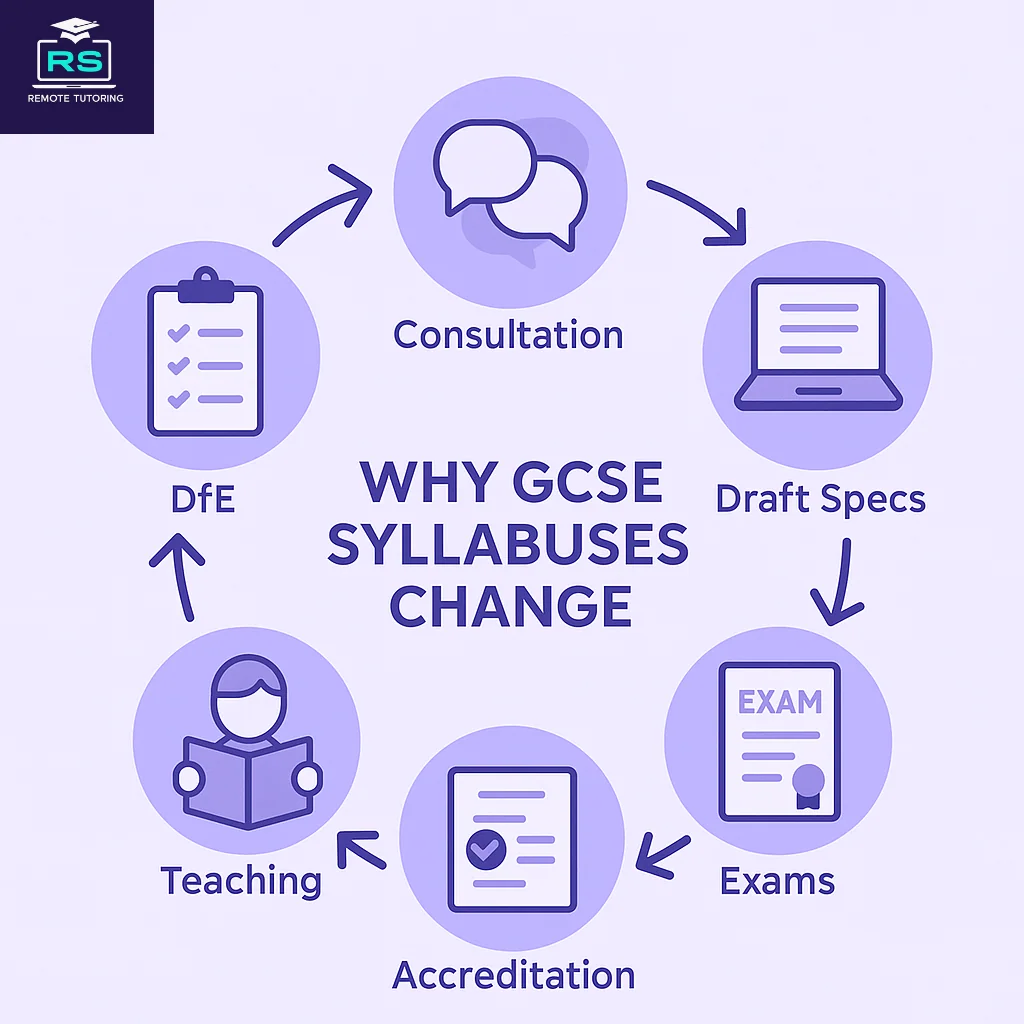
The GCSE examinations you see today are the product of decades of evolution. It takes years for any reform to make its way from concept to classroom. Typically, the Department for Education (DfE) or a devolved government body commissions a review, education experts and exam boards consult teachers and universities, draft specifications are published, and then the new courses are taught from Year 10 two years before the first exam. This cycle can take five years or more. The last major reform occurred between 2015 and 2017 when linear exams replaced modular ones and the A–G* grade scale became the 9–1 scale.
Reforms are typically driven by:
- Fairness: Ensuring that qualifications accurately differentiate between students of different abilities and minimise inequalities caused by exam styles.
- Curriculum relevance: Updating content to reflect the knowledge and skills needed in higher education and industry.
- Workload: Balancing depth and breadth so that students are stretched without being overwhelmed.
In 2026 the changes are comparatively modest. This is partly because another curriculum and assessment review is under way, and the government does not want to introduce large reforms until that review concludes. Nevertheless, there are important updates you should know about.
Confirmed syllabus changes for 2026

Continuing formula and equation sheets in maths and science
During the pandemic, students sitting GCSE mathematics and physics were given formula and equation sheets so they didn’t have to memorise every equation under stressful conditions. Following a consultation by Ofqual and the DfE, students taking GCSE mathematics, physics and combined science will continue to receive formula and equation sheets in exams through 2027.
The support sheets will be published by September of the academic year of the exam so teachers can integrate them into lessons. This change recognises that problem solving matters more than rote memorisation; it also reduces stress and levels the playing field.
What this means for you:
- If you’re taking GCSE maths, physics or combined science in 2025–2027 you don’t need to memorise every formula, but you do need to know how and when to apply them. Use revision time to practise using the formulae effectively.
- Teachers and tutors can download clean copies of the formula/equation sheets from exam boards once they are published, so there’s no surprise on exam day.
English Language (AQA) updates for summer 2026
The AQA exam board is making light-touch changes to the GCSE English Language paper in summer 2026. These are meant to improve clarity and fairness without altering the overall structure or total marks. Key changes include:
- Paper 1: Question 1 becomes multiple-choice; Question 3 will focus on a single effect rather than a series; Question 4 will no longer refer to a “student” in the text; Question 5 will remind students they can use their imagination and may write an opening instead of a full narrative.
- Paper 2: Question 2 wording clarified to help students understand expectations; Question 4 wording simplified; mark schemes updated for clarity.
Implications:
- Students taking exams in May/June or November 2026 should practise with sample papers using the new question wording. AQA will release updated sample papers and mark schemes.
- The number of questions, total marks and assessment objectives stay the same, so revision resources largely remain relevant.
Religious Studies (AQA) updates for 2026

AQA is also updating the Religious Studies specification A (8062) and the short course (8061). The changes are described as “light but meaningful” and come into force for exams in 2026. Notable amendments include:
- Replacing the word “contrasting” with “different” in 4‑mark AO1.3 questions to reduce ambiguity.
- AO1 5‑mark questions will become 6 marks, rewarding students more clearly for referencing sources and applying them.
- Question sections will follow a 1, 1, 4, 6, 12 mark pattern (i.e., multiple-choice, short definition, influence, extended explanation, essay). The 2‑mark questions are replaced by 1‑mark short questions to emphasise accurate knowledge.
- The content of the specification remains unchanged, and these updates do not affect earlier exam cycles.
Practical advice: Practice using sample papers with the new mark distribution. In our tutoring sessions we teach students to plan their answers according to mark weightings: spend less time on one‑mark questions and more on extended essays. Our tutor Sarah Ahmed, who specialises in Religious Studies, says, “Students often over-write on shorter questions. Practising with the new layout helps them allocate time effectively.”
New Science GCSE in Wales – “The Sciences” (Double Award)
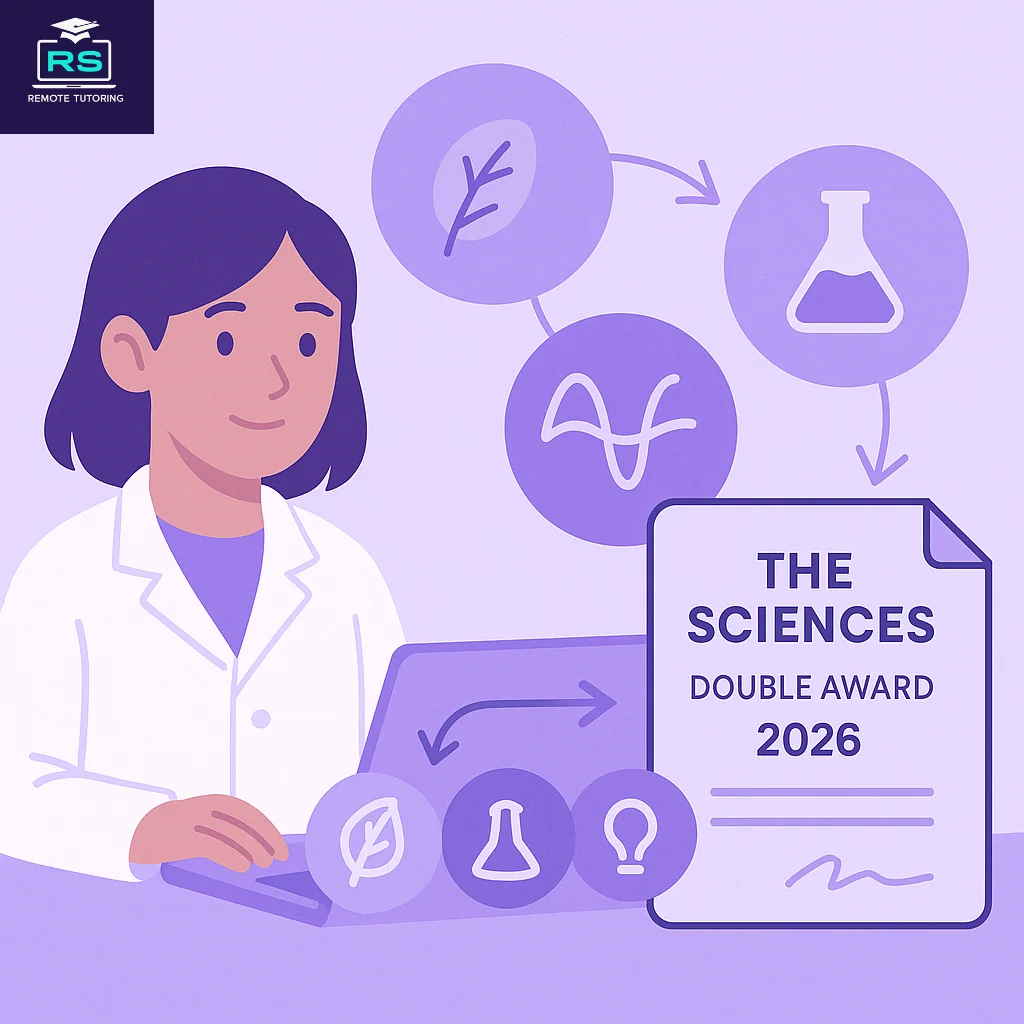
In Wales, the Curriculum for Wales brings a raft of new GCSEs across six Areas of Learning and Experience, phased in from September 2025 and 2026. One headline change is the introduction of “The Sciences” double award, originally slated for 2025 but delayed to 2026 to allow for refinement. The new specification will:
- Combine physics, chemistry and biology into an interdisciplinary qualification with two equally weighted exams.
- Spread assessment across Years 10 and 11 to reduce pressure and better capture progress.
- Remove the separate “Bringing the Sciences Together” synoptic unit and instead embed synoptic elements into each assessment.
- Offer an integrated science single award in 2026 alongside the double award.
Existing single-science GCSEs (biology, chemistry, physics) will remain available for students starting in 2025 but will be phased out by 2026.
GCSE Syllabus Update 2025 – Is Your Child Ready?
- Understand the latest GCSE syllabus changes
- Personalised study roadmap for your child
- Expert guidance from our top UK GCSE tutors
Dr. Anna Müller
Physics Tutor
Daniel Evans
Computer Science Tutor
Olivia Brown
Science Tutor
Updates to other subjects

While the big headlines centre on maths, science, English and Religious Studies, there are other tweaks worth noting:
- Modern foreign languages (MFL): The new MFL GCSE specifications emphasise phonics, dictation and reading aloud, and reduce the vocabulary list. Teachers are concerned about gaps between GCSE and A‑level but expect the spec to remain in place until at least 2029; exam boards will review outcomes after the first cohort completes A‑levels.
- Computer Science (AQA): From 2026, AQA’s Computer Science specification will be updated to reflect changes in technology and pedagogy (e.g., data representation, programming paradigms). The exam board emphasises the importance of computational thinking, coding in high‑level languages and understanding computer architecture. AQA will release details and sample questions in 2025.
- Design and Technology, Digital Media & Film, Health & Social Care, History, Physical Education: These are part of the second wave of new GCSEs in Wales for first teaching from September 2026. The new qualifications will include more non-exam assessment and digital components, aligning with the new curriculum and digital competence frameworks.
How new specifications are developed
Understanding the development process can demystify why changes take time and why teachers sometimes feel unprepared. Here is a simplified overview:
- Initiation: Government announces a curriculum review or the need to update a specific subject. For example, the DfE’s decision to consult on formula sheets for maths and science.
- Consultation: Exam boards and bodies like Ofqual or Qualifications Wales consult teachers, university academics and employers. Public consultations gather feedback; in the 2024 consultation, 94-95 % of respondents supported continuing formula sheets.
- Drafting: Subject experts write draft specifications and sample assessment materials. These go through multiple iterations, with regulators checking alignment to subject content requirements and fairness.
- Accreditation: Final draft specifications are submitted to regulators (Ofqual, Qualifications Wales). If approved, they become accredited specifications.
- Teacher training: Exam boards run training courses and webinars for teachers. Teachers then adapt schemes of work, lesson plans and resources. According to one teacher on Reddit, training can take “a full day briefing plus ongoing monitoring”.
- First teaching: Typically September for students starting Year 10. The first cohort sits exams two years later.
- Review and refine: After the first few years, exam boards adjust mark schemes and, if necessary, modify specifications.
Our own tutors stay abreast of these developments and regularly attend training sessions. Emily Johnson, our English tutor, notes: “With the 2026 English Language changes, the fundamentals remain the same. It’s all about improving clarity so that students aren’t tripped up by ambiguous wording.”
Potential future reforms and speculation
Beyond confirmed changes, there is speculation about broader reforms. A recent curriculum review signalled a desire to reduce content and encourage a broader curriculum, potentially replacing the English Baccalaureate (EBacc) requirement with a more flexible approach. Teachers debate whether additional content cuts are needed, especially in subjects like French and Spanish where grade boundaries are considered harsh and the jump to A‑level is steep.
Public commentary suggests that a new government might roll out reforms after 2026, but with a general election due by 2029 and pressing issues like immigration and NHS funding, big educational reforms may be deprioritised.
Our recommendation: Keep an eye on announcements from Ofqual, the DfE and exam boards. At the time of writing, no new system‑wide changes have been confirmed for 2026 beyond those listed above.
Making sense of assessment objectives (AOs)
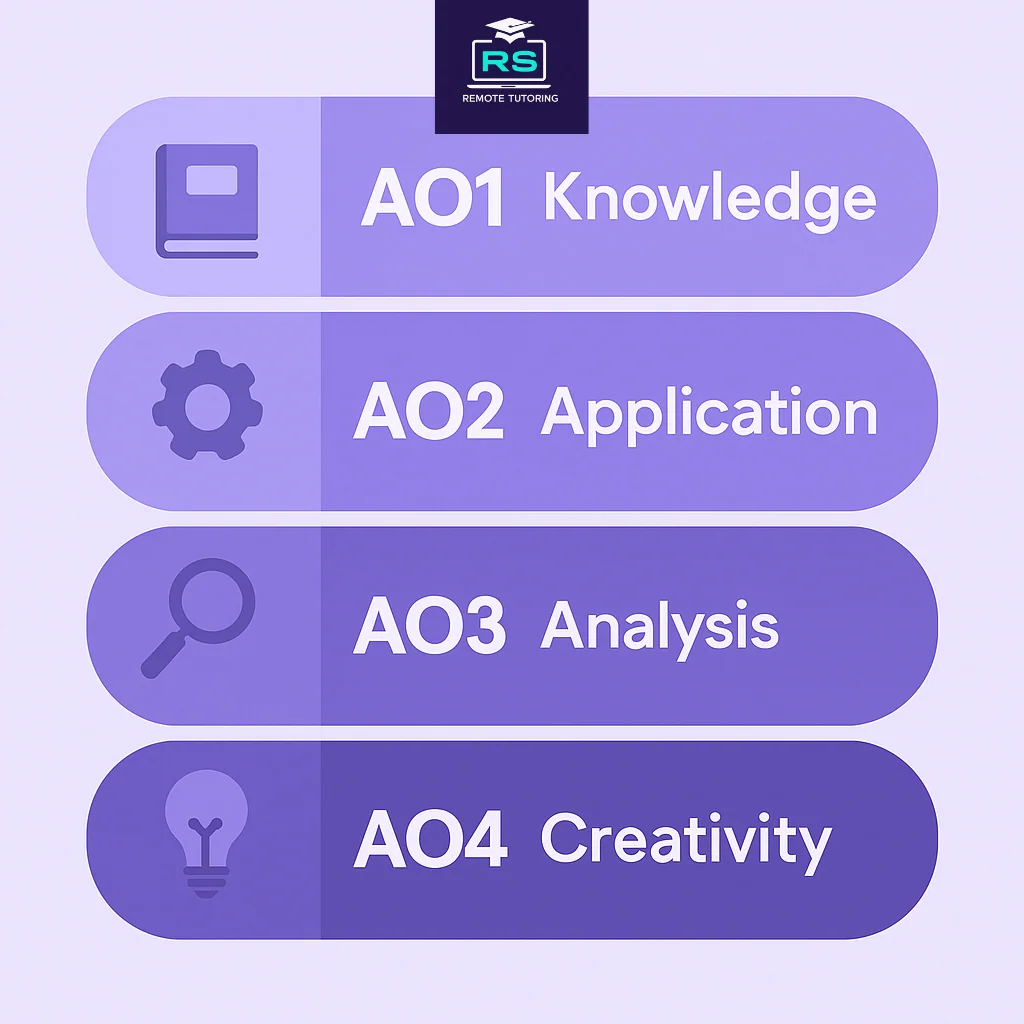
Every GCSE subject uses assessment objectives (AOs) to describe the skills and knowledge students must demonstrate. Understanding AOs helps you tailor your answers to what examiners want. For example:
- AO1 – Knowledge and understanding: Recall facts, definitions and details.
- AO2 – Application: Apply knowledge to solve problems or interpret information.
- AO3 – Analysis and evaluation: Break down information, compare ideas, critique arguments.
- AO4 – Creativity and synthesis: Produce original ideas, propose solutions or alternative approaches.
Each subject and exam board weights these objectives differently. In English, AO1 and AO2 might dominate, while in maths AO1 and AO2 focus on recall and problem solving. In some humanities subjects, AO3 may carry higher weighting. Our tutors help students dissect mark schemes to ensure they address the right skills; for example, Mark Robinson, our maths tutor, explains that high marks on AO2 come from showing your method clearly and using correct mathematical language.
How examiners mark GCSE papers
Parents often ask, “Who marks my child’s paper?” and “How can I trust the result?” Exam marking is a robust process overseen by exam boards and regulators. Here’s a simplified overview based on statements from Ofqual and exam boards:
1. Setting and quality assurance: Experienced teachers write exam questions and draft mark schemes. Senior examiners and subject experts check them before approval.
2. Standardisation: Before marking begins, examiners attend training meetings (online or face‑to‑face). They mark sample scripts and receive feedback to ensure they interpret mark schemes consistently. Examiners who do not meet the standard are retrained or removed from marking.
3. Script distribution: Completed exam papers are scanned and divided into digital bundles. Examiners mark either whole papers or specific questions. On-screen marking platforms insert “seed” scripts at regular intervals, scripts that have been pre-marked by senior examiners. If an examiner’s marking diverges from the seeded score, their marking is paused and reviewed.
4. Monitoring: Senior examiners monitor marking progress. Moderators randomly sample scripts for quality control. Examiners typically have three to four weeks to complete their allocation. As one English examiner explained online, they might spend two hours each evening marking papers under strict deadlines.
5. Awarding grades: After marking, senior examiners and statistical experts decide grade boundaries. They compare scripts from the current cohort with scripts from previous years just below previous grade boundaries, and use statistical evidence to set boundaries that maintain standards. Ofqual and Qualifications Wales review and challenge these decisions to ensure fairness.
6. Results and appeals: Marks are aggregated, and results are released. If you disagree with a grade, your school can request a review. Only in rare cases do grades change significantly; a small shift may occur if marking errors are found.
Understanding this process can build trust. Mark schemes and examiner reports are published after exams and are valuable resources for future revisions. Our article on mark schemes provides more detail on this process.
Using the updated syllabus to plan your GCSE journey
For students
- Familiarise yourself with changes early. Ask your teacher which exam board and specification you follow. For example, if you’re in Wales you might be taking the new integrated science or double award The Sciences GCSE; if you’re in England you might be using formula sheets in maths and science.
- Make the formula sheets your friend. Practise using the formula/equation sheets so you know exactly where to find each equation. At RS Remote Tutoring, we use past papers with the same support materials to simulate the exam environment.
- Adjust revision for AQA English and Religious Studies. Download the updated sample papers and practise with the new question formats and mark distribution. Focus on planning concise answers and using sources effectively.
- Stay flexible. Minor changes could still be announced before the 2026 exam cycle. Keep an eye on announcements from exam boards and regulators.
For parents
- Stay informed. Teachers will update you on any new specification details. Look for official communications from your child’s school and exam boards rather than relying on rumours.
- Encourage practice with new materials. Past papers are still invaluable, but ensure they align with the new structures. Use our revision guides and mark schemes as a supplement, not a substitute for deeper learning.
- Support mental health. Change can be stressful. Provide reassurance that adjustments are manageable with proper planning. Encourage a balanced revision schedule with breaks and healthy habits.
Insight from our tutors
Our tutors teach across multiple exam boards and adapt quickly to new specifications. Here are a few personal stories and tips:
Mark Robinson – Mathematics
“When the pandemic formula sheets were introduced, I saw students relax about memorisation but still struggle with application. In our sessions we treat the formula sheet like a map: it tells you where you can go, but you still need to know how to navigate. I make sure students practise deriving equations from first principles so they understand why a formula works. This deeper understanding is crucial when exam questions combine multiple topics.”
Emily Johnson – English Language & Literature
“The subtle changes to the 2026 English Language paper mostly clarify wording. Many marks are lost because students misinterpret a question. I emphasise reading the question aloud and underlining key command words. I also teach students to plan before they write: a five‑minute plan can make the difference between a disorganised answer and a well‑structured response.”
Sarah Ahmed – Religious Studies
“Religious Studies is often seen as straightforward, but the 2026 update shows that exam boards are looking for a deeper engagement with sources. One of my students used to summarise religious teachings without applying them to the question context. After practising with new six‑mark questions and learning to reference sources properly, she jumped from a Grade 5 to Grade 7. The key is to weave relevant teachings into your argument rather than listing them.”
These stories highlight that success isn’t about memorising mark schemes but about understanding concepts and practising application.
Frequently asked questions about the GCSE syllabus update
Will there be more radical changes after 2026?
Possibly. A curriculum review is under way and may recommend reducing content and broadening the curriculum. However, large reforms typically take several years to implement.
What if I’m sitting exams in 2025?
Most of the changes described here apply from 2026 onwards. For example, AQA English Language changes do not affect 2025 exams, and formula sheets will still be provided in 2025.
Do all exam boards follow the same changes?
English and Religious Studies updates discussed here are specific to AQA. Other boards may have different timelines. Always check your own board’s announcements.
Are grade boundaries going up or down?
Boundaries vary each year based on exam difficulty and cohort performance. Boards aim to maintain consistent standards across years, so boundaries may move slightly up or down. Focus on learning and practising rather than guessing boundaries.
What if I use a word processor?
Exam scripts typed on word processors are scanned and split into sections like handwritten scripts, then sent to examiners. Markers mark questions rather than whole scripts.
Change is a constant in education. While the 2026 GCSE syllabus updates are relatively small, staying informed is essential. Understanding new question formats, practising with updated mark schemes and revising using formula sheets can boost confidence and performance. At RS Remote Tutoring, we keep pace with every specification update so we can guide students effectively. Our tutors adapt lessons to the latest exam requirements and provide personalised feedback to help students navigate changes with confidence.
If you’d like tailored support to prepare for the 2026 GCSEs, book a free consultation with one of our subject experts. We’re here to help students not only understand the updates but thrive under them.
Raja specializes in Physics and Maths, with over 5 years of experience. He offers KS2, KS3, and GCSE Science and Maths lessons. He graduated from one of the top universities in the UK.
3 Comments
Your comment is awaiting moderation.
I lame would like u to tour my child
[…] and content: GCSE syllabus follow the English National Curriculum, emphasising British history, literature and cultural […]
[…] foundations in reading, writing and maths. The final report, expected in late 2025, will influence GCSE syllabuses from 2028 onward, but parents and students can start preparing now by understanding the review’s […]
[…] about providing personalized guidance that helps your child master challenging concepts, adapt to new syllabuses, and regain enthusiasm for learning. Understanding when, and how, tutoring can make a difference is […]