How to Choose Your GCSE Subjects in 2026: A Complete Guide
Selecting the right GCSE subjects is one of the first big decisions students make during their secondary‑school journey. Your choices can shape what you study in Years 10 and 11, influence which A‑levels you go on to take and even affect the university courses or careers you pursue later on. With changes to the curriculum on the horizon and a growing emphasis on digital skills and wellbeing, knowing how to choose your GCSE subjects wisely in 2026 is more important than ever. This guide distils expert advice from teachers, tutors and examiners to help students and parents navigate their options with confidence. Why GCSE subject choices matter GCSEs (General Certificate of Secondary Education) represent the first formal qualification stage in the UK. Achieving strong grades opens doors to A‑levels, vocational courses and apprenticeships. Universities and employers increasingly look beyond headline grades to the specific subjects students have taken. Following recent A‑level reforms, entry requirements for competitive degree programmes often specify minimum GCSE grades or certain subjects, particularly in English and maths. Even if university seems a long way off, thinking ahead now will keep your options open. Core subjects versus options Every student is required to take a set of core GCSEs. These core subjects include English, maths and science. Some schools also insist on a modern foreign language or a humanities subject (history or geography) as part of the English Baccalaureate (EBacc). Beyond the core, you’ll choose several optional subjects. These are what give you freedom to explore interests such as art, drama, technology or an additional language. How many GCSEs should you take? You must study at least five GCSE subjects, but most students take between eight and ten. A smaller number could limit your A‑level choices later, while taking too many can overload your timetable. A good rule of thumb is to prioritise quality over quantity: choose a broad, balanced set that reflects your strengths and ambitions without stretching you too thin. Timelines: when decisions are made Schools typically ask students to start thinking about their GCSE options during Year 9. At some schools, decisions are finalised towards the end of that year, though some may ask for choices as early as Year 8. It’s important to check your school’s deadlines and attend any GCSE option evenings. Use Year 9 to experiment with different subjects, talk to teachers and discover what you enjoy. Factors to consider when choosing your subjects Your interests and strengths One of the biggest indicators of success is how interested you are in a subject. Think about: What am I genuinely curious about? Do you look forward to science experiments or writing essays? Do numbers make sense to you, or do you prefer creative tasks? What comes naturally? Subjects that align with your strengths will feel less like a chore. How do I learn best? Practical subjects like music or design suit tactile learners; humanities subjects appeal to those who enjoy discussion and reading. Ask yourself the questions highlighted by experts: What am I interested in? What is the work like? Which A‑levels do I need for my future career? Do I want to go to university? Which courses suit how I learn?. Be honest with yourself and don’t choose a subject solely because friends are taking it. Future goals and university entry Some degree paths have very specific GCSE requirements. Medicine, dentistry and veterinary science often demand high grades in double or triple science, maths and English. For sciences, you will need to decide between a triple award (separate GCSEs in biology, chemistry and physics) or the double award (combined science). The triple route covers the three sciences in greater depth and is favoured by students considering scientific or medical careers. Humanities degrees may look for GCSEs in subjects such as history or a language, while creative courses might value art or design technology. Even if you have no firm career plans, choosing a balanced mix of academic and creative subjects will keep your options open. Universities pay close attention to English and maths, so aiming for at least a grade 4 (‘standard pass’) in these is essential. Some universities ask for grades 5s or higher in key subjects. School offerings and timetabling Availability varies between schools. A particular GCSE may not be offered if there are too few students interested or if specialist facilities are lacking. Some schools teach only double science, while others provide a wide range of languages and arts options. If your school doesn’t offer a subject you want, explore alternatives such as: Bear in mind that optional subjects often run in blocks. Two subjects in the same block cannot be taken together, so you may need to prioritise. Balance between coursework and exams Not all GCSEs are assessed in the same way. Some are entirely exam-based, while others include coursework or controlled assessments. If you thrive under exam pressure, subjects like maths and languages may suit you; if you prefer ongoing projects, consider art, design & technology or media studies. Choose a mix that plays to your strengths and spreads your assessment load across the year. Understanding the core GCSE subjects English Language and Literature English is split into Language and Literature. Both are compulsory at most schools. English Language focuses on communication skills like reading, writing, speaking and listening – while Literature explores novels, plays and poetry. Strong English skills are vital for all careers; they also underpin essay‑based A‑levels and university courses. Mathematics Maths is another core subject and a fundamental requirement for many careers. It develops problem‑solving, logical thinking and numeracy skills. GCSE maths is tiered: Foundation covers grades 1 to 5 and Higher covers grades 4 to 9. The higher tier includes more algebra, geometry and statistics, so choose based on your confidence and potential. Employers and universities often require at least a grade 4 in maths; some competitive courses expect grade 6 or higher. Science Students can choose between the Double Award (also known as Combined Science) and the Triple Award.
How to Prepare for GCSE Mock Exam: Proven Strategies and Timings for Higher grades
We have often heard that practice makes a man perfect. The well-proven saying is that without practice, nothing can be effective and cannot be achieved without fully committing to it. Rigorous practice is the key to success. When it comes to GCSE exam revisions, mock exams are often quoted as the ultimate fine-tuner successor of the GCSE. GCSE mock exams are more than just mere papers; they are the defining patterns that shape the preparation. Most students treat mock exams normally, missing the opportunities of identifying weaknesses, refining techniques and building confidence under a real-world exam environment. The fine guide will elaborate on how to prepare for GCSE mock exams, analysing the revision strategies, exam timings, subject-specific techniques and after mock analysis. Reasons Why Learning how to Prepare for GCSE mock exams: The first thing to clearly understand is actually understanding how to prepare for GCSE mock exams. Understanding is crucial, and this helps students Mock gives real-time exposure to the GCSE exam environment, setting it as the most crucial stage for practice before exams. A Step-by-Step Guide on How to Prepare for GCSE Mock Exams If the question comes, that usually comes to the mind of students how to prepare for the GCSE mock exam. Here is the step-by-step guide that assists every learner in the revision phase. Start Preparation Early There is the wise saying, The sooner the better. The more you start early, the more potential grades you will achieve. One of the biggest mistakes that is often made by students is not starting their preparation at an early time, which can lead a failure in the end. For effective planning, an effective and formulated timetable is necessary. Create an all-revised timetable. The strategic and well-devised timetable should include the following. Refer to the GCSE Specified syllabus for GCSE Revision: A key crucial element in how to prepare for the GCSE mock exam is practising and relying on what can be examined. This can only be done when a learner is totally aware of he specified syllabus. Download the specified syllabus from the UK Government website and use the syllabus as a checklist. This will ensure ; Focusing on Active Revision Techniques Traditional study methods are important, but now the world is shifting. The changing landscape involves the integration of modern tools. If the learner wants to truly seek the answer to how to prepare for the GCSE mock exam, then relying on passive learning and traditional methods won’t be enough. The active learning process should be integrated in order to achieve high. The high-impact vision method includes The active recall method strengthens the memory and also helps to improve the exam performance ratio. Effective Time Management: Timing is the most crucial aspect, and this is the point where most students lack. Practising mock exams through effective time management is a crucial aspect of GCSE preparation. This is the focal point which improves time management when going for actual exams. This ensures over answering, and time is managed effectively. If students often feel pressurized during exams. The key dimensions could be Specific Subjects GCSE mock exams preparation Tips and Tricks For the specific subjects such as English Language and Literature, Mathematics, and Science (the trio Biology, Physics and Chemistry) requires certain key techniques to make them study more effectively. English Language and Literature When learning how to prepare for GCSE mock exams for specific subjects, such as English. These things should be followed; Mathematics: The Difficult One For mathematics practice mock sessions; Science(the trio Biology, physics and Chemistry) Following the mentioned framework is really effective for learners who seek to prepare for GCSE mock exams. Past Papers: the most Crucial Aspect: Past papers are the backbone of how to prepare for GCSE mock exams. Practising past papers is the most effective trick that facilitates the learners in so many ways. But the most important thing is that the past papers should be used effectively and strategically. The effective practice helps to build confidence and improve techniques. What to do after GCSE mock exams: Just making yourself aware of how to prepare for GCSE mock exams, it is foremost necessary to figure out what to do next. After analysing the result, it is very much necessary to ask yourself the following questions; Creating a long analysis report for every subject is very effective for better performance. FAQS Conclusion Learning how to prepare for the GCSE mock exam effectively is one of the smartest investments a student can make. With the right revision strategies, exam timing skills, and post-mock analysis, GCSE mock exams become a powerful stepping stone toward final success. Treat your mocks seriously, revise strategically, and use feedback wisely, and you will walk into your real GCSE exams confident, prepared, and ready to achieve your best grades. RajaRaja specializes in Physics and Maths, with over 5 years of experience. He offers KS2, KS3, and GCSE Science and Maths lessons. He graduated from one of the top universities in the UK.
GCSE Online Revision Best Practices | Hybrid Study Support

In the fast-paced world, where every landscape is evolving rapidly, whether it’ss educational or technological dynamics, everything is evolving with certain changes. The educational landscape is undergoing dramatic changes, which are becoming more beneficial for students in terms of preparing and revising. The revolutionary shift from traditional classroom learning to the hybrid and online tools has made and reshaped the students preparing for GCSE exams, where consistency, revision and discipline are of the utmost demands. GCSE online revision has transformed the way students perceive things. Online education has made access to a wide range of study material, quizzes and notes, which are the uplifting tools that boost GCSE revision. As more students are inclined towards using digital tools, online resources, practising past papers and tutoring support, the demand and rise of Online GCSE revision best practices has grown. Remote or hybrid revision is incredibly effective, engaging and at the same time manageable and flexible, but when it is approached with the right strategies and right guidance. Without an organised and structured framework, the digital media is far more dangerous and becomes a tool of distraction, disturbance and ineffective reading. A clear Understanding of GCSE Revision in the Hybrid/Online Era Hybrid and online suits best in the rapidly growing world, as both approaches combine traditional methods of learning in combination with evolving technology. The key to feasibility in online dynamics is access to resources anytime, anywhere. Students can access resources anytime, review through online videos, use interactive quizzes and seek tutoring support. However, all these benefits require effective management and consistency to revise these digital tools. Components of Effective Online Revision Include; The increased flexibility comes with a lot of responsibility, which is why GCSE revision best practices are becoming essential. Why online GCSE Revision is getting more Normalised These days Everything occurs due to several reasons. There are several reasons why GCSE online models are evolving and rapidly growing these days. Students often struggle with managing the time and places when it comes to the revision of exams, whether GCSE or any other exams. With the use of online, digital tools, students can access information from anywhere, anytime, without the hindrance of space and time. Feedback is utmost necessary when it comes to preparing for exams; constantly getting personalised feedback helps to overcome mistakes. Through the use of online digital resources, students can actively receive feedback from tutors. Consistency is utmost necessary and marks a significant step towards success. Through the use of online varied resources, Students can review their missed lessons and which helps them to stay on track. The learning capacity of students varies from one another. Some students learn through just visuals, some want proper lectures and notes, while others learn just through hearing. Digital media provides interactive visuals, flash cards, and informative podcasts, valuing every type of student. Online GCSE Revision Best Practices: What Actually is more helpful and Beneficial The following are the practical strategies that help students to mould the digital tools into their weapons of success. Without a structured and well-organised revision plan, revision is not effective, and at the same time, it becomes overwhelming and inconsistent. Several tips and tricks help students create a well-organised revision plan for effective learning. This structured and revised plan helps students to boost their revision with full consistency and discipline. Most students rely on re-reading material instead of actively using it. Use these effective methods to shift your learning from passive learning to active learning to boost your GCSE revision plan. Active recall and constant repetition are the proven formula for ultimate success. Digital tools offer a wide range of helpful materials more interactively and engagingly, apart from traditional learning. There are a lot of online tools there for help, just needed the right guidance to uplift the success. The Ultimate Key is consistency; these tools are just guiding the path towards success. Making the time for revision sessions is utmost necessary and prevents cramming and boosts long-term understanding. A simple, weak revision and repetition cycle includes Many students struggle while using online tools because of a lack of professional guidance and support. Online tutoring helps to bridge the gaps by helping and offering. A structured online tutoring platform helps the students to stay on track and understand different topics. Common Pitfalls in Using Online Tools As everything is bound to have advantages and disadvantages. Similarly, even with the greatest access to online tools, there are several mistakes that students make that even realising and become the ladder of failure. Many students just listen to the lesson without applying real-world knowledge. Use Recall methods to make your learning more effective and engaging. Flexibility can turn to chaos and disruption. Working consistently, following a strict study schedule, can avoid the imbalance. All platforms are very much beneficial and effective, but only when used in the right direction. Use AI for explanation, not memorisation. Understanding and learning theoretical knowledge is necessary, but what comes here is the utmost practice of past papers. Students mostly avoid practising the papers, which leads to disruption. Hybrid Revision: Hybrid revision means making use of both online and traditional learning. This approach is often the balanced one because it merges and combines both ways of learning, giving the students a well-rounded preparation. Hybrid strategies combine This perfect blend helps to retain the information in the best possible and engaging way. How Parents Support their Children during GCSE Online Revision Parents’ guidance is utmost necessary and plays a major role in making the child’s learning more effective and engaging. Parents can assist A home full of support is foremost necessary and enhances the digital skills, making a positive impact on the grades themselves. Final Thought Online and hybrid learning are not just temporary trends; they are the future of education. With the right structure, tools, motivation, and guidance, students can excel in their GCSE exams and develop skills such as independence, digital literacy, and critical thinking. By following online GCSE revision best practices
The Rising Importance of GCSE Coursework and Non-Exam Assessment
GCSE success in the United Kingdom has been significantly associated with the performance of exams. Students massively revise and study for months with the hope that he things they are investing their energy into must align with the questions in the exam. But as the world is rapidly growing and the landscape is ultimately changing. Many of the institutions are rerecognising the utmost significance of the GCSE coursework and Nnon-examassessment as the essential components of the academic journey. Coursework and Non-exam Assessment encompass different ways of learning that demand consistency in learning, rational thinking and real-world building skills. Students need a quick help pack to bear the pressurising atmosphere of the final week of the exam, which is only done through the coursework. At RS remote tutoring, we help students to overcome anxiety, and we have researched and seen how coursework and non-exam assessments hold significant importance in the difficult phase for students. In this blog, we had covered the ultimate rising importance of Coursework and Non-Exam Assessments (NAE), why it is crucial for students and parents, how it is tagged and how we can help and guide students in the important phase of their qualification. What does GCSE Coursework mean? Coursework refers to the tasks that are completed over an extended period, typically before the exams. These assignments help the students in many ways, most importantly bearing the exam pressure. These assessments encompass As exams only measure memory and performance with high anxiety and unbearable pressure, coursework assesses students’ consistency, efforts and creativity, allowing students to explore areas of interest and engage with topics that are not always possible within the constraints of traditional exams. The addition of Coursework at GCSEs and A-levels depends upon students and parents, and it is thoroughly intentional. It aligns with educational needs that value creativity, rational thinking and real-world application of the student’s knowledge. Reasons why GCSEs Coursework Matters A lot The shift following the rising importance of GCSE coursework and NAE is not accidental. It reflects the transformation of how instructors view learning. Accurate Measure of Students’ Capabilities The most important reason why coursework and NAE are rising is that they encompass a deeper and fairer measurement of students’ abilities. Exams value ameasure memoryory and SPD, while coursework illustrates These skills help beyond the walls of classrooms, skills that are actively sought by universities and companies. Valuing Independent Learning Coursework values independent learning. Instead of relying on memorising facts and figures, students learn how to explore ideas, present their arguments and work effectively and independently. This builds academic maturity, something which is not earned through exam preparation. Minimising the Pressure of Exams Pressure is not everyone’s key to success. Not every student performs well under pressure. Many students are affected by exam anxiety, and the reason for their downfall is the fear of exams despite having a strong command of the subject. Through coursework, students can The learning method is of the greatest importance for GCSE coursework, fostering better grades and navigating exam anxiety. How Coursework and Non-Exam Assessment work effectively across GCSEs Different subjects demand different coursework, but the ultimate aim is the same: to gain skills that cannot be assessed in a written exam. English Language and Literature In the Subject of English Language, students may write creative essays, make an outline or write an analysis. Her e Coursework develops them to build clarity of expression, offers critical thinking in textual interpretationenabless them to write without any hindrance. The important factor that lies in GCSEs is the creativity that is captured through this fine practice, which cannot be accessed in timed exams. Science (The classic Trio: Biology, Chemistry, Physics) Many science subjects heavily draw upon the GCSE exams, but practical knowledge is essential for building a strong command of these subjects. NAE tasks help to evaluate Additionally, these tasks enhance the practical skills rather than just encompassing theoretical knowledge. Arts, Design and Technology Arts, Design and Technology are the subjects demanding creativity, the whole process and showcasing the final product, as it matters more than theoretical knowledge. These subjects are mostly demanding application of the learned Knowledge, which can be effectively done through Coursework. History and Geography History and Geography include long essays and investigations. Students learn to These Skills further help students beyond GCSEs How much Coursework is needed for final grades The contribution of the coursework varies upon the subject and the exam board. At GCSE level, Some subjects rely heavily on coursework. For example, the subjects Arts and Design demand up to 60%-70% of the coursework. Similarly, English language and literature include 20%- 30% of the coursework depending on the board students are opting for. Furthermore, Technological Subjects demand a high percentage of the coursework because the whole competence of the students depends upon the practical knowledge rather than the theoretical knowledge. Significance of the Coursework Coursework adds another layer of competence to the success of the students. It holds ultimate significance. Here are the reasons why the coursework is very much necessary Building Real-world applicable Skills Coursework teachers help to build creative management skills and also teach how to tackle complex tasks. These helpful skills are very much needed in assignments, personal growth and are also demanded by many of the institutions. Unlocking Disciplined Personality Traits Coursework is completed over weeks, which builds students’ efficiency in time management, tackling deadlines and maintaining consistency in their work, unlocking the disciplined personality traits to be found in every successful man. Confidence Ladder for the Students Struggling with Exams Many students who feel overwhelmed and anxious during exams perform better in coursework. Seeing their marks increasing with ultimate efforts and consistency might boost their morale and confidence, improving their exam results as well. Why GCSE Course Work is Increasing in the Technological World The modern Education system is evolving rapidly with every passing day, especially with the advent of technology. Courseworks and NEA are being uplifted for several reasons. Digital Skillset is utmost necessary. In this fast-paced world,
How to Prepare for GCSE Natural History in the UK
GCSE Natural Subject. Quite a new term, some students will often feel excitement, rush due to the addition of the New Subject in the curriculum. The introduction of this new subject is one of the finest developments in the educational landscape. For many years, educators, instructors and students have expressed their desire to introduce subjects that will explore many areas such as the natural landscape, the system, threats, history, and future. As with the fine introduction of this subject, students have the opportunity to explore wide areas covering their desires and deeply relevant to modern challenges like biodiversity, climate change, sustainable development and conservation. But as this is the new subject, many questions arise regarding its preparation. How to cover the syllabus, what kind of skills do we need, and how can parents support their children in this regard? Whether you are a student planning to opt for natural history or you are a parent wanting your child to study this emerging subject, this guide is for you. Why Natural History is an Emerging Subject Natural history is not another science subject like the classic trio of biology, science and chemistry; it is much more than that. It is the bridge between subjects like biology, physics, Geography, and history. It enhances the students’ capabilities to look closer at the world around them to observe, analyse, interpret and question the physical and biological landscape that occurs around them. In the fast-paced world, where environmental know-how is essential for everyone, GCSE falls perfectly at this moment. Students opting for this subject gain crucial knowledge in the fields of Opting for he subject and preparing for natural history is not just about exams and grades, but about understanding on a deeper level, the world through a critical lens, interpreting and becoming a member of conservation around the environment. How to Prepare for the New GCSE in Natural History: A Step-by-Step Guide As this is a New emerging Subject, Students may often feel overwhelmed and anxious about where to begin and how to start this subject. Following is the effective step-by-step guide to prepare for the GCSE most emerging subject. Understanding the Syllabus Understanding the subject syllabus is the most crucial aspect in the preparation. Although the Subject is new, the outlines shared by the institution refer to key themes. Habitat Identification This specific theme covers habitat, food chain, and different dynamics in population and ecosystem. Students explore these key areas to develop their clarity and enhance their Knowledge. Species Identification Alongside the habitat, students also explore key areas related to species such as plant species, animal species, and a bird species, which are an integral part of the ecosystem. Climate Change Students learn and investigate key areas related to climate change, global warming, and initiatives that are taken for conservation and sustainability. Adaptation and Natural Patterns This key theme refers to the exploration of areas such as biological and natural history, including fossils, natural selection and environmental shifts that occurred across decades. Impact of Humans on the Natural World The Subject also examines the Key themes, the most important the Homosapiens’s impact on the natural world. From Industrialisation to deforestation and pollution, students learn to analyse how actively humans shape the environment and the Ecosystem. Build Strong Observation and Analytical Skills Every history, whether human history or natural history, demands noticing and observation rather than theoretical Knowledge The observations, the more the student grasps the fieldwork. Start Journals Journaling helps in many ways; students organise their thoughts and track patterns in the environment. Use the journal for recording. These are not small success tips; these are the foundations that directly align with how students will be assessed. Why Build Strong Scientific Skills Natural history is not the typical subject like the classic trio, biology, physics and chemistry. It requires a deep understanding of scientific terminology to reflect the observations. They need to thoroughly understand These Skills help immensely in the theoretical coursework needed for the exam. When to Engage With Media To make learning more fun, students should engage in content, read and watch the content that helps build clarity in their field. The following is helpful content that students may watch and read to enhance their knowledge about the subject. These Helpful resources spark curiosity and real-world awareness, perfectly aligning with the preparation for the exams. Awareness of the Environmental Issues History is deeply connected to the ongoing and current events. Students should start looking for Use Online Platforms For Varied Learning There are different platforms that offer a wide range of nature courses, including; These resources help students to build the roots in the specific subject and make it easy to build the foundations of the subject before even starting the course. Seek Tutors’ support for GCSE Natural History New Subject As this subject is emerging and totally new for the students, professional support is utmost necessary for cracking this subject. Professional guidance is utmost necessary and can help in several ways. FAQS Conclusion The new emerging subject is way more than an academic qualification. It is a pathway for the students to reconnect with the natural world. Preparation of this subject does not demand expensive tools or fancy textbooks. The students just have he nautical and observing mind. With the right preparation, observing and analytical skills, students can easily tackle this subject with full confidence and excitement. RajaRaja specializes in Physics and Maths, with over 5 years of experience. He offers KS2, KS3, and GCSE Science and Maths lessons. He graduated from one of the top universities in the UK.
How to Choose Between GCSE Optional Subjects: Parents and students’ guide
GCSE Optional Subjects Selection is one of the biggest milestones that students achieve during their academic journey. Choosing GCSE optionals is a crucial point that underlies both excitement and anxiety for students as well as parents. Although the Selection of subjects is crucial, it is only evident. Which subjects unlock doors for the opportunities, which subjects are easy to understand and tackle? What are the right fits for the student’s interest, expertise and strengths? These are the major questions that come along the way of both parents and students. As an Remote tutoring Provider, we have helped several students to choose between the right subjects which can help build confidence, enhance their area of expertise and also unlock doors for various future opportunities. This parent’s, and student’s guide everything you need to know while choosing your GCSE optionals. Which subjects work more? Which crucial aspects are involved in choosing the right Subject? What is the difference between safe and specialist choices, and what are the factors which should be avoided while opting for your options? Whether you are confused, overwhelmed or excited about your choices, this guide will help you transform your thoughts and make it feasible for choosing the right options. Why Choosing the Right Subject Selection for GCSE Matters Subject selection is the root cause of unlocking many of the opportunities. This is the most fundamental aspect for the students of GCSE. GCSEs lay down the foundation of the academic journey, and it is very important to note why the right selection of subjects matters. There are two aspects of subject selections, Mandatory or the compulsory subjects are fixed, while the optional subject offers students to enhance their learning and boost their confidence. Optional subjects can One of the crucial aspects of choosing the right options is that it makes learning more fun in school. Students’ performance is relatively high in the subjects that align with their overall area of expertise. Which GCSE subjects are Mandatory Every Student in the UK must study these core Subjects; basically, these are the mandatory subjects which every student has to take. The core subjects are The classical trio leads to two grades in the GCSEs and covers Biology, Physics and Chemistry, unlocking the doors for the students aiming for medicine, engineering, or science-related fields. One important factor to consider is that many schools also want students to study some foreign language, such as Spanish, German, or French and also require at least one humanities subject, like History or Geography, to study. But the approach varies from school to school, as a balanced approach is needed for a strong academic foundation. Which GCSEs Optionals are Available: Choosing the options is one of the most important aspects, and students go through a rigorous process of choosing additional subjects to go alongside the academic curriculum. There is a broad list of optional subjects from which students can choose 3-4 options, and can discuss with their teachers for further clarification. The varied list of options is given below. Humanities Languages Arts and Design Technical and Practical Subjects Each selection varies accordingly to the areas of interest of the students to the future career options, but the goal is always the same to help students choose the subjects that align with their area of interest and career options. A Fine Guide: How to choose GCSE optionals Following is the step-by-step guide on how to choose your GCSE optionals to reduce confusion, anxiety and ensure long-term wise choices. Analyse the Student’s Strengths and Preferences The first and foremost crucial point in subject selection is the students’ strengths, their area of expertise. This is the most significant aspect because the choice, along with the student’s strengths, is the strongest point for studying and the underlying foundation for achieving the highest grades. The The The Following Questions Should be considered If the child is more inclined towards working on a computer, then this should be the first reason to choose Computer Science. Considering the Future Career Options While choosing any subject, considering which point these choices will lead to is of the utmost necessity. Analysing the career pathways is the crucial step for selecting any of the options for GCSE students. If the Student Chooses If the child is totally blank and has no idea which subjects to pursue, a balanced approach is a wise option to keep the doors open. Understand the Workload of each optional All Subjects are not equal; every other has a different level of difficulty. Some subjects are easy to grasp but have a long list of topics to cover. While some subjects are short in terms of syllabus, but hard to swallowAnalysingg the workload of each option is necessary before choosing the one. Here is the breakdown of the workload Before finalising any subject, firstly, go through the course expectations, homework schedule, and required skillset. Students choosing subjects that align with their area of interest bear the workload more effectively and efficiently. Research the School’s and Teachers’ Performance This step is often ignored, but it is the most crucial one. Schools may offer a wide variety of subjects, but differ in the way of teach and provide resources. Before opting for he subjects, analysing the school performance is mandatory. Parents should consider the following questions. These questions matter because the good teacher makes the hard subject easy to grasp. Mistakes that should be avoided for choosing GCSE Optionals These are the mistakes that students often make while undergoing the selection task of GCSE optionals. But these mistakes should be avoided in order to get better clarity on each subject. Forming decisions based on emotions and anxiety leads to destruction and regret. Thoughtful consideration is very much encouraged. Use Guidance from Parents and Professionals Schools often host evenings for a better understanding of choosing options, but this advice is often overgeneralised. Guidance from expert professionals is needed for those experienced with the UK GCSE system, for clear guidance. They can offers Remote Tutoring
How to Answer GCSE Exam Questions Effectively: A Comprehensive Guide for London Students
Sitting GCSE exams in the UK can feel like a marathon: months of revision culminate in a few hours under timed conditions. Success requires more than memorising facts; you must read questions accurately, plan your responses and manage your time wisely. In the UK, where education competition is high, mastering exam technique can make the difference between grades. This guide of ours offers practical strategies, drawn from education experts and exam boards, to help you tackle any GCSE question with confidence. Understanding What the Examiner Wants Before you write a single word, you need to understand exactly what the question is asking. Exam questions use instruction words such as analyse, evaluate, compare and describe to signal the type of response required. It is important to spot these instruction words, identifying key concepts in the question and recognising relationships between ideas. Failing to respond to all instruction words means you could miss out on marks. Decoding Command Words A handy way to decode questions is to learn the common command words: Pro Tip: Create a flashcard deck with command words and their meanings; review them weekly so you can quickly interpret exam questions. Unpacking Multi‑Part Questions Questions sometimes contain two instruction words such as “describe and evaluate.” Each part needs attention. Failing to address both commands means you lose marks because the marks are split between the two tasks. Always underline both command words to remind yourself that two separate actions are required. Planning Is Half the Battle Exams reward clarity of thought and structure. Rushing to write without a plan increases the risk of irrelevant waffle and missing key points. Effective planning involves the following steps: Answering Different Types of Questions GCSE papers include a variety of question styles from multiple choice and short‑ answers to extended essays and problem-solving questions in GCSE science and maths. Tailoring your technique to each question type increases your marks. Multiple Choice and Short‑Answer Questions Structured and Data‑Response Questions These questions, common in sciences, geography and economics, typically allocate marks for specific steps. To maximise marks: Extended Response and Essay Questions For long‑answer questions in subjects like English Literature, History and Religious Studies: Problem‑Solving Questions in Maths and Science Managing Your Time and Stamina Exam success isn’t just about knowledge; it’s about staying calm and using your time efficiently. Before the Exam During the Exam After the Exam When the exam ends, take a moment to decompress. Don’t dwell on what you might have missed. Use the experience to adjust your approach for the next paper. Revision Strategies to Build Exam Technique Good exam technique starts long before you enter the hall. Here are proven revision methods: Applying Exam Technique in London Being based in London brings unique factors to consider: Frequently Asked Questions Choosing the right exam technique early can transform your GCSE performance. If you’re based in London and want personalised support, our experienced tutors can assess your strengths, develop a tailored revision plan and practise exam questions with you. Contact us today to start your journey to exam success. RajaRaja specializes in Physics and Maths, with over 5 years of experience. He offers KS2, KS3, and GCSE Science and Maths lessons. He graduated from one of the top universities in the UK.
Trending GCSE Subjects for Future Careers in the UK
Subject selection is an utmost important, tricky, as well as exhausting task for students. Choosing GCSE subjects is the biggest decision that comes along the way at the secondary level. These decisions shape the future pathways for better opportunities such as apprenticeship, higher education and career directions. In recent years, a quite clear pattern has been observed in choosing the subjects, and the most trending subjects in the UK are STEM and business studies, emerging most trending GCSE subjects. With increasing demands of employability, in a data-driven world, the demand for trending subjects is rapidly rising day by day. Our guide cover why these subjects are trending, why students are choosing the subjects and how these trending subjects help students in many ways. Why Are STEM and Business Subjects Trending at GCSE With each passing day, technology is increasing, and students are much more inclined towards media, digital, entrepreneurship, finances, economics, science and subjects like these, which are gaining massive popularity. This shift is associated with multiple trends. Economic Awareness With the growing awareness of entrepreneurship and finances, people are much more inclined toward economy-related subjects. In recent years, students have gained much more interest in building startups, freelancing careers, and digital businesses. This shift indirectly increased the demand for GCSE economic subjects such as Accounting, Entrepreneurship and Business studies. The Digital Revolution Coding, Automation, biotechnology, and robotics are the fields which are fostering in today’s world. Students have eagerly recognised the importance of these fields, which is an additional competitive edge for university admission and future job needs. Revolution towards Career Growth The trending subjects of GCSE STEM and business studies lead to fast-growing career options such as software development, health care, cyber security and marketing analytics, which is another focal point why students are much more inclined towards these subjects. University Admission Value Universities offer admission to those who choose a blend of analytics, science and applied business subjects. These trends make STEM and business studies stand out as one of the most practical and future-oriented options for future career prospects. Top Trending GCSE Subjects in STEM The following breakdown shows the most in-demand subjects, why these subjects are trending and what future roads they will lead to. GCSE Computer Science: The fastest-growing STEM Computer Science is one of the most trending STEM subjects across the UK. As with every passing day, the world is surrounded by the digital world, and the demand for digital technology is increasing day by day. With the increasing demand for Artificial Intelligence, cybersecurity and programming becoming the world’s priority, students are increasingly inclined towards choosing Computer Science. Why the Subject is Trending The subject is one of the top priority lists of the students because Students learn computer languages Python, JavaScript, etc.c) Who Should Choose Computer Science The students who are deeply inclined towards Choosing computer science is not the only option, but i a gateway to a foundational career in the digital world. GCSE Maths: The Most Essential STEM subject Mathematics is one of the core foundations not only in GCSE exams but in any field. Though this subject is traditionally compulsory, additional maths and higher-tier maths have become increasingly popular among highly ambitious students. Why It is Trending Mathematics is also another Trending STEM subject because Why Should You Choose It Choosing Mathematics leads to unlocking diverse career pathways such as; Mathematics is the core foundation in the GCSE STEM education; choosing maths and its growing importance leads to students entering a data-driven world. The classical Science Trio( Biology. Chemistry, Physics) The separate Science track, the ultimate trio Biology, Chemistry and Physics, are the leading choice among students aiming high for a competitive future career and competitive options. Reasons Why the TRIO is Trending The trio options are trending for several reasons. These are Career Pathways The students can lead up to Students who have a natural curiosity towards experimentation, chemicals, and problem-solving thrive in these subjects. GCSE Design and Technology This is quite a modern subject, often combining creativity and technology. Students design and innovate the products that solve real-life problems. Why is this subject combination at the top list Future Pathways The combination unlocks doors to GCSE Business Studies: The Most Popular Non-STEM subject Business studies are one of the top trending subjects and are widely chosen by students in GCSE exams. Because students are much more inclined towards finance, economics, and entrepreneurship. Reasons Why the Subjects are Trending Career Pathways Choosing business studies unlocks doors for In the data-driven world, where everyone is inclined towards start-ups and digital marketing, Business Studies offers students a tool to become creators and innovators. GCSE Economics Economics is another trending subject which has gained popularity among students who are curious about global systems of money, markets, and trade. Why are students choosing GCSE Economics? Students are way more inclined towards economics because it offers them; Career pathways Choosing GCSE Economics is ideal for those students who Economics is the wise choice as it is analytical, modern and relevant in the fast-paced world. GCSE Accounting and Finance Students who are inclined more towards money management, corporate finances, selecting this subject is a wise choice. Reason for being on the top list The following reasons highlight why this subject is trending Career Pathways Choosing this subject combo leads to jobs such as Choosing the Right Subject for GCSE: A Practical Guide As STEM and Business studies hold utmost importance in their own ways, students should choose the subjects based on their area of interest and long-term career options. Identifying Strengths Identifying the strengths holds utmost importance as it is one of the leading steps that defines your success. Analysing Career Goals There are certain pathways which lead to certain destinations. For example; Choosing Biology leads to a career in Medicine Similarly, If you are inclined towards Business studies, then the career options vary from HR communication to Auditing, tax consultancy and banking. Balancing passion and Practicality The ideal advice for the students is to
GCSE Foundation vs Higher Tier: How to Choose the Right Level in 2026
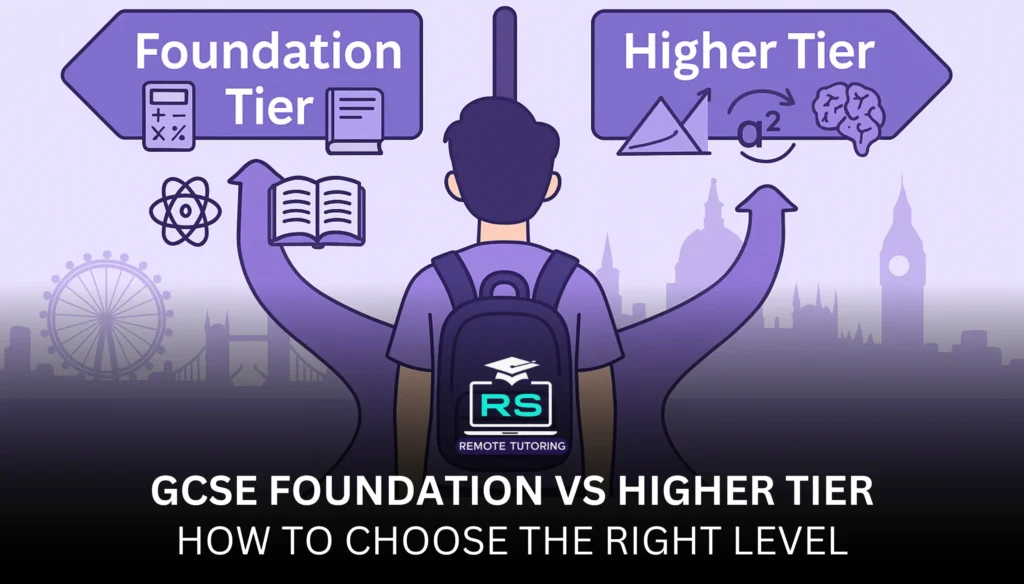
Going throught the GCSE landscape in the United Kingdom can be confusing, especially when it comes to choosing between the Foundation and Higher tiers. Parents and students often wonder which level best suits their goals, whether switching tiers is possible, and how each tier affects future opportunities. This guide has demystifies the differences between the tiers, explained the whole grading system, and gives advice to help you make an informed choice. What Are GCSE Tiers and Why Do They Matter? Since the introduction of reformed GCSEs in England in 2015, subjects like mathematics, combined science and some language courses offer two tiers of exams: GCSE Foundation and Higher. Each tier has its own range of grades and question styles. Ofqual’s guidance explains that the Foundation tier targets grades 1–5, while the Higher tier covers grades 4–9 and includes a “safety‑net” grade 3. The removal of coursework and the emphasis on terminal exams mean that tier choice can significantly affect the outcome. The Grading Ranges Explained Tier Grade range Highest possible grade Safety net Intended candidate Foundation 1–5 Grade 5 (strong pass) None Students aiming for a secure pass without requiring advanced maths or science for further study. Higher 4–9 Grade 9 (highest) Grade 3 (if performance falls below grade 4, the student may receive grade 3 rather than an ungraded result). Students who need higher grades for A‑levels or wish to keep STEM and competitive pathways open. Pro Tip: In the current 9–1 grading system, grade 5 is considered a strong pass. Universities and employers often look for a minimum of grade 5 in key subjects like English and Maths. Key Differences Between Foundation and Higher Tiers To decide which tier suits you, it helps to understand the differences in content, difficulty and assessment. Here are the main contrasts: 1. Course Content and Topic Depth 2. Question Style and Difficulty 3. Pros and Cons of Each Tier Foundation Tier Pros: Foundation Tier Cons: Higher Tier Pros: Higher Tier Cons: 4. Overlap and Fairness In order to make the system fair, crossover questions are included in both tiers. Grades 3–5 can be achieved on either tier, and some exam questions appear in both foundation and higher papers. This helps standardise difficulty and ensures that students aiming for a grade 5 have multiple pathways. How to Choose Between Foundation and Higher Choosing the right tier isn’t just a matter of ability; it requires consideration of your goals, exam style preference and future aspirations. Here’s a structured approach to help you decide. Step 1: Assess Your Current Attainment Teachers usually base tier decisions on your prior attainment. Look at your mock exam results, past test scores and teacher feedback. If you’re consistently working at a grade 4 or higher, the higher tier could be appropriate. For students struggling to reach a grade 4, foundation may be safer. Ask yourself: Are you comfortably achieving grades 4–5 in practice papers? If not, would additional support help you meet the demands of Higher? Step 2: Consider Future Ambitions Step 3: Evaluate Your Confidence and Learning Style Some students thrive under pressure and enjoy challenging problems. Others find exam anxiety affects their performance. The more demanding Higher papers require resilience and the ability to tackle unfamiliar questions. Take practice papers at each tier to see where you feel more comfortable. Step 4: Review Timelines and Switching Options Exam boards allow changes of tier fairly late usually until late April (the Ofqual blog notes around 21 April for maths, though this can vary). Teachers may switch a student to foundation if practice papers suggest they might not reach grade 4 on the higher tier. Conversely, exceptionally high performers on foundation may be moved up. However, changing tier requires re‑entry fees and administrative work. Pro Tip: Talk to your teacher well before the January mock exams. If you feel you’re on the wrong tier, open the conversation early so there’s time to gather evidence (through practice papers) and make a switch if needed. Step 5: Align With Your Personal Strengths Every student’s journey is different. If you’re strong in algebra and enjoy logical reasoning, the higher tier will challenge and reward you. But if maths causes anxiety and you’re aiming for a secure pass, the foundation tier offers a more manageable route. Step 6: Factor in UK Specific Considerations Living in London offers advantages and challenges: GCSE Tiers Beyond Maths: English and Science While maths is the most widely known subject with tiers, Combined Science also offers Foundation and Higher exams, and some language courses still have tiered papers. Frequently Asked Questions Tips for Success Regardless of Tier When Should You Decide? Most schools start discussing tiers at the end of Year 10. This gives students time to improve if they aim for the Higher tier. However, decisions are not set in stone. Continuous assessment via mock exams helps teachers gauge your suitability. If you’re unsure, ask to sit practice papers from both tiers in October of Year 11. This allows plenty of time to adjust your study plan. If you’re based anywhere in the United Kingdom and need help deciding between GCSE Foundation and Higher tiers, our experienced tutors can provide personalised assessments and guidance. Get in touch today for a trial lesson and plan your path to success! Conclusion Choosing between the Foundation and Higher GCSE tiers is an important decision that impacts your grades, confidence and future study options. By understanding the grade ranges, content differences and pros and cons, you can make an informed choice. Remember, there’s flexibility to switch tiers, especially if you communicate early with your teachers. Use practice papers to assess your level, consider your aspirations and take advantage of the support available in London’s vibrant educational landscape. RajaRaja specializes in Physics and Maths, with over 5 years of experience. He offers KS2, KS3, and GCSE Science and Maths lessons. He graduated from one of the top universities in the UK.
How to Use AI and Online Tools to Boost Your GCSE Revision

Studying for any kind of exam always feels exhausting and frustrating, especially when it comes to the preparation before the exam. Preparing for one kind of specific exam, especially that of GCSE, is always overwhelming for both students and parents. Often entangled between busy schedules, exhausting school routines, and the importance of these exams, left students with so much pressure before the actual toiling week began, obviously the exam season. GCSE revision encompasses tons of subjects, piles of notes, high expectations of parents and the constant tug between peace and pressure. But this constant suffering is much easier than using AI, the artificial intelligence which has made revision smarter, easier and more focused than traditional methods, but all matters when this effective partner is used efficiently and smartly. Why Traditional Revision Feels Exhausting Before the advent of AI, students actively relied on traditional Methods of revision such as And it was often considered that one hour equals better results, though all these methods were quite helpful, but research shows that they are not much more effective. Effective learning involves how students study instead of how long they sit at the desk. The brain works better through The research study shows that thinking about how students study effectively can lead to up to seven months of additional progress in school. Revision methods such as making notes, rereading them are quite productive but demand a lot of time and struggle. Planning strategically requires active engagement; applying various teaching methods relating to the students’ area of expertise can lead to students’ success. And this is the point where AI fits in, enhancing the naturally functioning of the brain. How AI can boost your Revision for GCSE exams AI is not just a tool; it is a clear pathway for success, innovation and creativity. More than 60% of UK students use AI to boost their GCSE revision instead of relying on the traditional methods of revision. Students can simply write a question and get answers simply by clicking. They can get AI is the bridge between students drowning in long textbooks and wanting a quick and clear pathway. Here’s how AI can help boost your GCSE revision. Simplifying Complex topics Algebra, chemical bonding, historical timelines and Essay structures are the most difficult areas according to the students. AI can help students and provide easily generated material that breaks down complex topics into simpler ones. Helps in creating study material AI helps generate flashcards, shorter summaries, and can also create visuals that aid in memorising complex topics. AI is the time, Saveir. Artificial Intelligence is the time eScair. Instead of spending hours on research and writing, A Ii helps to generate ready and exam-friendly notes, condensing long chapters into short ones for effective revision. Enhance Writing SkillAI Ai not only works with revision it also helps to improve writing skills. AI grammar checkers improve sentence structures and guide students in writing top-notch and better essays in their GCSE exams. Building a well-organised GCSE Revision plan. Revising without an organised and structured plan leads to uneven practice and ultimately to failure. Here is the three-step method to create a well-organised study plan. The Thethree-steps planning method helps to restore the practice and guides in several ways. Set clear and Specific Goals For revision. Use clear goals that define your objectives. Vague goals often lead to weakening your progress. Revision must be measurable, realistic and targeted. Instead of Writing Reviewing Notes Simply write; Or, why are you studying chemistry? Use this objective This technique will ensure the smooth revision and also boost the students ‘ productivity. Pomodoro technique The Pomodoro Technique is one of the effective and scientifically proven studying methods for the GCSE exams. It helps to break long study hours into small, focused study sessions that help the brain to be active without becoming overwhelmed. A standard Pomodoro cycle includes This technique is helpful as it trains the brain to stay focused and organised, reduces procrastination, and builds consistency and discipline. Analysing Your GCSE subjects’ strengths and weaknesses Students should honestly evaluate their strong and weak areas by asking questions Students should rank subjects from strongest to weakest, as this technique helps them to analyse which subjects need more attention and which do not require more. AI thus helps to foster the study plan and allocate time wisely to every subject. Top AI tools that boost your GCSE Revision AI is one of the most helpful tools that enhances the preparation of students can help in many ways when used effectively and efficiently. Here is the list of top AI tools that students can use for better understanding. ChatGPT, Gemini and Microsoft Copilot AI chatbots such as ChatGPT, Microsoft, and Gemini can boost your revision. These can help in several ways, such as For example, Students can write: Structure of an atom for GCSE students, and you can get a fully revised, easy explanation from the chatbots. Notion AI Notion AI is another helpful tool that can boost your study revision. It can help in several ways, such as All material is both visually appealing and exam-friendly. Quizlet It is one of the top tools for Seneca Learning The learning application uses animation, quizzes, and short explanations to make learning more engaging and fun. It adapts to the student’s pace and also provides valuable feedback. BBC Bitesize Another trusted platform provides clear explanations, Videos, and subject-specific guides. This application typically works better for those students who learn effectively through videos and visuals. Learning through Visual Aids: A Stronger Strategy Visual learning can help boost your productivity, making learning fun and creative at the same time. It is scientifically proven to boost memory retention. Most Students remember more through. Different learning applications, such as YouTube, Seneca, provide animated lessons and built-in quizzes that help students navigate difficult topics. Track your Learning through AI Tracking progress is the secret to high success. Many learning platforms offer dashboard highlights that track the progress of students. This helps