
How Online GCSE Tutoring Improves Student’s Confidence and Motivation

GCSE exams often encompass a wide variety of techniques that can not be mastered wholly before the exams. The GCSE preparation phase is not just the student’s testimonial elaborating whether they are ready for the exams or not but also the ultimate exam of their confidence and motivation. The exam time period often answers the most persistent question, Are students able to handle their anxious thoughts during the exam? Will the exams make them overwhelmed or shatter their confidence? The answer to these persistent questions is not just lecturing the children about the importance of the exams in their life but it involves the need of expert guidance that not only delivers the lectures but also motivates students while also building their confidence. Preparing for the GCSE exams is the most curricular stage particularly students are emotionally less charged and in need of solace that makes them emotionally well charged. Between academic pressure, competition, and competition with prs students mostly feel less confidence and more anxious even when their intellectual ability is top tier. Research in educational psychology states that students’ achievement is not driven by intelligence alone but two powerful predictors such as academic confidence and intrinsic motivation are utmost necessary. When students in their firm believe that they can do it, they are through;y aware of their intellectual side and are more confident about their knowledge. It becomes extremely easy to tackle the most demanding exam. In the following blog, we will explore how online GCSE tutoring strengthens the confidence , and motivation through research integrated insights blackened by the evidence of the educational impact. Why Confidence and Motivation are Utmost Important Instead of Raw intellectual ability Confidence and motivation are the utmost beliefs that make up the entire student’s success. Before diving into the exact topic, how expert online GCSE tutors help students in building their confidence and boosting their motivation , it is firstly necessary to understand why the two elements should be present in the lives of students to achieve the desired success. Albert Baundra’s theory of the self efficiency stats that students who believe in their academic ability and capability of completing the academic task are more likely to; Similarly, low confidence on the other hand creates avoidance behaviour. For example; the student who believes that they are bad at maths, or they cannot solve the difficult maths problems will unconsciously avoid practising maths, which further reinforces failure. On the other hand, being motivated is the utmost important key to achieve the desired success, because motivation influences; It is important to note that GCSE success is not built one week before exams but it is built through motivation, consistency over months. Without the dose of motivation even the capable students won’t pass. How Online GCSE Tutoring Builds Academic Confidence Online tutoring is most recommended, in terms of flexibility and feasibility. Tutors not only clear the students’ concepts but also build ultimate confidence in the students making them realise that they are capable and they can do it. Online tutoring improves confidence through structured psychological and academic mechanisms. Personalized learning removing the Fear of Falling behind Online turing mainly encompasses personalised learning tailored to the needs of the students. In the traditional classroom setting, teachers are most likely moving at the average pace trying to meet the requirements of every student. Students who struggle in the topic may never fully catch up the entire lecture before class fully moves to the next one, particularly leaving the knowledge gaps among students. Online GCSE tutors work differently. The teachers which are often provided through our platform RS remote tutoring , they mainly tailor the sessions to the student’s; When students finally understand the topic they found previously confusing, something powerful happens and they gain something, rebuilding their ability to believe. Research in adaptive learning environments shows that personalised instructions significantly increases the learners confidence because it further creates repeated mastery experiences, actually the small wins that undoubtedly accumulate over time. Immediate Feedback Strengthening the Self Belief Feedback is utmost necessary to clarify the mistakes and to highlight weak areas of the students so that they can easily cope with their mistakes to achieve the desired success, but the feedback is mostly difficult to receive in the large classrooms comprising a number of students.and it can be delayed. In contrary to this, Online tutors provide; This real time feedback is very much necessary which can often prevent long term misunderstanding and reinforces critical thinking. From the cognitive psychology perspective, timely feedback delivered to the students improves retention, more importantly it reduces the formation of negative self perception as students begin to think I can fix that. Instead of ; I always get this wrong. Structured Progress Tracking Makes Improvement Visible One of the foremost reasons that students lack motivation is because progress feels invisible. Online tutoring often includes; When students see measurable improvements, it further reinforces competence. From the perspective of the behavioural sciences visible progress activates the reward system in the brain, encouraging continued effort. How Online GCSE Tutoring Increases Motivation Confidence and motivation reinforces each other. As confidence grows motivation tightens Online GCSE Tutoring enhances motivation in several research supported ways. Clear Goal Setting Improves Direction and Focus Effective tutors do not simply the topics but instead they simply structured goals as; Goal setting theory clearly elaborates that specific measurable goals significantly increases motivation as compared to the vague and unstructured intentions. Students often feel motivated when they know they are working hard or simply when they are aware of this and can see themselves getting closer to their desired destination. Interactive digital tools increasing the Engagement Online tutoring is not simply using one and only one digital platform and makes the entire learning boring. Instead effective type is one which makes the boring lecture into the engaging creativity often gaining the attention of the students. Modern digital online platforms such as our RS remote tutoring use; It is often noted that the engagement increases
How Many Hours to Study for GCSEs? (2026 Guide)
GCSE exams, the hardest exams often considered in the UK. Students appraising in the GCSEs are really concerned about the preparation and pay attention to every nitty gritty detail encompassing the exams strategy or the exam preparation. Not only the students but parents also show deep attention towards the students’ preparation and the extra guidance students are availing other than the school. But the question arises, despite the every successful attempt of the preparation phase; How many hours should I study for the GCSE exam? The question seems really simple but it is full of confusion, stress and even unnecessary pressure. It is often believed by most of the students that they should study long hours in order to achieve success, while other schools of thought ignore the actual value of time. But the ultimate truth lies somewhere in between. Research in education and cognitive science shows that there is no fixed number of hours that guarantees the desired success students are preparing for.Instead, what matters most is how effectively the study hours are used. This can be whole one through structured and well organised planning The following guide encapsulates all the necessary measures, explaining how many hours should a student preparing for GCSE in the UK study and how to use those hours strategically to gain the desired success. Understanding Why Studying More Hours Does Not Always Mean Better Results One of the biggest fallacies is that Studying more hours is ultimately equal to better results.but this is not the solution of every problem In reality this approach highly backfires. Recent studies in the educationist field encapsulates that the more inclination towards passive revision such as re reading notes, or highlighting textbooks has very low retention rates. Students often feel productive but it’s not beneficial for long term use and the information is very little that actually sticks to the brain Contrary to this, active revision techniques such as integrating flow charts, practising past papers are far more effective even if done for a few hours. This clearly suggests that 3 focused hours are much more beneficial than 6 – 7 unfocused hours. Most Recommended GCSE Study Hours To answer the most persistent question, the following includes the deep and clear guidelines for the students appearing in GCSEs across the UK because the structured approach to revision is the ultimate key for the desired success. Year 10: Building the Strong Foundation The early year is marked by the strong foundational phase. During this year the students should focus on understanding the concepts rather than fully dwelling themselves in the intense revision phase. The most recommended study time for the initial foundation phase is; At this stage, students should focus on; Consistency matters a lot more than intensity. Start of the Year 11 At the onset of the year 11, the year is marked by the starting of the structured revision phase. And during thai time period, the revision becomes more focused and intentional. The most recommended study time during the crucial phase is; During the process Students should; Research in the areas suggest that the early revision reduces stress and improves long term memory retention. 3-4 Months Before the GCSE exams: The intense crucial Phase Before the actual exams begin it is very important for the students to master each and every topic because the last 3-4 months are intensive for revision, and this is the phase where revision takes a serious turn. The most recommended study time is At this stage should should This phase is critical because exam performance depends more on application than memorisation. The Actual Peak Preparation Phase: Unlocking the Final Month The final months are more demanding, but the months should be approached strategically. The most recommended study time for the final month is; However, research warns against overloading:Studying beyond 5–6 hours daily leads to diminishing returns. The focus should be on: During the Exams: Smart Maintenance Strategy Managing time effectively during the exam time period is the ultimate concern of the students and it is even more demanding but the students’ stress is reduced to some extent. The most recommended study time during the exam season is; At this stage: What Makes Study Hours More Effective? After unlocking the exam revision hours, it is important to understand what makes the study hours more effective and preparation friendly. Furthermore, simply sitting at the desk is not enough. The effectiveness of study time depends on how the brain processes information. The Focused Study Sessions Research shows that concentration drops significantly after every 30-50 minutes. The ultimate solution to the concentration problem is the structured study blocks. This clearly means; This improves both productivity and retention. Active Revision Method: One of the biggest mistakes that GCSE students make is heavily relying on passive revision methods, r reading notes, highlighting textbooks. These are often the low impact methods. The ultimate key that boost the revision process is the active revision method, which includes; Active recall strengthens memory pathways and improves exam performance. Spaced Repetition: Study Less, Remember More Instead of cramming everything, students should revise the topics over time. This means that This method reduces total study hours while improving long-term retention. How Top Performers Actually Study High achieving students do not study for hours Instead thy; Signs revealing You Are Studying Too Much Studying more isn’t always better. In fact, overstudying can harm performance. Look out for: If these occur, it’s a sign to: Reduce hours and improve study methods. Common Mistakes Students Make About Study Hours Avoid these common pitfalls: FAQS Final Thoughts So, how many hours should you study for GCSE?The truth is, success doesn’t come from studying the longest, it comes from studying the smartest.By combining the right number of hours with proven techniques like active recall, spaced repetition, and consistent revision, students can achieve top GCSE grades without burnout. For parents and students alike, the goal should not be to maximise study hours, but to maximise learning efficiency. RajaRaja specializes in
French vs German vs Spanish: Which GCSE Language Should You Choose?

Choosing a language at GCSE level can feel daunting because your decision might influence your grades, future university options and even your career path. Which language is easier to learn, French, German or Spanish? The answer depends on your goals, your interests and how much effort you’re willing to invest. This comprehensive guide compares French, German and Spanish in terms of difficulty, GCSE grading trends, global usefulness and cultural appeal. It also touches on Italian, another Romance language that some GCSE candidates consider. Understanding GCSE Modern Foreign Languages (MFL) GCSEs in French, German and Spanish follow a similar structure: assessments cover listening, reading, speaking and writing, with a heavy emphasis on vocabulary, grammatical accuracy and the ability to translate between English and the target language. Historically, French and German have been graded more harshly than Spanish, prompting Ofqual to review grade boundaries. A 2024 to 25 report noted that adjustments to grading brought French and German in line with Spanish, raising the proportion of grades at 7+ (equivalent to A/A*) for French from 26 % in 2023 to 28 % in 2024 and 29.7 % in 2025, and for German from 27.6 % in 2023 to 34 % in 2025. Despite these changes, Spanish remains the most popular GCSE language: entries rose from 109,594 in 2020 to 136,871 in 2025, whereas French entries dipped from 134,651 in 2024 to 132,808 in 2025. German entries fell by 7 % in 2025. Why grades and popularity matter While popularity doesn’t equate to ease, it does affect grading. A larger cohort can spread ability profiles, making grade boundaries fairer. Conversely, smaller cohorts (notably in German) often contain high‑attainment students, which pushes grade boundaries up. Understanding these trends helps you gauge how competitive each subject is and whether you’ll need higher scores to stand out. Factors to Consider When Choosing a Language 1. Personal interest and motivation You’ll spend hundreds of hours studying your chosen language. Enjoyment is the biggest predictor of success. Teachers at Scarborough College advise students to pick the language they enjoy most because dedication and curiosity make the difference. If you enjoy multiple languages, consider studying two; knowledge from one Romance language (French or Spanish) can reinforce the other. 2. Linguistic family and similarity to English English is a Germanic language heavily influenced by French. That gives you an advantage when learning French vocabulary but makes Spanish grammar and pronunciation more predictable. German comes from the same family as English but uses four cases and three grammatical genders, making grammar less familiar. Spanish and French are both Romance languages derived from Vulgar Latin; they share roughly 75 % lexical similarity, which can make learning one easier if you already know the other. 3. Pronunciation and spelling 4. Grammar complexity Feature Spanish French German Gender Two genders (masculine, feminine) Two genders; nouns almost always end with predictable endings Three genders (masculine, feminine, neuter) Cases No case system; word order determines roles No case system Four cases (nominative, accusative, dative, genitive) Verb conjugation Regular patterns; two main past tenses More irregular verbs; use of auxiliary verbs makes compound tenses complex Conjugation is regular and logical, with fewer exceptions; fewer past tenses than French or Spanish Sentence structure Subject–verb–object order; adjectives follow nouns Subject–verb–object; adjectives often follow nouns but must agree in gender and number Word order varies: verb is usually in second position; verbs move to the end in subordinate clauses. Once mastered, rules are consistent Use of accents Acute accent and diaeresis mark stress Five different accent marks; silent letters Umlauts (ä, ö, ü); ß sound 5. Career relevance and global reach Think beyond GCSEs. Which language will open the most doors for you? Spanish and French are used on multiple continents, while German dominates central Europe. Here’s how they compare: Spanish French German Italian (optional) Italian isn’t as widely taught in UK secondary schools but sometimes appears alongside other languages. Roughly 85 million people speak Italian worldwide, more than the population of Italy, and Italian communities exist in Argentina, the USA, Brazil and Canada. Italian is a Romance language, so if you’ve mastered Spanish or French, Italian grammar will feel familiar. However, it has many irregular verbs and is less globally relevant than Spanish or French. For those passionate about opera, fashion, design or cuisine, Italian offers cultural rewards but may not justify the limited GCSE exam entries. Comparing Ease of Learning and Exam Performance The Foreign Service Institute’s categories provide a useful benchmark for relative difficulty. Spanish and French are Category I languages; with dedicated practice, you can reach conversational proficiency in about 600 to 750 hours. German belongs to Category II; because of its case system and different word order, it demands slightly more time (30 to 36 weeks of study). Italian is also Category I. GCSE performance trends Summary of pros and cons Language Advantages Challenges Spanish Widely spoken; essential for travel and business; straightforward pronunciation and spelling; high GCSE success rates Verb conjugations (subjunctive) can be tricky; popularity means you need high marks to stand out French Useful in diplomacy, art and global organisations; many English cognates; scholarships available Irregular spelling and pronunciation; gender and agreement rules; historically harsh grading, though now improving German Logical grammar; strong economic and academic prospects; less competition at GCSE Cases and three genders; longer learning curve; decreasing uptake in UK schools Italian Beautiful sound; gateway to opera, fashion and art; easier if you know another Romance language Fewer GCSE opportunities; irregular verbs; limited global reach Tips for Excelling in Your Chosen Language Seasonal immersion trips from the UK For UK students, immersion experiences are just a short flight away. Consider these seasonal tips: FAQs Conclusion Ready to embark on your language journey? Whether you’re leaning towards Spanish for its global reach, French for its elegance, or German for its logic and economic relevance, our tutors can help. Contact us today for a free consultation and discover how personalised lessons can make your GCSE language choice enjoyable and successful. Have questions about immersion programs or exam preparation? Reach out to our
Using AI for GCSE Revision: ChatGPT Do’s and Don’ts
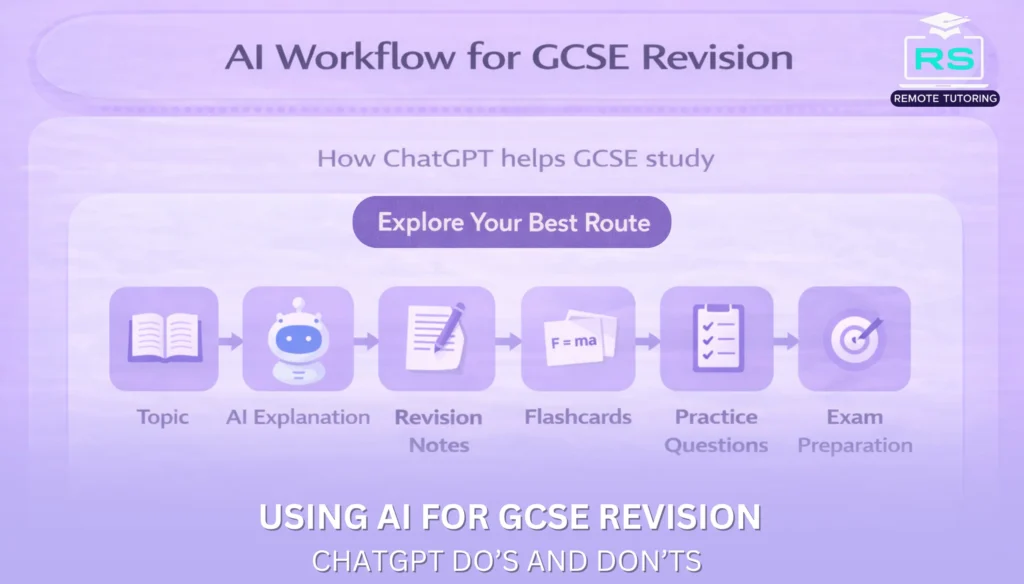
The world is undergoing significant changes and almost everyone is shifting towards the technology that is now leading the world. In the growing time period, the rapid shift is also impacting the student’s education in terms of thor extra support that is called tutoring, the shift is more inclination towards the online tutoring while also technology leaving the mark in the revision and preparation strategies of the students preparing for the GCSE exams in the developed country like UK. Various platforms are launched and are being tremendously emerging meeting the requirements of the preparation strategies of the students. But here comes the most asked questions. How to use the AI tools effectively? Which AI tool is most beneficial or meeting the requirements which the students or parent Preferred. In order to answer the questions, this guide investigates how to use the most of AI, especially ChatGPT, using it to guide your learning and revision methodology with more accuracy than ever before. The Growing Role of Artificial Intelligence in Education Artificial Intelligence is growing rapidly with its use in almost every field of life. Especially when it comes to Education, several researches including A recent study form Go student found that almost 23 percent of the students use AI tools in order to improve their course work, revealing the inclination towards the digital tools in the field of education. Similarly, different chat bots such as Gemini, ChatGPT, Depseek are increasingly popular these days and the tremendous use of these chatbots sparks the intervention that shows how the world is being shifted towards the digital landscape. Although AI has taken the stage and the world is being drowned into the world of AI but some expats rigorously caution about the excessive use of Artificial intelligence as it is the danger of human creativity, intelligence and one of the most important is problem solving skills. Expert scholars further revealed that it should be used strategically as a learning support tool not as a shortcut, as excessive reliance can create a false sense of mastery where the students feel confident without understanding the material wholly. Additionally, for the GCSE students, the right approach is not to wholly boycott digital tools or excessively relying on them but approach should be the balanced integration of textbooks, teachers guidance, tutoring support and the use of Artificial Intelligence. Understanding Why ChatGPT is Best AI Chat bot for Revision of the GCSE Exams Although many of the chatbots are beneficial if used strategically, ChatGPT is most common among today’s generation and people are excessively relying on it. Instant Explanation of the Complex Topis The most important obstacle that comes along the way of the students is that they are suffering with the complex topics and are difficult to swallow. The biggest advantage of using ChatGPT is that it can break down the complex topics into easy and manageable chunks which students can easily get into. Instead of searching through the multiple websites students can get the structured and well organised answer just by one click. Generative Revision Notes Instantly Another difficulty students face is that they are struggling with the bundles of notes that are difficult to memorize and creating the revision notes during the crucial time of GCSE preparation phase. Gpt helps in this regard and summarises the topics efficiently. AI can easily generate; However, one important thing to note is that cross checks the information from the textbooks or the notes you already have made using the class lectures, this ensures the authenticity of the work generated from ChatGPT or any other online chat bot. Personalized Learning Experience Every student holds a different capability of learning. Some learn by listening, others learn by watching visually, while others prefer visual explanations in order to gain conceptual clarity. Traditional classroom education just provides the teachers lectures, some may prefer the visual cardboards in order to make the lecture engaging but it is very rare. ChatGPT helps in this regard, just by giving the prompt, the instructions all you get your desired response within the minute. ChatGPT allows th students to customize the responses by asking; Research further encapsulates that AI assisted learning environments can increase student’s learning environment interactive , making the learning more interactive rather than just the boring lectures. 5 Practical Ways to Use ChatGPT for GCSE revision The following ways explain how to use ChatGPTin order to make your revision more nuanced and well organized. 1. Generating Summaries for the long notes One of the persistent challenges that students face is that they suffer from the long hefty notes during their GCSE preparation journey. Artificial intelligence has an amazing ability to shorten and condense the given file into manageable chunks, it further condenses the large quantity of complex information, While in doing so you can also generate maps, diagrams so that the student can easily gain the conceptual clarity about the most difficult GCSE concept. But the question arises how to generate the desired information, As always AI depends on just on the prompt that is given by the students and generates all the desired information based on the given prompt. For example; You can give the prompt in a way; You are the way UK qualified English teachers. Summarise my lectures on GCSE English literature; I understand the basic story of the novel but I am struggling with the most important thematic areas. Generate the flashcards and give the theme cycle in a way that I can easily get a clear idea about it. Using the above mentioned approach you can easily get the exam based content, focusing on just relevant data that will likely help you to prepare for the exams without giving all the irrelevant content. 2.Using AI to Create a Well Organized Study Plan Making a well structured study plan is utmost necessary to avoid obstacles that come along the way in the Preparation of GCSE examination. A well organised study plan ensures clarity and discipline in the preparation phase of the
Choosing A‑Level Subjects After GCSE: Best Combinations, Facilitating Subjects & Expert Tips
Your A‑level choices can open doors to exciting university courses and careers or unintentionally close them. A-Level Subjects After GCSE, many students feel overwhelmed by the sheer number of subjects and conflicting advice. In this guide, we demystify the process of choosing A‑level subjects, explore the best and worst combinations, and answer the questions students frequently ask. Whether you have a clear career goal or are still undecided, this article will help you make informed choices for the 2026 academic year and beyond. Why your A‑level choices matter The subjects you choose at A‑level shape your future options. A‑level selection can impact which university courses you can apply to. Certain degrees require specific subjects. For example, a pharmacy degree needs chemistry plus at least one of biology, maths or physics, while some English degrees require either English Language or Literature. Choosing the right combination now can therefore keep your pathways open for medicine, law, engineering, psychology or other competitive courses. It’s also important to remember that A‑levels are significantly harder than GCSEs. You’ll be expected to work more independently and master more demanding material. Most students take three subjects because universities typically base offers on three A‑levels; although some ambitious students take four, the workload increases substantially. Picking subjects you enjoy and excel in will make the transition smoother and give you the best chance of success. Core principles for choosing your A‑level subjects Career and study advisors agree on three guiding principles: Facilitating subjects and why they matter ‘Facilitating subjects’ are A‑levels that are highly regarded by universities and appear frequently in entry requirements. Careerpilot notes that these include Mathematics, English Literature, Physics, Biology, Chemistry, History, Geography and modern or classical languages. Choosing at least one or two of these subjects can help you meet a broad range of degree requirements and keep your options open. However, some universities publish lists of subjects they consider ‘less effective preparation’. The London School of Economics, for example, has a list of non‑preferred subjects, while the University of Sheffield publishes a list of preferred subjects. This doesn’t mean you should avoid creative or vocational subjects entirely, but ensure that your other choices meet entry requirements. Entry requirements and minimum grades To enrol on A‑level courses you usually need at least five GCSEs at grades 9 to 4 and grade 6 in the subjects you want to study. Schools and colleges may have their own policies, but most look for at least a grade 6 or 7 in GCSE subjects you intend to continue. If you’re considering a subject not offered at GCSE (such as psychology or law), strong grades in related subjects (e.g., English or history) will help demonstrate aptitude. Best A‑level combinations and what to avoid There is no one‑size‑fits‑all answer, but here are some proven combinations and common pitfalls: STEM pathways If you’re aiming for medicine, engineering or other science degrees, universities often require or recommend Mathematics, Chemistry, Biology or Physics. For medicine and dentistry, chemistry is essential and biology is usually required or recommended. For engineering, maths and physics are must‑haves, while further maths is an advantage but not always essential. Computer science degrees often require maths and sometimes physics. Avoid: choosing only one science if you may apply for a STEM degree later. Careerpilot advises that if you’re taking a science A‑level, you should consider whether you need to take another science or maths to support scientific careers. Humanities and social sciences Degrees in law, politics, economics, history or English typically require at least one essay‑based subject. A common combination is English Literature, History and Politics. Economics degrees may require maths. Geography pairs well with subjects like biology or economics if you are interested in environmental science or international relations. Avoid: choosing only practical subjects without an essay‑based subject if you want to keep your humanities options open. Universities look for evidence of analytical and writing skills. Creative and performing arts If you’re passionate about art, drama, music or design, you should include these subjects. However, complement them with at least one facilitating subject such as English or History to keep academic routes open. Creative industries often value a combination of artistic skills and academic rigour. Avoid: taking multiple creative subjects without any facilitating subject. Some universities may not accept combinations like Art, Photography and Media Studies for traditional academic courses. Business, finance and economics For business or finance degrees, Mathematics is advantageous and sometimes essential. Economics, Business Studies and Politics make a strong trio. Many universities accept both Business Studies and Economics, though Careerpilot cautions that some universities might not like combinations of very similar subjects. If you choose one, pair it with maths or a humanities subject. Avoid: choosing Business Studies and Economics together if your target universities list them as overlapping subjects or non‑preferred combinations. Languages and linguistics Modern languages (French, Spanish, German, Mandarin) and classics (Latin, Greek) open doors to careers in translation, international relations, law and business. They pair well with humanities subjects and with subjects like politics or history. Avoid: dropping languages too soon if you are interested in international careers. Language proficiency is a valuable skill that can differentiate you in the job market. If you don’t know what you want to do Many students have no specific career plan at 16. To keep your options open, choose a mix of subjects across different disciplines. For example: You’ll need to pick only three or four, but using this template helps ensure you cover different skill sets and keep doors open. You could also explore Core Maths or an Extended Project Qualification (EPQ) to demonstrate independent research. Worst A‑level combinations There’s no formal list of forbidden subjects, but certain combinations are less favoured: The role of AS‑levels and independent study AS‑levels (advanced subsidiary) are qualifications taken after one year of study. Oxford College notes that AS‑levels carry 40% of an A‑level’s UCAS points and can influence your predicted grades. Under the new system in England, AS grades do not count towards
Further Maths GCSE Past Papers: Mastering AQA Level 2 for 2026
GCSE Further Maths is a unique qualification: it sits between the standard GCSE and AS‑level Maths, providing stretching material for students who relish algebra, trigonometry and calculus. In the United Kingdom, the AQA Level 2 Certificate in Further Mathematics (exam code 8365) is the most common programme, though Edexcel and OCR also offer additional maths courses. Success in this subject can open doors to A‑level further maths, competitive sixth‑form places and STEM careers. This guide covers deep into further maths GCSE past papers, shows you how to use them effectively, and explains everything you need to know for the 2026 exam cycle. Why Further Maths matters and who should take it Further Maths is optional for most GCSE students, but it is ideal if you: The course covers advanced algebraic techniques, matrices, trigonometry, geometry, calculus and proof. It also introduces topics from AS‑level such as the binomial theorem, radians and transformations of functions. Because the syllabus is more demanding, exam questions can be more complex and require deeper reasoning. Therefore, practising with past papers is vital. GCSE Further Maths Support Struggling with Further Maths Past Papers? Further Maths past papers can feel tough when algebra, calculus, matrices and proof questions take too long. Get one-to-one GCSE Further Maths tutoring and prepare confidently for the 2026 exams. Book a Free Trial Lesson × Free Trial Lesson Free Further Maths Trial Fill in your details and our team will contact you to arrange a free GCSE Further Maths trial lesson. Why use past papers? Past papers aren’t just about practice; they are diagnostic tools. Testing yourself with past papers helps you identify which topics need more revision. When you work through old papers, you discover: By reviewing mark schemes and examiners’ reports, you can learn the exact reasoning behind solutions and avoid common mistakes. Past papers also familiarise you with the structure of the exam and reduce anxiety on test day. Understanding the AQA Level 2 Further Maths qualification Exam structure AQA Level 2 Further Mathematics consists of two papers, each worth 80 marks: Each paper lasts 1 hour 45 minutes, and the overall qualification is graded from 9 to 4 (with 9 being the highest). Most schools teach Further Maths in Year 11 or as an after‑school course starting in Year 10. Grade boundaries Grade boundaries vary slightly each year, depending on paper difficulty. AQA’s official boundaries for June 2023 show that out of a maximum 160 marks, a grade 9 required 137 marks, a grade 8 required 120, a grade 7 required 103, a grade 6 required 85, a grade 5 required 68 and a grade 4 required 59. Paper 1 boundaries were 68 for grade 8, 59 for grade 7 and 42 for grade 5, while Paper 2 boundaries were 69 for grade 8, 60 for grade 7 and 43 for grade 5. Use these figures as a benchmark: in a typical year you might need around 86% for a grade 9 and around 40 to 45% for a grade 4. However, boundaries can shift slightly depending on the cohort and exam difficulty. How to use Further Maths past papers effectively Studying GCSEs past papers is not just about quantity; it’s about strategic practice. Here’s a step‑by‑step approach: GCSE Further Maths Support Struggling with Further Maths Past Papers? Further Maths past papers can feel tough when algebra, calculus, matrices and proof questions take too long. Get one-to-one GCSE Further Maths tutoring and prepare confidently for the 2026 exams. Book a Free Trial Lesson × Free Trial Lesson Free Further Maths Trial Fill in your details and our team will contact you to arrange a free GCSE Further Maths trial lesson. Beyond AQA: Edexcel and OCR Further Maths AQA’s Level 2 Certificate is the main Further Maths qualification in England, but there are other variants: Edexcel Level 2 Further Mathematics (9FM0): Sometimes called “Additional Mathematics,” this qualification is targeted at high‑achieving GCSE students. It covers algebra, trigonometry, calculus and proof. Past papers are available from Edexcel’s qualification support pages. The exam comprises two papers similar to AQA’s: one non‑calculator and one calculator. OCR Additional Mathematics (6993): This legacy course is no longer widely offered. Some independent schools still use OCR Additional Mathematics as a bridge to A‑level Maths. Past papers can be found through OCR’s resource finder and teacher forums. If you are studying Edexcel or OCR further maths, always download the correct past papers and mark schemes. The topics and question styles are broadly similar to AQA but may emphasise different techniques, such as matrices or proof. Exam preparation schedule for 2026 Autumn and Winter (September to December 2025) Spring (January to March 2026) Exam season (May to June 2026) Pro tips for success Practise writing solutions clearly. Method marks require you to show working, especially in proofs and algebraic manipulation. Avoid skipping steps; write each line logically. Understand the context. Many Further Maths questions are problem‑solving scenarios. Read the question carefully and decide which techniques apply. Check units and accuracy. Round answers to the correct degree of accuracy. Write exact values where required (e.g., in terms of π). Leverage mark schemes. For each paper, read the mark scheme to see what examiners expect. Note how marks are split between method and final answer. Work with peers. Explaining solutions to classmates helps you solidify your own understanding. Consider forming a study group. GCSE Further Maths Support Struggling with Further Maths Past Papers? Further Maths past papers can feel tough when algebra, calculus, matrices and proof questions take too long. Get one-to-one GCSE Further Maths tutoring and prepare confidently for the 2026 exams. Book a Free Trial Lesson × Free Trial Lesson Free Further Maths Trial Fill in your details and our team will contact you to arrange a free GCSE Further Maths trial lesson. Frequently Asked Questions Conclusion Ready to conquer Further Maths GCSE? Our expert tutors specialise in AQA Level 2 Further Mathematics and can help you master advanced topics, develop exam technique and maximise your grade.
GCSE Periodic Table: Guide to Elements, Metals & Non‑Metals for 2026 Exams
Understanding the periodic table is at the heart of GCSE Chemistry. Whether you’re sitting AQA, Edexcel or OCR, the periodic table is your road‑map to the elements. It shows you how atoms are arranged, why metals behave differently from non‑metals, and how groups and periods reveal patterns in reactivity. Yet each exam board’s insert has subtle differences, and many students overlook simple exam strategies that can save time and marks. This guide unpacks everything you need to know about the GCSE periodic table, explains how it’s structured and used in UK exams, and offers UK‑specific revision tips for 2026. Why the periodic table matters in GCSE Chemistry Chemistry isn’t just about memorising facts. The modern periodic table orders elements by increasing atomic number, the number of protons in an atom into horizontal rows called periods and vertical columns called groups. Elements in the same group share similar properties because they have the same number of electrons in their outer shell. These patterns help you predict reactions, balance equations and understand why metals lose electrons while non‑metals gain them. Grasping the logic of the table is therefore a powerful exam skill. In 2026, exam boards continue to provide an insert during your exams, but it omits certain rows and uses specific group numbering. Knowing these nuances will help you avoid surprises on test day. The modern periodic table explained The periodic table is “periodic” because the pattern of chemical properties repeats at regular intervals. Here are the basics every GCSE candidate should know: Metals vs non‑metals The stepped line on the periodic table separates metals from non‑metals. Metals lie to the left of this line and non‑metals to the right. Group 1 and group 2 are metals; groups 6, 7 and 0 are non‑metals. Metals tend to lose electrons to form positive ions, while non‑metals gain electrons to form negative ions. Most elements are metals, which is why the left of the table is more crowded. The most important groups Group 1 – Alkali metals: These reactive metals have one electron in their outer shell and react vigorously with water, oxygen and chlorine. Their reactivity increases down the group: lithium reacts steadily with water while potassium ignites and disappears quickly. Group 7 – Halogens: These non‑metals exist as diatomic molecules (e.g., Cl₂) and have seven outer electrons. They react with metals to form halide salts and with non‑metals to form covalent compounds. Reactivity decreases down the group because gaining an extra electron becomes harder as the atoms get larger. Group 0 – Noble gases: These gases have full outer shells (eight electrons, except helium with two) and are unreactive. Their boiling points increase down the group. How exam boards design the GCSE periodic table Not all GCSE periodic tables look the same. AQA, Edexcel and OCR use slightly different formats. Creative Chemistry compares them and notes the main differences: Feature AQA Edexcel OCR Group numbering Uses numbers 1 to 0 across the top; recommended IUPAC numbers 1 to 18 are not used Similar to AQA OCR uses the IUPAC numbers 1 to 18 for groups Relative atomic mass Shown below the element symbol; values given to two decimal places; copper and chlorine masses are not rounded Same as AQA Same as AQA Atomic number Shown above the symbol Same Same Lanthanides & actinides La and Ac symbols are shown; lanthanides (58 to 71) and actinides (90 to 103) are omitted Same OCR includes the names “lanthanides” and “actinides” for these rows Super‑heavy elements Elements 112 to 118 (Cn, Fl, Lv) are shown None shown Only Cn, Fl and Lv are shown These differences don’t change the chemistry, but you should practice with your board’s version so you know where to look for atomic numbers and masses. Some boards provide a printable periodic table or digital insert; make sure to download the correct one for revision. What AQA’s periodic table insert includes AQA’s insert for Chemistry GCSE notes that the lanthanides (atomic numbers 58 to 71) and actinides (90 to 103) are omitted, and that the relative atomic masses of copper (Cu) and chlorine (Cl) are not rounded to whole numbers. These exceptions are important because you might need to calculate relative formula mass using 63.5 for Cu and 35.5 for Cl. The insert lists each element with its atomic number and symbol, but does not include the mass number for hydrogen (1) or oxygen (16). Knowing which data are provided will help you plan your answers. How to use the periodic table during your GCSE exam You’ll receive a periodic table insert in your exam booklet. Here are some pro tips to make the most of it: 1. Identify metals vs non‑metals quickly: Draw an imaginary zig‑zag line starting at boron (B), down through aluminium (Al) and silicon (Si). Elements to the left are metals; those to the right are non‑metals. Use this to decide whether an element will form positive or negative ions. 2. Use group numbers to predict reactivity: The group number equals the number of outer electrons. Alkali metals (group 1) react more vigorously down the group, while halogens (group 7) get less reactive down the group because larger atoms find it harder to gain an extra electron. 3. Check atomic numbers: If a question asks you about atomic structure, look at the atomic number (above the symbol) to find the number of protons. For example, chlorine has atomic number 17, meaning it has 17 protons and 17 electrons. 4. Use relative atomic masses for calculations: The larger number (below the symbol) is the relative atomic mass; use it to calculate molar masses. Remember that Cu is 63.5 and Cl is 35.5, while most other masses are whole numbers. 5. Remember omissions: Lanthanides and actinides aren’t shown, so don’t worry if you can’t find them. If a question mentions uranium or cerium, you’re likely in the wrong exam! 6. Don’t confuse atomic number with mass number: The smaller number is the atomic number; the larger one is
GCSE Results Day 2026: Date, Times, Timetable and What to Expect
Waiting for GCSE results can be nerve wracking, but knowing the key dates and what to expect can make the whole experience smoother. GCSE results day 2026 is confirmed for Thursday 20 August 2026. Schools will receive the marks a day earlier (Wednesday 19 August) and exam officers will have access to results from 12:01 am, while students can pick up their envelopes from about 8:00 am. An Education Record app will make digital results available nationally at 11:00 am. In this guide you’ll find everything you need to know: how to collect your GCSE results, how to interpret your grades, what to do if things don’t go to plan, and answers to common questions. We’ll also shared practical tips for students and parents in London and across the United Kingdom, including local weather advice, travel considerations and next steps after results day. Key Dates and Timetable for GCSE Results Day 2026 Important Dates Exam Season and Timetable Reminders GCSE exams will take place from early May to late June. The first exam is scheduled for Monday 4 May 2026, and the last exam for Friday 26 June 2026. Maths papers for Edexcel, OCR and AQA run on 14 May (Paper 1), 3 June (Paper 2) and 10 June (Paper 3). English Literature and English Language papers occur between 11 May and 21 May. Science exams are scattered throughout May and June, with Combined Science usually in late May and early June. Understanding this timetable helps students plan revision and appreciate when results will arrive. GCSE Results & 2027 Support Got Your GCSE Results? Let’s Plan the Right Next Step Whether your child is preparing for GCSE 2027, considering a resit or wants to improve a particular subject, our expert tutors can help. Book a free 30-minute one-to-one assessment to discuss their current grade, target grade and the support they need. Book a Free GCSE Assessment × Free 30-Minute Assessment Turn GCSE Results Into a Clear Plan Tell us the subject, current grade and target grade. Our team will contact you to arrange a free online assessment and recommend the right tutoring support. How to Get and Read Your GCSE Results Collecting Results in Person Most students go into school on results day to pick up a sealed envelope. Schools typically open their doors from 8:00 am to 10:00 am, though some invite students at specific time slots to avoid overcrowding. You’ll need to show a form of ID (such as a student ID or passport) before receiving your envelope. Bringing a charged phone means you can call family and share the news, and keep photo ID in case the school requires additional confirmation. Pro tip: If you want privacy, arrive early when fewer people are around; if you prefer sharing the experience with friends, go later when more students will be there. Whatever you choose, take your time opening the envelope, emotions run high and teachers are on hand to talk things through. Getting Results Online or by Post Can’t collect results in person? Schools often email or text results, and some exam boards provide secure online portals. From 2026, the Education Record app allows students across England to access their GCSE results digitally at 11 am. However, headteachers still encourage students to collect the paper envelope for the in‑person support, especially if you need advice or have questions. If you’re away on holiday, you can arrange for a parent, guardian or trusted friend to collect your results. They must bring a signed letter of authorisation and a copy of your ID. Results posted out usually arrive within one or two working days; confirm your school has your correct address well ahead of time. Understanding Your Results Sheet Your results sheet lists each subject and the grade you achieved using the 9 to 1 scale. Grades 9–1 correspond to the old A*–G system: grade 9 equates to a high A*, grade 4 is equivalent to a low C (standard pass), and grade 5 is a strong pass. If you see a U (ungraded) you did not achieve the minimum standard. The sheet may also include your component marks (for each paper), although your overall grade is based on the combined total. Grade boundaries are published on results day; they show the minimum marks needed for each grade and help interpret how close you were to the next level. For example, AQA publishes grade boundaries at 8:00 am when results are released. Preparation Tips for Results Day Take Care of Yourself Results day can be stressful. Getting a good night’s sleep and eating normally in the days leading up to results day, and sharing any worries with parents or trusted adults. Taking a walk or doing something relaxing the night before can help you stay calm. Plan Your Travel In London and many parts of the UK, August weather can be changeable. Check the forecast the night before and plan your travel accordingly. Public transport may be busy during the morning rush, so leave extra time to get to school. Bringing a bottle of water and a light jacket can help you stay comfortable while waiting. Decide Who You Want With You Consider whether you want to open your results alone, with family, or with friends. Many students prefer to share the moment with a parent or guardian; others find strength in celebrating with peers. There is no “right” choice; think about what will make you feel supported. Schools may limit how many people can accompany you, so check their guidelines. Have a Backup Plan It’s wise to discuss different scenarios, what you’ll do if you meet your target grades, and what to do if you don’t. Talk to teachers, parents or a guidance counselor about your options. Preparing a list of phone numbers for your chosen sixth form, college, apprenticeship provider or training organisation will allow you to act quickly if you need to confirm or adjust your plans. GCSE Results & 2027 Support Got Your GCSE Results?
AQA GCSE Physics Past Papers & Equation Sheet 2026
The jump from Year 10 to GCSE Year 11 can feel daunting, especially when you’re faced with two full physics papers and a long list of formulae. AQA GCSE Physics (8463) is one of the most popular physics courses in England and is widely taken by students across London and the wider UK. With new exam timetables and support materials being announced for 2025‑2027, many parents and students are asking: What do the 2026 physics exams look like? and How can past papers and the equation sheet help me succeed? This comprehensive guide explains the structure of the AQA GCSE Physics exam, demystifies the equation sheet, and shows you how to make the most of past papers. We’ll also answer common questions about the 2026 exam series and provide practical revision tips tailored to students in London and across the UK. Overview of the AQA GCSE Physics Exam Exam Structure: Paper 1 and Paper 2 AQA Physics (course code 8463) is split into two equally weighted papers. Each paper lasts 1 hour 45 minutes, is available in both Foundation and Higher tier, and carries 100 marks, representing 50 % of the GCSE. The papers are structured as follows: Both papers use a mix of multiple‑choice, structured, short answer and open response questions. Students must sit both papers in the same tier (Foundation or Higher). Each exam includes a section with calculation questions, which is where the equation sheet comes into play. Foundation vs Higher Tiers Knowing which tier you’re sitting helps tailor your revision: Higher tier students should master algebraic rearrangements and be ready for extended calculations, while Foundation tier students should focus on core concepts and effective use of the equation sheet. What Is the AQA GCSE Physics Equation Sheet? AQA provides an equation sheet for GCSE Physics and Combined Science exams. This document lists selected physics equations in both words and symbols and indicates which equations apply only to Higher tier (shown in bold). The equation sheet is not a complete formula list: it covers the more challenging equations that students often find hard to remember. You still need to know many basic equations and all relevant units by heart. However, the sheet means you don’t have to memorise every formula, instead, you must learn how to use them. What’s on the Equation Sheet? According to AQA’s guidance: 2025–2027 Update: Formula Sheets Included! After the disruption caused by school closures, the Department for Education decided that students taking GCSE Physics and Combined Science do not need to memorise formulae. As a result, full equations and formulae sheets will be provided in the 2025, 2026 and 2027 exams. AQA confirms that the 2025 sheet remains the same as the one used in 2024 and will be continued through 2026. This applies to: This support will remain until at least 2027, so you can confidently use the published equation sheet for revision and practice. Why Provide an Equation Sheet? AQA and Ofqual stress that physics is about applying concepts, not rote learning. The equation sheet aims to: Keep in mind that the equation sheet doesn’t include units; you must still know them, and you should be comfortable rearranging formulae. How to Use the AQA Equation Sheet Effectively Having the equation sheet is an advantage only if you know how to use it. Here are pro tips drawn from educational experts and examiners: Why Past Papers Are Your Best Friend What Are Past Papers? Past papers are previous exam papers published by the exam board. They come with mark schemes and, in some cases, model answers and video solutions. They provide an authentic taste of exam format, question style and difficulty. For AQA Physics, there are two main sets of past papers: These are available for both Foundation and Higher tiers, typically from the 2018 to 2024 exam series, plus specimen papers and practice sets. Many revision sites also offer model answers and video solutions, which are invaluable for understanding how marks are awarded. How to Use Past Papers Also Read Our Other Guide on How to Use GCSE Past Papers to Maximise Your Score Revision Strategies for AQA Physics 2026 Create a Revision Plan Divide your revision into three phases: Focus on High‑Yield Topics Based on examiner reports and mark patterns, some topics yield more marks: Make sure you also cover smaller topics like Space physics (only Physics Separate, not Combined), which often forms a few high‑mark questions. Use Multiple Revision Resources Stay Healthy During Revision Balance is important. Schedule breaks, exercise and sleep. In London, take advantage of daylight hours by revising with natural light, especially in spring when the sun returns. Use winter evenings for quieter study sessions and keep a warm drink on hand. Also Read Our Other Guide on GCSE Online Revision Best Practices | Hybrid Study Support Frequently Asked Questions Conclusion and Next Steps AQA GCSE Physics in 2026 is about understanding the exam structure, knowing how to use the equation sheet, and practising with past papers. The equation sheet reduces memorisation, but success comes from deep comprehension and application. Start early, revise systematically and make use of all available resources. Ready to boost your physics grade? We offer a complete set of AQA past papers, model answers and revision notes, plus expert online tutors based in London and around the UK. Contact us today to book a free consultation and download your 2026 equation sheet. With the right support and practice, you’ll approach exam day with confidence. RajaRaja specializes in Physics and Maths, with over 5 years of experience. He offers KS2, KS3, and GCSE Science and Maths lessons. He graduated from one of the top universities in the UK.
GCSE Grade Boundaries 2026 All Boards & Subjects – AQA, Edexcel, OCR, Eduqas & CCEA
Understand how GCSEs are graded can feel confusing, especially when the phrase “grade boundaries” starts appearing around results day. Grade boundaries are the minimum number of marks students need to achieve a particular grade in each subject. They convert raw exam scores into the 9‑1 grades used in England. The boundaries change every year because exam papers vary in difficulty; if a paper is harder, boundaries fall, and if a paper is easier, they rise. In this guide,e we demystify the process for 2026, summarise typical raw marks by exam board and subject, and answer common questions about next summer’s grade boundaries. What Are GCSE Grade Boundaries? Grade boundaries are set by exam boards after all the papers have been marked. During a process called awarding, senior examiners review the overall performance of the student cohort and compare the papers with those from previous years. They adjust the mark thresholds to reflect the difficulty of each paper, ensuring that students aren’t unfairly penalised or advantaged. This process helps maintain consistency from year to year, so a grade 7 in 2026 represents the same standard of achievement as a grade 7 in previous years. The grading system uses numbers 9 to 1 instead of the old A* to G grades. Grade 9 is the highest, grade 4 is a standard pass (comparable to the bottom of old grade C), and grade 5 is a strong pass (roughly top of old C/low B). Grade 1 is equivalent to the bottom of the old G. For subjects like Combined Science, students receive two adjacent grades (for example, 9-9, 9-8, 8-8, etc.), reflecting that the qualification counts as two GCSEs. How Grade Boundaries Are Set Why Do Grade Boundaries Change? Exam boards design papers to a similar level of difficulty each year, but small variations in difficulty are inevitable. To keep standards consistent, grade boundaries shift up or down to reflect those differences. For example, if a maths paper is harder than expected, the mark needed for a grade 4 may drop to ensure that the same proportion of students achieve a standard pass. Conversely, an easier paper may see boundaries rise. GCSE Results & 2027 Support Got Your GCSE Results? Let’s Plan the Right Next Step Whether your child is preparing for GCSE 2027, considering a resit or wants to improve a particular subject, our expert tutors can help. Book a free 30-minute one-to-one assessment to discuss their current grade, target grade and the support they need. Book a Free GCSE Assessment × Free 30-Minute Assessment Turn GCSE Results Into a Clear Plan Tell us the subject, current grade and target grade. Our team will contact you to arrange a free online assessment and recommend the right tutoring support. When Are Grade Boundaries Released? Grade boundaries are usually published on the morning of results day. In 2026, GCSE results day falls on Thursday, 20 August 2026, and boards such as AQA, Edexcel, OCR, Eduqas, and CCEA will release their boundaries at 08:00. Students receiving results in January (resits or vocational awards) can check boundaries on the relevant release dates (for example, OCR releases January results on 11 March and 19 March 2026). Will GCSE Grade Boundaries Be Higher in 2026? Because grade boundaries depend on exam difficulty and how students perform, it’s impossible to say whether they will be higher or lower than in 2025. After the disruptions of the pandemic, boards aim for stability and comparable outcomes. Historical data show that boundaries typically vary by only a few marks year‑to‑year; for instance, the difference between a grade 5 boundary in maths may be within 5 to 10 marks between series. The best strategy is to focus on understanding the specification and practising past papers rather than worrying about boundaries. Formula and Equation Sheets for 2026 In response to pandemic learning disruptions, the Department for Education decided that students do not need to memorise formulae or equations for GCSE maths, physics and combined science in 2025 to 2027. Candidates will be provided with formula sheets for these subjects. This support material will continue for the May/June and November 2026 exams. It may make some questions slightly easier, but grade boundaries will adjust accordingly. Understanding Grade Boundaries by Exam Board Below we summarise typical raw mark thresholds based on the 2025 summer series, which provides a useful benchmark for 2026. Remember that boundaries may shift slightly in 2026, but these examples illustrate the range of marks typically needed for each grade. For simplicity, we show boundaries for GCSE Maths, English Language and Combined Science. (All marks are out of 240 unless otherwise noted.) AQA Grade Boundaries (2025 Benchmark) Subject & Tier Grade 9 Grade 8 Grade 7 Grade 6 Grade 5 (Strong Pass) Grade 4 (Standard Pass) Grade 3 Notes Maths (Higher) 219 191 164 130 96 63 46 Out of 240. Maths (Foundation) 188 160 119 79 39 — — Boundaries for grades 5–1 (grade 4 approx 79). English Language 131 121 111 100 95 86 78 Out of 160. Combined Science (Trilogy) Higher 314 274 238 203 168 133 108 Out of 420 (two equal marks across two papers). Combined Science (Trilogy) Foundation 258 228 198 168 138 108 78 Students receive a double grade (e.g., 6-6). Why choose AQA? AQA is the largest exam board. Its papers use straightforward language and a clear progression of difficulty. The board offers a broad range of subjects and provides detailed specifications and plentiful past papers. Edexcel Grade Boundaries (2025 Benchmark) Subject & Tier Grade 9 Grade 8 Grade 7 Grade 6 Grade 5 Grade 4 Grade 3 Notes Maths (Higher) 217 186 156 121 87 53 36 Out of 240. Maths (Foundation) 175 144 105 67 29 — — Grade 4 ~67 marks. English Language (Specification A) 148 135 122 110 96 82 68 Out of 160 (approx values). Combined Science (Higher) 311 273 236 200 165 128 97 Out of 420. Combined Science (Foundation) 263 233 202 171 140 109 78 Out