

Exams period is often marked by anxiety and stress. But what is most dangerous and anxious is the day when the result comes out. Result day brings both joy and nervousness for the students. GCSE results day can be life changing. It opens doors for various opportunities, to sixth forms, various apprenticeships, college courses and long term career paths.But what happens when the students could not achieve desired grades, and the result could not reflect the efforts put in.
Every year thousands of students appear to take the GCSE exam, uncover the first step of their career success and thousands of hopes are tied to this one exam, but the sudden shift in the result day shatters their dreams. Every year many students challenge their results through reviews of marking, clerical checks and formal appeals. Yet many students miss this finite opportunity due to confusion, fear or misinformation.
The following guide will help both students and parents, explaining how to appeal GCSE results or get papers remarked on, when it is worth doing and how to make informed decisions blacked by evidence not emotion.
Jump to Section
Understanding GCSE Result Review System:
Before initiating the process of paper rechecking. Understanding the core essential components of the review system is very much significant. GCSE exams follow strict marking schemes designed by bodies such as AQA, OCR and WJEC. The whole process is standardized, it is not infallible specially in subjects involving extended answers, interpretations or essay based exams.
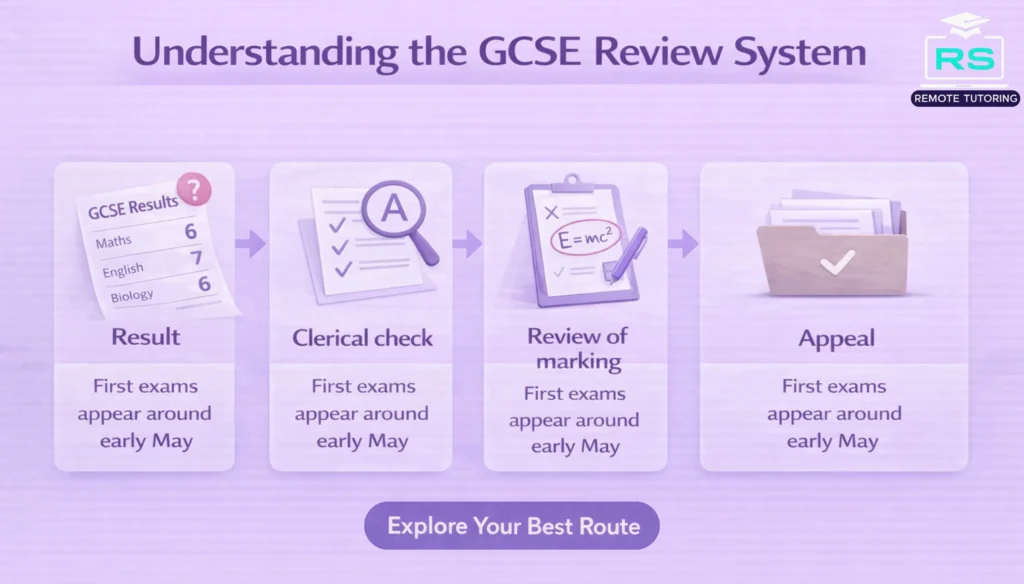
If the students could not achieve the desired grades, there are three post result services available.
- Clerical Re check
- Review of Marking
- Formal Appeal
Each service works on different levels, serving different thoughtful purposes.
A Guide for Rechecking GCSE Result
The following steps will help the parents and students to tackle the most thoughtful process after the results have been declared.
Deciding whether the Appeal for Marks renewal is worth it ?
The first and foremost obligatory step is deciding whether the marks rechecking step is worth it or not , the most asked question is whether it may shift the result or students are only left with thor declared previous marks. Following steps should be considered before reviewing the papers.
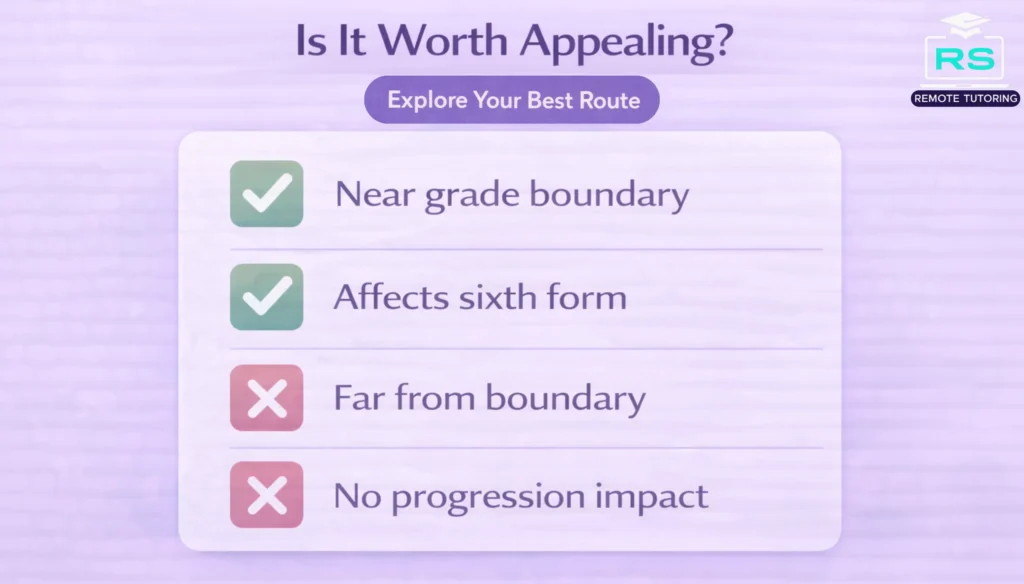
A remark or appeal may be appropriate if:
- You are 1 to 3 marks away from the next grade boundary
- The grade affects sixth form or college admission
- You consistently performed better in mock exams or coursework
- You believe an examiner may have misapplied the mark scheme
- Your teacher believes the paper underperformed compared to ability
If you are Lacking at some peaks, consider the following points explaining why the appeal is not worth it
- You are far below the grade boundary
- The subject is entirely objective (e.g., Maths) unless near a boundary
- You cannot afford the fee and the grade outcome does not affect progression
- You are emotionally reacting without evidence
Request for GCSE Answer Scripts
Another key important area to heaven is on requesting for the access of the scripts. Schools may request the exam boards for access to the answer scripts.The step is worth crucial because;
Viewing the paper allows:
Teachers to assess whether marks were harsh or misapplied
Identification of missed credit in longer answers
Evidence-based decision-making rather than guesswork
Paper reviewing is very much beneficial for the students having the following subjects
- English Language & Literature
- History
- Geography
- Religious Studies
- Sociology and other humanities
Types of GCSEs Reviews
Understanding the type of reviews is an important step that students and parents felt short of. Most families are not actually aware of the options that are valuable for the paper rechecking.
Clerical Recheck:
This is the most simplest option of the rechecking phase. This basically navigate;
- Marks were added correctly
- All questions were marked
- Grades were correctly issued
This option is quite reliable for the exam containing expected admin errors. The cost is mostly lower than the recheck but the grades do not change significantly.
Review of Marking:
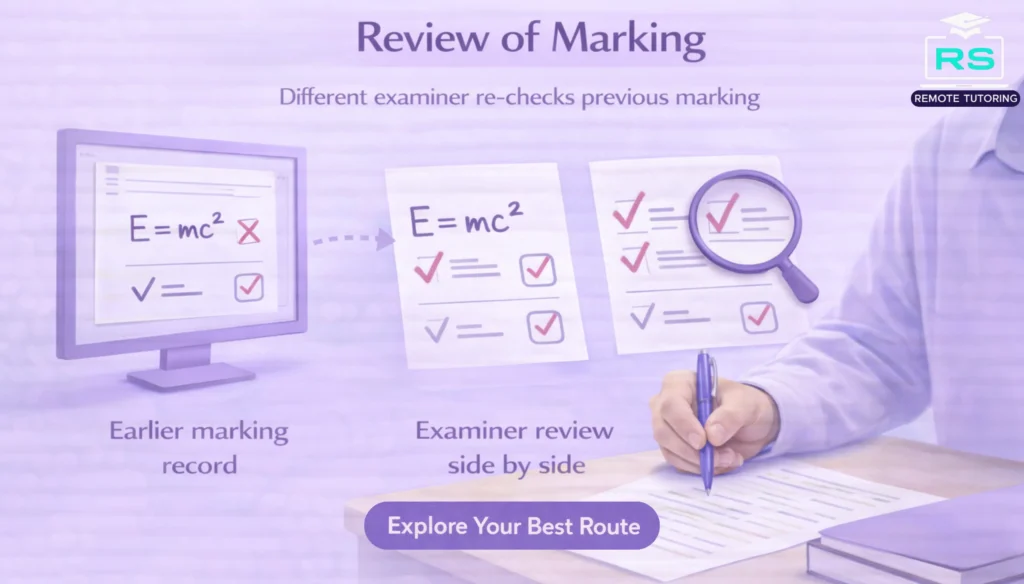
This is another crucial type of the paper appealing. Most widely common option The process occur through a the different examiner
- Reviews the original marking
- Applies the mark scheme again
- Adjusts marks if necessary
A key point to consider is that examiners do not recheck the paper from scratch but checks whether the marks are aligning with the original marking scheme. Paper remarking , te quiet common option often leads to
- Grade increases
- Grade stays the same
- Grade decreases
Formal Appeal:
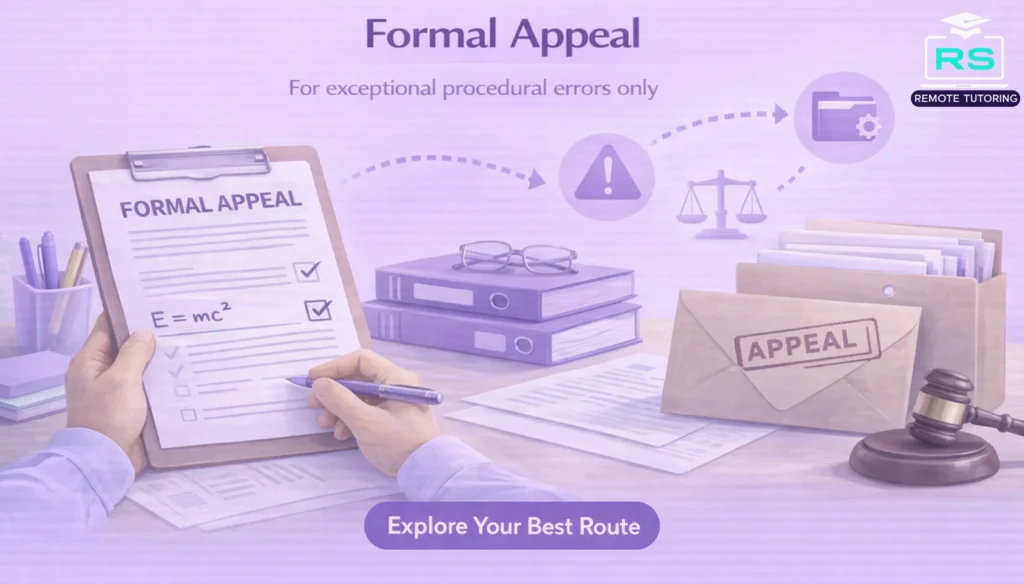
Another wide option for paper remarking is the formal appeal. These appeals are not about academic paper judgements and they are only valid if
- Exam board rules were not followed
- School procedures were flawed
- There was administrative malpractice
Another key dimension to look into it is that appeals are rare and difficult to win and usually pursued after the review of marking.
GCSE Appeal and Marking Deadlines:
This is the most important step because this is the focal point where many of the parents and students are unaware and miss the finest opportunity. Deadlines are strict and missing the means of losing the right to challenge the result.
Access to Scripts: Usually within days of results
Clerical Re-check: Early September
Review of Marking: Mid to late September
Appeals: After review outcome, often October
Schools mostly submit the request on the behalf of students, immediate and early communication if necessary.
Strategies Consideration: Maximizing Success
The following should be considered for maximizing success.
Choose the Right Papers
- Focus on papers closest to grade boundaries
- Prioritise subjects affecting progression or admissions
- Avoid blanket remarking of all subjects
Listen to Teacher Judgement
Teachers often have access to:
- Historical marking trends
- Examiner feedback
- Performance data
Their guidance significantly improves success rates.
Emotional Realities: Managing Expectations
Appealing GCSE results can be stressful. It is important to:
- Prepare emotionally for any outcome
- Have a backup plan for sixth form or college
- Understand that a remark is a review; not a guarantee
In many cases, schools allow conditional enrollment while results are under review.
FAQs
Can GCSE grades go down after a remark?
Yes. Marks can increase, stay the same, or decrease. This is why schools often require written consent before submitting a review.
How long does a GCSE remark take?
Typically 10–20 working days, though it may take longer during busy period
Is a GCSE appeal different from a remark?
Yes. A remark reviews academic marking. An appeal challenges procedural errors.
Can I remark only one paper of a subject?
Yes. You can select individual papers, which can be strategic if one paper underperformed.
Conclusion
Appealing GCSE results or requesting a remark is neither a desperate move nor a guaranteed fix; it is a formal academic process designed to protect fairness.When done strategically, with teacher input and clear evidence, it can genuinely change outcomes and unlock opportunities. When done impulsively, it can waste time, money, and emotional energy.
The key is understanding when to challenge, how to challenge, and what to expect. GCSE results do not define a student but ensuring those results are accurate is a right worth exercising carefully.

Raja specializes in Physics and Maths, with over 5 years of experience. He offers KS2, KS3, and GCSE Science and Maths lessons. He graduated from one of the top universities in the UK.




2 Comments
[…] Two process points that catch families out. You must give written consent before a review goes in, because the grade can drop. And private candidates can’t apply directly to the board; the request goes through the centre that entered you. The full paperwork side, including what happens if the review fails and you want to appeal, is covered in our walkthrough of challenging a GCSE result and requesting a remark. […]
[…] the mark scheme. They don’t re-mark generously. Once your centre submits the request, the remark itself takes up to 20 calendar days, which is worth knowing if a college place is hanging on the outcome. […]