
There is a point every GCSE student reaches during the hectic phase of preparation. Usually it is about a week before exams, when reality hits a little harder. The difficulty level increases as the notes are not fully done. Some topics feel confused. And suddenly, time is all about to run, students anxiously feeling like it is slipping faster than expected.
I have already seen this pattern again and again, and to be very honest, I have also experienced this phase during a crucial part of my own journey. But here comes the good news: last minute GCSE revision is not only possible, it can actually be incredibly effective when done right, especially with the support of expert GCSE revision tutors.
But here is the truth most guides would not tell you: “It is not about working harder in this final week. It’s about working smarter than you ever have before.” Emily Johnson , Expert English Tutor at Rs Remote Tutoring
Jump to Section
Why Last Minute GCSE Revision Can Still Work
Before moving towards the revision strategies, it is important to understand why last minute revision strategies are thoroughly important. One thing that became clear quite quickly to me was that memory works differently under pressure.
When time is limited:
- Your brain prioritises what feels important
- You naturally focus more intensely
- Distractions become easier to cut out
From my experience, as during the initial years of my preparation, students who panic and try to cover everything struggle the most. But those who narrow down their focus and apply smart strategies to their preparation phase often get the output more of their expectations.
Want to revise properly before your GCSE exams? Join our GCSE Revision Program.
Join NowThe Biggest Mistake Students often commit in the Final Week of their preparation
I remember a student telling me, “I am just re-reading everything again and again.”
This is where things go wrong.
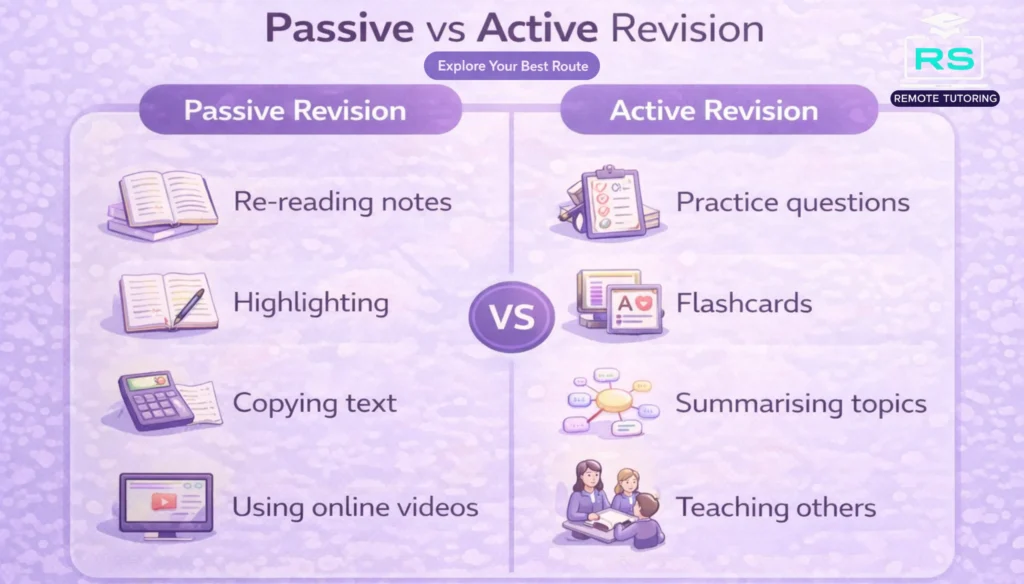
Passive revision (reading, highlighting, copying notes)
Trying to cover every topic equally
Studying for long hours without strategy
What made the biggest difference for us, and for many students I have all worked with was wholly to:
- Active recall method
- Exam-focused practice
- Strategic prioritisation
How to Prioritise in Your Final Week
You do not have time for everything, and that is okay. What you actually need to do is a simple decision system:
Step 1: Divide Topics into 3 Categories
- Strong:the topics that do not need the time more only requiring the quick review only
- Moderate: The topics that needs to be practised and enforced
- Weak: the weak areas are the ones requiring the proper focus, these must be the core of your final week.
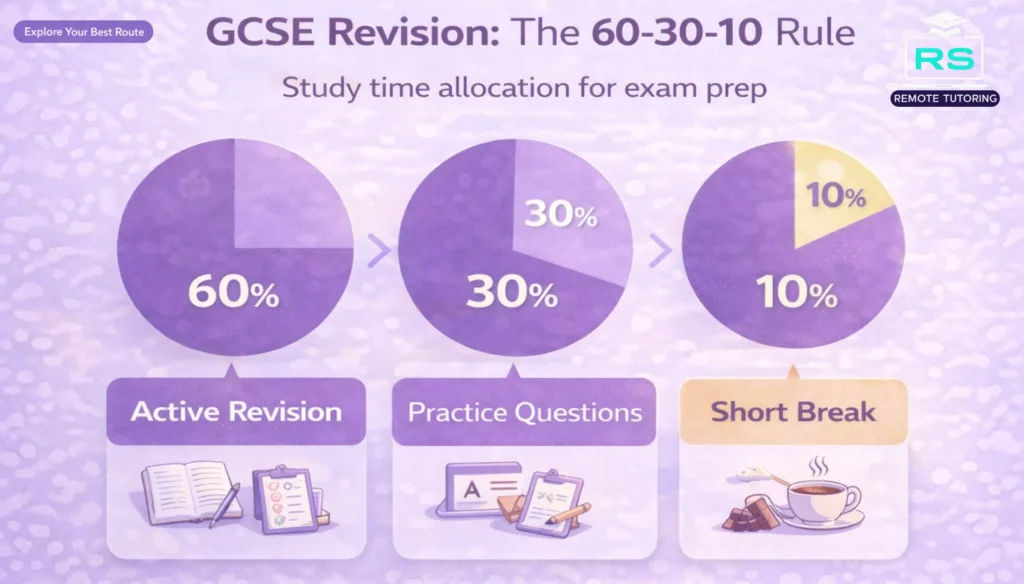
Step 2: Apply the 60-30-10 Rule
- 60%: the focus should be on the weak areas
- 30%: the focus should entirely be on the practical enforcement of the theory
- 10%: the least percentage should be given to the strong topics that actually need little attention.
Many students do not realise this, but it is important to understand that over-revising strong topics feels productive but gives almost no grade improvement.
The Most Effective Last Minute GCSE Revision Techniques
The following are some of the most effective last minute GCSE revision techniques that can genuinely help students improve their results when used properly.
1. Active Recall (Your utmost Number 1 Tool)
Instead of reading notes, ask yourself:
- Can I explain this without looking?
- Can I answer a question about it?
The active recall forces your brain to retrieve the information, strengthening your brain memory to actually hold on and work better when anxiously recalled during the exam hours.
2. Past Papers Are Non-Negotiable
If there is one thing I would genuinely recommend, it is this: Do as many past paper questions as possible.
Not full papers every time, even:
- 10-15 questions per topic
- Timed sections
- Marking your own answers
This builds:
- Exam technique
- Confidence
- Speed
3. The Teach It Out Loud Method
This method refers to the process of revising the topic and then significantly teaching it to yourself for better results. For this method, Explain a topic as if you are teaching someone.
I remember doing this and realising: If you can’t explain it simply, you don’t understand it yet..
Want to revise properly before your GCSE exams? Join our GCSE Revision Program.
Join NowA Realistic Final Week Revision Plan
I usually encounter a certain thing that students do not lack with the strategies, as they are aware of proven strategies for their GCSE revision and maximizing their final week to avoid the pressure during the exam hours. What really makes them fail or attain the low grade is the revision timetable, Here is a structure that actually works:
Daily Framework
Morning (High Focus)
- Focus on Weak topics
- Active recall + questions
Afternoon
- Past paper practice
Evening
- Light review (flashcards, summaries)
Night
- Stop heavy studying
- Let your brain rest
Study Sessions
Use:
- 50 minutes study
- 10-minute break
This keeps your focus sharp without burnout.
How Many Hours Should You Study in the Final Week?
This is the most important concern of the students. They are often entangled , torn between the question about how many hours one should study during the final week. This is where many students go wrong, because anxiously focusing on studying more hours actually is not true in most of the cases.
More hours ≠ better results. From what me and our other tutors have seen:
- 4 to 6 focused hours per day is ideal
- Beyond that, productivity drops
What actually matters more is :
- Quality of revision
- Focus level
- Technique used
What to Do the Night Before the Exam
This part matters more than most students think.
Do NOT:
- Learn new topics
- Stay up late cramming
Instead:
- Light review
- Go through key formulas or summaries
- Sleep properly
I still remember how much clearer everything felt after a good night’s sleep compared to a late-night cram.
FAQs
How can I revise effectively at the last minute for GCSEs?
Focus on active recall, past paper practice, and prioritising weak topics. Avoid passive reading and instead test yourself repeatedly under exam conditions.
What is the best strategy for last minute GCSE revision?
The most effective strategy is combining active recall with past papers while focusing primarily on weak areas using a structured daily plan.
How many hours should I study in the final week before GCSE exams?
Aim for 4 to 6 hours of focused revision daily. Quality matters more than quantity, so use active techniques rather than long passive study sessions.
Does last minute revision actually work?
Yes, if done correctly. Focused, strategic revision using active recall and exam practice can significantly improve performance even in the final week.
Final Thoughts
Last minute GCSE revision is not just about catching up on everything. It is all about:
- Being honest about where you are
- Focusing on what actually moves your grade
- Using techniques that make your brain work
From experience, what stayed with me most is this:
- The students who succeed in the final week aren’t the ones who panic.
They’re the ones who simplify, focus, and execute.
And if you do that, even now, there is still a lot you can turn around.

Raja specializes in Physics and Maths, with over 5 years of experience. He offers KS2, KS3, and GCSE Science and Maths lessons. He graduated from one of the top universities in the UK.