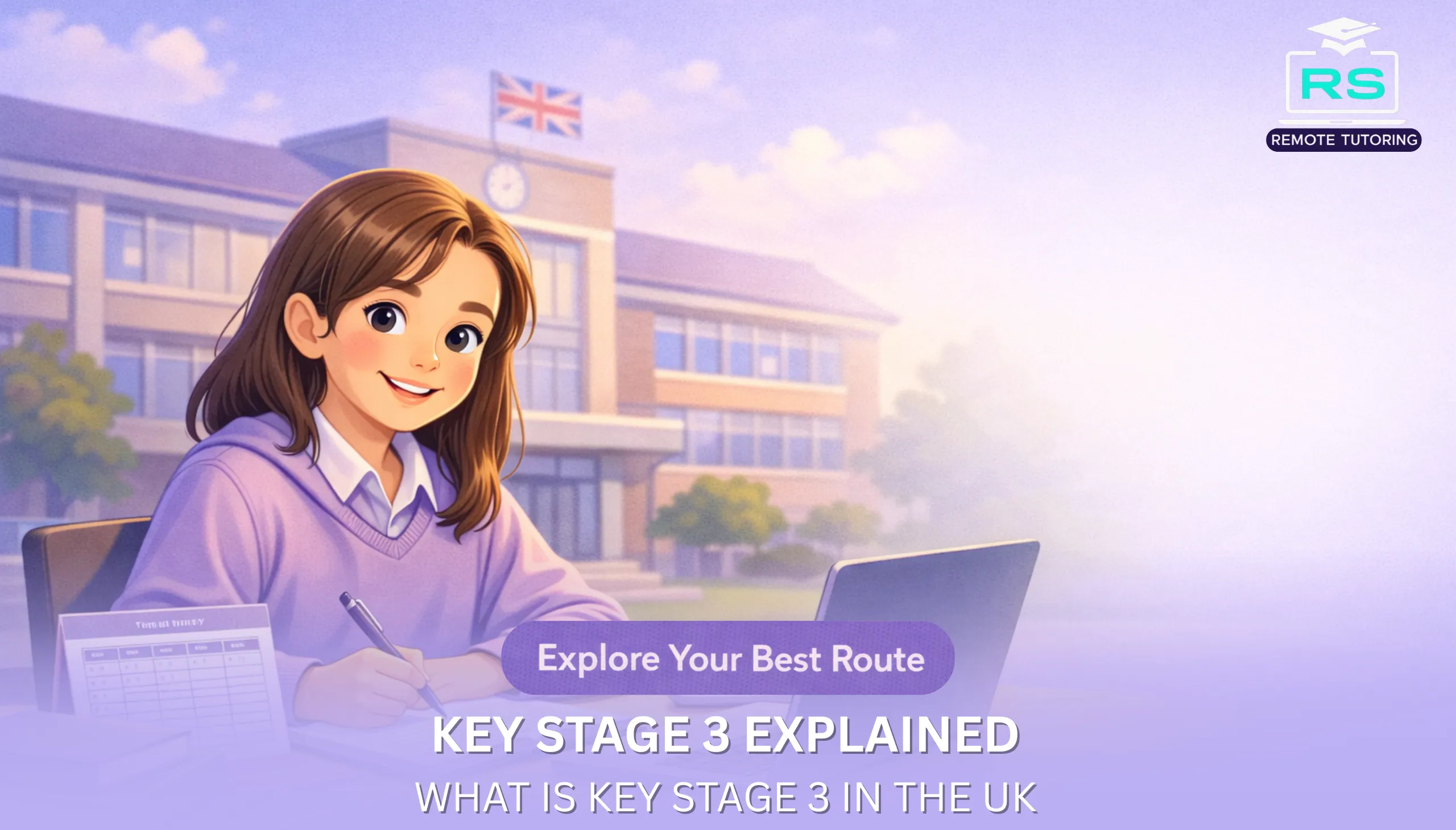
The move from primary school to secondary is one of the biggest transitions in a child’s education. I still remember the mix of excitement and nerves when my own niece started her first day of Year 7: new teachers, a massive campus, lockers and, most of all, a timetable full of subjects she’d never studied before. Key Stage 3, often shortened to KS3, covers this formative period. For parents, pupils and teachers alike, it can feel like stepping into a new world. In this guide I’ll share what Key Stage 3 is, what ages and year groups it covers, and how you can support children through these crucial years. Along the way I’ll add stories from my own experience and from conversations with other parents and educators.
Jump to Section
What Is Key Stage 3?
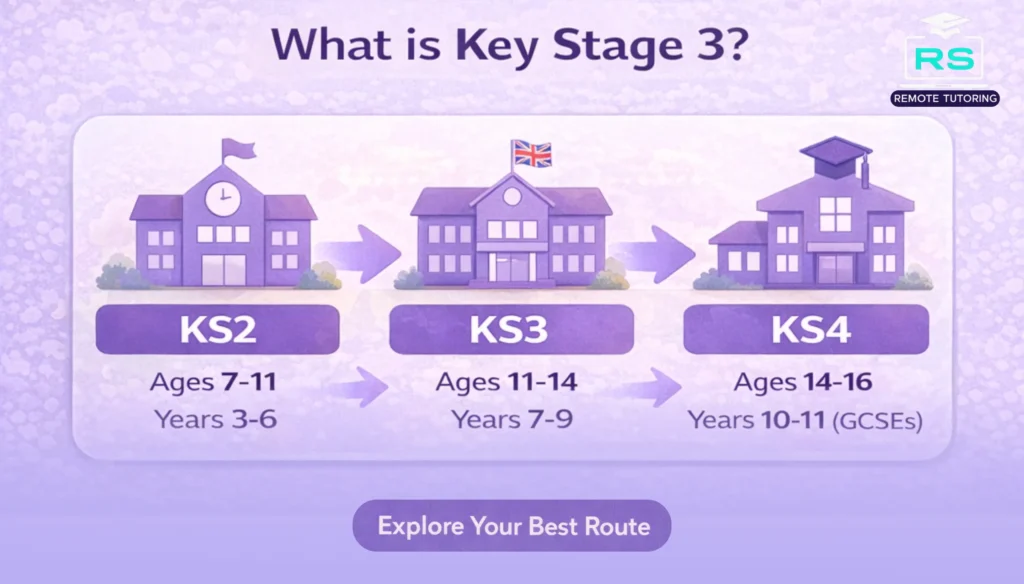
Key Stage 3 is the first phase of secondary education in England and Wales. It spans Years 7 to 9, with pupils typically aged 11 to 14. During this stage, students follow the national KS 3 and KS 4 curriculum, building upon the foundational knowledge from primary school (Key Stage 2) and preparing for the more specialised study of Key Stage 4 and GCSEs. In Scotland the equivalent period is the Third/Fourth Level, while in Northern Ireland it’s referred to simply as KS3. Regardless of name, the purpose is similar: to give children a broad and balanced education and help them transition from childhood to adolescence.
I often tell parents that Key Stage 3 is both a bridge and a launch pad. It introduces subject specialists, homework routines and the independence students will need later. My neighbour’s son, for instance, discovered his love for design technology in Year 8, a subject he’d never encountered before. That passion eventually led him to pursue engineering at university. Without the breadth of KS3 he might never have uncovered that interest.
KS3 Across the UK: A Note on Terminology
Although this guide focuses primarily on England and Wales, it’s worth noting regional differences:
- England & Wales: KS3 covers Years 7 to 9 for ages 11 to 14. It follows a national curriculum with compulsory subjects and foundation subjects.
- Scotland: The Third/Fourth Level broadly covers S1–S3 (ages 11 to 14). After that, pupils enter the Senior Phase (S4–S6).
- Northern Ireland: KS3 spans Years 8 to 10 (ages 11 to 14) as primary school ends at Year 7. Pupils then progress to KS4 for GCSEs.
Wherever you are in the UK, the underlying aim is the same: to give young adolescents a solid educational foundation before they specialise.
Age Range & Year Groups
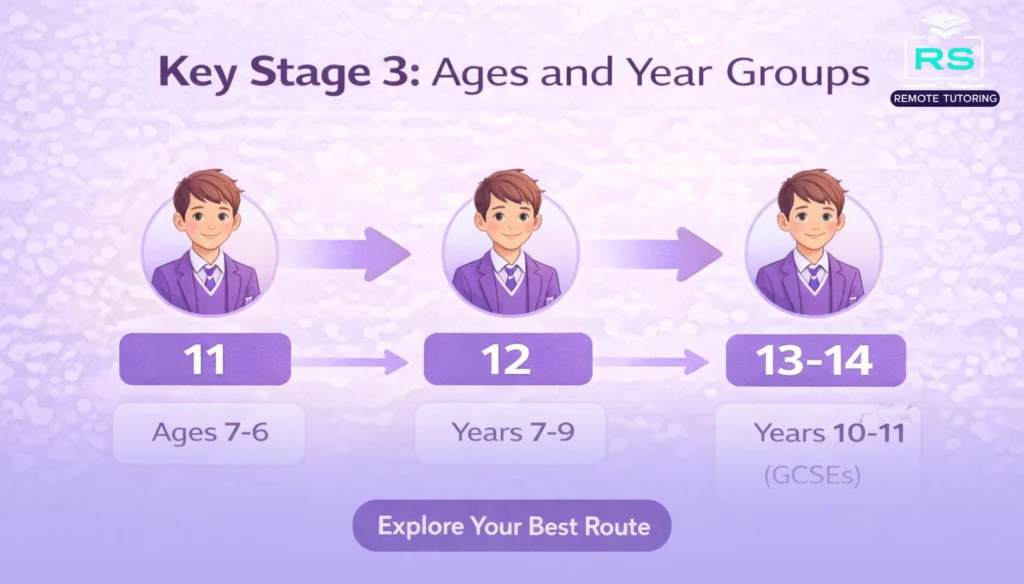
One of the most common questions I get from parents is “what age is Key Stage 3?” KS3 starts when children leave primary school at the end of Year 6. In England and Wales they begin Year 7 at age 11, move into Year 8 at 12, and finish Year 9 at 13 to 14. Scotland operates similarly but labels the years S1 to S3.
The table below summarises the typical ages and year groups across the UK’s key stages. Keeping sentences brief ensures the table remains easy to scan.
| Key stage / level | Ages (approx.) | Year groups (England/Wales) | Year groups (Scotland) |
| Early Years | 3–5 | Nursery & Reception | Nursery, P1 |
| Key Stage 1 (KS1) | 5–7 | Year 1–2 | P2–P3 |
| Key Stage 2 (KS2) | 7–11 | Year 3–6 | P4–P7 |
| Key Stage 3 (KS3) | 11–14 | Year 7–9 | S1–S3 |
| Key Stage 4 / Senior Phase | 14–16 | Year 10–11 (GCSE) | S4–S5 |
| Post‑16 / Sixth Form | 16–18 | Year 12–13 (AS/A Levels) | S6 / Senior Phase |
Age ranges are approximate; birthdays during the academic year mean some pupils may be a few months older or younger. The wide developmental spread between an 11‑year‑old Year 7 and a 14‑year‑old Year 9 is significant, something teachers adapt to by tailoring lessons and expectations. As a father of teenagers, I’ve seen first-hand how Year 9 students can feel both like seasoned veterans and anxious newcomers preparing for their GCSE options.
Key Stage 3 Curriculum: Core, Foundation & Beyond
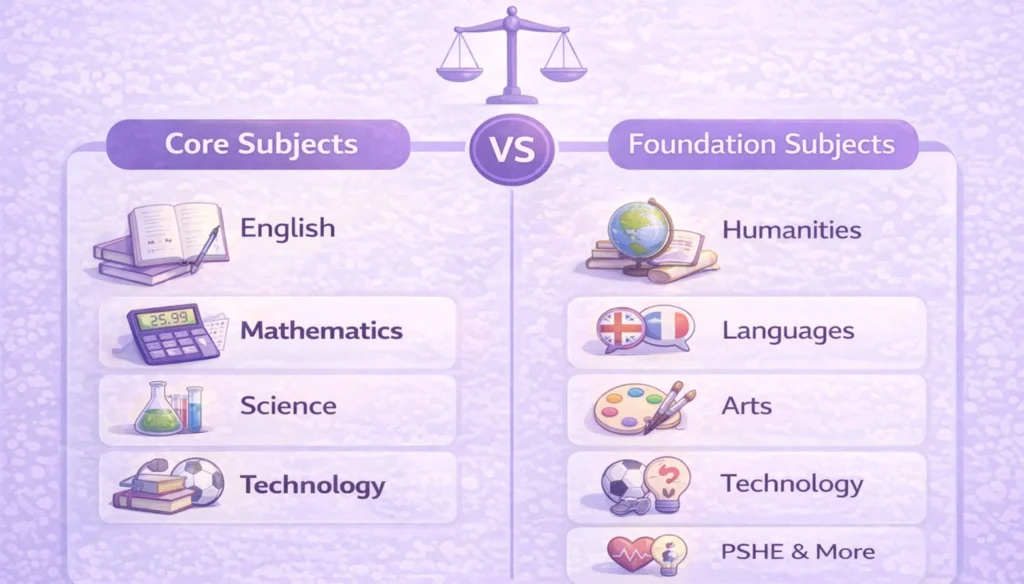
KS3 offers students the chance to explore a broad range of subjects. According to the UK government’s national curriculum, compulsory subjects at Key Stage 3 include English, maths, science, history, geography, modern foreign languages, design and technology, art and design, music, physical education, citizenship and computing. Schools must also provide relationships and health education, sex education and religious education.
In practice, the curriculum is often broken down into core and foundation subjects:
Core subjects
- English: Reading, comprehension, creative and analytical writing, grammar, punctuation and speaking skills. Pupils encounter literature ranging from Shakespeare to contemporary fiction, building their critical thinking and communication skills. From my experience, Year 7 students sometimes struggle with Shakespearean language; reading abridged versions together at home can make a big difference.
- Mathematics: Number operations, algebra, geometry, statistics, probability and ratio. KS3 maths moves quickly from basic arithmetic to abstract reasoning. My daughter found algebra puzzling at first; visual models like bar modelling and plenty of practice exercises helped concepts click.
- Science: Often taught as separate disciplines (biology, chemistry and physics) but sometimes as combined science. Pupils design experiments, learn scientific methodology and explore topics from cells and ecosystems to forces and chemical reactions. Encourage your child to ask questions and, if possible, visit science museums or watch documentaries to spark curiosity.
Foundation subjects
- History and Geography: Pupils study British and world history, geographical skills, environments and global issues. In Year 8 my class debated the causes of the Industrial Revolution; the lively discussions developed research and presentation skills.
- Modern Foreign Languages (MFL): French, Spanish or German are typical. Some schools offer Mandarin or other languages. Learning a new language at 11 can be challenging, but it also opens doors to different cultures.
- Design and Technology: Projects ranging from woodwork and textiles to food technology and electronics. Many students, like my neighbour’s son, discover practical talents here that shape later career choices.
- Art and Design: Drawing, painting, sculpture, digital art and art history. Creativity is nurtured alongside critical analysis.
- Music: Playing instruments, singing, composition and understanding musical styles. Some schools encourage ensemble participation.
- Physical Education (PE: Sports, fitness and health. KS3 encourages all pupils to participate and fosters teamwork.
- Citizenship and Computing: Citizenship teaches pupils about government, democracy, human rights and community involvement. Computing covers digital literacy, programming, data and online safety.
- Personal, Social, Health and Economic (PSHE): Many schools integrate PSHE, focusing on wellbeing, relationships, mental health and financial literacy.
- Religious Education (RE) and Sex Education: Schools must offer these; parents have the right to withdraw their child from sex education or religious education. I remember being unsure whether my son should attend sex education lessons. After talking to the school nurse and other parents, we realised how important these sessions are for fostering healthy relationships and respect.
Optional & Enrichment Subjects
Many schools extend beyond the statutory subjects to enrich learning. Options can include drama, business studies, additional languages, food technology, textiles or extra sciences. Availability depends on staffing and facilities, but encourage your child to try new subjects, they might uncover hidden passions.
Outside the classroom, clubs and societies offer enrichment: choir, sports teams, robotics, coding clubs, art clubs, debating societies and the Duke of Edinburgh’s Award. Participation helps students develop confidence, teamwork and leadership skills, and it makes school feel like a community rather than just a place to sit in lessons.
The Learning Experience: Independence & New Routines
Moving into KS3 feels a bit like starting at a small university. Instead of one classroom teacher, pupils have a timetable of lessons taught by subject specialists. They carry timetables, textbooks and, often, mobile phones. This independence can be both liberating and daunting. I remember walking through the corridors with Year 7 students in my role as a mentor; some would anxiously clutch their timetables, worried about getting lost. Within a few weeks they were confidently navigating from science labs to art studios.
Homework & Study Skills
Expect a noticeable increase in homework compared with primary school. Assignments might include reading chapters, answering comprehension questions, completing worksheets, creating presentations or researching topics. Encourage your child to:
- Use a planner (write down homework tasks and deadlines. Digital apps work too, but paper planners offer a tactile reminder).
- Establish routines (set aside a regular time each day for homework. In our household, we’ve found that tackling homework before dinner frees up evenings for relaxation).
- Break tasks into smaller chunks (long projects become manageable when divided into stages. For example, creating a history project might involve research one night, writing the next and assembling visuals another).
- Ask for help early (encourage your child to approach teachers if they don’t understand something. KS3 teachers expect questions and value proactive students).
Teaching Styles & Class Sizes
KS3 classes are usually larger than those in primary school, and teachers are specialists in their subject. Teaching methods vary: you’ll see group discussions, independent research, practical experiments and formal note‑taking. Students are encouraged to develop critical thinking and to speak up. When I asked a Year 9 class what they enjoyed most about science, several said they loved being trusted to use Bunsen burners and design their own experiments.
School pastoral systems provide support too. Most schools have a form tutor or homeroom teacher who meets their class daily, monitors wellbeing and acts as a first port of call for concerns. Don’t hesitate to contact the form tutor if your child seems anxious or overwhelmed.
Assessment & Progress Tracking
Unlike Key Stages 1 and 2, there are no national curriculum tests (SATs) at the end of Key Stage 3. Instead, schools use a range of assessment methods to gauge progress. These include:
- Class tests & end‑of‑topic exams (short tests or longer assessments evaluate understanding of recent units).
- Coursework & projects (research assignments, creative projects and group work allow students to apply knowledge).
- Practical assessments (particularly in science, PE, art and technology).
- Homework & participation (regular homework completion and classroom contribution give teachers insight into engagement).
- Teacher assessment & reports (teachers use rubrics to mark work and provide feedback. Most schools send termly or half‑termly reports summarising progress and effort).
Many schools align KS3 grades with the 9‑1 GCSE scale (9 being the highest) to help parents understand progress toward GCSEs. Others use level descriptors or bespoke systems. It’s important to focus on progress and effort, not just attainment. Look for improvement over time and whether your child engages with feedback.
From experience, I’ve found that progress reports can sometimes feel vague. One teacher wrote that my daughter “needs to take more care with homework,” but didn’t specify how. Don’t be afraid to ask for clarification at parent‑teacher meetings. Keep your own notes on questions and discuss your child’s strengths and challenges.
Tips for Interpreting Reports
- Effort grades (high effort often signals resilience and willingness to improve).
- Progress indicators (compare current performance to the start of the year).
- Teacher comments (look for specific advice. If comments are generic, ask teachers for detail).
- Attendance & punctuality (missing lessons can hinder progress).
- Homework quality (thorough, timely homework indicates good study habits).
From KS3 to GCSE: What Comes Next?
By Year 9, students are getting ready for Key Stage 4 (KS4), the two‑year period in which they typically study for GCSEs or Technical Awards. KS3 is deliberately broad to allow children to discover subjects they enjoy before specialising. In Year 9 most schools start the options process:
- Information sessions (assemblies and presentations outline available subjects and qualification pathways).
- Guidance from teachers & careers advisors (professionals help students match subjects to interests and future goals).
- Discussions at home (parents and guardians talk through choices, balancing enjoyment, aptitude and long‑term plans).
- Submitting choices (students typically select 3–4 options alongside core subjects (English, maths and science).
Options vary by school: some operate “pathways” grouping subjects (e.g. humanities, arts, technology) while others allow free choice. Many schools encourage pupils to pursue the English Baccalaureate (EBacc), a combination of GCSEs in English, maths, science, a humanities subject and a language. The EBacc is valued by some universities and can keep future options open, but it isn’t compulsory.
KS3 vs GCSE (KS4)
Parents often ask whether GCSEs are part of Key Stage 3 or 4. GCSEs fall under Key Stage 4, which comes after KS3. KS3 lays the groundwork across many disciplines; GCSEs involve more rigorous study and formal exams. Pupils narrow their subject choices, focus on deeper content and start preparing for qualifications. KS4 therefore has higher stakes: grades obtained at GCSE influence post‑16 options such as A levels, apprenticeships or vocational training.
Common Challenges & How to Support Your Child
KS3 coincides with early adolescence. It’s a time of rapid physical, emotional and social change and it brings its fair share of challenges. Here are some issues pupils may face and strategies parents can use to help.
Academic Challenges
Increased workload and new subjects: The jump from primary to secondary often results in more homework, new disciplines (e.g., languages or technology) and higher expectations. Help your child break down tasks, use planners and establish routines.
Adapting to different teaching styles: Pupils must adjust to multiple teachers with varying expectations. Encourage your child to ask questions, seek clarification and reflect on what strategies work best for each subject.
Managing homework from multiple subjects: Organisation becomes crucial. Use a family calendar or homework app to track assignments.
Social & Emotional Challenges
Navigating larger schools and new friendships: Secondary schools are often much bigger than primary schools. Finding their way around and making friends can be daunting. Attend orientation days, join clubs and talk openly about friendships and peer pressure.
Self‑confidence & identity: Adolescence is a period of intense self‑discovery. Pupils may feel pressure to fit in or to meet parental expectations. Celebrate their strengths, encourage them to be themselves and remind them that it’s okay to ask for help.
Digital & social media pressures: Phones and social networks become more prevalent. Discuss online safety, screen time balance and respectful digital communication. Share your own experiences with social media pitfalls to make the conversation more relatable.
Supporting Learning at Home
Parents play an essential role in helping children thrive during KS3. Here are practical ways to support:
- Create a supportive environment: Set up a quiet study space with good lighting. Encourage a routine but remain flexible when your child needs a break.
- Encourage reading: Regular reading improves vocabulary and comprehension. Try reading the same book and discussing it together. My son and I bonded over science‑fiction novels.
- Stay connected with school: Attend parents’ evenings, read newsletters and communicate with form tutors or subject teachers. Teachers appreciate proactive parents and will share strategies tailored to your child.
- Promote independence: Let your child take responsibility for homework and organisation, but be on hand for support. Gradually increase independence as confidence grows.
- Discuss current affairs: Relate school subjects to real life. For example, discuss historical events in the news or link geography lessons to climate change.
- Balance extracurricular activities: Clubs and sports build skills and friendships, but ensure there’s time to rest and study.
- Monitor wellbeing: Watch for signs of stress, bullying or disengagement. Contact school pastoral staff if concerns arise.
When to Seek Extra Help
If you notice significant drops in grades or motivation, social difficulties, reluctance to attend school or concerns about future pathways, reach out to teachers, learning support departments or trusted tutors. External tutors can provide targeted support in tricky subjects and boost confidence. Our community of experienced tutors has helped many KS3 pupils build solid foundations for GCSEs and beyond.
Practical Tips from Experience
Over the years I’ve gathered numerous anecdotes from parents and teachers. Here are some tips you don’t always find in official guides:
- Label everything: Secondary school is a sea of identical PE kits and pencil cases. My daughter lost three school jumpers in her first term until we labelled them clearly.
- Pack bags the night before: Morning panic is no fun. Lay out books, PE kit and equipment before bed. This simple habit reduces stress.
- Practice timetable navigation: During the first week, walk through the school map or practise at home. It helps pupils feel confident on day one.
- Encourage lunchtime clubs: Joining a club is a great way to make friends. My niece found her tribe in the drama club and went on to star in the school play.
- Talk about mental health: KS3 pupils experience mood swings and stress. Normalise conversations about anxiety and resilience. I’ve found that listening without judgment is far more helpful than immediately offering solutions.
Seasonal & Regional Considerations
The UK climate can be unpredictable, particularly for families moving from warmer climates. In autumn and winter, days are short and dark by 4 pm, which can affect mood. Encourage your child to get outside during daylight hours for exercise and natural light. In spring and summer, longer days mean opportunities for field trips and outdoor sports. Pack waterproofs and layers; British weather can change rapidly.
If your family plans to relocate, consider regional differences in the curriculum and school calendars. Scottish and Northern Irish schools have slightly different term dates and holidays. Ensure you check local authority websites for up‑to‑date information.
Frequently Asked Questions
What age is Key Stage 3?
Key Stage 3 covers pupils aged 11–14, corresponding to Years 7, 8 and 9 in England and Wales. In Scotland it aligns with S1–S3, while in Northern Ireland it includes Years 8–10.
What comes after Key Stage 3?
After KS3, pupils progress to Key Stage 4 (KS4), during which they typically study for GCSEs or equivalent qualifications. KS4 spans Years 10–11 in England and Wales and S4–S5 in Scotland.
Is GCSE part of Key Stage 3 or 4?
GCSEs are part of Key Stage 4, not KS3. KS3 provides a broad foundation, while GCSE study is more specialised and leads to formal qualifications.
Do pupils take exams in Key Stage 3?
There are no national SATs or GCSE‑style exams at the end of KS3. Schools assess pupils through internal tests, coursework, practical work and teacher judgment.
What are C1, C2, C3 and C4 schools?
These terms are not officially linked to Key Stage 3. They generally refer to categories used by Ofsted or local authorities to describe school performance or catchment areas. They can vary regionally and are not part of the national curriculum structure. Always check with your local council or school for clarification.
Should my child do Key Stage 3?
Yes. Key Stage 3 is a compulsory part of the national curriculum in England and Wales and is essential preparation for KS4. It offers a balanced education across a wide range of subjects and helps children discover their interests before narrowing choices. Even if your child is homeschooled, the KS3 framework provides a helpful guideline.
What’s the difference between KS3 and KS2?
KS2 (Years 3–6) is the final stage of primary school, focusing on foundational skills in core subjects and some early science and humanities. KS3 introduces subject specialists, expands the curriculum to include languages, design and technology, and promotes greater independence. It serves as a bridge between the hands‑on learning of primary school and the exam‑oriented study of GCSEs.
Conclusion
Key Stage 3 marks an important transition from childhood to adolescence. Spanning ages 11–14, it combines a broad curriculum, new social landscapes and increased independence. With the right support at home and school, pupils can thrive during these years and develop the skills, knowledge and resilience they’ll need for GCSEs and life beyond. I’ve watched many young people navigate KS3, some sail through, others stumble and then flourish. The common thread is support, patience and encouragement. Embrace the journey, celebrate small victories and remember that every student’s path is unique.
Going through Key Stage 3 is exciting, but it can feel overwhelming. If you’d like personalised guidance, our experienced tutors specialise in English, maths, science and more. They can help your child build solid foundations and grow in confidence. Contact us today to discuss your child’s needs.
Raja specializes in Physics and Maths, with over 5 years of experience. He offers KS2, KS3, and GCSE Science and Maths lessons. He graduated from one of the top universities in the UK.