How to Choose GCSE Tutor for 2026
General Certificate of Secondary Education (GCSE) exams are a pivotal milestone for students in England, Wales and Northern Ireland. Achieving strong grades at age 16 opens doors to sixth form, A‑levels, apprenticeships and further education. It also builds confidence ahead of A‑levels or vocational courses. Yet not every student finds the two‑year GCSE programme easy. By 2026, exam boards will continue to use the linear course model, with all assessments at the end of year 11 and core subjects such as English and maths requiring at least a standard pass (grade 4). Parents often worry about revision habits, missing coursework, lack of motivation or simply not understanding a particular topic. If you are looking to hire private tuition, it is important to know how to choose GCSE Tutor, and our guide explains everything you need to know to choose best GCSE tutor for 2026 for any subjects such as, maths, engish, science, etc. Why Consider a Tutor for GCSE Preparation and Exam Before rushing to hire a tutor, first decide if your teenager truly needs extra support. Ask questions such as: if the answer to all of these questions is “yes,” a tutor may not be essential, otherwise additional support could make a difference. Common reasons to hire a GCSE tutor include: However, tutoring is not a magic wand. A tutor cannot force a teenager to study, motivation and engagement must come from within. Tutors also only see students for a limited time each week, so independent study between sessions is critical. Steps To Choose Best GCSE Tutor for your Child in 2026 GCSE Exams Our panel of tutors has carefully considered and identified 9 steps that every parent or child should follow to properly assess their exact requirements before hiring a tutor in the United Kingdom for exam preparation, ensuring the best results. Step 1: Assess Your Child’s Needs Every student is different, so start by understanding what your child needs. Identify strengths and weaknesses Compile recent test results, teacher comments and predicted grades. Look for patterns: are there specific topics causing difficulty, or does your child struggle with exam technique? Many students are motivated but lack confidence or struggle with exam questions or techniques. Know the curriculum and exam boards Different exam boards have slightly different specifications. For example, AQA, Edexcel and OCR all offer GCSE maths but structure their papers differently and use separate formula sheets in 2026. A good tutor should align lessons with your child’s exam board and syllabus. Be prepared to tell prospective tutors which board your child is taking, and ask them about their familiarity with that board. Determine goals Decide whether you are targeting a grade improvement, building general confidence, or preparing for higher tiers (e.g., aiming for grades 7–9). Also consider if the support is for specific subjects or multiple courses. Some students benefit from tutors in only one subject (such as maths) while others may need help across science, English and humanities. Having clear goals will help you evaluate potential tutors and measure progress. Step 2: Understand Qualities of a Great Tutor Several competitor guides highlight the qualities parents should look for in a tutor. Principal Tutors emphasises six key characteristics, which we expand below: 1. In‑depth subject knowledge The tutor must deeply understand the current curriculum and the latest exam board specifications. They should know how topics are examined and be able to teach exam techniques and mark schemes. For example, GCSE maths tutors should be comfortable with the new formula sheets used in the exam from 2025–2027 and able to explain how to apply them in problem solving. Subject‑specific tutors for English, science, computer science or religious studies (subjects we specialise in at RS Remote Tutoring) should be able to help students interpret texts, design experiments or write analytical essays with exam‑style rigour. 2. Effective communication Communication is more than speaking clearly; it involves listening, questioning, checking understanding and adjusting explanations to suit your child’s learning style. Good tutors also provide feedback to parents about progress. Tutors need to listen to concerns, identify difficult areas and coach exam techniques. Look for someone who can explain complex ideas in simple terms and is patient with repetition. 3. Patience and empathy Learning can be frustrating when a topic doesn’t click. Great tutors create a non‑judgemental environment where students can ask questions without feeling stupid. They show empathy for exam anxiety and encourage a growth mindset (“you can learn this with practice”). 4. Adaptability and personalised teaching No two students learn the same way. Tutors should adapt their approach to match your child’s learning style, energy level and progress. They might use visual aids, practice questions, video explanations or real‑world examples. They also need to adjust the pace of lessons depending on how quickly your child grasps concepts. Look for tutors who mention differentiated strategies rather than a rigid “one‑size‑fits‑all” plan. 5. Strong organisational skills A tutor should plan each session, monitor progress and keep track of homework. They should know how to use digital tools, exam board resources and revision timetables to keep lessons structured. A disorganised tutor who arrives unprepared wastes valuable time and undermines your child’s confidence. 6. Motivation and inspiration Finally, tutoring isn’t just about knowledge; it’s about inspiring students to believe in themselves. Principal Tutors emphasises that tutors should celebrate small wins, show enthusiasm for learning and make subjects relevant to students’ interests. A great tutor acts as a mentor, boosting self‑belief and encouraging independent study. Step 3: Check Qualifications, Experience and Safety Not all tutors are equal. Here are factors to investigate: Teaching qualifications While there is no legal requirement to hold a teaching qualification to be a private tutor in the UK, many parents prefer tutors with Qualified Teacher Status (QTS) or relevant degrees in their subject area. Head Start Learning notes that you should look for relevant qualifications (e.g., a maths tutor with a maths degree and QTS) and check that they are familiar with the major exam boards. Experience and specialisation Ask prospective tutors
GCSE Exam Date 2026: Timetable, Key Dates and Complete Guide for Students and Parents

Every spring, millions of pupils across the UK prepare to sit their General Certificate of Secondary Education (GCSE) exams. These tests mark the culmination of Key Stage 4 and open the door to sixth‑form study, apprenticeships or vocational courses. Knowing exactly when the 2026 GCSE exams take place is crucial if you want to build a revision timetable, book holidays and avoid last‑minute stress. In this comprehensive guide we explain when GCSE exams will run in 2026, how exam timetables are organised, what to expect in different subjects, entry deadlines, results day, GCSE reforms that will affect exam formats and how to prepare effectively. Whether you’re a pupil, a parent or a private candidate, this guide will help you navigate the exam season with confidence. When are the GCSE Exam Date in 2026? The 2026 summer exam period is scheduled to run from the week beginning Monday 4 May 2026 and finish on Friday 26 June 2026. This window covers all written papers set by the main exam boards, AQA, Pearson Edexcel, OCR, WJEC/Eduqas and CCEA. The boards publish their full timetables each autumn, and individual schools issue personalised schedules to their students. Dates may change slightly in the months leading up to the exams, so always check the final timetable from your exam centre. Note: The Joint Council for Qualifications (JCQ) exam timetable page is the official source for the latest GCSE schedules. Key takeaways about the 2026 exam window: Get Free 1-on-1 Online Session with Our 15 Specialized GCSE Tutors Clear guidance on what to study (and when) Mock practice tied to real exam dates Flexible online scheduling Contact Now Morning and afternoon exam sessions All exam boards hold two sessions each day: a morning session starting at 09:00 and an afternoon session starting at 13:30. Schools must follow these start times, though they can vary by a few minutes for local arrangements. Some larger exams may run into the late afternoon. Occasionally a board will schedule an evening session for exams that cannot fit elsewhere, but this is rare. Contingency days and national events The Joint Council for Qualifications (JCQ) usually reserves contingency days toward the end of the exam period. These are additional days set aside in case a national or local event (for example, a national mourning period or widespread transport disruption) forces the rescheduling of an exam. Students must remain available until the final contingency day. Check your exam timetable for details. How GCSE timetables are organised Exam boards and their timetables GCSEs are offered by several exam boards. Each board sets its own timetable, but they coordinate via the JCQ to avoid clashes for popular subjects: Each exam board releases its final summer timetable by the end of the preceding October. Schools and exam centres then create personalised schedules for each pupil, listing paper codes, dates, times and exam rooms. Candidates should always use the timetable given by their centre rather than generic schedules. Example subject timing Although the specific dates differ each year, the structure of GCSE exam date follows a familiar pattern. Here are typical timings for major subjects, based on recent exam cycles (note that 2026 may vary): These patterns give you a rough sense of when subjects fall. You must consult the final timetable for exact dates. Get Free 1-on-1 Online Session with Our 15 Specialized GCSE Tutors Clear guidance on what to study (and when) Mock practice tied to real exam dates Flexible online scheduling Contact Now Key dates and deadlines Understanding the administrative calendar helps you avoid missed opportunities or penalty fees. Here are the main milestones for the summer 2026 GCSE series: Key event Typical date range (2026) Notes Entries open October 2025 Schools start entering candidates with exam boards. Private candidates should register through an approved centre at this time. Normal entry deadline Early February 2026 Schools and centres must submit final candidate entries. Late fees apply after this date. Late entry/amendment deadline March 2026 Last chance to add or change entries (with additional fees). Exams begin Week beginning 4 May 2026 First written papers (often for foreign language listening or smaller boards’ subjects). Contingency day(s) Late June 2026 Reserved in case of national disruption; all candidates must remain available. Results day Thursday 20 August 2026 (provisional) Schools receive results the day before. Students collect results from 08:00 on Thursday. Post‑results deadlines Late August/September 2026 Deadlines for priority reviews of marking (for university applicants), access to scripts, and remarks. Autumn resits November 2026 Resit window for English Language and Maths only. The entry deadline is early September. GCSE results day 2026 Results day is expected to be Thursday 20 August 2026 (the third Thursday in August). On this date, students can collect their provisional results from their school or log on to digital portals. Schools and colleges receive results a day earlier under embargo. Shortly after receiving results, you should: Reforms and changes affecting GCSE exams in 2026 Extension of formula and equation sheets The COVID‑19 pandemic led to temporary changes in how GCSEs were assessed. One of the most significant modifications was the introduction of formula sheets in mathematics and equation sheets in physics and combined science exams. The UK government’s Department for Education (DfE) decided that students should not have to memorise formulae or equations for the 2025, 2026 and 2027 exam series. Instead, exam boards will provide these sheets in the exam booklets. Note: Full details are outlined in Ofqual’s guidance on formula and equation sheets A public consultation by Ofqual found that continuing the use of formula sheets levels the playing field for students whose education was disrupted and supports those with special educational needs. Students must still understand how to apply the formulas; memorisation is no longer assessed. If you are sitting maths, physics or combined science in 2026, practise using the formula sheet so you know where to find each equation quickly. Digital exam trials Exam boards are piloting digital assessments. Pearson Edexcel, for instance, has trialled online
GCSE Reform & Exam Changes 2025‑27: Formula Sheets, Digital Trials & Resits
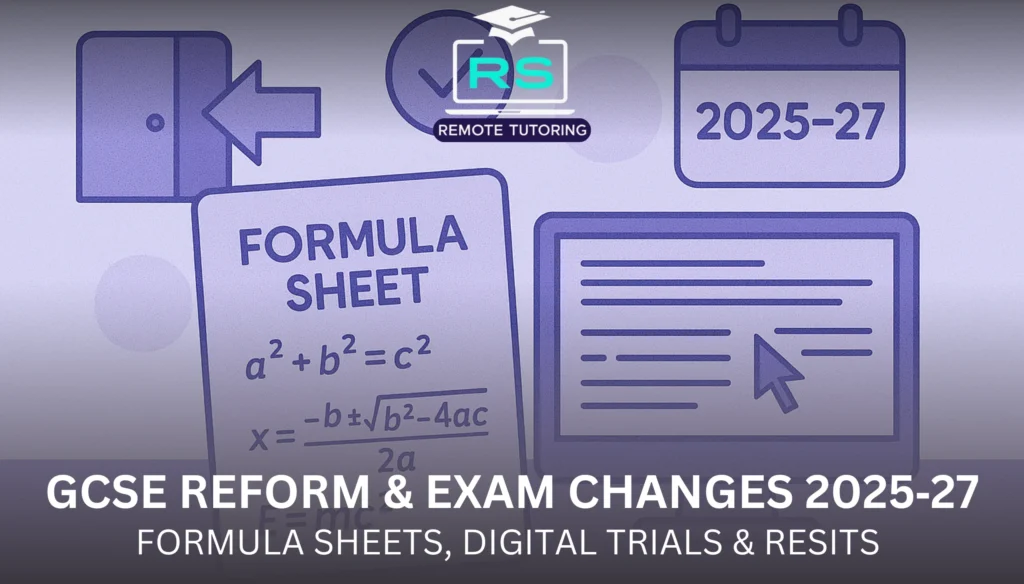
The phrase “GCSE reform” crops up every year around results day, but over the next few years it will have real substance. Here we covered the proposed changes to GCSE exams in England, from the continued use of formula and equation sheets to the rollout of digital assessments and a much broader curriculum review. It also tackles common questions such as “Is a GCSE resit mandatory?” and looks at alternatives being discussed, like replacing GCSEs entirely. GCSEs have existed since 1986, when they replaced the two‑tier systems of O‑levels and CSEs. They were designed to provide a single, more inclusive qualification for 16‑year‑olds leaving school. Since then, they have been revised several times, most notably under reforms introduced by Michael Gove in the 2010s that made courses linear, removed most coursework and modular exams, and introduced a 9–1 grading scale. Those reforms were intended to raise standards and align England’s exams with the most rigorous in the world. However, the world has not stood still. Young people must now remain in education or training until 18, not 16, and the curriculum must prepare students for a future that will be shaped by artificial intelligence, global competition and environmental challenges. At the same time, the lingering impacts of the COVID‑19 pandemic have exposed inequalities and prompted temporary concessions that may now become permanent. Add to this a growing chorus of critics who argue that high‑stakes exams harm mental health and fail to promote real learning, and it is clear why policy‑makers are re-examining the GCSE landscape. Why Are GCSEs Being Reformed? Calls for change Many educationalists, parents and employers believe that the current GCSE system is no longer fit for purpose. Key complaints include: There are also broader concerns that GCSEs prioritise academic knowledge over practical and vocational skills demanded by employers. In fast‑evolving industries such as digital technology, engineering and healthcare, future success may depend more on adaptability, problem‑solving and collaboration than on an ability to recall facts under timed conditions. Existing reforms Before exploring the proposed changes ahead, it is important to understand what has already changed. The previous round of GCSE reforms, completed in 2017–2019, introduced several significant adjustments: These reforms were intended to raise standards and bring England’s qualifications closer to those in high‑performing education systems. However, they also increased the stakes and the complexity of GCSEs. The next phase of reform seeks to address those unintended consequences. Pandemic‑Era Concessions: Formula and Equation Sheets Extended Why formula sheets were introduced During the 2020 and 2021 academic years, schools closed for long periods due to the COVID‑19 pandemic, and students faced significant learning loss. To compensate, the Department for Education (DfE) introduced formulae sheets for GCSE mathematics and equation sheets for physics and combined science. These sheets listed all the formulas students might need, reducing the memory burden at a time when many had missed lessons. Extension through 2027 As exams returned to normal, teachers and parents wondered whether these sheets would disappear. In late 2023, Education Secretary Bridget Phillipson asked the exam regulator Ofqual to extend the concession. Ofqual’s subsequent consultation concluded that students will not have to memorise formulae in maths or equations in physics and combined science for the 2025, 2026 and 2027 exam seasons. This applies to all exam boards in England, including AQA, OCR, Edexcel and WJEC/Eduqas. It covers the November series as well as the summer series. Formula/equation sheets will be provided alongside the exam paper. Students will still be expected to know how to apply the formulas; the goal is to support understanding rather than memorisation. Equality and accessibility considerations Ofqual’s equality impact assessment found that formula sheets improved access for many students with special educational needs and disabilities (SEND) who may struggle to remember numerous equations. However, some teachers worried that younger or less‑confident pupils might spend time searching the sheet rather than focusing on problem‑solving. Ultimately, the regulator concluded that the benefits outweighed the drawbacks and that schools could mitigate potential confusion with practice and guidance. Practical tips for students while preparing: Digital Exams: The Move Onscreen Trials and timelines Another major change on the horizon is the shift from paper‑based exams to onscreen assessments. Leading exam boards – including Pearson Edexcel, AQA, OCR and WJEC/Eduqas, are developing digital platforms to deliver GCSEs online. In 2023, Edexcel announced plans to pilot digital papers in English Language and Business Studies. The initial goal was to have at least one subject available digitally by 2025. Delays and practicalities have pushed back the roll‑out, but the board still aims to have history and business studies available digitally by 2027 and to provide most GCSE subjects onscreen by 2030. AQA and OCR are also developing platforms and have trialled digital mocks with selected schools. How digital exams work Onscreen exams will contain the same questions as the paper versions. Students log into a secure portal, complete the paper by typing responses or using drawing tools for diagrams, and submit their answers electronically. The system automatically saves progress to prevent lost work due to glitches. Some key features and considerations: Preparing for digital assessments To adapt to onscreen exams, students and teachers should: National Curriculum and Assessment Review: A Potential Overhaul In addition to specific changes like formula sheets and digital exams, the Government is conducting a wide‑ranging review of the national curriculum and assessment. This review examines what students should study from early years through post‑16 and how their learning should be assessed. The Education Secretary has described the current system as “outdated and unfit for the digital age”. Although the review’s recommendations have not yet been published, several themes have emerged: Possible replacement or integration of GCSEs Some commentators argue that GCSEs should be replaced by a school‑leaving diploma or passport qualification that includes academic, vocational and life‑skills elements. Such a diploma could be completed over four years and assessed in multiple ways, reducing the reliance on final exams. The Cambridge Assessment roundtable even floated the idea of ending Key Stage
How Do GCSEs Work? Guide for Parents, Students, and Private Candidates (2025)
GCSEs (General Certificate of Secondary Education) are UK qualifications typically taken at age 14 to 16 (Years 10-11). Students study a mix of core and optional subjects, are assessed mainly by end-of-course exams with some non-exam assessment (NEA) in certain subjects, and receive grades on different scales depending on where they sit the exams. Your GCSEs significantly influence your entry to sixth form/college, apprenticeships, and future study opportunities. Still confuse how do GCSEs works? This guide explains what GCSEs are, who takes them, how they’re assessed, how the grading works (9 – 1 vs A – G), how many to choose, GCSE results, resits,* and options for private/adult learners all in one place. Note: The GCSE system is changing fast. For a breakdown of upcoming reforms, including extended formula sheets, digital exam pilots, and broader curriculum review. Check out our GCSE Reform & Exam Changes 2025-27 guide. What is GCSE in UK GCSEs are subject-by-subject qualifications that mark the end of Key Stage 4 in secondary school. You usually study them over two years and sit the exams in May – June of Year 11. Adults can also take GCSEs later to meet job, training, or university requirements. Book a Free 1-on-1 Session with Our Tutor Best tutors in the UK Personalized learning plans Flexible online scheduling Start Your Free Trial Core vs Optional GCSE Subjects Most students take 8 to 10 GCSEs. Every school sets its own programme, but broadly: Core (usually required): GCSE Optional Subjects: History, Geography, Computer Science, Religious Studies, Art & Design, Music, Drama, PE, Business, Design & Technology, and languages (French, Spanish, German, etc.). EBacc (English Baccalaureate) is a performance measure for schools encouraging a set of academic subjects, English, Maths, Sciences, a language, and History or Geography. How Do GCSEs Work? 1) Written exams (the main component) Most GCSEs are assessed by final exams taken at the end of the course (Year 11). Papers are marked externally by your exam board. 2) Non-Exam Assessment (NEA) or practicals (subject-dependent) Some subjects include assessed coursework or practical components, for example: Note: Sciences is assessed in written exams. Schools provide NEA task according to board rules, exam boards moderate marks. Check NEA Sample Guide. 3) Tiered entry (selected subjects) In Maths and some Science courses, you may enter Foundation (grades 1 to 5 available) or Higher (grades 4 to 9 available). Your teacher will guide which tier matches your performance. GCSE Grading: 9-1 vs A*-G England: Wales: Northern Ireland: International GCSEs (IGCSEs): Grade boundaries (the marks needed for each grade) are set after marking each series and vary slightly per paper/board. They’re published on results day. When Are GCSE Exams and Results? How Many GCSEs Should You Take? Most students take 8 to 10. Balance matters: Why GCSEs Matter (and how long they last) Private Candidates & Adult Learners You can take GCSEs outside school as a private candidate: Note: Costs vary by board/centre/subject. Budget for the exam entry plus any centre administration fee. If you need coursework/NEA, check whether your chosen specification allows private candidates (many NEA subjects are school-based consider alternatives like IGCSEs with exam-only routes). Special Cases: Short Course, Applied & International If You Don’t Get the Grades You Need We’ve got a full guide: GCSE Resits 2025: Dates, Rules & How to Prepare. Book a Free 1-on-1 Session with Our Tutor and Get Best Grades in Resit Best tutors in the UK Personalized learning plans Flexible online scheduling Start Your Free Trial Choosing GCSE Options: A Quick Checklist How to Prepare for GCSE FAQs GCSE Key Takeaways RajaRaja specializes in Physics and Maths, with over 5 years of experience. He offers KS2, KS3, and GCSE Science and Maths lessons. He graduated from one of the top universities in the UK.
GCSE Resits 2025: Dates, Rules & How to Prepare
Resitting a GCSE can feel difficultf, but it’s also an opportunity to improve your grades and open up new academic or career pathways. Whether you missed the required pass grade or simply want to boost your score, this guide will explain when GCSE resits take place in 2025, how to enter, what costs to expect, and how to prepare effectively. It draws on the most recent information from exam boards, education experts, and official guidance. Update Alert: With reform in motion, resit arrangements may shift. Read our GCSE Reform & Exam Changes 2025-27 guide to understand how formula sheets, assessment changes, and resit policies are evolving. When Can Students Retake GCSE Exams? Once you have received your GCSE results in August 2025, you might be considering a resit, especially if you did not achieve the grade you needed. In the UK, resit opportunities differ by subject: Key GCSE Resit Dates & Deadlines (2025/26) Knowing the deadlines and exam dates ensures you don’t miss your chance to register. Resits Date Events and Subjects 4 October 2025 (Saturday) Entry deadline for GCSE resits. Late entries may incur additional fees. 5 November 2025 (Wednesday) Deadline to submit English Language spoken‑language endorsement grades. 4 November 2025 (Tuesday) English Language Paper 1 5 November 2025 (Wednesday) Mathematics Paper 1 6 November 2025 (Thursday) English Language Paper 2 Friday 7 November 2025 (Friday) Mathematics Paper Monday 10 November 2025 (Monday) Mathematics Paper 3 7 January 2026 (Wednesday) Results released to schools and colleges. 8 January 2026 (Thursday) Results released to students. Subject specific dates for Maths resits A subject‑specific example from The Exam Tutor shows that major exam boards schedule maths resit papers across three sessions in early November. While these are provisional, they illustrate the typical timetable. Always check your own board (AQA, Edexcel, OCR, WJEC) for the final dates. Who Has to Resit English and Maths GCSE? Achieve at least Grade 4 (standard pass) in English and Maths is government expectation. Tes explains students who do not attain a Grade 4 standard pass in these subjects “will need to resit”. Students who choose to retake to improve a grade must pay the exam fee; however, those required to resit because they didn’t meet the Grade 4 threshold typically aren’t charged. How to Book a GCSE Resit Booking a resit involves several steps: How Much Do GCSE Resits Cost? Costs vary widely depending on the subject, exam board and whether you enter on time. To give you a sense of scale: Always ask your chosen centre for a full breakdown of fees to avoid surprise costs. Understand GCSE Grade Boundaries for Resits Grade boundaries are the minimum marks needed to achieve each grade. These boundaries are set after papers are marked and can differ slightly between summer exams and November resits. Tes explains that during the summer, boundaries are partly informed by Key Stage 2 data (predicting cohort performance). For the smaller November resit cohort, examiners instead compare papers against the previous summer series. This adjustment ensures it’s “no easier or harder to achieve a particular grade in any particular exam series”. Key terms: You never lose your original grade: if your resit grade is lower, you can still use the higher result. How to Prepare for Your GCSE Resit The best way to approach your resit is with a structured plan. Drawing on advice from revision experts and exam tutors, here are proven strategies: Preparing for Maths or English Specifically Maths and English are the most common resits, so tailor your plan: What Happens After GCSE Resit? You’ll receive a provisional statement of results early in January 2026. Official certificates arrive later in the spring term. If your grade still doesn’t meet requirements: Remember: if you resit and achieve a lower grade, you keep the higher grade. Alternatives to GCSE Resits: Functional Skills & Equivalency Exams Functional Skills Level 2 in English and Maths are widely recognised as GCSE equivalents. They are: There are also GCSE equivalency exams, which are shorter composite exams and may offer faster turnaround times, as little as two working days for result. These are particularly useful for teacher training programmes and adult learners. GCSE Resit FAQs Below are some quick‑fire answers to common questions: Final Thoughts Resitting a GCSE may feel like a setback, but it’s actually a second chance to solidify your skills and improve your future prospects. By understanding the key dates, entry rules, costs, grade boundaries, and preparation strategies, you can approach your resit with confidence and a clear plan. At RS Remote Tutoring, our qualified UK tutors specialise in helping students prepare for GCSE resits. We offer: Whether you’re aiming for a first‑time pass or chasing a higher grade, we’re here to help you succeed. Book a free consultation today to start your resit journey with expert support. Disclaimer: The guide is based on publicly available information from UK exam boards, government education portals, and expert sources as of August 2025. RajaRaja specializes in Physics and Maths, with over 5 years of experience. He offers KS2, KS3, and GCSE Science and Maths lessons. He graduated from one of the top universities in the UK.
When Is GCSE Results Day 2025? Time, Online Access & What to Expect
GCSE Results Day 2025 is the big day when students across the United Kingdom finally know how they performed after years of study and weeks of summer waiting. Whether you are aiming for A-levels, apprenticeships, or vocational qualifications, results matter but don’t panic, we are here to help you get through everything. In this complete guide, we’ll answer your most searched questions, including when is GCSE Results Day 2025, what time to collect your results, how to check results online, how grade boundaries work, and what to do if you forget your login info or do not get the grades you need. ICYMI: Upcoming GCSE reforms could impact results procedures in the future. Learn more about how the GCSE is changing in our GCSE Reform & Exam Changes 2025-27 guide, covering everything from digital exams to curriculum reviews. When Is GCSE Results Day 2025? GCSE Results Day 2025 in the UK will be on Thursday, 21 August 2025. This date is confirmed by leading exam boards including AQA, OCR, Edexcel (Pearson), and WJEC. What Time Are GCSE Results Released? GCSE results is available for to students to collect from 8:00 AM local time on Results Day. However: For most students, collecting exam results in person is still the norm. How to Check GCSE Results Online Can’t go to school on Results Day? You are not alone. Many students including private candidates and those studying abroad need to access their results online. Here is how: Common Ways to Access GCSE Results Online (UK School Candidates) Important: Always confirm with your school in advance which platform they’ll use. For GCSE Private Candidates If you are a private candidate who gave GCSE exams through an exam centre (not a school). You will receive your results directly from the exam centre, either: Contact exam centre at least a week before Results Day to confirm how and when you will get your results. What If You Forget Your Login or Details? If you forget your login details: Tip: Always double-check contact details with school staff a week before Results Day. GCSE Results Day Checklist To be prepared, bring: What Will You Receive? On GCSE Results Day, students will get a provisional statement of results. This includes: Official GCSE certificates will be sent to your school later in the autumn term. GCSE Certificates Understanding GCSE Grade Boundaries Grade boundaries are minimum marks needed to achieve each grade. They are: GCSE Grade Key Terms: GCSE Key grades: Check the grade boundaries for each subject on your exam board’s website on 21 August. Tip: Do not panic if your grades are lower than expected, Speak to your school about options What to Do After You Receive Your Results Use the National Careers Service for free advice on your options What If You’re Not Happy With Your Results? Request a Review, Speak to your school to request a remark or clerical check. Deadlines for GCSE review is within 3 weeks. Students can request their school to recheck within 3 weeks of the announced result date. GCSE Resits Dates Always speak to your school or college careers advisor or use the National Careers Service for guidance. FAQs: GCSE Results Day 2025 Need Extra Help After Results? Whether you need to prepare for resits, boost confidence in core subjects, or get back on track. We at RS Remote Tutoring offers GCSE subject support tailored to your needs. Our expert UK-based tutors specialise in: Book a free consultation RajaRaja specializes in Physics and Maths, with over 5 years of experience. He offers KS2, KS3, and GCSE Science and Maths lessons. He graduated from one of the top universities in the UK.
What Is GCSE? How to Prepare – Guide for Parents & Students (2025)
GCSEs are one of the most important academic milestones for students in the United Kingdom. Whether you are a parent who is trying to support their child or a student preparing for your future, understanding What is GCSE and how it work can make the whole process feel less challenging. What is GCSEs and Who Takes Them? GCSE stands for General Certificate of Secondary Education. These qualifications are opted by students in England, Wales, and Northern Ireland at the end of Key Stage 4, in Year 11 when students are around 15 to 16 years old. This is a main assessment for secondary school students and a key stepping stone to A Levels, apprenticeships, college, or vocational courses. Why Are GCSEs Important? When Are GCSE Exams Held in 2025? GCSE exams typically begin in May and run through June, with exact dates depending on subject and exam board. Results are released in August 2025. How Many GCSEs Subjects Students Take? Most students can take 8 to 10 GCSEs subjects. Some take more or fewer, it depends on the school or special educational requirements of the student. GCSE Core Subjects vs Optional Subjects Core GCSE subjects (compulsory for most students) Optional GCSE subjects (vary by school and may include) How to Choose GCSE Subjects: Tips for Students and Parents How Are GCSEs Assessed? Assessment methods include: Subjects like Art, Drama, and PE often include practical work. Spoken language in English is assessed separately and reported as pass/fail. How GCSEs Exams are Graded (GCSE Grading System) The current GCSE grading system uses numbers instead of letters: A grade 5 is strong pass, while grade 4 is standard pass. Anything below 4 is considered as failed. What Happens If You Don’t Pass? Do not worry, students can resit English and Maths in November or following year. Schools and colleges offer support, and there is option to choose vocational or apprenticeship routes. What to Do After Passing GCSEs Exam in UK Once GCSEs are done, students can choose: GCSE Exam Boards in UK There are several exam boards that provide and mark GCSE exams: Each board have slightly different syllabuses and paper formats, so it is important to know which one your school uses. How to Prepare for GCSEs Parental Support Tips for GCSE Exams How Is GCSE Progress Measured Before Exams? Most UK schools use: Understanding this can helps parents intervene early with GCSE tutoring or extra help if needed. Frequently Asked Questions About GCSEs GCSE Understanding Importance GCSEs are major academic milestone but they are just one part of journey. With right information, preparation, and support, both parents and students can approach GCSE Exams with confidence. If you need expert help, RS Remote Tutoring offers qualified UK tutors to support your child through every stage of their GCSE preparation. RajaRaja specializes in Physics and Maths, with over 5 years of experience. He offers KS2, KS3, and GCSE Science and Maths lessons. He graduated from one of the top universities in the UK.