
Selecting the right GCSE subjects is one of the first big decisions students make during their secondary‑school journey. Your choices can shape what you study in Years 10 and 11, influence which A‑levels you go on to take and even affect the university courses or careers you pursue later on. With changes to the curriculum on the horizon and a growing emphasis on digital skills and wellbeing, knowing how to choose your GCSE subjects wisely in 2026 is more important than ever. This guide distills expert advice from teachers, tutors and examiners to help students and parents navigate their options with confidence.
Jump to Section
Why GCSE subject choices matter

GCSEs (General Certificate of Secondary Education) represent the first formal qualification stage in the UK. Achieving strong grades opens doors to A‑levels, vocational courses and apprenticeships. Universities and employers increasingly look beyond headline grades to the specific subjects students have taken. Following recent A‑level reforms, entry requirements for competitive degree programmes often specify minimum GCSE grades or certain subjects, particularly in English and maths. Even if university seems a long way off, thinking ahead now will keep your options open.
Core subjects versus options
Every student is required to take a set of core GCSEs. These core subjects include English, maths and science. Some schools also insist on a modern foreign language or a humanities subject (history or geography) as part of the English Baccalaureate (EBacc). Beyond the core, you’ll choose several optional subjects. These are what give you freedom to explore interests such as art, drama, technology or an additional language.
How many GCSEs should you take?
You must study at least five GCSE subjects, but most students take between eight and ten. A smaller number could restrict your A‑level choices later on, while taking too many can overload your timetable. A good rule of thumb is to prioritise quality over quantity: choose a broad, balanced set that reflects your strengths and ambitions without stretching you too thin.
Timelines: when decisions are made
Schools typically ask students to start thinking about their GCSE options during Year 9. At some schools decisions are finalised towards the end of that year, though some may ask for choices as early as Year 8. It’s important to check your school’s deadlines and attend any GCSE option evenings. Use Year 9 to experiment with different subjects, talk to teachers and discover what you enjoy.
Factors to consider when choosing your subjects

Your interests and strengths
One of the biggest indicators of success is how interested you are in a subject. Think about:
What am I genuinely curious about?
Do you look forward to science experiments or writing essays? Do numbers make sense to you or do you prefer creative tasks?
What comes naturally?
Subjects that align with your strengths will feel less like a chore.
How do I learn best?
Practical subjects like music or design suit tactile learners; humanities subjects appeal to those who enjoy discussion and reading.
Ask yourself the questions highlighted by experts: What am I interested in? What is the work like? Which A‑levels do I need for my future career? Do I want to go to university? Which courses suit how I learn?. Be honest with yourself and don’t choose a subject solely because friends are taking it.
Future goals and university entry
Some degree paths have very specific GCSE requirements. Medicine, dentistry and veterinary science often demand high grades in double or triple science, maths and English. For GCSE sciences, you will need to decide between a triple award (separate GCSEs in biology, chemistry and physics) or the double award (combined science). The triple route covers the three sciences in greater depth and is favoured by students considering scientific or medical careers. Humanities degrees may look for GCSEs in subjects such as history or a language, while creative courses might value art or design technology.
Even if you have no firm career plans, choosing a balanced mix of academic and creative subjects will keep your options open. Universities pay close attention to English and maths, so aiming for at least a grade 4 (‘standard pass’) in these is essential. Some universities ask for grade 5s or higher in key subjects.
School offerings and timetabling
Availability varies between schools. A particular GCSE may not be offered if there are too few students interested or if specialist facilities are lacking. Some schools teach only double science, while others provide a wide range of languages and arts options. If your school doesn’t offer a subject you want, explore alternatives such as:
- Studying through distance learning: online GCSE providers allow you to take subjects outside of school hours.
- Community or supplementary schools: some languages or cultural subjects are taught at weekend schools.
- After‑school or evening classes: these may be available through adult education colleges.
Bear in mind that optional subjects often run in blocks. Two subjects in the same block cannot be taken together, so you may need to prioritise.
Balance between coursework and exams
Not all GCSEs are assessed in the same way. Some are entirely exam based, while others include coursework or controlled assessments. If you thrive under exam pressure, subjects like maths and languages may suit you; if you prefer ongoing projects, consider art, design & technology or media studies. Choose a mix that plays to your strengths and spreads your assessment load across the year.
Understanding the core GCSE subjects
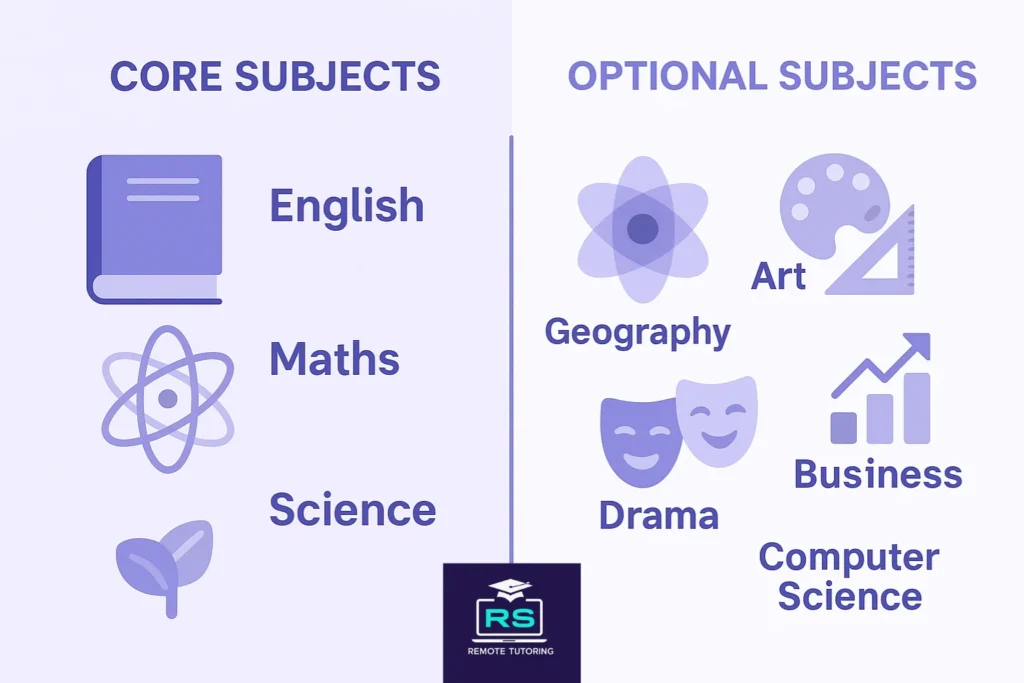
English Language and Literature
English is split into Language and Literature. Both are compulsory at most schools. English Language focuses on communication skills like reading, writing, speaking and listening, while Literature explores novels, plays and poetry. Strong English skills are vital for all careers; they also underpin essay‑based A‑levels and university courses.
Mathematics
Maths is another core subject and a fundamental requirement for many careers. It develops problem‑solving, logical thinking and numeracy skills. GCSE maths is tiered: Foundation covers grades 1–5 and Higher covers grades 4–9. The higher tier includes more algebra, geometry and statistics, so choose based on your confidence and potential. Employers and universities often require at least a grade 4 in maths; some competitive courses expect grade 6 or higher.
Science
Students can choose between Double Award (also known as Combined Science) and Triple Award. Both are compulsory pathways, but the triple award yields three separate GCSEs in biology, chemistry and physics while double award counts as two GCSEs. Consider the triple award if you plan to study science A‑levels or pursue careers in medicine, engineering or research. Otherwise, the double award provides a broad overview and frees up an option slot.
Navigating optional GCSE subjects
Humanities and social sciences
Subjects like History, Geography, Religious Studies and Sociology develop analytical thinking, argument construction and an understanding of society. History and geography remain popular choices, with recent years seeing an increase in entries. These subjects complement law, politics, teaching and journalism pathways.
Modern languages
Studying a language such as French, Spanish or German not only enhances communication skills but also improves memory and cultural awareness. A language GCSE is part of the EBacc and is valued by universities. If your school requires one language as a core subject, choose the one you find most engaging.
Creative and performing arts
Art & Design, Drama, Music, Dance and Media Studies provide opportunities for creativity and self‑expression. They typically include significant coursework or practical assessments. These subjects support careers in the arts, but they also develop transferable skills like communication, collaboration and critical thinking.
Technical and vocational options
Design & Technology (DT), Food Preparation & Nutrition, Computer Science and Business GCSEs bridge academic study and practical skills. DT and Food include design projects and evaluations; Computer Science combines programming, theory and problem‑solving. Business or Economics offers insight into finance, marketing and entrepreneurship. Such options may suit students who enjoy hands-on learning or who want a head start in technical careers.
How to make your GCSE choices

Choosing subjects is not simply a tick‑box exercise. Use a structured approach to ensure you make informed decisions:
- Research: Read each subject’s syllabus on your school or exam board website. Look at the balance of exam versus coursework, the topics covered and potential careers linked to the subject.
- Talk to teachers: Teachers know how a course is taught and what skills are required. Ask for honest feedback on your aptitude and work ethic.
- Speak to current students: Older students can provide first‑hand insight into workload and enjoyment. Ask them what surprised them about the course.
- Think about the future: Consider which A‑levels or post‑16 courses you might want to study. Some subjects are required for progression. For example, A‑level biology usually requires a GCSE in biology or combined science.
- Keep your options open: If you’re unsure about a career path, select a balanced mix of arts, sciences and humanities. This approach keeps doors open until you’re ready to specialise.
- Don’t follow the crowd: Choose subjects because they suit you, not because friends are taking them or you think they’re “easy”.
Pro tips from our tutors
Our experienced tutors have seen students succeed by following a few extra strategies:
- Plan ahead: Use a decision matrix to score each subject against criteria such as interest level, strength, assessment format and career relevance. This helps to clarify which options stand out.
- Ask about resources: Does your school have specialist teachers and facilities for the subject? A well‑resourced department can make a big difference to your learning experience.
- Consider workload distribution: Combining three coursework‑heavy subjects can create stress. Balance them with exam‑based options.
- Visit GCSE options evenings: These events allow you to see display work, speak to teachers and ask questions. Take notes and compare subjects afterwards.
Impact of the upcoming curriculum review
The UK government’s Curriculum and Assessment Review aims to create a broader, richer curriculum and reduce exam stress. Although final details are due in late 2025, the review highlights several themes:
- Maintaining core knowledge but broadening skills: English, maths and science will remain central, but there will be greater emphasis on digital literacy, creativity and critical thinking.
- Reducing high‑stakes assessment: Feedback suggests that the volume of GCSE exams can be overwhelming. Future GCSEs may include more continuous assessment and digital components to ease pressure.
- Flexibility for vocational routes: Evidence indicates that performance measures like the EBacc may restrict student choice. The review could lead to a more flexible system that values vocational and technical subjects alongside traditional academics.
While these changes won’t dramatically overhaul GCSEs by 2026, students should be prepared for updates such as formula sheets in maths and science exams, minor specification tweaks and a stronger focus on digital skills. Always check the latest guidance from exam boards and speak to teachers about how upcoming changes may affect your subject choices.
Frequently asked questions
How many GCSEs can I choose in 2026?
Most students will choose eight to ten GCSE subjects, although you must take at least five. Schools may limit the number you can choose depending on timetable blocks and resources. Aim for a balanced set that reflects both your interests and your future plans.
Which GCSEs are compulsory?
English Language and Literature, maths and science are compulsory for all students. Some schools also require a language and a humanities subject to meet EBacc targets. Check with your school for additional compulsory subjects.
Do universities care which GCSEs I choose?
Yes especially for competitive degrees. Many university courses have specific GCSE requirements, and universities pay particular attention to English, maths and sciences. Taking a broad mix of academic subjects will keep your options open. However, it’s possible to take an A‑level in a subject you didn’t study at GCSE, though you may have to work harder to catch up.
What if my school doesn’t offer the GCSE I want?
If a subject isn’t available at your school, you can study it through an online learning provider, at a neighbouring school or via evening classes. Your school may allow you to attend another institution for one subject if it fits into your timetable. You’ll need to organise this early and ensure you can attend all lessons.
How do I decide between triple and double science?
Choose triple science if you love science, perform well in the subject and may pursue science A‑levels. It covers more content and leads to three separate GCSEs, which some universities prefer. Choose double science if you want a balanced workload or plan to focus on arts, humanities or vocational courses.
Can I change my subjects later on?
Changes are possible but usually only within the first few weeks of Year 10, depending on space in classes. Changing later becomes difficult because you will have missed crucial teaching. If you are unsure between two options, speak to teachers and your head of year before finalising your choices.
Final thoughts and next steps
Choosing GCSE subjects is a personal decision that requires careful thought. Balance your passions with practical considerations like future career plans, workload and teaching quality. Discuss your ideas with trusted adults, attend information evenings and use decision tools to evaluate options. Remember, no subject choice is “make or break”, there are always alternative routes to your goals.
If you’d like personalised guidance or help excelling in your chosen subjects, our qualified tutors at RS Remote Tutoring are here to support you. We offer expert tuition in core subjects like English, maths and science, as well as specialist coaching for options such as computer science, languages and humanities. Our flexible online lessons and clear feedback will help you make confident choices and achieve your best results. Contact us today to start planning your GCSE journey.

Raja specializes in Physics and Maths, with over 5 years of experience. He offers KS2, KS3, and GCSE Science and Maths lessons. He graduated from one of the top universities in the UK.


1 Comment
[…] is the step-by-step guide on how to choose your GCSE optionals to reduce confusion, anxiety and ensure long-term wise […]