
Note for UK families: Choosing between GCSE and BTEC isn’t just a theoretical decision, it can shape the next few years of your child’s education and career. This guide explains what each route involves, compares them in plain English, and highlights how to make the right choice for your situation in London or elsewhere in the UK.
Jump to Section
What Are GCSEs?
GCSEs (General Certificates of Secondary Education) are academic qualifications studied in England, Wales and Northern Ireland. They usually span two years, from Years 10 and 11 in the UK schooling system culminating in external exams. Assessment is heavily exam‑based, though some subjects may include controlled assessments or practical coursework.
Key points about GCSEs:
- Academic focus: GCSEs emphasise theory and subject knowledge. They cover a broad curriculum including English, maths, sciences, humanities and languages.
- Exam‑oriented: Final grades are mainly decided by exams taken in May and June. There is less continuous assessment than vocational courses.
- Grades 1–9 scale: The reformed GCSEs use a numerical grading system where 9 is the top mark and 1 is the lowest. Grade 4 is roughly equivalent to the old C grade.
- Progression routes: GCSEs are widely accepted by sixth‑form colleges, universities and employers. They are the traditional route to A levels, T levels or apprenticeships.
Tip: Exam boards such as AQA, Pearson Edexcel and OCR run GCSE exams across UK schools and colleges. Check with your local school or exam centre for registration deadlines (usually January for May/June exams) and exam fees.
What Are BTECs?
BTEC stands for the Business and Technology Education Council. A BTEC qualification is vocational and designed to prepare students for specific careers. Instead of one final exam, BTECs rely on practical projects, assignments and sometimes online tests across the course.
Levels and Equivalency
BTECs are available from Entry Level up to Level 7. Here are the most relevant for school‑aged students:
| BTEC Level | Typical age group | Equivalent academic level | Description and progression |
| Level 1/Level 1 Introductory | 14+ | GCSE grades D–G (old scale) or grades 1–3 | Provides basic knowledge; often called BTEC First Certificate. A First Certificate usually equals one GCSE. |
| Level 2 | 15–16 | GCSE grades 4–9 (old grades A*–C) | Examples include BTEC First Diploma or Extended Certificate. A Level 2 Diploma equates to four GCSEs. Successful completion can lead to BTEC Level 3 or A levels. |
| Level 3 | 16–18 | A levels | BTEC National Diploma or Extended Diploma. A two‑year Level 3 Extended Diploma equals three A levels and carries UCAS points for university. |
BTECs are recognised by employers, further‑education colleges and universities. Many universities accept BTEC Nationals for entry into degree courses, especially when combined with A levels.
Why Choose a BTEC?
- Practical and hands‑on: BTECs emphasise industry‑specific skills. Students complete coursework, projects and placements rather than purely theoretical exams.
- Continuous assessment: Grading is based on assignments and projects submitted during the course rather than a single final exam. This suits learners who do better through ongoing coursework.
- Industry relevance: BTECs are developed with employers and universities. They reflect current workplace skills and include up‑to‑date technology and practices.
- Flexible progression: After Level 2, students can progress to Level 3 BTECs, A levels, T levels, apprenticeships or employment.
Popular BTEC Subjects
BTECs are offered in a wide range of fields. Common subjects include:
- Business
- Engineering
- Health & Social Care
- Information Technology
- Sport Science
- Performing Arts
- Hospitality and Tourism
- Media Production
In London, many sixth‑form colleges and FE colleges (e.g., Haringey Sixth Form College, City and Islington College) offer both academic and vocational routes. Visiting open days can help families gauge which courses and campuses feel like the right fit.
GCSE vs BTEC: How They Compare
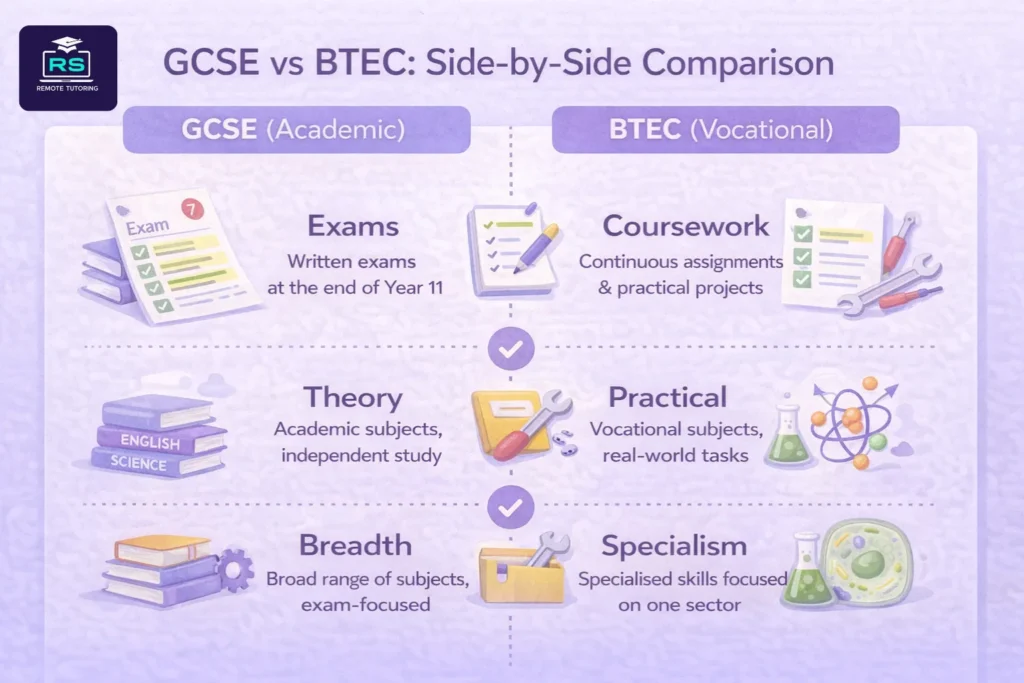
Deciding between an academic GCSE path and a vocational BTEC route depends on your strengths, interests and long‑term goals. Below is a side‑by‑side comparison:
| Feature | GCSEs (Academic Route) | BTECs (Vocational Route) |
| Main focus | Broad academic knowledge across multiple subjects | Specialist skills tailored to one sector |
| Assessment style | Mostly written exams at the end of Year 11 | Continuous coursework, practical projects and online tests |
| Learning style | Theoretical study, independent reading and revision | Hands‑on practical tasks, portfolios and presentations |
| Flexibility | Less flexible once subjects are chosen; heavy exam pressure | More flexible; assignments can be paced over the year |
| Recognition | Widely recognised by all sixth‑forms, universities and employers | Recognised by employers, colleges and many universities. Some competitive university courses may prefer A levels |
| Subject breadth | Students choose 8–10 subjects, ensuring broad coverage | Students focus on one main subject area but explore it in depth |
| Progression | A levels, T levels, apprenticeships, or entry‑level jobs | BTEC Level 3 (equivalent to A levels), apprenticeships, or direct employment |
Assessment and Grades
- GCSE grading: 1–9 scale. Grade 9 represents top performance; grade 4 is considered a standard pass.
- BTEC grading: Pass (P), Merit (M), Distinction (D), Distinction* (D*). A Distinction at Level 2 broadly equates to GCSE grade 7/8, while a Merit corresponds roughly to grade 5/6 and a Pass to grade 4.
Advantages and Disadvantages
GCSE Advantages
- Breadth of knowledge: You study several subjects, which keeps future options open.
- Academic rigour: Prepares students for theory‑heavy A levels and university degrees.
- Universally recognised: Every school and employer understands GCSE grades.
GCSE Disadvantages
- Heavy exam pressure: Success depends on performance in final exams, which can be stressful.
- Less practical learning: Students who learn best by doing may find GCSEs dry.
BTEC Advantages
- Practical learning: Ideal for students who thrive on hands‑on projects.
- Continuous assessment: No “all or nothing” final exam; allows students to improve gradually and show consistent effort.
- Industry relevance: Reflects real‑world skills, making graduates job‑ready.
BTEC Disadvantages
- Limited subject range: You focus on one specialism; if you later change your mind, switching fields can be hard.
- Perception gaps: Some competitive universities or courses may favour A levels over vocational qualifications.
- Coursework load: Continuous assignments require good time management and self‑discipline.
Pro tip: If you love a subject like engineering or media and already know your career path, a BTEC could offer in‑depth knowledge and industry exposure. If you’re unsure or want to keep your options broad, GCSEs might be safer.
How Do Vocational Qualifications Differ from Academic Ones?
Vocational qualifications like BTECs focus on developing skills for a particular job or industry. They involve practical activities, placements and projects and have fewer final exams. Academic qualifications like GCSEs and A levels emphasise theoretical understanding across a range of disciplines and rely heavily on exams.
BTEC vs GCSE PE
Some schools and colleges offer BTEC Sport or BTEC Sport Science at Level 2 or 3 as an alternative to GCSE Physical Education. The differences include:
- Assessment: BTEC Sport is mostly coursework and practical tasks such as coaching sessions, fitness tests and presentations. GCSE PE includes written exams and practical assessment across several sports.
- Content: BTEC Sport may cover sport business, coaching and training principles, whereas GCSE PE focuses on physiology, anatomy, health and well‑being along with practical performance.
- Progression: BTEC Sport can lead to Level 3 Sport courses, apprenticeships or sport‑related degrees. GCSE PE leads to A‑level PE, T level in Sport and Fitness, or sports apprenticeships.
BTEC Levels and GCSE Equivalencies
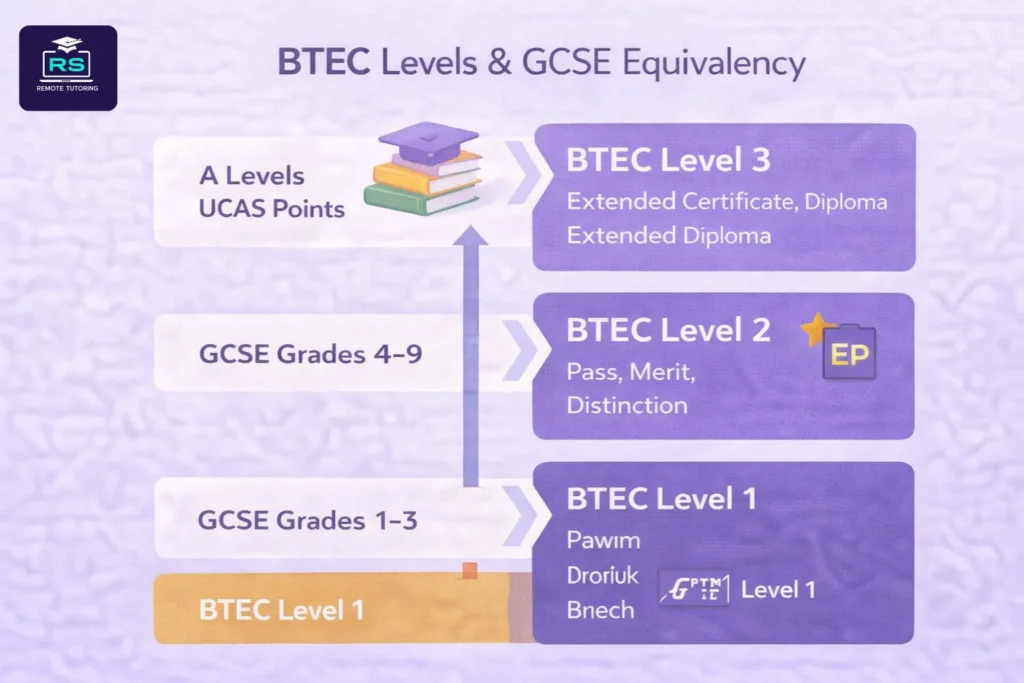
Understanding how BTEC levels map to GCSE grades helps when comparing routes or calculating UCAS points:
- BTEC Level 1: Equivalent to GCSE grades 1–3 (old grades D–G).
- BTEC Level 2 Pass: Equivalent to GCSE grade 4 (old C). Merit and Distinction correspond to grades 5/6 and 7/8 respectively.
- BTEC Level 3 Extended Certificate: Roughly equivalent to one A level. The Diploma equals two A levels and the Extended Diploma equals three A levels.
Note on grading conversions: Each exam board may have slightly different conversion tables. Always check official guidance from Pearson or your school.
How to Decide Between GCSE and BTEC
Choosing the right path involves more than just grades. Consider the following:
- Learning style: Do you excel at written exams or prefer coursework? GCSEs demand exam confidence; BTECs reward consistent effort.
- Career goals: If you’re targeting a specific profession (engineering, IT, health care), a BTEC may give you a head‑start. If you’re unsure, GCSEs keep doors open.
- University plans: Some universities accept BTEC Nationals for entry to degree programmes, especially when combined with A levels. Check individual entry requirements.
- Time management: BTECs require good organisation to keep up with assignments; GCSEs need focused revision ahead of exam season.
- Local availability: In London, some schools offer BTECs alongside GCSEs. Visit open days or speak to teachers to understand which courses suit your profile.
- Future reforms: The UK government is phasing in new qualifications like T levels and V levels to streamline vocational routes. Knowing about upcoming changes can help you choose courses that will remain recognised.
Pro tip: Combine routes. Many students choose a mix of GCSEs and BTECs (e.g., GCSE English and maths alongside a BTEC in digital media). This balanced approach provides both academic grounding and practical experience.
FAQs
What is the difference between vocational and GCSE qualifications?
Vocational qualifications (BTECs) focus on practical, job‑specific skills with continuous assessment. GCSEs are academic and theory‑based, assessed mainly through final exams.
Are vocational and BTEC the same?
In the UK, BTEC is one brand of vocational qualification. There are also NVQs, T levels and other vocational courses. All vocational courses emphasise hands-on learning and industry relevance.
What is the difference between GCSE and BTEC?
GCSEs offer a broad academic education with exam‑based assessment; BTECs provide specialist vocational training assessed through coursework. Both routes are recognised by employers and educational institutions.
What is the difference between a vocational and academic pathway?
A vocational pathway prioritises skills development, work placements and practical projects; an academic pathway prioritises theoretical study, essays and exams.
What is the difference between BTEC and GCSE PE?
BTEC Sport is coursework‑heavy and covers topics like coaching and sport business; GCSE PE involves written exams and practical performance across several sports. Both lead to further study but suit different learning styles.
Which BTEC subjects are available?
Popular BTEC subjects include business, engineering, health & social care, IT, sport science, performing arts, media, hospitality and tourism. Your local London college may offer additional options.
How do BTEC grades convert to GCSE 9–1?
At Level 2: Distinction ≈ GCSE grade 7/8, Merit ≈ grade 5/6, Pass ≈ grade 4.
Is a BTEC Level 2 equivalent to a GCSE?
Yes. A BTEC Level 2 Extended Certificate or Diploma is equivalent to 3–4 GCSEs at grades 4–9. A Level 2 First Certificate is equivalent to one GCSE.
Why might employers or universities value a BTEC?
Because BTECs develop practical skills and industry knowledge. Employers appreciate work‑ready graduates, and universities recognise the coursework as evidence of independent study and time management.
What is a BTEC Level 2 equivalent to?
A BTEC Level 2 qualification (Diploma or Extended Certificate) is equivalent to multiple GCSEs at grade 4–9. It allows progression to Level 3 courses, apprenticeships or employment.
Seasonal Considerations
Exam seasons
- GCSE exam season: May and June. Some subjects offer November resits. Ensure you register by January to secure a place.
- BTEC assessments: Spread throughout the year. External assessments or online tests may also occur in January or June; check your course timetable.
Local opportunities
London boasts a wide range of sixth‑form colleges and vocational training centres. Examples include City of Westminster College, London South Bank College and New City College. Many employers in London’s booming media, finance and tech sectors respect vocational qualifications, especially when combined with work placements.
Weather and planning
London weather can be unpredictable. If your BTEC course involves outdoor projects or placements (e.g., construction or sports), plan for rain. The long days of May and June (exam season) provide ample daylight for revision; winter coursework deadlines may require extra motivation during darker evenings.
Conclusion
Both GCSEs and BTECs are valid routes to success. GCSEs provide a broad academic foundation and are ideal for students who enjoy theoretical study and plan to pursue traditional university degrees. BTECs offer practical, vocational training with continuous assessment and are perfect for those who thrive on hands‑on learning and want to develop job‑ready skills.
In London’s dynamic environment, mixing academic and vocational qualifications is common. By understanding the differences, considering personal strengths and future ambitions, and consulting teachers and careers advisers, families can choose the path or combination that best suits them.
Ready to explore your options?
If you’re a UK parent or student deciding between GCSEs and BTECs, speak to your school’s careers adviser or arrange a visit to a local sixth‑form college. Understanding your learning style and long‑term goals will help you make an informed decision. Feel free to contact us for personalised advice or expert GCSE tutors help on navigating academic and vocational routes.

Raja specializes in Physics and Maths, with over 5 years of experience. He offers KS2, KS3, and GCSE Science and Maths lessons. He graduated from one of the top universities in the UK.

1 Comment
[…] provisional timetables show that some vocational or BTEC qualifications begin slightly earlier than the main GCSE season. A timetable issued by a secondary academy lists […]