
Choosing when to sit your General Certificate of Secondary Education (GCSE) exams can feel daunting, especially as timetables change every year. In 2027 the UK exam boards, Pearson Edexcel, AQA, OCR, WJEC/Eduqas and CCEA have released provisional exam timetables ahead of a formal consultation. These tables outline when each subject exam will be held, along with guidelines on start times and contingency days. Since GCSE grades are often critical for sixth‑form, apprenticeship or university entry, students and parents need clarity on the key dates well in advance.
This guide provides a complete overview of the GCSE exam timetable 2027 for England and the wider United Kingdom. It covers provisional and final schedules, board‑specific deadlines, the summer 2026 timetable for comparison, and even explores the perennial question of which language is easier to learn, French, German or Spanish, to help you choose your Modern Foreign Language (MFL) option.
Jump to Section
How GCSE timetables are created
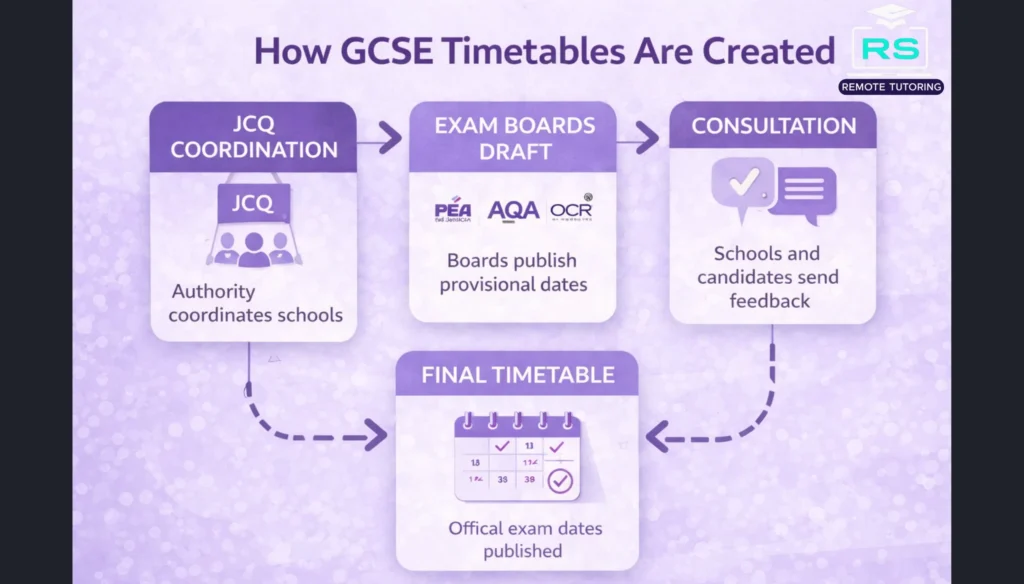
The exam boards collaborate through the Joint Council for Qualifications (JCQ) to agree common exam slots. Each board then publishes provisional timetables the year before the exams and invites feedback from schools and candidates. AQA notes that a six‑week consultation for the summer 2027 timetables ran between 2 February and 20 March 2026, after which the final timetables will be published in early May.
The WJEC/Eduqas website explains that provisional timetables allow centres to comment on clashes and that feedback received by 20 March 2026 will inform the final version. This collaborative approach ensures that exams across different boards avoid overlapping sessions and that contingency planning for disruptions is consistent.
Get Ready for GCSE 2027 with Expert Online Tutoring
Help your child build confidence before exam pressure starts. RS Remote Tutoring provides one-to-one GCSE support for Maths, English, Science and more, with expert tutors and a free trial lesson.
Key timetable principles
- Common start times: Exam boards agree that morning exams begin at 9 am and afternoon exams at 1:30 pm. Centres can start earlier or later within a one‑hour window (8:30 to 9:30 am or 1:00 to 2:00 pm) to manage local issues. OCR makes the same allowance, with candidates still supervised before and after exams.
- Contingency day: To handle national or local disruption (such as a pandemic or major incident), exam boards designate Wednesday 23 June 2027 as a contingency day. Candidates must remain available until this date..
- Results day: For summer 2027, AQA’s provisional timetable states that results will be issued to schools electronically on Wednesday 18 August 2027 and made available to students on Thursday 19 August 2027. Edexcel, OCR, WJEC and CCEA usually follow the same schedule.
- Non‑exam assessment (NEA) deadlines: Many subjects include coursework or practical components. For example, AQA’s submission date for most NEA components is 7 May 2027, with Art & Design due 31 May 2027. Schools must also schedule MFL speaking tests during a window from 12 April to 21 May 2027.
GCSE exam timetable 2027: week‑by‑week overview
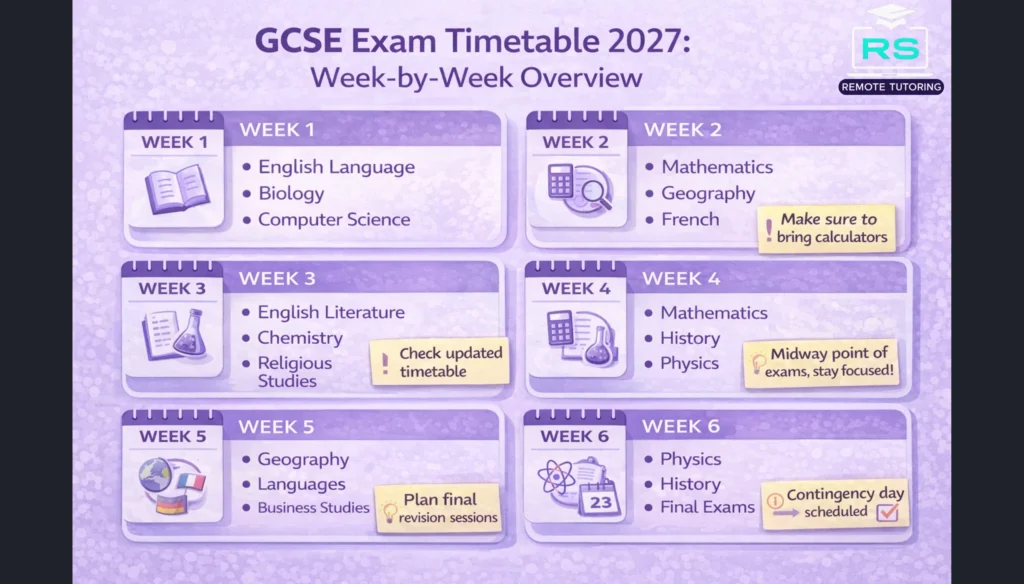
Although the detailed subject schedule varies by board, the provisional timetables follow a similar structure. GCSE exams will start in early May 2027 and continue until late June 2027, with the contingency day on 23 June. Below is a high‑level overview based on the Pearson Edexcel and AQA provisional timetables findings:
| Week (2027) | Key subjects & examples | Notes |
| Week 1: Monday 10 May to Friday 14 May | Languages (e.g. Turkish listening & reading), Citizenship Studies, German listening and understanding (Foundation & Higher) and Psychology begin on Monday. Biology Paper 1 and Combined Science Paper 1 follow on Tuesday, while English Literature Paper 1 and Business Paper 1 appear on Wednesday. | Start of formal written exams. MFL speaking tests should already be underway since mid‑April. |
| Week 2: Monday 17 May to Friday 21 May | Mathematics Papers 1 or 2, Geography, History and French listening/reading typically occur. OCR lists Ancient History, Biology and Chemistry exams during this week. | Humanities and core subjects such as Maths gain prominence. Centres manage timetable clashes when students sit multiple sciences. |
| Week 3: Monday 24 May to Friday 28 May | English Language, Computer Science, Religious Studies and Physics are often scheduled. Combined Science Paper 2 and Business Paper 2 appear in many boards. | Mid‑exams period. Students should take advantage of the half‑term break to revise remaining papers. |
| Week 4: Monday 7 June to Friday 11 June | Higher tier mathematics or further maths, Geography Paper 2, History Paper 2, and Languages such as Spanish listening & reading. OCR schedules Latin and Media Studies. | After half‑term, exams resume. Some boards hold art and practical assessments during this week. |
| Week 5: Monday 14 June to Friday 18 June | Chemistry, Physics, Economics and Music. Edexcel lists German reading and writing papers here. | Many science and optional subjects conclude. |
| Week 6: Monday 21 June to Friday 25 June | Final examinations in subjects like Additional Maths, Drama and Late entry languages. The contingency day on 23 June stands ready for any rescheduled papers. | Students should remain available in case of unexpected disruptions. |
Pro tip: Create a personalised calendar that marks each exam date, NEA submission deadline and speaking test window. Begin revision early for subjects scheduled in the first two weeks and prioritise coursework tasks due in early May.
Board‑specific details
Pearson Edexcel
The Pearson Edexcel GCSE Summer 2027 Provisional Examination Timetable highlights the following:
- Start times: Exams must be taken on the day and at the time shown. Morning sessions start between 8:30 – 9:30 am and afternoon sessions between 1:00 – 2:00 pm. Candidates taking multiple exams in a single session can have a supervised break.
- Week 1 schedule: Monday 10 May features Biblical Hebrew, Computer Science (Paper 1), Turkish listening and reading, Citizenship Studies and German listening/understanding. Biology Paper 1, Combined Science Paper 1 and English Literature Paper 1 follow on Tuesday and Wednesday.
- Subjects distribution: The Edexcel timetable spreads humanities and languages across the weeks; mathematics and sciences are interspersed to minimise clashes.
AQA
AQA’s May/June 2027 Provisional Exam Timetable provides additional context:
- Exam conduct notes: Each exam must be taken on the specified day. Morning exams are scheduled at 9 am and afternoon exams at 1:30 pm, with schools allowed to start up to 30 minutes earlier or later.
- NEA submission dates: Most non‑exam assessments are due by 7 May 2027, with a later deadline of 31 May 2027 for GCSE Art & Design.
- MFL speaking test window: Schools can schedule Modern Foreign Language speaking tests between 12 April and 21 May 2027.
- Contingency day: The boards designate Wednesday 23 June 2027 as the contingency day. Candidates must remain available until then.
- Results days: Provisional timetables indicate that results will be released electronically to schools on 18 August 2027 and to students on 19 August 2027.
OCR (Cambridge)
OCR’s June 2027 Provisional Examination Timetable (for GCSE and Cambridge Nationals) offers similar guidance:
- Contingency sessions: OCR emphasises that both the morning and afternoon of 23 June 2027 are contingency sessions.
- Start times: Examinations start at 9 am or 1:30 pm; however, centres may adjust within the 8:30 to 9:30 am and 1:00 to 2:00 pm windows. Students remain under supervision until 10 am or 2:30 pm, even if their paper ends earlier.
- Week view: The OCR timetable divides exams into six weeks (10 May–25 June). For example, Ancient History (code J198/01) is scheduled for Friday 14 May (pm). The subject list includes key subjects such as Biology, Chemistry, Maths, English Language and Literature, Geography, Physics and Latin.
WJEC/Eduqas
WJEC’s provisional timetable is currently under review. The board invited comments on proposed Summer 2027 exam dates until 20 March 2026. Final timetables will be published after review. The site reminds schools that timetable clashes must be managed according to JCQ guidance and that supervised rest breaks are permitted.
CCEA (Northern Ireland)
CCEA’s draft timetable for Summer 2027 emphasises moderation and speaking test windows:
- Speaking & assessment windows: English Language speaking and listening runs from 1 March to 7 April 2027, drama assessments from 4 March to 7 April 2027 and Modern Foreign Language (MFL) speaking tests from 5 April – 30 April 2027. Music performance visits are scheduled between 7 April to 11 May 2027.
- Exam start times: Exams start at 9:15 am or 1:30 pm; morning sessions must not start earlier than 9 am, and afternoon sessions must not start earlier than 1 pm.
- Key dates: The contingency day is 23 June 2027, and results will be available on 19 August 2027. The timetable lists specific subject codes and durations across the weeks, e.g., Mathematics Units 1 to 4 on 13 May.
Summary table: core GCSE exam dates 2027
| Event | Date (2027) | Evidence |
| Earliest written exams | Monday 10 May | Edexcel lists Biblical Hebrew, Computer Science and Turkish papers on 10 May. |
| MFL speaking tests window | 12 April – 21 May (AQA) and 5 April – 30 April (CCEA) | Students must arrange oral exams within these windows. |
| NEA submission deadline | 7 May (most subjects) and 31 May (Art & Design) | All coursework must be submitted. |
| Contingency day | Wednesday 23 June | All boards designate this day for rescheduled exams. |
| Results days | Schools: 18 August; Students: 19 August | AQA provisional timetable provides results publication dates. |
Get Ready for GCSE 2027 with Expert Online Tutoring
Help your child build confidence before exam pressure starts. RS Remote Tutoring provides one-to-one GCSE support for Maths, English, Science and more, with expert tutors and a 30 Min trial lesson.
A‑level exam dates 2027
For students moving on to A‑levels, the provisional timetables show that the May/June 2027 A‑level exam series will overlap with GCSEs. AQA’s provisional schedule for A‑level exams (not reproduced here) indicates that AS/A‑level exams will run from late April to late June 2027. Pearson Edexcel and OCR follow a similar pattern. If you are studying both GCSEs and A‑levels (e.g., early entry for Mathematics), ensure you check both timetables to avoid clashes.
Revision plan and study tips
The extended exam period means you need a robust revision plan. Here are some must‑know tips to maximise your preparation:
- Start early and prioritise: Create a revision timetable at least three months before the exams. Allocate more time to subjects scheduled in the first two weeks and those with heavier content (e.g., sciences and history).
- Use past papers: Practising with past papers under timed conditions helps you familiarise yourself with question formats and manage time effectively. For languages, include listening and speaking practice.
- Balance coursework and revision: Complete NEA tasks well ahead of the 7 May deadline to free up time for revision. For art subjects, use the later 31 May deadline strategically.
- Attend MFL speaking sessions: Schedule your language speaking test early in the April–May window to gain feedback and reduce pressure later in the exam series.
- Mind your health: Sleep well, eat nutritious meals and schedule breaks. Exams can be stressful; maintaining your wellbeing helps you concentrate and recall information.
Regional considerations for students in the United Kingdom
Daylight saving time affects exam start times. The OxfordAQA guidance notes that the published starting times are given in UK time and vary with daylight saving. Students taking international GCSEs or those located in Scotland, Wales or Northern Ireland should verify local times and adjust accordingly.
FAQs
Will GCSE 2027 exams include formula sheets?
For several years after the COVID‑19 pandemic, exam boards issued formulae and equation sheets for subjects like Mathematics and Physics to support students. As of 2026/27 there is no confirmation that formula sheets will continue, and the assumption is that students should learn formulae as in pre‑pandemic years. Always check the final exam specifications released in spring 2027.
Is GCSE changing in 2026?
The core structure of GCSEs is not scheduled for significant reform in 2026. Ofqual’s evaluation acknowledges that French and German remain among the five hardest GCSE subjects, while Spanish aligns more closely with average difficulty. Minor adjustments to vocabulary lists and question styles may occur, so consult your exam board’s specification.
Should I sit the 2026 exams or wait for the 2027 series?
It depends on your readiness. Sitting the 2026 series means you will finish earlier and can move on to A‑levels or other studies; the exam period spans April–June 2026 with results released on 20 August 2026. If you need more preparation time or plan to retake, waiting until 2027 may yield better results. There are no major specification changes between the two years.
What date do GCSE exams end in 2026?
The 2026 GCSE series concludes with a contingency day on 24 June 2026. Most exams finish by mid‑June, but students must remain available until the contingency day in case rescheduling is required.
If I fail my 2026 GCSE exam, can I resit in 2027?
Yes. Students who do not achieve their desired grades in 2026 can resit in the November 2026 series (for English Language and Mathematics) or the Summer 2027 series. Universities and employers typically consider the highest grade achieved.
Conclusion
The GCSE exam timetable 2027 may appear complex at first glance, but understanding the overarching structure makes it manageable. Exams start in early May and finish by late June, with a contingency day on 23 June. Key deadlines such as NEA submissions and MFL speaking tests occur in April to May.
While the provisional timetables are subject to change following consultation, the general pattern remains consistent across boards. By mapping your subjects against the weekly schedule and following the revision strategies above, you can approach the 2027 exams with confidence.
Join our GCSE revision programme to access structured study plans, past papers and one‑to‑one GCSE tutoring. Whether you’re aiming for top grades in 2026 or planning ahead for 2027, our experienced tutors will help you master every subject and maximise your potential.
Raja specializes in Physics and Maths, with over 5 years of experience. He offers KS2, KS3, and GCSE Science and Maths lessons. He graduated from one of the top universities in the UK.



1 Comment
[…] life, especially in connection with the assessments process, exam and tests. When it comes to the GCSE exam, as it is the major milestone in the student academic journey, being pissed off and overwhelmed are […]