Home/ Programmes/ KS3 Tutoring

KS3 tutoring

KS3 tutoring for Years 7, 8 and 9, before it gets harder

Gaps that appear in Year 7 do not close by themselves. They turn up again in Year 10, when the content moves faster and there is far less time to go back and fix them.

One to one online lessons in Maths, English and Science, matched to your child's actual level and the topics their school is teaching. £30 a lesson, and the first 30 minutes are free.

No card details for the trial. Change tutor at any time, at no cost.

KS3 tutoring at a glance

Year groups
Years 7, 8 and 9, ages 11 to 14
Subjects
Maths, English, Science, Computing, Religious Studies
Price
£30 a lesson, from £25 on an annual plan
Free first session
30-minute gap check, no card details
Format
Live one to one on Zoom, never group
Lesson length
60 minutes, usually weekly
Parent updates
After every lesson
Leads into
GCSE tutoring, same tutors

KS3 is not examined, which is exactly why it gets neglected. It is also the cheapest time to fix a problem.

Google 4.9 34 reviews on Google and Bark Google reviews Parent reviews Pricing Teaching UK students since 2020.

Start here

Book a free KS3 gap check

A free 30-minute session where the tutor works out where your child actually is, rather than where the school report says they are. You get an honest view of what needs fixing first, and you decide afterwards whether to book anything.

Tell us about your child

Year group, subject and the main difficulty is enough to get started. We reply seven days a week, usually within minutes.


No card details are taken and there is no obligation to book lessons afterwards. See our privacy policy. Prefer to message? WhatsApp us.

What the gap check tells you

  • which topics are genuinely missing, rather than which look weak
  • whether the gap is from primary school or from this year
  • whether it is understanding, confidence or working habits
  • roughly how long it should take to close
  • whether your child and that tutor actually get on

If we think tutoring is not what your child needs, we will say so. That happens occasionally and it is better said in a free session than three months in.

Is this your child?

Secondary school is harder than most families expect

The jump from one teacher to twelve, from set homework to independent deadlines, exposes gaps that primary school covered up. Some children say so. Most do not, and it shows up as avoidance instead.

Signs parents notice first

  • homework taking far longer than it should
  • test results dropping after the move to secondary
  • reports saying "needs more practice" or "should participate more"
  • saying "I don't get it" without being able to say what
  • avoiding a subject, or going quiet about it entirely
  • weak number or reading skills from primary showing through
  • Year 9 students who seem unready for GCSE choices
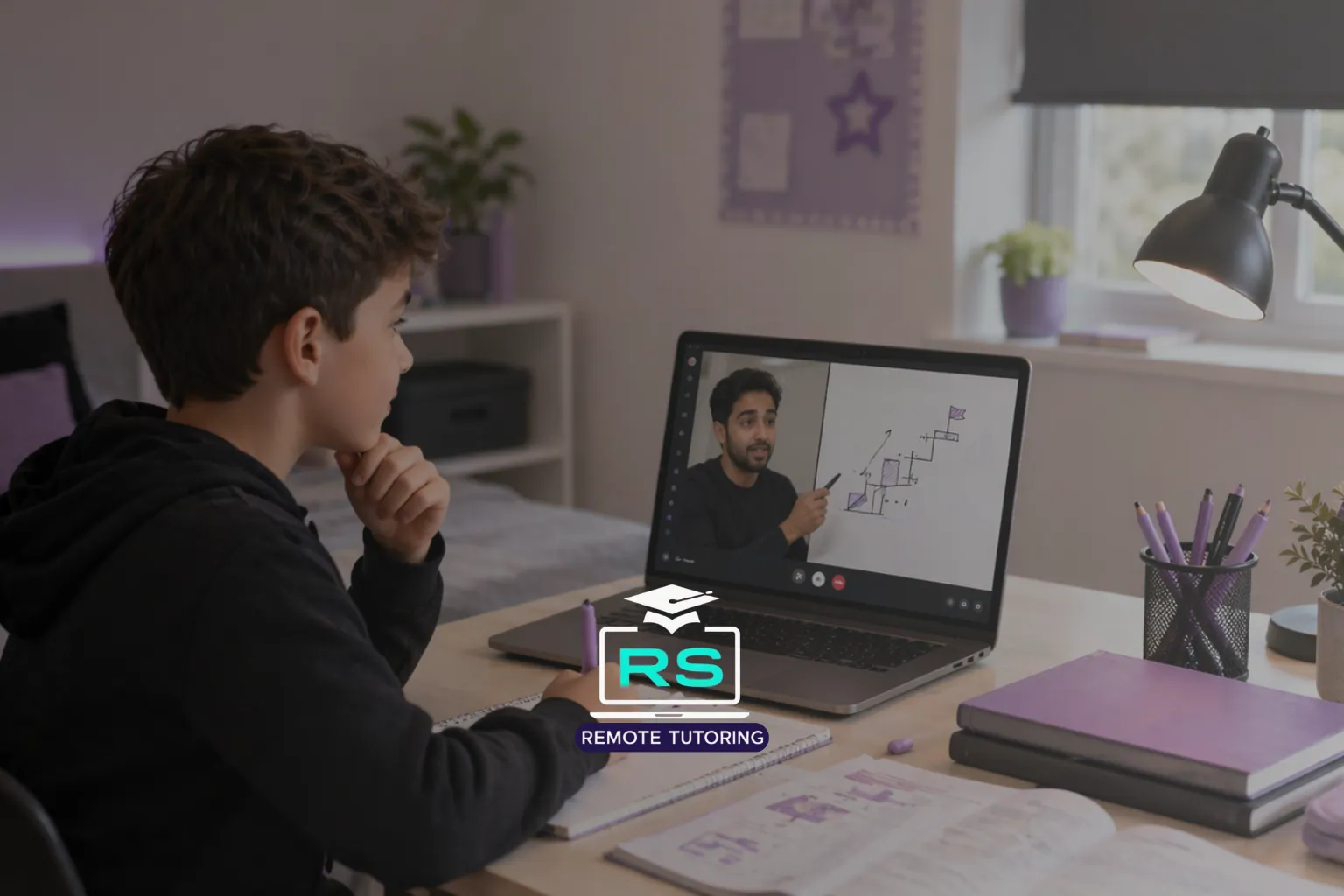
Year 7 student getting online KS3 tutoring support

None of these mean a child is struggling academically in a serious way. Most of the time it is one or two missing foundations and a knock to confidence, both of which are straightforward to deal with at this age.

The case for acting now

Why bother when KS3 is not examined?

Precisely because it is not examined. Nothing forces the issue, so gaps sit there quietly until Year 10, when GCSE content arrives at speed and assumes all of it is already secure.

GCSE assumes KS3 is done

Year 10 Maths does not revisit fractions and negative numbers, it builds on them. A student who never secured them spends two years compensating rather than learning, which is exhausting and shows up in the grade.

It is cheaper to fix now

A gap in Year 7 might take six lessons. The same gap in Year 11, tangled up with exam pressure and two years of workarounds, takes considerably longer and costs more.

Confidence is easier to rebuild early

A twelve year old who thinks they are bad at Maths usually is not, and can be talked out of it. A sixteen year old has believed it for four years, and that is a much harder conversation.

Year 9 has its own deadline, which parents often miss. Option choices happen during it, and a student who has quietly given up on a subject will not pick it, whatever their actual ability.

By year group

Years 7, 8 and 9 need different things

A Year 7 settling in and a Year 9 heading for option choices are different problems. The pace, the focus and the amount of confidence work all change depending on where your child is.

Year 7

The transition year. One teacher becomes twelve, homework becomes self-managed, and primary gaps surface within a term.

  • Fractions, decimals, percentages and first algebra
  • Reading comprehension, grammar and writing structure
  • Science basics across all three disciplines
  • Homework method rather than homework answers
  • Study habits and organisation

Year 8

The year gaps become visible. Work gets more demanding and students often stop saying they are struggling.

  • Ratio, proportion, algebra, geometry and graphs
  • Longer written answers and paragraph structure
  • Science explained through examples, not definitions
  • Support with school tests and topic reviews
  • Rebuilding confidence in a subject already avoided

Year 9

The last year before it counts. Option choices happen here, and GCSE content starts in some schools.

  • Early GCSE foundations in Maths, English and Science
  • Algebra, problem solving and multi step questions
  • Essay structure and evidence based writing
  • Scientific reasoning and clearer explanations
  • Revision habits before Key Stage 4 begins

Subjects

What we teach at KS3

Maths, English and Science are the core of what families ask for, and we also cover Computing and Religious Studies at this level. Lessons follow what the school is actually teaching rather than a separate syllabus.

KS3 Maths

Usually the first subject parents ask about, and usually a foundations problem rather than a Year 8 problem.

  • Number, fractions, decimals and percentages
  • Ratio, proportion and scaling
  • Algebra, expressions and equations
  • Angles, area, volume and shape
  • Graphs, statistics and probability

KS3 English

Where the demands change most sharply, since students are suddenly asked to read closely and write at length.

  • Reading comprehension and inference
  • Grammar, punctuation and vocabulary
  • Paragraph and essay structure
  • Creative and descriptive writing
  • Early Shakespeare, poetry and quotation work

KS3 Science

Three subjects taught as one, which is where students quietly lose track of which bit they do not understand.

  • Cells, body systems and ecosystems
  • Particles, reactions and the periodic table
  • Forces, energy, circuits and waves
  • Scientific vocabulary and explanation
  • Data, graphs and practical skills

The same tutors teach these subjects at GCSE, so nobody changes person when your child moves into Year 10. You can see the full team on the tutors page and the subject detail on subjects.

KS3 specialists

Who would teach my child?

Most of our 39 tutors teach at KS3. The six below are the ones we most often match with Years 7 to 9, including a primary and transition specialist with ten years of experience and two teachers holding QTS.

Tamanna

KS3 Maths and English foundations

10+ years teachingTransition specialist

Ten years teaching Maths, English, reading and Science to students in the years just before secondary school, which makes her the right person for a Year 7 or 8 who arrived already behind. Rebuilding foundations is a different skill from stretching a Year 11.

Best for Year 7 and 8 students working below age expectation

Mei

English, KS3 and GCSE

PGDE EnglishBA Linguistics15 years teaching

Fifteen years in English education, including leading a department, plus a postgraduate diploma in the subject. Reading comprehension, grammar and vocabulary are exactly where KS3 students gain most, and exactly where she concentrates.

Best for comprehension, grammar and written accuracy

Lily

Maths, KS3 and GCSE

PGCE with QTSSecondary Maths

Holds QTS as well as a PGCE, so mainstream secondary classroom teaching rather than tutoring alone. Particularly good on the misconceptions that quietly derail a student long before anyone notices a problem.

Best for spotting the misconception behind a repeated mistake

Nadia

Science and Maths

MSc BiochemistryB.Ed8+ years teaching

A Master's paired with a Bachelor of Education, so subject knowledge and teacher training arrive together. Covers all three sciences, which suits KS3 where they are taught as one subject.

Best for KS3 Science across Biology, Chemistry and Physics

Imran

Maths, KS3 and GCSE

PGCE Secondary MathsQualified teacher

A career in secondary and further education, so the route from Year 7 arithmetic through to the Higher tier paper is familiar ground. Teaches to the school's scheme of work and marks as he goes.

Best for families who want a qualified classroom teacher

Rumaan

Science and Maths, Head Tutor

MPharm7 years teaching

Founded RS Remote Tutoring in 2020 and still teaches. Tends to take the students who have already decided science is not for them, which at KS3 is usually a confidence problem rather than an ability one.

Best for students who have lost confidence in a subject

Measuring it

How will you know it is working?

There is no GCSE grade at KS3, which makes tutoring easy to sell and hard to judge. So we report progress in terms of what your child can now do, and there are four things worth watching for yourself.

Weeks 1 to 3

Homework gets faster. Not better yet, just faster, because your child stops sitting in front of a question they cannot start. This is usually the first thing parents notice.

Weeks 4 to 6

They attempt questions they would previously have skipped. Getting it wrong having tried is real progress at this stage, and worth more than a right answer copied from a friend.

Weeks 6 to 10

How they talk about the subject changes. "I hate Maths" becomes "I'm alright at Maths except graphs". That narrowing is the sound of a gap closing.

Through the term

School assessments and reports start to move. This lags the other three by some weeks, which is why we do not ask you to judge tutoring on it alone.

What you get after every lesson

An update covering what was taught, what your child understood, what still needs work and what has been set for next time. Written in plain English rather than as a score out of ten, because a score would be invented.

If nothing is moving after half a term, we will say so and either change the approach or change the tutor. Both are free.

On reviews, honestly

Our published reviews are almost entirely from GCSE families, because that is most of what we teach. We would rather point that out than put a Year 11 science result on a Year 7 page and hope you do not notice.

You can read all 34 of them, unedited, and judge for yourself.

What you get

What KS3 tutoring includes

A free gap check, a plan built around the school's topics, weekly one to one lessons on Zoom, and an update after every session so you can see whether it is working.

Free gap check first

Thirty minutes working out where your child actually is, before any money changes hands and before anyone recommends a plan.

Built on school topics

Lessons follow what the class is covering, so tutoring supports school rather than running a parallel course your child has to keep up with twice.

Method, not answers

Tutors help with homework, but the point is teaching the method. Finishing the homework quickly helps nobody in Year 10.

Confidence work

Most KS3 students need patience more than pressure. A student who will now attempt a question they would previously have skipped has made real progress.

Parent updates after lessons

What was covered, what improved, what still needs work. In plain English, not a colour-coded chart.

Optional recordings

Lessons can be recorded on request where appropriate, subject to safeguarding and consent, so a student can revisit an explanation before a test.

The process

From enquiry to first lesson

Most families are booked in within a day or two of getting in touch. Nothing is paid before the gap check.

  1. Tell us the year group, the subject and the main difficulty
  2. We read it and come back with any questions, usually within minutes
  3. We put forward one tutor, with the reason for the choice
  4. Free 30-minute gap check with that tutor, on Zoom
  5. You decide whether to book, with no follow-up sales call
  6. Weekly lessons begin at a fixed slot, with updates after each one

Safeguarding

All lessons are one to one on Zoom, and we can confirm a tutor's DBS status before lessons begin if you would like to see it. Our full safeguarding policy sets out how we work with students under 16.

If you would prefer to sit in on the first lesson or two while your child settles, that is entirely normal at this age and nobody will find it odd.

Cost

How much is a KS3 tutor?

£30 for a 60-minute one to one lesson, falling to £27.50 on a three-month term plan and £25 on an annual plan. The same rate applies at KS3 as at GCSE and A-Level, and to every subject.

Pay as you go

£30

per 60-minute lesson
No commitment, £120 a month

Term plan

£27.50

per 60-minute lesson
3 months, 12 lessons, £330

Annual plan

£25

per 60-minute lesson
12 months, 48 lessons, £1,200

No sign-up fee and no matching fee. A short run of lessons to clear one topic is perfectly reasonable and we will not push you towards a plan you do not need. The 30-minute gap check is free and takes no card details.

Common questions

KS3 tutoring questions

Anything not answered here, message us and we will tell you straight. We usually reply within minutes.

Do you have KS3 tutors available at the moment?

Usually, since most of our 39 tutors teach at KS3. Availability tightens from January and again before summer exams, when GCSE students take the evening slots first. Tell us the days and times you need when you enquire and we will confirm before anything is booked.

What is the free gap check?

A free 30-minute session where the tutor works out where your child actually is, rather than where the report says. No card details are taken and there is no obligation to book afterwards. You get an honest view of what needs fixing first.

Which subjects do you tutor at KS3?

Maths, English and Science are the core, and we also cover Computing and Religious Studies at this level. We do not teach History, Geography or Modern Foreign Languages, and we would rather say so than take the booking.

How do you decide which tutor we get?

Someone reads your enquiry and matches on the year group, subject, what is actually going wrong, whether confidence is part of it, and the times you are free. You get one name and the reason for it, not a shortlist to compare.

Is one lesson a week enough at KS3?

For most students, yes. KS3 gaps are usually narrower than they feel, and weekly lessons over a term tend to close them. If your child is a long way behind we will say so at the gap check rather than after three months.

Can we book just a few lessons for one topic?

Yes, and sometimes that is genuinely all that is needed. Pay as you go has no minimum, and we will not push you towards a term plan for a problem that takes four lessons to fix.

How much does KS3 tutoring cost?

£30 for a 60-minute lesson, £27.50 each on a three-month term plan and £25 each on a twelve-month annual plan. The same rate as GCSE and A-Level, with no sign-up fee and no matching fee.

Are your tutors DBS checked?

We can confirm a tutor's DBS status before lessons begin, and you are welcome to ask. Our safeguarding policy sets out how we work with students under 16, and all lessons are one to one on Zoom.

How will I know if it is working without a grade?

You get an update after every lesson covering what was taught and what still needs work. Beyond that, watch three things: whether homework is getting faster, whether your child attempts questions they used to skip, and whether they can name what they find hard instead of saying they hate the subject. School assessments move last, usually by several weeks.

Should I sit in on lessons?

At KS3 it is worth being nearby for the first lesson or two while the routine settles, then stepping back. Most students at this age work better without a parent in the room, and you will get an update after each session anyway.

Will tutoring just be homework help?

No. Tutors will help with homework, because that is what is in front of your child that week, but the point is teaching the method behind it. Finishing tonight's homework quickly is worth very little in Year 10.

Can the same tutor continue into GCSE?

Yes, and most families do exactly that. The tutors on this page teach GCSE as well, so nobody changes person in Year 10 at the point when continuity matters most.

What if the tutor is not the right fit?

Tell us and we will rematch at no cost. You do not lose lessons, restart a plan or pay a fee. At this age the fit between tutor and student matters more than almost anything else.


Free 30-minute gap check

Fix it in Year 8 rather than Year 11

Tell us the year group, the subject and what is going wrong. We will put forward one tutor and set up a free gap check. No card details, no obligation, no follow-up sales call.

+44 7377 137585 admin@rsremotetutoring.co.uk Online tutoring across the UK

Enquiries answered 24 hours a day, 7 days a week. We usually reply within minutes, and WhatsApp is the fastest way to reach us.