Passing GCSE English Language is one of those things that sounds straightforward until you are sitting in front of the paper and realise you are not quite sure what the examiner actually wants from you. I have been tutoring English at GCSE level for years, and that moment, the realisation that something felt off in an exam they had prepared for, is something students describe to me again and again. It is not usually a lack of effort. It is usually a lack of the right kind of preparation.
This guide is my attempt to give you everything I wish more of my students had known from the start. Whether you are sitting AQA in summer 2026, working through a November resit, or supporting someone at home, this is a genuine, practical walkthrough of how to pass GCSE English Language, not just the obvious tips you will find everywhere, but the things that actually make the difference.
Jump to Section
Why Students Struggle With GCSE English Language
One of the most common patterns I have seen is students treating English like a memory-based subject. They mostly enter the exam hall with vague ideas, especially when it comes to the structure. Most Probably;
- They revise quotations.
- They memorise techniques.
- They learn definitions.
But then the exam paper arrives with an unseen text, and suddenly everything feels unfamiliar. The reality is that GCSE English Language is mostly a skills-based exam. Examiners reward students who can:
- analyse quickly
- explain effects clearly
- interpret meaning
- structure ideas logically
- write with control under pressure
This is why passive revision rarely works.
The Biggest Shift That Helps Students Improve Fast
The biggest transformation not only lies just shifting your study patterns but the students actually achieve high when they stop asking;
“What technique is this?”
And start asking:
“Why did the writer use it here?”
That shift matters enormously. A Grade 5 answer often identifies techniques. Similarly; Grade 8 or 9 answer explains:
- the writer’s intention
- emotional effect
- alternative interpretations
- deeper implications
For example:
Weak analysis may include;The writer uses a metaphor.” While the Stronger analysis may encompass;
“The metaphor creates a sense of emotional suffocation, making the setting feel oppressive and claustrophobic.”
The second answer actually explores meaning. That is what examiners reward.
How to Pass GCSE English Language Without Burning Out
This is the most important question I have usually encountered, even when I was the students, similarly as the teacher also and the only one thing I would recommend is that One thing I genuinely recommend is avoiding massive revision marathons. Students often think:
“I need to revise English for five hours.”
But In reality, shorter focused sessions work far better. A much more effective structure is:
- 25 minutes active practice
- 5-minute break
- repeat
This keeps concentration sharper and prevents mental exhaustion.From experience, students who revise consistently for smaller periods often outperform students doing occasional all-night cramming sessions.
The Most Effective Revision Method for GCSE English Language
Use Past Papers Earlier Than You Think
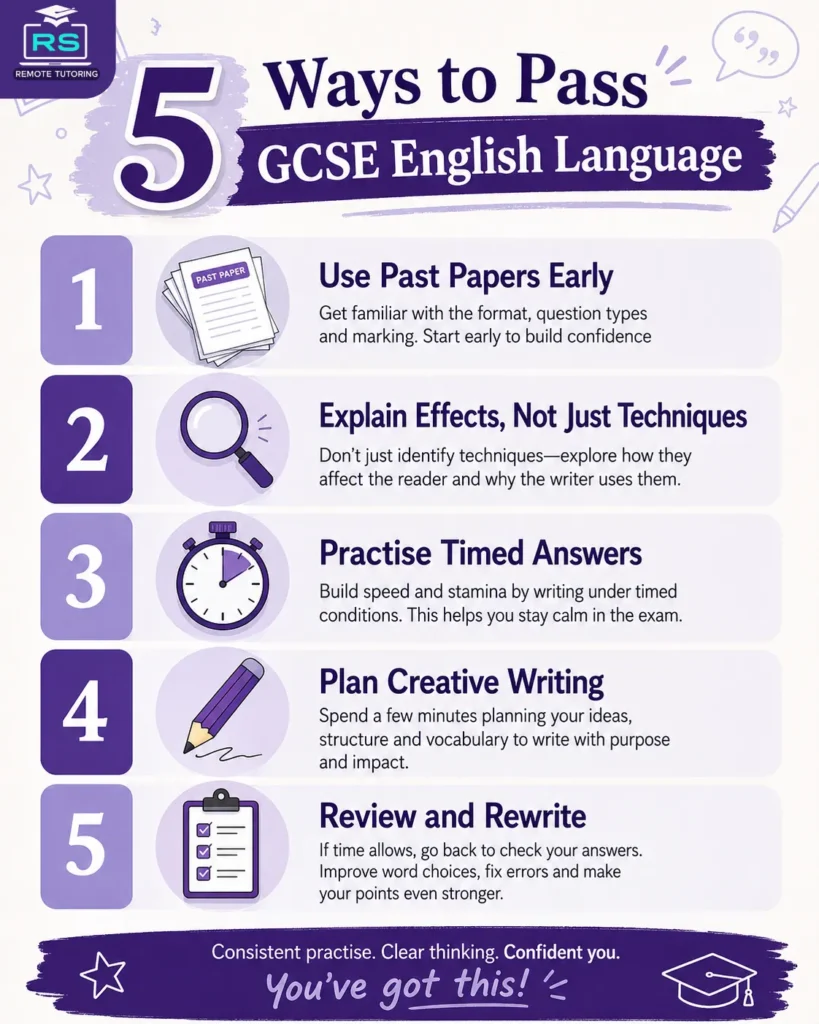
Many students save past papers until the final few weeks. That is the biggest mistake they usually commit. Past papers are not just for testing knowledge. They train you to recognise:
- question patterns
- timing pressure
- command words
- examiner expectations
We quickly realised that students improve fastest when they:
- attempt a question
- compare it to a mark scheme
- rewrite weaker sections
That third step matters most. Simply completing papers is not enough.
How High-Grade Students Actually Analyse Texts
Students often think Grade 9 analysis means sounding sophisticated, even though one of my students lamented innocently, Teacher these students hold special capabilities, we are too far from them. But actually this is the whole myth. The grade 9 truly does not revolve around the capabilities but it wholly means sounding thoughtful. A strong answer usually does three things:
- zooms into specific words
- explains emotional impact
- explores multiple meanings
For example:Instead of:
“The word ‘dark’ creates tension.”
A stronger response might say:
“The adjective ‘dark’ creates uncertainty and vulnerability, suggesting the character is emotionally trapped as well as physically isolated.”
Notice how the second response explores layers. That depth matters.
The Truth About Vocabulary in GCSE English Language
Students often force complicated vocabulary into answers because they believe it sounds intelligent. Examiners notice this immediately. What stayed with me most from examiner feedback sessions was how often markers preferred:
- clarity
- precision
- control
over random advanced words. You do not need to sound like a Victorian novelist. You need to sound confident and intentional. Strong vocabulary should feel natural.
Creative Writing: What Actually Gets High Marks
This is where many students lose marks unnecessarily. A lot of creative writing advice online focuses on:
- ambitious punctuation
- difficult vocabulary
- endless techniques
But genuinely strong creative writing usually succeeds because it creates:
- atmosphere
- emotional control
- believable detail
I remember reading a student story that barely used any complex vocabulary, yet it scored extremely highly because the emotional tension felt authentic from beginning to end. That student understood pacing.And pacing matters far more than throwing in twenty metaphors.
A Creative Writing Structure That Works Consistently
A reliable structure is:
Beginning
Start in the middle of something interesting. Avoid:
“It was a dark and stormy night.”
Instead:
- begin with movement
- dialogue
- tension
- uncertainty
Middle
Focus on one central emotion or atmosphere.Do not overload your story with too many ideas. This is the point where truly the audience or the examiner reflects deeply.
Ending
The resolution of the story leaves an emotional impact. Many strong endings:
- return to an earlier image
- reveal something unexpected
- create reflection
Common Mistakes Students Make in Paper 1

Writing Too Much for Early Questions
Students often spend:
- 15 minutes on Question 2
- then rush Question 5
This damages overall marks badly.Question 5 carries huge weighting.Time management matters and it should be taught even though practised more and more to sound more discipline and practical.
Feature Spotting Instead of Analysis
Listing techniques are not enough.Examiners want interpretation.Adding analysis and in depth content truly matters a lot and this is where examiners differentiate between and high achieving student and the average student.
Overcomplicated Writing
Trying too hard usually weakens clarity. Use simple sentences, or more often the compound ones. The complex sentences add to the ambiguity and usually students deviate from the existing topic.
Ignoring Structure Questions
Students focus heavily on language analysis but forget structural analysis completely. This is the foremost biggest mistake that further unlocks another step of losing marks.
How to Revise Paper 2 Properly
Paper 2 often scares students because it combines:
- reading
- comparison
- persuasive writing
But once students understand the structure, confidence improves quickly. One thing many parents I have spoken to say is:
“My child understands the texts but struggles to organise answers.”
That is incredibly common. The solution is practising structured comparison.For example:
- Source A presents…
- In contrast, Source B…
- Both writers…
- However…
Simple comparative phrasing creates clarity.
The Role of Mark Schemes and Why Most Students Use Them Wrong
Mark schemes are incredibly useful. But students often read them passively.
Instead:
- compare your answer directly
- identify missing depth
- rewrite one paragraph better
That rewrite process is where improvement happens.
What Grade 9 Students Usually Do Differently
From experience, top-performing students often:
- practise consistently
- review feedback carefully
- improve weak areas directly
- write under timed conditions
- stay calm under pressure
But something else matters too. They are willing to sound original. Examiners read hundreds of repetitive answers. Thoughtful interpretation stands out.
The Hidden Skill Most Students Ignore
There are some hidden gems that should be unlocked in order to sound more practical and consistent. Reading regularly is one of the most recommended and widely chosen by the high achievers. Not because reading magically guarantees a Grade 9. But because regular reading improves:
- sentence rhythm
- vocabulary naturally
- comprehension speed
- writing instinctively
Students often do not realise how much their writing style improves simply by being exposed to strong writing consistently.
Even:
- newspaper features
- opinion articles
- memoir extracts
- short fiction
Can further help enormously.
Exam Day Advice Students Rarely Hear
One thing I did not expect when I first started tutoring GCSE English was how much panic affects performance. Strong students sometimes underperform simply because they:
- rush
- freeze
- overthink
During the exam:
- move on if stuck
- keep writing
- trust your preparation
Momentum matters.
If your current revision methods are not improving your marks, focus less on memorising techniques and more on practising interpretation under timed conditions. Small consistent improvements usually lead to the biggest jumps in GCSE English Language grades.
FAQS
Can you revise for the GCSE English Language effectively?
Yes. Although the texts are unseen, students can still revise exam technique, timing, structure, analytical skills, creative writing, vocabulary, and question types. Effective revision focuses on practising responses rather than memorising information.
How long does it take to improve in the GCSE English Language?
Most students begin seeing improvement within 6–10 weeks of consistent practice. Significant grade jumps usually happen when students actively review feedback and practise timed exam responses regularly.
What is the hardest part of GCSE English Language?
Many students struggle most with analysis because they identify techniques without fully explaining meaning and effect. Others find timing difficult, especially balancing reading questions with extended writing tasks.
How many past papers should I complete?
Quality matters more than quantity. Completing 1–2 papers weekly with detailed review is usually more effective than rushing through many papers without reflection.
Do examiners care about ambitious vocabulary?
Only when it sounds natural and controlled. Forced vocabulary can weaken clarity. Examiners reward precise, effective writing more than complicated wording.
Is GCSE English Language harder than Literature?
Students often find Language harder because the texts are unseen and require quick interpretation under time pressure. Literature involves memorisation, while Language focuses more on analytical skill and writing control.
What grade do most students get in GCSE English Language?
Grades vary yearly, but achieving Grade 8 or 9 is relatively uncommon nationally. However, strong exam technique and consistent practice can significantly improve performance.
Final Thoughts
GCSE English Language can feel unpredictable at first.But once you understand what examiners actually reward, the subject becomes far more manageable. The students who improve most are rarely the ones doing the most revision overall. They are usually the students who:
- practise deliberately
- reflect carefully
- improve weak areas honestly
- stay consistent
And perhaps most importantly, they stop trying to sound impressive and start trying to communicate ideas clearly. That is often the real difference between average answers and excellent ones.

Raja specializes in Physics and Maths, with over 5 years of experience. He offers KS2, KS3, and GCSE Science and Maths lessons. He graduated from one of the top universities in the UK.