As a tutor, I still remember how stressful the lead-up to GCSE exams can be for students. Many are trying to manage several subjects at once, complete past papers, write longer answers, and wait for feedback before they know what to improve. That waiting time is often where progress slows down.
In the past, students would print exam questions, complete them by hand, submit them to a teacher or tutor, and then wait days for marking. By the time the feedback arrived, the student had often moved on to another topic or forgotten the thinking behind their answer.
This is where AI marking tools such as MarkMe can make a real difference. At first, many students and parents were unsure about AI marking for GCSE work, and that is understandable. But when used properly, it can give students quick, focused feedback on their answers, highlight missing analysis, point out weak structure, and suggest practical improvements based on exam-style expectations.
In this guide, I’ll explain how AI marking works, why it can be useful before GCSE exams, and how students can use it without becoming fully dependent on it. I’ll also share examples from students I have supported, learners in the UK, to show how digital marking tools can fit into a real revision routine.
By the end, you’ll understand whether AI marking is right for your child or students, which subjects benefit most from it, and how to use it alongside proper teaching, past papers, and tutor feedback to improve exam performance.
Jump to Section
Understanding AI Marking for GCSE
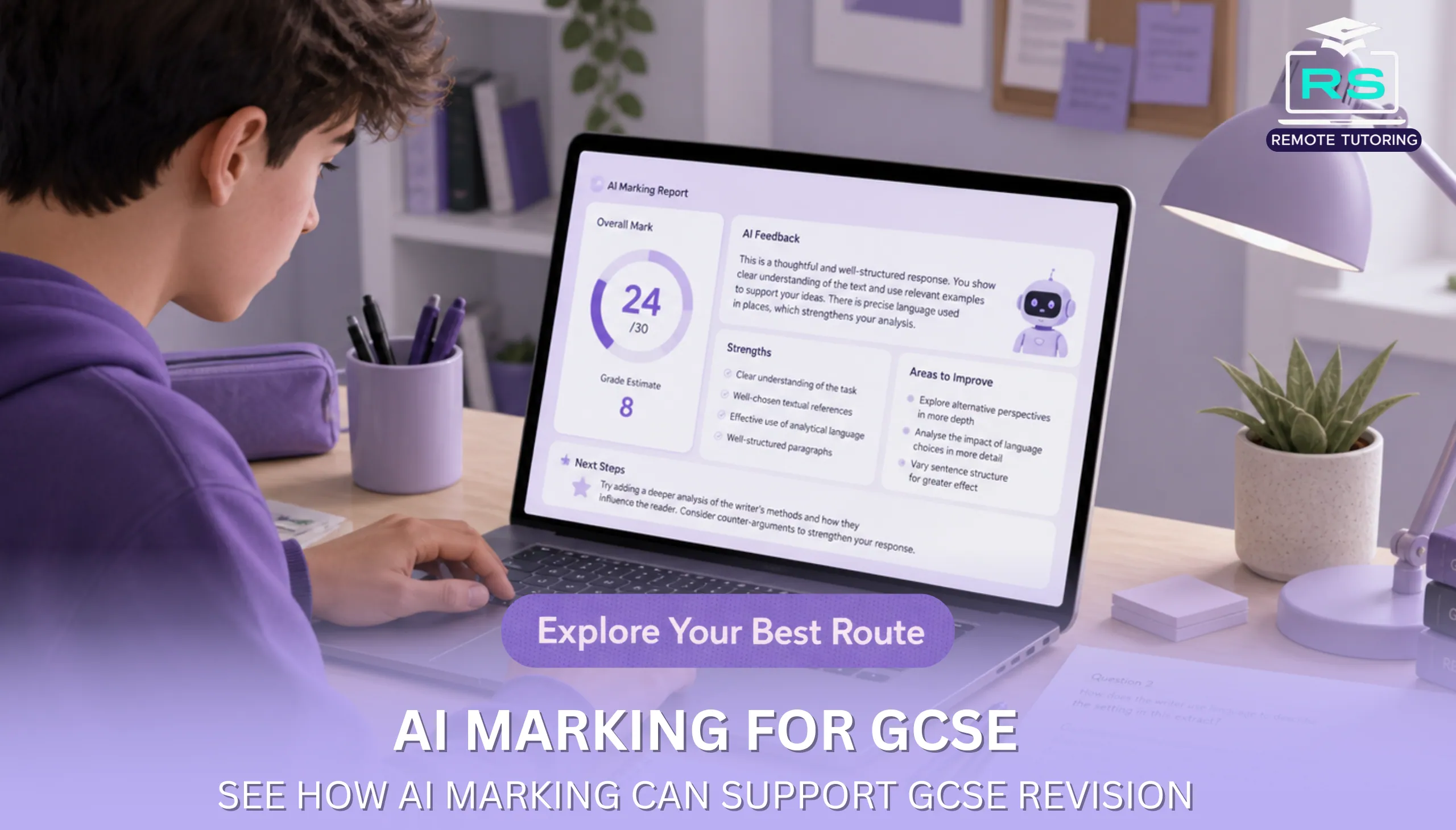
What is AI marking? At its core, AI marking uses natural language processing (NLP) to assess a piece of student work against exam board criteria. When you upload a handwritten answer, the system first converts it to digital text using OCR (optical character recognition). It then compares your response to the mark scheme: does your essay include the required evidence? Is your argument structured logically? Are key terms used correctly? Finally, it generates structured feedback that mirrors what an examiner might say. This might include an overall grade band, strengths, areas for improvement and specific tips for the next attempt.
Crucially, AI marking tools do not “understand” your essay like a human does. They look for patterns in language and compare them to training data. That means they excel at marking structured, criteria‑based writing but may struggle with highly creative responses. The most effective tools, like MarkMe, are trained on actual exam board mark schemes and examiner reports, making their feedback exam‑specific.
Why Use AI Marking Before Your GCSE Exams?
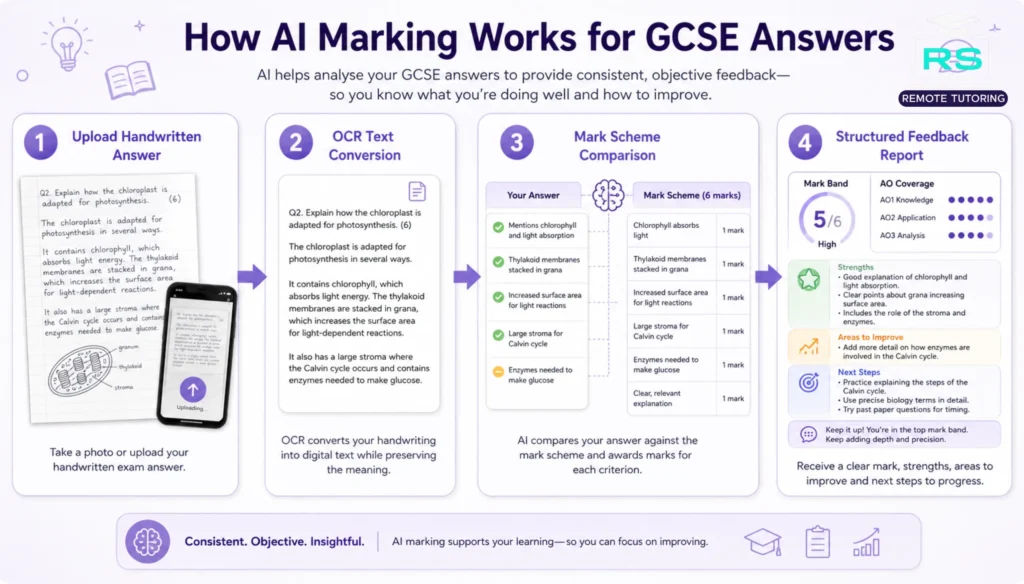
1. Speed of feedback
The revision cycle that drives improvement is simple: write a practice answer → get feedback → apply that feedback → write again. The faster you can repeat this cycle, the more you learn. Waiting a week for your teacher’s comments means maybe one feedback cycle per week. Using AI marking for GCSE essays, you can complete two or three cycles in a single session. When exam dates are looming (typically from early May to late June), time is precious.
2. Objective assessment
Even the best teachers have busy days and unconscious biases. AI marking evaluates work based on the criteria you’re aiming to meet. It doesn’t get tired, and it won’t award marks out of sympathy or frustration. For example, when I practised a history essay, the AI flagged that I’d used too few examples of causation; my teacher hadn’t noticed because she was juggling dozens of scripts.
3. Fits with exam practice conditions
Tools like MarkMe allow you to upload photos of handwritten answers, so you practise under exam conditions, writing by hand, organising your time and still receive digital feedback. This replicates the real exam more closely than typing, which is an advantage for subjects like English, History or Geography.
4. Personalised and actionable feedback
The most helpful AI tools do more than assign a mark. They tell you what you did well and where you missed marks, often citing specific lines or parts of the mark scheme. In my case, the feedback wasn’t generic: it highlighted that I used evidence well but needed to “zoom in on individual word choices” to reach the highest level. That specificity guided my next revision session.
5. Confidence boost and stress reduction
Revision for GCSEs can be stressful, especially when exam season is condensed. Getting immediate, constructive feedback reassures you that you’re on the right track. It also prevents last‑minute panic because you’ve tested yourself repeatedly under timed conditions.
Who Benefits Most from AI Marking?
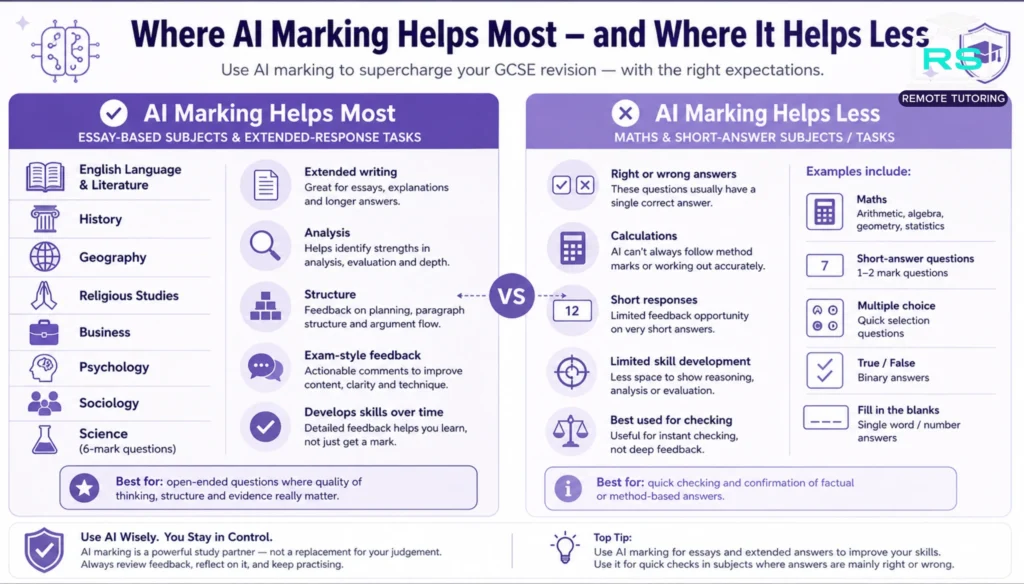
AI marking is most valuable for subjects that require extended written responses. Based on my experience and research, here’s how it breaks down:
- English Language & Literature: Both require analysing texts and crafting essays. AI feedback helps you refine language analysis, structure and evaluation.
- History & Geography: These subjects demand sustained arguments with evidence and context. AI can identify whether you’ve included enough examples, used proper terminology and answered the command words.
- Religious Studies, Business, Psychology and Sociology: Extended response questions follow structured mark schemes; AI helps you hit the criteria.
- Science (six‑mark questions): AI can mark the extended responses in science exams, but it isn’t needed for short answers or calculations.
- Mathematics: AI adds little value because answers are either right or wrong. It can’t replace practising problem sets or checking solutions yourself.
- Languages (e.g., German, French): AI tools for language marking are emerging but still limited; check whether your chosen tool supports your language.
Choosing an AI Marking Tool: What to Look For
Not all AI markers are created equal. When evaluating tools like MarkMe or others, consider:
Alignment with exam boards
Does it mark against AQA, Edexcel, OCR or WJEC criteria? Generic AI models cannot reliably apply UK mark schemes.
Handwriting support
Since GCSE exams are handwritten, look for tools that accept photo uploads and handle typical student handwriting.
Subject coverage
Make sure the tool supports the subjects you’re taking. Many free AI markers focus on English; MarkMe covers several humanities and science subjects.
Quality of feedback
Feedback should be specific and actionable. Avoid tools that just give a grade without explaining how to improve.
Data privacy and ethics
Check whether your answers are stored, how they’re used and whether the tool complies with data protection laws. AI markers should treat students’ work confidentially and avoid using identifiable data.
Cost and accessibility
Some tools offer free trials; others require subscriptions. Choose one that fits your budget, but remember that free tools may have limited features.
Using MarkMe: Step‑by‑Step
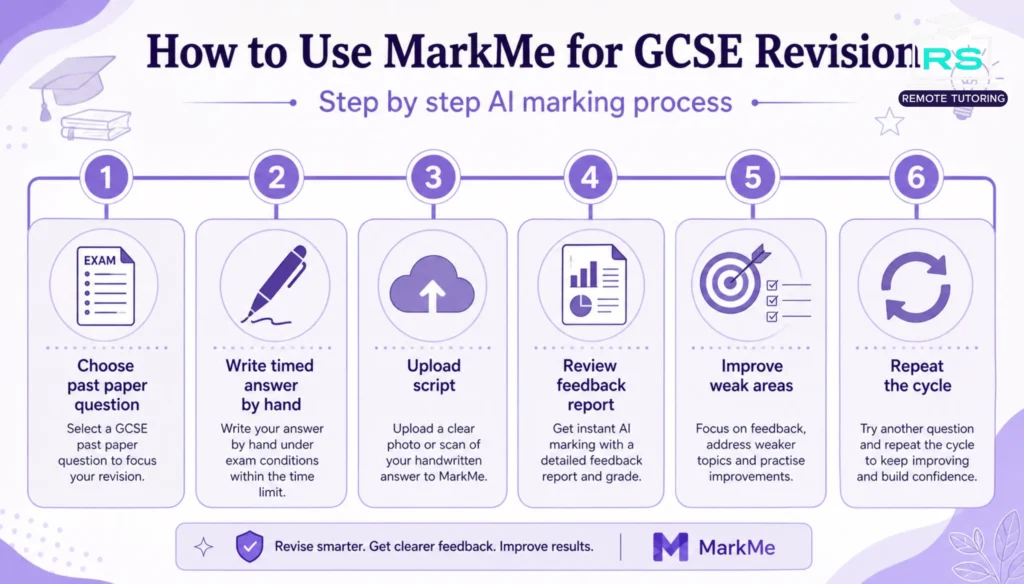
Over the past year, we’ve guided several students through MarkMe, and we’ve settled on a straightforward process:
Collect practice questions
Use past papers or sample questions from your exam board. For essay‑based subjects, pick questions that cover different themes and question types.
Write under timed conditions
Set a timer matching the exam (e.g., 45 minutes for a history essay). Write by hand to build stamina and simulate the exam environment.
Upload your answer
Take clear photos of your script. MarkMe’s OCR will convert your handwriting to text, so good lighting and legible writing help.
Review the feedback immediately
MarkMe will produce a report showing your overall grade band, strengths and areas for improvement. Pay attention to comments referencing the mark scheme (e.g., “you included relevant context but lacked analysis of significance”).
Choose one or two focus points
Don’t try to fix everything at once. If the tool says your analysis lacks depth, plan to work on n analysis next time; if it highlights weak evidence, source better quotations or case studies.
Repeat the cycle
Write another answer targeting your improvement areas. Upload again and compare feedback. Two or three iterations can drastically improve your exam technique.
Combine with teacher feedback
Share your AI report with your teacher. They may offer additional insights or correct misunderstandings. AI feedback is a supplement, not a replacement.
From experience, what made the biggest difference for us was consistency. Students who integrated MarkMe into weekly revision sessions saw a clear upward trend in mock exam scores. One student told me, “I quickly realised that the AI wasn’t just marking my work; it was teaching me to think like an examiner.” Another noted that being able to upload handwritten answers meant he could practise anywhere, even on a bus ride home.
Integrating AI Marking into a Revision Plan
Here’s a structured approach to combining AI feedback with a broader revision strategy, especially if your exams run from early May to late June:
- Start 6–8 weeks before exams: Early March is ideal. Review your syllabus and identify which topics need the most work.
- Alternate between content review and practice: Use textbooks, revision guides and teachers’ notes to review content. Then apply what you’ve learned by writing practice answers and having MarkMe provide feedback.
- Schedule sessions: For each subject, plan at least one AI‑marked practice session per week. After each session, summarise the feedback and set goals for the next attempt.
- Simulate full papers: In the final four weeks (mid‑April onwards), write full past papers under exam conditions. Use AI marking for the extended questions and mark short answers yourself.
- Reflect and adjust: After each session, ask yourself: “What did I improve?” and “Where am I still losing marks?” My students often created a simple table tracking topics, marks gained and improvement notes.
- Look after yourself: Schedule breaks, exercise and sleep. AI may accelerate learning, but it can’t compensate for burnout. Many parents we have spoken to say that balanced schedules produced calmer, more focused children.
Personal Experiences & Lessons Learned
Let me share a few personal insights that stood out for our students using AI marking with GCSE students:
- We quickly realised that AI feedback is only as good as the questions you feed it. When we used poorly worded or out‑of‑date questions, the feedback was confusing. Stick to recent past papers or trusted practice questions.
- One thing I did not expect was how motivating immediate feedback can be. Students who normally avoided essay practice started enjoying the challenge of improving their score from 6/8 to 7/8 within the same hour.
- Students often do not realise that feedback works best when they act on it immediately. Waiting days to write another essay means you forget what you just learned.
- From experience, AI marking is most useful when combined with discussions. After reading the AI report, talking it through with a teacher or friend helps clarify misunderstandings.
- Many parents I have spoken to say they were initially worried about AI replacing teachers. After seeing how it sped up revision without removing the human element, most embraced it as an additional tool.
Limitations & Ethical Considerations
No tool is perfect. Be aware of these limitations:
Formative, not summative
AI feedback is designed to help you improve; it does not predict your final grade. Avoid letting a low AI score discourage you, or a high score make you complacent.
Creative responses
Highly original or unconventional answers may confuse AI. If you’re writing a creative piece, prioritise teacher feedback.
Data privacy
Make sure your chosen platform stores data securely and complies with regulations. If you’re under 18, ask a parent or teacher to review privacy policies.
Handwriting quality
Very messy handwriting may reduce OCR accuracy. Write clearly and use good lighting when photographing your work.
Bias and fairness
AI models are trained on past exam data; if that data contains biases, the model might reinforce them. That’s another reason to treat AI feedback as a supplement, not an absolute judgment.
Frequently Asked Questions
Is MarkMe AI accurate?
MarkMe is designed specifically for GCSE students and has been tested and validated by qualified teachers and examiners. It marks against real exam standards, providing feedback that aligns with what an examiner would expect. However, no AI can guarantee perfect accuracy; use it to guide your revision, not as a definitive grade.
What is the AI that marks GCSEs?
Several platforms offer AI marking for GCSE. Tools like MarkMe, Gradescope and other AI markers listed in educational resources evaluate essays and extended responses using NLP and mark schemes. Each has different features; MarkMe is tailored to GCSE subjects with support for handwritten uploads and subject‑specific feedback.
How can I use AI for GCSE revision?
Use AI marking tools to write practice essays under timed conditions, upload them for feedback, study the detailed comments and then write another response focusing on the suggested improvements. Integrate this into your revision schedule, combining content review with practice. AI marking is most valuable for humanities and essay‑based subjects.
How can teachers use AI to mark student work?
Teachers can assign practice essays, collect student responses and use AI marking to generate preliminary feedback. This frees up time to focus on individual misconceptions and provides consistent baseline assessments. Teachers should still review AI feedback for accuracy and provide personalised guidance.
Can you use AI in GCSE exams?
No. AI tools are for practice and revision. During the actual exams, you must rely on your own knowledge and skills. However, using AI marking during revision helps you align your answers with mark schemes and improve your writing technique.
Additional Tips for Success
Pair AI with human feedback
Share your AI report with teachers or peers. Discussing the feedback helps you interpret it correctly and avoid misapplying advice.
Keep a revision journal
After each AI‑marked essay, note what you did well and what you’ll work on next. Reflecting on progress boosts confidence.
Use multiple resources
AI marking isn’t a standalone solution. Combine it with textbooks, revision guides, video tutorials and group study sessions.
Monitor your mental health
Revision can be stressful. Schedule breaks, eat well, sleep enough and talk to friends or counsellors if anxiety spikes.
Stay adaptable
If you discover that AI feedback isn’t improving your answers, adjust your approach. Sometimes you need to step back and revisit core concepts rather than writing endless essays.

Raja specializes in Physics and Maths, with over 5 years of experience. He offers KS2, KS3, and GCSE Science and Maths lessons. He graduated from one of the top universities in the UK.