
I still remember the first week after finishing my GCSEs. There was a sense of relief, celebration and a long summer stretching ahead. Yet the phrase everyone kept telling me, “It’s a big jump from GCSE to A‑Level”, rang in my ears. At the time, I didn’t fully grasp what the transition from GCSE to A‑Level really meant. As September approached, I quickly realised this wasn’t just about harder exams. You go from juggling eight to ten subjects to specialising in just three or four; the workload intensifies, teachers expect you to study independently and the responsibility for your learning shifts squarely onto your shoulders.
In this guide, written from my experience and from conversations with other students and teachers, we’ll explore why the jump feels so hard and how to navigate it successfully. You’ll find tips for different subjects, advice on using tools like GCSE to A‑Level grade predictors, and practical pointers for managing the leap whether you’re in the UK or studying Cambridge A‑Levels abroad. Let’s get into it.
Jump to Section
Why the Jump Feels So Hard
1. Depth over breadth
At GCSE you cover a broad spectrum of topics across many subjects. A‑Levels narrow that range down to a few areas, but each course delves into much greater depth. In my first A‑Level maths lesson the textbook was twice as thick as anything I’d used before and the problems were multi‑step. A friend who took biology said she was shocked at the level of detail expected about cellular processes and ecosystems. That depth means you spend longer per topic, which is rewarding but demands focus.
2. Independent learning
Teachers at GCSE often remind you about homework, chase missing coursework and offer revision sessions. At A‑Level you’ll have fewer taught hours and several free periods. These aren’t free time to socialise, they’re scheduled for independent study. It took me a few weeks to adjust, and I quickly realised that using free periods productively makes all the difference. If you’re studying outside the UK, such as in Pakistan’s Cambridge system, you may also have long gaps between lessons. Embrace them as opportunities to read ahead, practise questions or consolidate notes.
3. Different exam style
GCSE assessments focus heavily on recall and straightforward application of concepts. A‑Level exams require you to synthesise information, analyse data and construct well‑reasoned arguments. For example, A‑Level history essays demand critical evaluation of sources, and A‑Level physics problems often combine multiple principles. The GCSE to A‑Level conversion is not just a grade issue; it’s a cognitive jump that challenges you to think more like a researcher than a memoriser.
4. Relationship with teachers
Students often cite the shift in dynamic with teachers. In Sixth Form you’re treated more like an adult. Teachers may be called by their first names and expect you to take the initiative. In my case, this meant approaching my biology lecturer when I didn’t understand an enzyme pathway rather than waiting for them to check in. Many students feel intimidated by this change, but it’s great preparation for university or workplace relationships.
5. Balancing responsibilities
For some, the transition coincides with taking on part‑time work, caring responsibilities or applying for university. Juggling these alongside demanding A‑Level study can feel overwhelming. It’s why being organised and prioritising rest become essential.
What Actually Changes? A Side‑by‑Side Look
| Area | GCSE | A‑Level |
| Number of subjects | 8–10 subjects across a broad range | Usually 3–4 subjects, studied in much greater depth |
| Depth of coverage | Covers key concepts at a foundational level | Explores topics in detail; deeper conceptual understanding is required |
| Learning style | Teachers guide closely and provide structured lessons | Independent learning is essential; you’re expected to read around topics, take initiative and fill gaps yourself |
| Assessment style | Focus on recall and applying learned techniques | Emphasis on analysis, evaluation and constructing detailed arguments; longer essays and complex problems |
| Teacher support | Regular reminders and close monitoring | Far less hand‑holding — you must manage deadlines, ask for help proactively and stay organised |
| Personal responsibility | Workload managed by teachers; deadlines set and enforced | You manage your own workload, organisation and pacing |
Recognising these differences early helps set expectations and reduces the shock when classes start.
Understanding Grade Conversion and Using Predictors
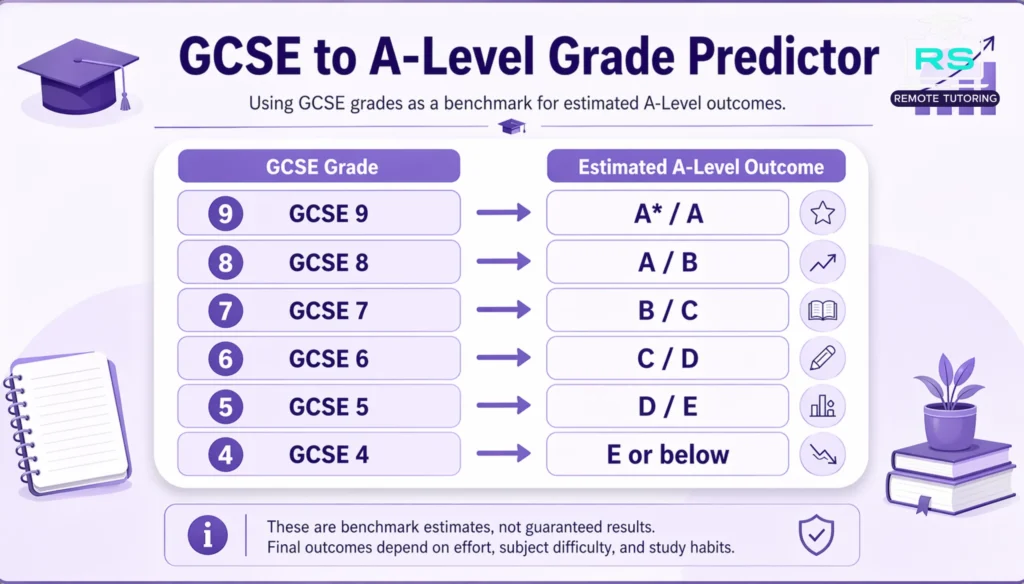
One of the most common questions I hear is, “What GCSE grades are equivalent to A‑Levels?” The truth is there isn’t a direct one‑to‑one GCSE to A‑Level conversion, because A‑Level grades reflect a higher standard. However, there are tools called grade predictors that estimate what A‑Level grade you might achieve based on your GCSE scores and subject choice. For example, Cambridge Assessment’s research reports highlight correlations between GCSE grades and A‑Level outcomes, and the Department for Education publishes statistical progression rates.
Many exam boards and tutoring websites offer GCSE to A‑Level grade predictor math tools. These online calculators take your GCSE maths grade, compare it with historical data and suggest a target A‑Level grade. Similar predictors exist for biology and other sciences. Use them cautiously: they provide a benchmark, not a guarantee. When I input my 9 in GCSE maths, the predictor suggested an A in A‑Level maths if I maintained consistent study habits. That target kept me motivated, but the real result depended on my effort.
You might also come across Gcse to a level 2022 predictors or downloadable GCSE to A level pdf guides summarising grade boundaries for the 2022 cohorts. If you took your exams during the pandemic years, note that grade distributions in 2021 and 2022 were atypical because of teacher‑assessed grades. Adjust your expectations accordingly.
Bridging Worksheets and Resources
Another effective way to prepare is by using GCSE to A‑Level worksheets and bridging courses. Many schools provide bridging assignments over the summer; some publish them online as PDFs. These worksheets often focus on core concepts that will be assumed in September. For example:
- Mathematics: Algebra, trigonometry and calculus basics. A GCSE to A level grade predictor Maths can show you which topics you need to strengthen before tackling A‑Level coursework. Completing bridging worksheets helped me remember factorisation and functions so I wasn’t playing catch‑up in October.
- Biology: Key GCSE concepts like cell structure, enzymes and basic genetics. I downloaded a GCSE to A level grade predictor biology spreadsheet that compared my GCSE science marks with typical A‑Level outcomes. It highlighted that students who scored less than a 7 at GCSE often found the jump particularly challenging. Using bridging worksheets online allowed me to practise reading scientific literature, a skill heavily tested at A‑Level.
Many of these worksheets are available online through exam boards (AQA, Edexcel, OCR, WJEC) or tutoring websites. If you can’t find them easily, ask your teachers; they often have PDF packs or can direct you to reputable sources. Completing them over the summer bridges the gap and builds confidence.
Preparing Over the Summer: A Student’s Checklist
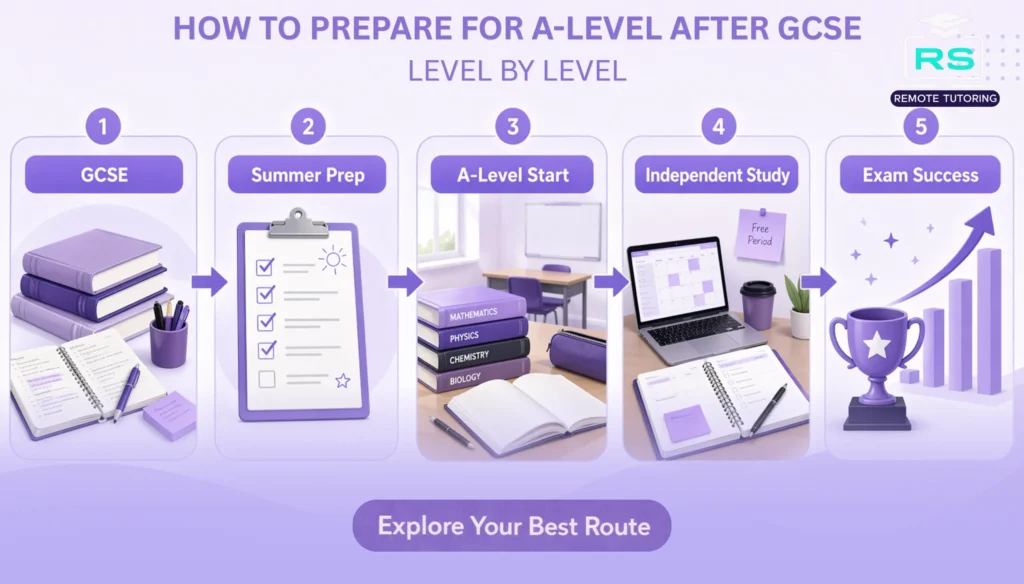
The summer between GCSEs and A‑Levels is both a well‑deserved break and an opportunity to get ahead. You don’t need to study all day, but spending a few hours each week on preparation will make September smoother. Here’s a checklist based on what worked for me and others I spoke to:
- Review the specifications: Visit your exam board’s website and download the specification for each subject you plan to take. Skim through to understand the topics and assessment objectives.
- Gather resources: Collect textbooks, revision guides and any recommended reading. For essay‑based subjects, start reading novels or articles from the reading list. If you’re taking economics or sociology, listen to podcasts or documentaries to familiarise yourself with terminology.
- Complete bridging assignments and worksheets: Use the gcse to a level worksheets provided by your school or board. If none are available, look for gcse to a level online resources that offer diagnostic quizzes and practice questions.
- Brush up on core GCSE content: A‑Levels build directly on GCSE knowledge. If your algebra or grammar is rusty, revisit those topics. Use flashcards, YouTube tutorials or revision apps. When I revisited GCSE chemistry before starting A‑Level chemistry, I realised how vital those basics were for understanding organic mechanisms.
- Establish a routine: Spend a little time reading or practising each day, but also schedule rest, exercise and social activities. Adapting to structured independent study during the holiday makes the September timetable less daunting.
- Reflect on your goals: Think about why you chose each subject and what you hope to achieve. Setting clear goals, whether you aim for a university course or a particular career, will keep you motivated when workload spikes.
Building Effective Study Habits from Day One
When A‑Level lessons start, the habits you build in the first month will shape your success. Here are strategies I found invaluable:
- Review notes immediately: Within 24 hours of a lesson, re‑read your notes and summarise them in your own words. Then revisit them after a week and a month (spaced repetition). This method, highlighted in many cognitive psychology studies, strengthens long‑term memory.
- Create a system: Use separate folders (physical or digital) for each subject and organise your worksheets, handouts and essays. I colour‑coded each subject and created a simple indexing system in my binder and laptop. When exam season arrived, I could easily find past papers and notes.
- Plan weekly: At the start of each week, write down your lessons, deadlines and independent study slots. Treat your free periods as scheduled work sessions. A paper planner or digital calendar works equally well; the key is consistency.
- Active recall and practice: Rather than passively re‑reading notes, test yourself using practice questions, flashcards or by explaining concepts aloud. For maths and science, practise problems until you can solve them without prompts. For essay subjects, practise planning essays and writing paragraphs under timed conditions.
- Seek help early: If you struggle with a topic, ask your teacher or classmates promptly. Don’t wait until the week before a test. In my first term, I joined a study group that met every Friday. Discussing problems aloud not only clarified concepts but also built camaraderie.
Subject‑Specific Tips & Insights
Mathematics and Further Maths
- Start practising algebraic manipulations and trigonometric identities during the summer; they underpin almost every topic.
- Use a GCSE to A‑Level grade predictor maths tool to set a realistic target. If the predictor suggests a lower grade than you hope, dedicate extra time to problem‑solving and consider working with a tutor.
- Attend all lessons; new concepts like differentiation and integration build on each other. Missing a class can leave a gap that’s hard to fill.
Biology
- Master GCSE topics such as cell structure, respiration and genetics before starting. A gcse to a level grade predictor biology can highlight areas needing reinforcement.
- Learn how to read scientific papers. A‑Level biology often requires you to evaluate experimental data and design investigations. Start by summarising simple research articles to build confidence.
- Make diagrams your friend. Sketching processes like mitosis or the nitrogen cycle from memory deepens understanding.
Chemistry
- Practise balancing equations and understanding moles and stoichiometry during the summer. These are foundational skills for physical and organic chemistry.
- Get comfortable with orbital theory and periodic trends early on; they recur throughout the course.
- When revising, try to explain mechanisms and reactions step by step. Teaching a friend (or even an empty room) clarifies your own understanding.
Physics
- Strengthen your algebra and trigonometry skills, you’ll use them constantly in mechanics and electromagnetism.
- Familiarise yourself with unit conversions and significant figures to avoid mistakes.
- For practical work, keep an organised lab book. Record observations, errors and improvements. This habit becomes invaluable for the practical endorsement.
Humanities and Essay‑based Subjects (History, English, Sociology)
- Begin reading widely in the summer. For history, pick up a general overview of your chosen periods. For literature, read set texts ahead of time to enjoy them without pressure.
- Practise constructing arguments. When reading news articles or historical accounts, ask yourself how you’d argue for or against the author’s viewpoint. This builds the critical thinking needed at A‑Level.
- Keep a vocabulary list. Strong essay writing requires precise language and varied sentence structures.
Managing Workload, Stress and Well‑being
The intensity of A‑Levels can be stressful, especially if you’re balancing work or family duties. Here’s how to keep on top of things:
- Prioritise rest and exercise: You can’t perform well if you’re exhausted. Schedule time for sleep, physical activity and relaxation. Even a 20‑minute walk between study sessions resets your brain. Grove Tutors emphasise the importance of exercise and rest.
- Use breaks wisely: Free periods and evenings shouldn’t be used solely for social media. Use short breaks to read ahead, recap notes or practise a few questions. At the same time, give yourself guilt‑free downtime to avoid burnout.
- Stay connected: Share your struggles with friends, family or teachers. Many students think they’re the only ones finding the jump hard, but everyone faces challenges. Talking about them can relieve anxiety and open avenues for support.
- Look after mental health: If you feel overwhelmed, speak to a counsellor or trusted adult. Sixth Forms and international schools often have pastoral support teams. Mindfulness apps, journaling or light exercise can help manage stress.
Common Challenges (and How to Beat Them)
Even with preparation, unexpected challenges arise. Here are some I encountered and how I tackled them:
- Procrastination. With more free time and fewer subjects, it’s easy to delay tasks. I used the Pomodoro Technique (25‑minute work blocks followed by short breaks) and wrote deadlines in bold on my calendar. Starting assignments early meant I had time to improve them rather than rushing at midnight.
- Falling behind in one subject. In my second term, chemistry started to slip. I created a recovery plan: booked weekly sessions with a tutor, practised past papers every weekend and asked my teacher for extra questions. Within six weeks my confidence recovered.
- Comparing yourself to others. Some peers seem to grasp concepts instantly. Remember that everyone has strengths and weaknesses. Focus on your progress. Use grade predictors as a guide, not a measure of your worth.
- Balancing extracurriculars and study. It’s tempting to drop hobbies to concentrate on A‑Levels. Actually, playing football once a week or attending a music club can improve concentration and mood. Schedule them like any other commitment.
Voices from Students Who Made the Leap
- “I quickly realised how important it is to use free periods wisely. At first, I thought of them as breaks, but my grades improved when I treated them as study sessions.” Zara, A‑Level Sociology & English Literature
- “One thing I did not expect was the difference in teacher relationships. They expect you to be proactive. The best advice I received was to ask questions immediately rather than letting confusion build.” Ahmed, A‑Level Biology & Chemistry
- “I remember thinking I was good at maths after my GCSE 9, but the first few A‑Level problem sets humbled me. Using a grade predictor and bridging worksheets highlighted areas I needed to strengthen.” Samira, A‑Level Maths & Physics
- “The biggest difference for me was writing essays in history. At GCSE you can memorise facts; at A‑Level you need to form arguments and evaluate sources. I practised by reading historians’ work and constructing arguments aloud.” Tom, A‑Level History & Politics
These insights and our reviews show that while the transition is challenging, students develop strategies to thrive. Learning from peers accelerates your own adaptation.
Frequently Asked Questions
Is there a big jump from GCSE to A‑Level?
Yes. The transition from GCSE to A‑Level involves deeper subject knowledge, greater independence and more rigorous assessments. You’ll study fewer subjects but in far greater detail. The workload is heavier, and teachers expect self‑motivation. By preparing over the summer, using bridging worksheets and adopting strong study habits early, you can manage the leap effectively.
What are the five hardest A‑Levels?
Difficulty is subjective, but students and teachers often cite Further Maths, Physics, Chemistry, Biology and Modern Languages as particularly demanding because they require strong foundations and a high level of analytical or linguistic skill. However, choosing subjects you enjoy can offset the perceived difficulty. With the right preparation, especially revising GCSE content and practising regularly even the toughest courses become manageable.
What GCSE grades are equivalent to A‑Levels?
There isn’t a direct equivalence, but statistical analyses show that high GCSE grades correlate with higher A‑Level outcomes. Grade predictors convert GCSE scores into estimated A‑Level grades by comparing past cohorts. For example, students with 8s and 9s at GCSE often achieve As and A*s at A‑Level if they maintain consistent study habits. Use a GCSE to A level grade predictor to set goals, but remember that effort, engagement and subject choice have a big impact.
How many hours should I study at A‑Level compared to GCSE?
A general guideline is to spend about one hour of independent study for each hour of class. With typically 15–18 taught hours per week, aim for 15–20 hours of personal study. This includes reviewing notes, completing homework, practising questions and reading around the subject. Adjust based on how quickly you grasp material; some weeks may require more intensive study.
What is a GCSE to A‑Level grade predictor and should I use one?
A grade predictor is a tool, sometimes a spreadsheet or online calculator that estimates your probable A‑Level grade based on your GCSE results and subject. They use historical data to suggest targets. They can be motivating and help identify weak areas (e.g., through a GCSE to A level grade predictor Maths or biology tool). Use them as a guide, not as a definitive forecast.
Conclusion
The transition from GCSE to A‑Level is undeniably challenging. You’ll navigate deeper content, increased independence and a different relationship with teachers. However, with careful preparation, disciplined study habits and support from friends, family and mentors, the jump becomes manageable and even enjoyable.
Remember to make the most of the summer break, use GCSE to A‑Level worksheets and grade predictors to set realistic goals, and don’t hesitate to ask for help when you need it. The leap may feel large now, but it leads to exciting intellectual growth and new opportunities. As someone who’s been there, I promise you’ll adapt faster than you expect and the skills you develop will serve you well beyond A‑Level.

Raja specializes in Physics and Maths, with over 5 years of experience. He offers KS2, KS3, and GCSE Science and Maths lessons. He graduated from one of the top universities in the UK.