A few weeks into paying for tutoring, most parents ask themselves the same quiet question: is this actually working? The grades haven’t jumped yet, the invoices have, and it’s hard to tell whether the weekly sessions are moving anything. It’s a fair question and the honest answer is that the value of online GCSE tutoring is rarely captured by the next report card alone.
Good tutoring is an investment, and like any investment it should be judged on measurable outcomes but the right measures are broader than a single grade. The Education Endowment Foundation rates one-to-one tuition as one of the more powerful interventions available, worth roughly +5 months of additional progress over a year when it’s well targeted. This guide gives parents and students a practical framework to judge whether their online tutoring is delivering real results, across grades, learning, engagement, confidence and return on investment.
Jump to Section
What does “value” actually mean in online tutoring?
Value in online tutoring means measurable improvement over time, not just a higher final grade. It spans academic progress, faster learning, deeper engagement, growing confidence and stronger independent study habits. Judging tutoring on one exam misses most of what good tutoring is actually doing week to week.
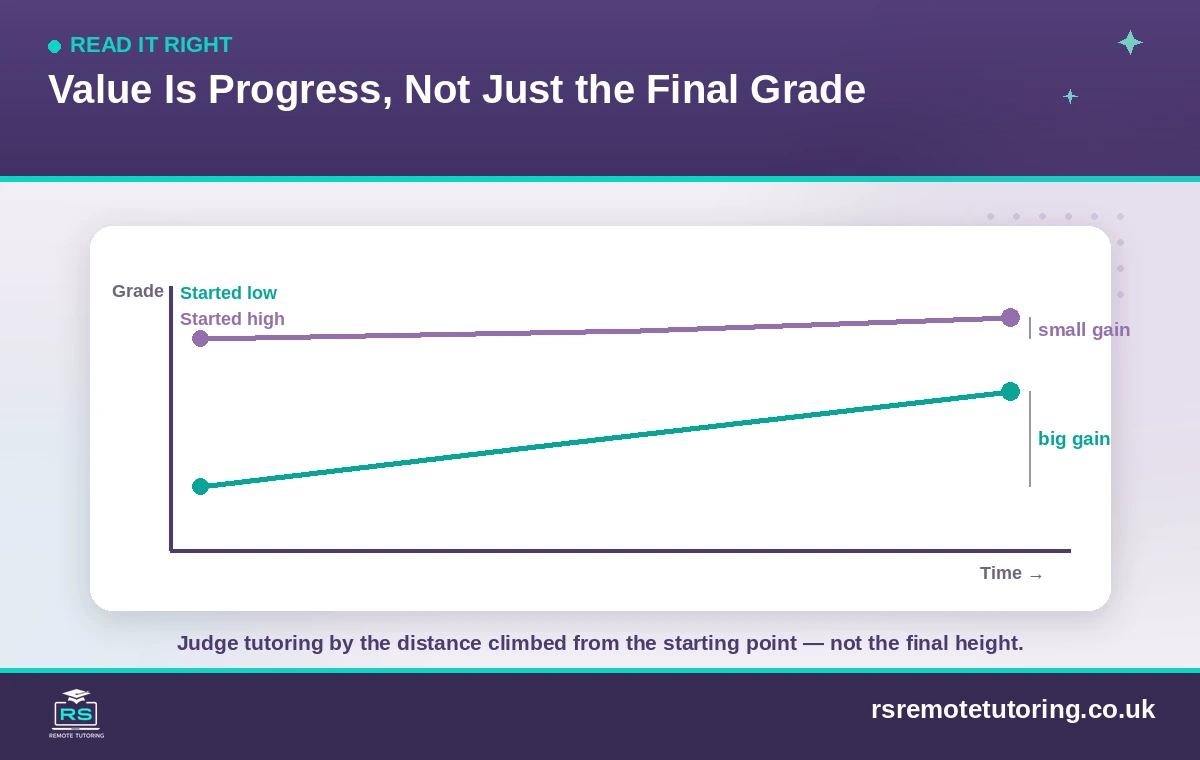
That matters because improvement isn’t always immediate or purely grade-based. A student who moves from a grade 3 to a grade 5 has gained more, in real terms, than a grade 8 student nudging to a 9, even though the second number looks more impressive. Real value lives in progress relative to the starting point, which is exactly why a broader set of signals is worth tracking.
| Dimension | What to track | A healthy sign |
| Academic progress | Mock scores, predicted grades, past papers | A steady upward trend from the baseline |
| Learning gains | Topic mastery, repeated mistakes | Fewer repeat errors, rising accuracy |
| Engagement | Attendance, homework, participation | Consistent, active involvement |
| Confidence | Exam anxiety, willingness to try | Calmer, more willing to attempt hard questions |
| Return on investment | Cost vs grade and skill gains | Meaningful improvement for the outlay |
How do you measure academic performance properly?
You measure academic performance by tracking the trend, not a single snapshot. Look at mock exam scores over time, changes in predicted grades, past-paper performance and subject-specific progress, then read all of it relative to where the student started rather than against a fixed target.
Improved grades are the most obvious marker that tutoring is working, and they matter. Parents and students usually watch for:
- Improvement in mock exam scores
- Changes in predicted GCSE grades
- Performance on past papers
- Progress within specific weak topics
Targeted tutoring tends to lift exam performance most when sessions are aligned to the exam board and a structured revision plan, the sort of plan we cover in how tutors build a GCSE study plan. But grades alone can mislead. Someone climbing from a low baseline to a solid middle grade may be getting far more value than a high achiever making tiny gains, so always read performance as progress from the starting point.
Why measure learning gains and not just results?
You measure learning gains because they reveal genuine understanding, which final scores can hide. Learning gains capture how much a student improves over time regardless of their starting level, through before-and-after assessments, topic mastery, fewer repeated mistakes and rising accuracy on practice questions.
Concretely, these are worth tracking:
- Pre-lesson and post-lesson checks on the same topic
- Topic mastery moving from shaky to secure
- A fall in repeated, same-type mistakes
- Increasing accuracy on practice questions
Tutoring is most effective when it closes knowledge gaps and reinforces understanding, rather than drilling a student to scrape a pass. That’s what makes learning stick for the long term, far more valuable than short-lived memorisation that evaporates a week after the mock.
Is engagement a sign that tutoring is working?
Yes, engagement is one of the clearest early signals, often visible long before grades move. A student who turns up regularly, completes the set work, participates actively and asks questions is far more likely to benefit. Rising engagement usually predicts rising results.
Watch for four things in particular:
- Regular attendance and punctuality
- Completion of assigned work between sessions
- Active participation during lessons
- Asking questions and seeking clarification
Engagement tends to climb in one-to-one online sessions because the attention is personal and the pressure of a full classroom is gone. Consistency compounds it: students who attend steadily and follow a structured plan improve significantly more than those with stop-start sessions. In short, the more engaged the student, the more value the tutoring is creating.
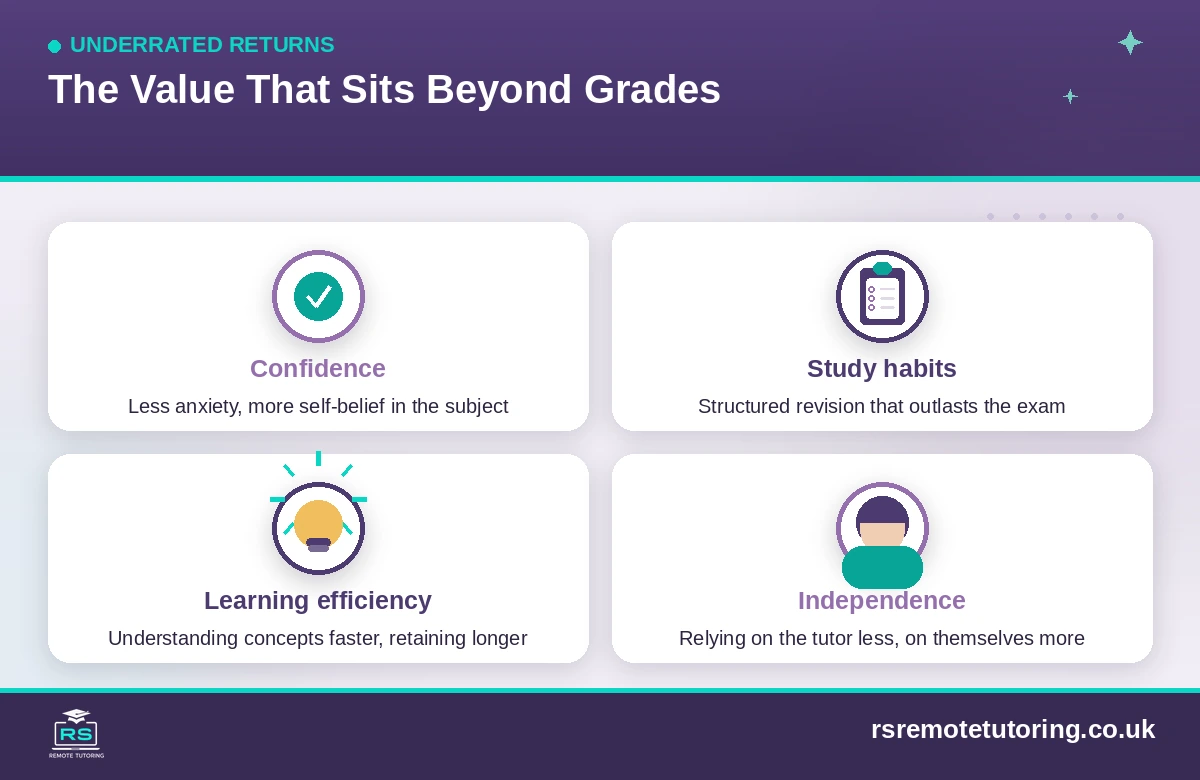
Does tutoring build confidence as well as grades?
Yes, and confidence is one of the most overlooked returns on tutoring. Many students underperform not from a lack of ability but from self-doubt. Effective tutoring rebuilds self-belief, reduces exam anxiety, and makes students more willing to attempt hard questions, which then lifts performance across the board.
The confidence signals to look for include self-belief when tackling difficult questions, less anxiety before exams, greater willingness to participate, and a more positive attitude to the subject overall. Confidence works as a multiplier: a student who stops fearing maths often carries that steadier mindset into science, and into the exam hall itself. We’ve written more about the family side of this in supporting your child through GCSEs.
How can you tell if tutoring is building independence?
You can tell tutoring is building independence when your child starts relying on the tutor less. The best tutoring teaches students how to learn, time management, structured revision, active recall and spaced repetition so they can eventually study effectively on their own. Growing independence is a sign of success, not redundancy.
Strong tutoring develops self-regulated learning skills that matter well beyond GCSEs:
- Time-management and planning skills
- Structured revision techniques
- Use of active recall and spaced repetition
- The ability to study productively without supervision
The paradox of good tutoring is that it works towards its own redundancy. When a student begins driving their own revision, the investment has done something a grade can’t show, it’s created a capable independent learner. Those exam-technique habits are covered in how tutors teach exam techniques.
Does the tutoring align with the GCSE exam?
Alignment is itself a measure of value. Effective tutoring focuses on the specific exam board, AQA, Edexcel or OCR, all regulated by Ofqual teaches exam technique and mark schemes, improves timing, and drills targeted past papers. Two students with similar understanding can score very differently if only one knows how marks are actually awarded.
If the sessions ignore the board, skip mark schemes, or never touch a past paper, that’s a red flag regardless of how pleasant they are. Ask whether your tutor can name your child’s exam board and describe how the papers are structured, a good one will, immediately. You can see how this works in practice on our online tutoring for GCSE page.
How do you weigh cost against outcomes?
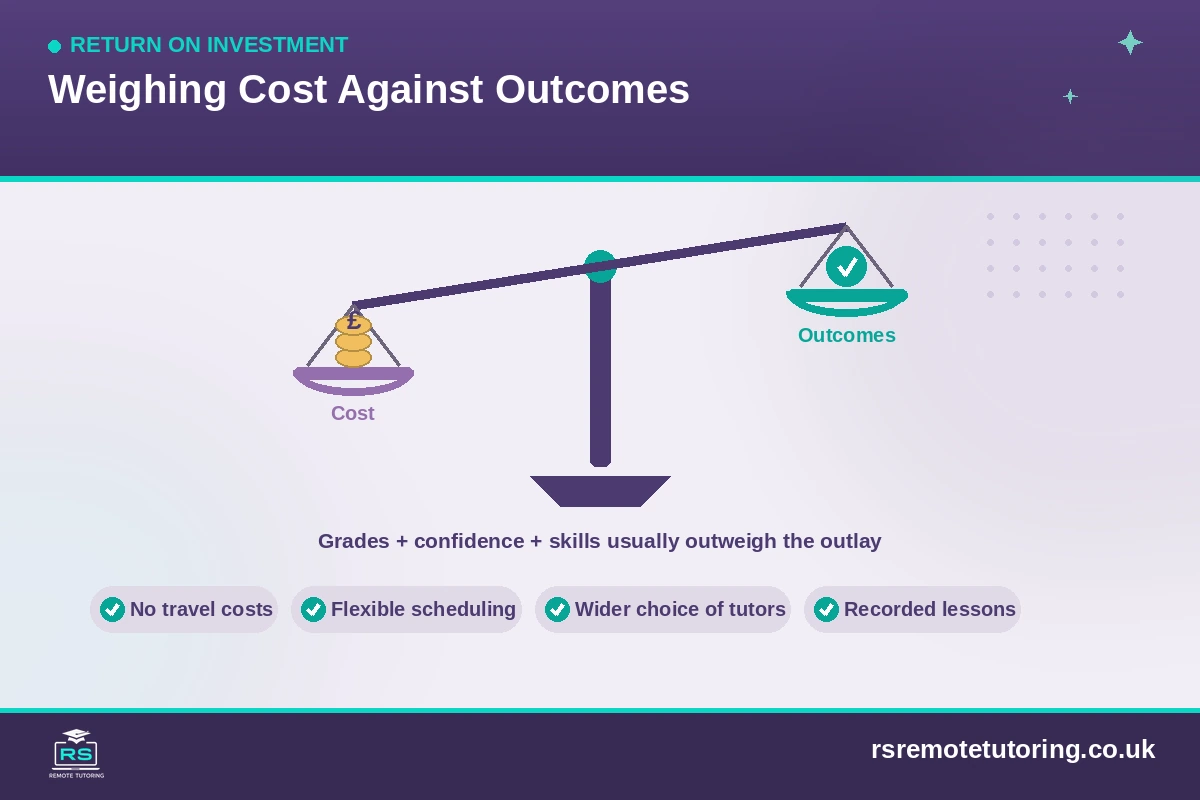
You weigh cost against outcomes by comparing total investment with total improvement, both tangible and intangible. Consider cost per session, spend over time, grade and performance gains, and study time saved. A modest financial outlay that produces meaningful academic improvement represents high value, even before you count confidence and skills.
Online tutoring often improves that ratio compared with in-person tutoring, because there are:
- No travel costs or travel time
- Flexible scheduling around school and commitments
- Access to specialist tutors regardless of location
- Recorded lessons a student can revisit
When you tally the return, weigh the tangible outcomes (grades) alongside the intangible ones (confidence, independent study skills, motivation). You can see current session costs on our pricing page and judge the ratio for yourself.
A practical framework to measure tutoring value
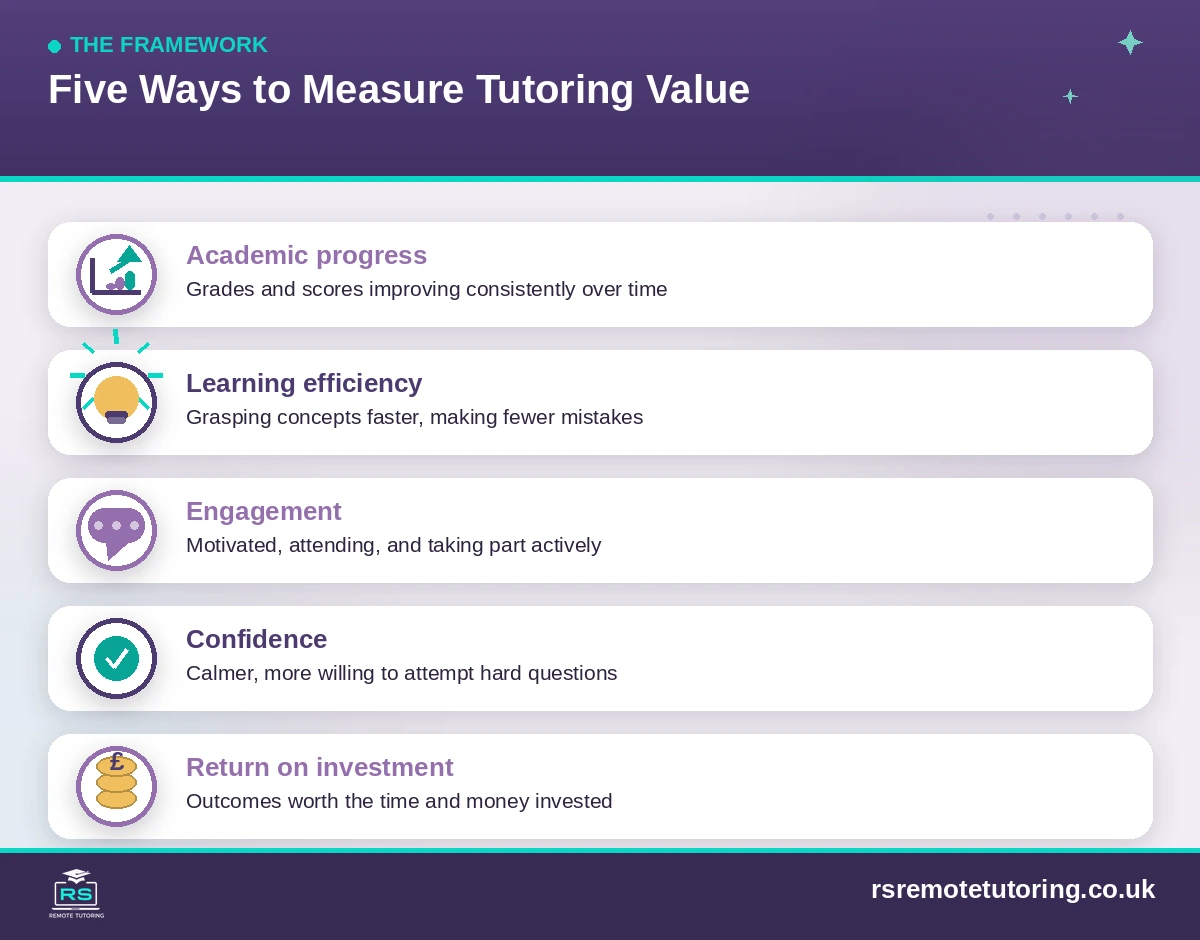
To keep evaluation simple, run the sessions past these five questions every few weeks:
- Academic progress are grades and test scores improving consistently?
- Learning efficiency is the student grasping concepts faster and making fewer mistakes?
- Engagement is the student motivated and actively taking part?
- Confidence are they calmer and more self-assured about exams?
- Return on investment are the outcomes worth the time and money?
If most answers are trending in the right direction, the tutoring is working, even if the headline grade hasn’t caught up yet.
What mistakes do parents make when judging tutoring?
The most common mistakes are all about impatience and narrow focus. Parents often judge tutoring on final grades alone, expect results within a session or two, overlook tutor quality, or never set clear goals in the first place. Meaningful improvement usually takes several weeks of consistent effort.
Here are the errors worth avoiding:
- Focusing only on final grades rather than progress from the baseline
- Expecting a transformation within a handful of sessions
- Ignoring tutor quality and subject/board expertise
- Not agreeing clear academic goals at the start
Set goals early, give it a term, and measure against the framework above rather than a single number. That’s how you see the real trajectory.
Frequently Asked Questions
How can I measure the success of online GCSE tutoring?
Track progress across five areas over time: academic performance, learning efficiency, engagement, confidence and return on investment. Read each relative to your child’s starting point rather than a fixed grade, and look for a consistent upward trend across several weeks.
Is online GCSE tutoring effective?
Yes. Evidence such as the EEF Toolkit shows well-targeted one-to-one tuition can add several months of progress, and it typically improves confidence and study habits alongside grades. Effectiveness depends on structure, consistency and alignment to the exam board.
How long before I see results from tutoring?
Usually several weeks, not a couple of sessions. Engagement and confidence often shift first, followed by learning gains, with grades catching up last. Judging tutoring after one or two lessons almost always understates its value.
Does tutoring help beyond exams?
Yes. Beyond grades, good tutoring builds time management, structured revision and independent study skills that carry into A-levels, university and work. Many parents rate these long-term gains as the most valuable part of the investment.
Is online tutoring better value than in-person?
Often, yes. Removing travel, adding scheduling flexibility, and widening access to specialist tutors tends to improve the value ratio. What matters most is tutor quality and consistency, the format is a convenience advantage, not a guarantee on its own.
How do I know if my child’s tutor is good?
A strong tutor knows the exam board, works from mark schemes and past papers, sets and reviews work, and can show progress over time. If sessions feel unstructured or goals were never agreed, that’s worth raising early. Our tutors page explains how we match and vet them.
Final thoughts
Measuring the value of online GCSE tutoring takes a wider lens than the next grade. Academic improvement matters, but the fuller picture includes confidence, better study habits, faster learning and long-term academic growth, the things that keep paying off after the exams are over.
When tutoring is structured, personalised and consistent, the results can be genuinely transformational. Use the framework here to judge it honestly, and you’ll know whether your investment is doing its job. If you’d like to see it in action, book a free trial or get in touch.

Raja specializes in Physics and Maths, with over 5 years of experience. He offers KS2, KS3, and GCSE Science and Maths lessons. He graduated from one of the top universities in the UK.