

GCSE Maths
Problem solving, showing working, multi-step questions, timing and past-paper practice, at whichever tier the school has entered them for.
Explore GCSE Maths tutoring →Live one-to-one GCSE tuition across the UK
Your child gets one tutor, working on the specification their school entered them for, on the topics that came back wrong in the last mock. Lessons are live, one-to-one, and cost £30 each.
We are not a tutor marketplace. You will not be handed a filtered list of strangers and left to pick. Tell us the year group, subject and what is going wrong, we will put forward a tutor who fits, and you try them for 30 minutes before paying anything.
No card details, no commitment to continue, and no grade promises we cannot keep.
The more you tell us, the more useful the trial is. Exam board and tier matter more than most parents expect.
Takes about 30 seconds. No card details.
We will only use these details to answer your tutoring enquiry. Read our Privacy Policy.
What usually prompts the search
Almost always because something specific has happened. A mock came back lower than expected, homework has turned into a nightly argument, or a student who understands a topic in class cannot turn it into marks in an exam question.
Nobody goes looking for a tutor on a good week. Something has usually changed, and it is worth naming what.
A mock result exposes gaps that were easy to ignore in October. Homework starts taking three hours because the foundations under it were never solid. Or the content is there, genuinely there, and it still falls apart the moment it meets an exam question with a command word in it.
Working out which of those it is comes first. Then lesson time goes where the problem is, rather than restarting the syllabus from page one.

Plenty of GCSE difficulties start two years earlier. A tutor can go back to that point, explain it a different way, and check the student can actually use it before moving on.
Knowing the content is not the same as scoring on it. Command words, showing working, choosing evidence, structuring a longer answer, reading a mark scheme. Separate skills, and all teachable.
"Revise everything" is not a plan. A tutor ranks topics by what is most likely to cost marks, then uses practice questions to surface the errors that keep repeating.
Sometimes a school target. Sometimes the grade 4 a college place depends on. Sometimes rebuilding after a result that knocked their confidence flat. We turn the goal into priorities, not promises.
Year 10, Year 11 and resits
All three, but the focus should not be identical. Year 10 is about securing foundations while new content keeps arriving. Year 11 works from mock evidence and exam technique. A resit needs a different plan, not a louder repeat of the one that did not work.
| Stage | Where the tutoring goes | Worth enquiring when |
|---|---|---|
| Year 10 | Securing foundations, keeping pace with new content, building study habits, early assessments | small gaps are starting to affect new topics, or confidence is slipping |
| Year 11 | Mock evidence, weaker areas first, exam questions, timing under pressure | mocks or school feedback show a gap between current work and the next goal |
| Resit | What the previous result actually showed, what has to change, the specific resit route | the learner needs a different plan, not the same revision again |
Close to an exam window and short on time? GCSE revision tutoring is built for that. Planning a retake? GCSE resit tutoring. Still in Years 7 to 9 and not on GCSE content yet? KS3 tutoring is the better starting point. You can also compare all tutoring programmes side by side.
Subjects
Maths, English Language and Literature, Combined and separate Sciences, Computer Science and Religious Studies. Availability depends on the subject, tier and tutor timetable, so ask before assuming. Detailed topic coverage sits on each subject page.
Problem solving, showing working, multi-step questions, timing and past-paper practice, at whichever tier the school has entered them for.
Explore GCSE Maths tutoring →Reading analysis, writing, essay structure, set texts, quotations and timed responses. Both papers, or whichever one is causing the trouble.
Explore GCSE English tutoring →Combined Science or separate Biology, Chemistry and Physics. Hard concepts, required practicals, calculations and the wording examiners actually reward.
Explore GCSE Science tutoring →Exam board and tier
We ask before the first lesson. Specifications are not interchangeable, and a student sitting Edexcel Higher should not be practising OCR Foundation papers. Send the course details you have and we confirm tutor coverage before anything is booked.
This is the part most providers gloss over, and it is the part that decides whether the lessons are useful or merely pleasant.
Do not know the exam board? That is completely normal, and about half of parents do not. Ask the school, or send us whatever course information you have and we will tell you what else we need.
One thing to be clear about: schools and exam centres decide entry and tier. A tutor can prepare a student for the course they are entered for. Any tutor presenting a tier change as their decision to make is overreaching.
Why families choose us
Marketplaces give you a search filter and several hundred profiles. You compare strangers on price and star ratings, book one, and hope. We do the matching ourselves, on subject, level, exam board, availability and the actual problem, and if the fit is wrong you tell us and we look again.
Sherpa and Tutorful are genuinely good at what they do, and if you want to browse and choose yourself, use them. Some parents prefer that.
What they cannot do is know that your daughter is fine on algebra but falls apart on anything with a graph in it, and that she needs a tutor who will slow down rather than one with the best profile photo.
Choosing well from a list of four hundred requires you to already know what you are looking for. Most parents, reasonably, do not.
So we do that part. One name, with the reason we picked them.
Getting started
Four steps. Send the year group, subject, exam board and what is going wrong; we suggest a tutor; you take a free 30-minute trial; you decide whether to carry on. No payment until after the trial.
 Step 1
Tell us the year group, subject, main difficulty, course details and when the student is actually free. If you have a recent mock paper or school feedback, say so in the notes.
 Step 2
The trial works out what the student finds hard, what they are aiming at, and whether the tutor's way of explaining things lands. A specific question makes it far more useful than a general chat.
 Step 3
If you continue, the tutor starts with whatever is most likely to remove an immediate barrier. Priorities shift as new school content, mocks and exams arrive.
 Step 4
Lessons pair explanation with the student actually doing the work and getting feedback on it. Progress gets reviewed through what they can now do, not through claims.
Inside the lesson
A lesson runs live on video with a digital whiteboard and shared documents. The student works through problems while the tutor watches, gets corrected in the moment, and finishes with one specific next step rather than an instruction to revise.
An hour of watching someone else explain things is not tutoring. The student has to be doing the work while somebody qualified watches them do it. That is the only part of this that cannot be replaced by a revision video, and it is the part you are paying for.

Lessons can also go on homework, mock preparation, timed questions, past-paper review, essay planning, calculations, required practicals or a revision plan. The balance follows the subject and whatever is most urgent.
The starting plan
From evidence, not a generic sequence. Recent marked work and a short live task show where the first real gap is. The starting plan answers four questions and gets revised as mocks and school content move.
| Planning question | Evidence used | What the tutor does next |
|---|---|---|
| What is difficult now? | Student explanation, marked work, school feedback, mock questions | Finds the first misconception or missing skill to fix |
| What matters next? | Specification, tier, current school topic, mock or exam date | Prioritises what is relevant now instead of teaching a generic order |
| Can they do it alone? | A fresh question, completed without a model to copy | Adjusts the explanation, the scaffolding or the difficulty |
| Is it helping? | Error patterns, topic accuracy, independence, timing, school assessments | Continues, revisits, or changes the plan |
You do not need perfect records. One specific example beats "they need help with everything" every time.
Measuring progress
Through observable changes, not a promised grade. Fewer repeated errors, better accuracy on fresh questions, less prompting needed, clearer working, better timing, and a positive trend across comparable school assessments.
No responsible tutor can guarantee a GCSE result. It depends on the starting point, attendance, time available, independent practice, what school is doing, and what happens on the day. Anyone promising you a grade is either guessing or selling.
One more, and it matters more than it looks: the student being able to say what they understand and what they still cannot do. A student who can name their own gap is most of the way to closing it.
The Education Endowment Foundation's review of one-to-one tuition finds it is more likely to help when it is linked to normal lessons, based on identified learning gaps, and monitored so support can be adjusted. That is evidence about a method, not a promise about any individual student.
Education Endowment Foundation, One to one tuitionTutor matching
Subject knowledge is the easy part. The tutor also has to explain clearly, notice the moment a student is lost, and change approach when the first explanation does not land.
Not every brilliant mathematician can do that, and the free trial exists so you can judge it rather than take our word for it.

Physics & Science
PhD in Physics. GCSE waves, forces and electricity, explained through real-world examples rather than formula sheets.
View full profile →
Computer Science
Programming, algorithms and computing fundamentals. Structured, exam-focused teaching for students who need the theory to click as well as the code.
View full profile →
Religious Studies
Islamic Studies, philosophy and ethical debate, with the exam-answer structure GCSE RS actually rewards.
View full profile →Parent feedback
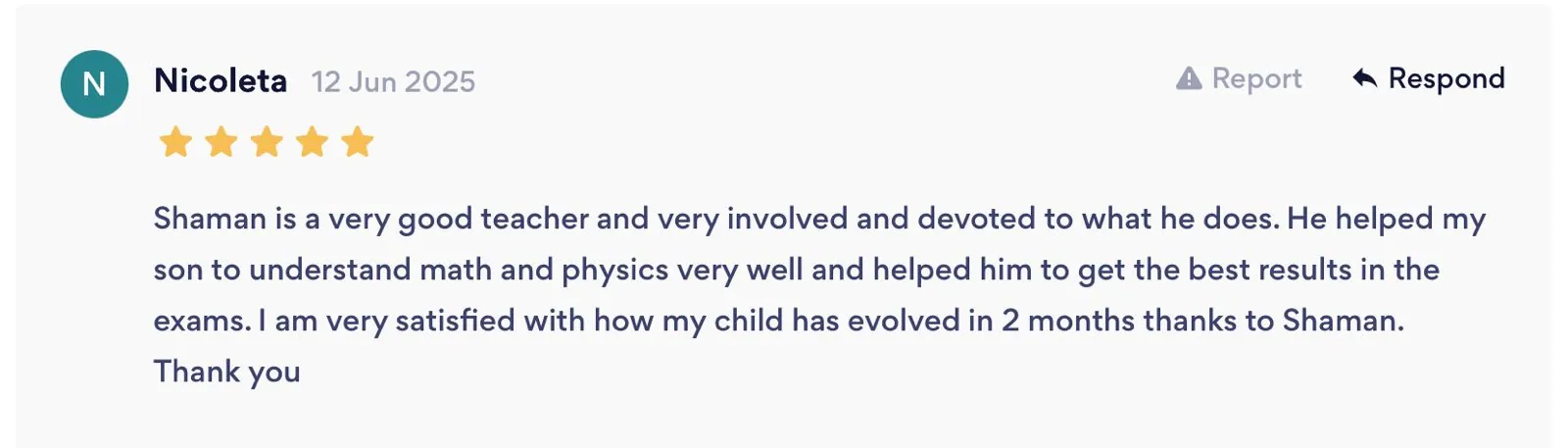
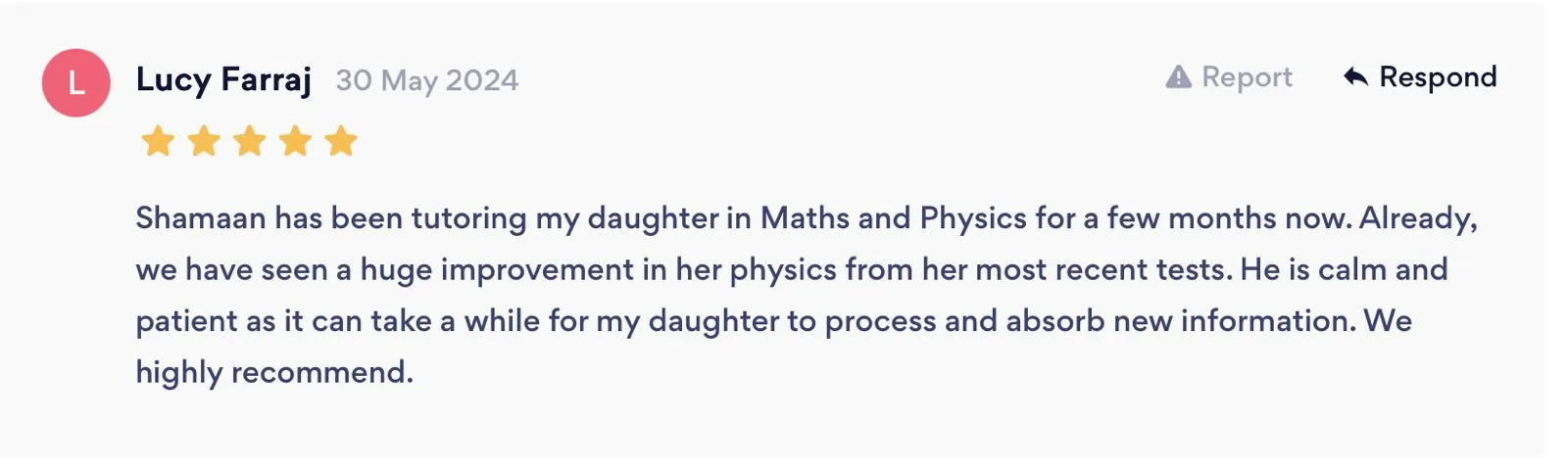
Every quote below links back to the review it came from, on Google, Bark or Trustindex.
"My daughter just got 7 7 in her combined science GCSE… They explain in a way she could understand."
"My daughter has improved her Math grade significantly after starting to have online lessons."
"Already, we have seen a huge improvement in her recent tests. The patience made all the difference."
Price
£30
per 60-minute lesson"The first 30-minute trial is free, with no card details taken and no obligation to continue. No sign-up fee, no joining fee, no package you have to buy upfront.
The lesson length, tutor and subject availability, your regular day and time, the payment schedule, cancellation and rescheduling terms, whether homework and parent updates are included, and how a tutor change is handled if the fit turns out wrong.
Honest fit
No, and it is better to say so now. It suits students willing to talk, answer questions and work live on screen. It works less well for a student who disengages on video, or without a stable connection, a decent device and somewhere quiet to sit.
We will tell you honestly whether the available tutor and the online format suit. If they do not, we would rather say so than take the booking.
Common questions
Anything not covered here, message us and we will answer. We usually reply within minutes.
Live subject support delivered over video. In a one-to-one lesson the tutor responds to the student's questions, pace and working in real time, rather than handing over recorded videos or worksheets.
£30 per lesson, one-to-one. The first 30-minute trial is free with no card details taken. Confirm lesson length, payment terms and cancellation policy before the first paid lesson.
Mainly Years 10 and 11, plus resit learners. If a Year 9 student has not started GCSE content yet, KS3 tutoring is usually the better fit.
Maths, English, Science, Biology, Chemistry, Physics, Computer Science and Religious Studies. Availability depends on subject, level, schedule and a suitable tutor, so ask us to confirm before booking.
Tell us the awarding organisation and specification when you enquire and we will confirm whether a suitable tutor is available before you book anything paid. Unsure? Ask the school or send what course information you have.
Yes, where the subject is tiered. Share the current tier when you enquire and the tutor shapes practice around it. The school or exam centre makes the formal entry decision, not the tutor.
Yes, where it matches the need. Tutors use exam-style questions, official past papers and mark schemes to find recurring errors, practise timing and improve how knowledge gets applied under pressure.
Possibly. Different subjects may need different tutors. Tell us every subject and your preferred times so we can check whether a workable schedule and suitable matches exist.
Yes, through a dedicated service. The starting point should be the previous result, the subject and board, the next intended sitting, and what has to change in the preparation. See GCSE resit tutoring.
No, and be wary of anyone who says otherwise. A tutor can explain difficult content, provide practice and feedback, find gaps and prepare a student for the exam. The result also depends on their starting point, attendance, independent work and school support.
It depends on the subject, tutor availability and the times you can keep to consistently. Send the course details and preferred schedule and we will confirm the next genuine option rather than quote a response time we cannot hold to.
Start with a free trial
Send the year group, subject, exam board if you know it, what is going wrong, and when the student is free. We will arrange a trial worth having and confirm whether a suitable tutor is available.
No grade guarantees. No invented tutor profiles. One honest conversation about what your child needs and whether we are the right people for it.