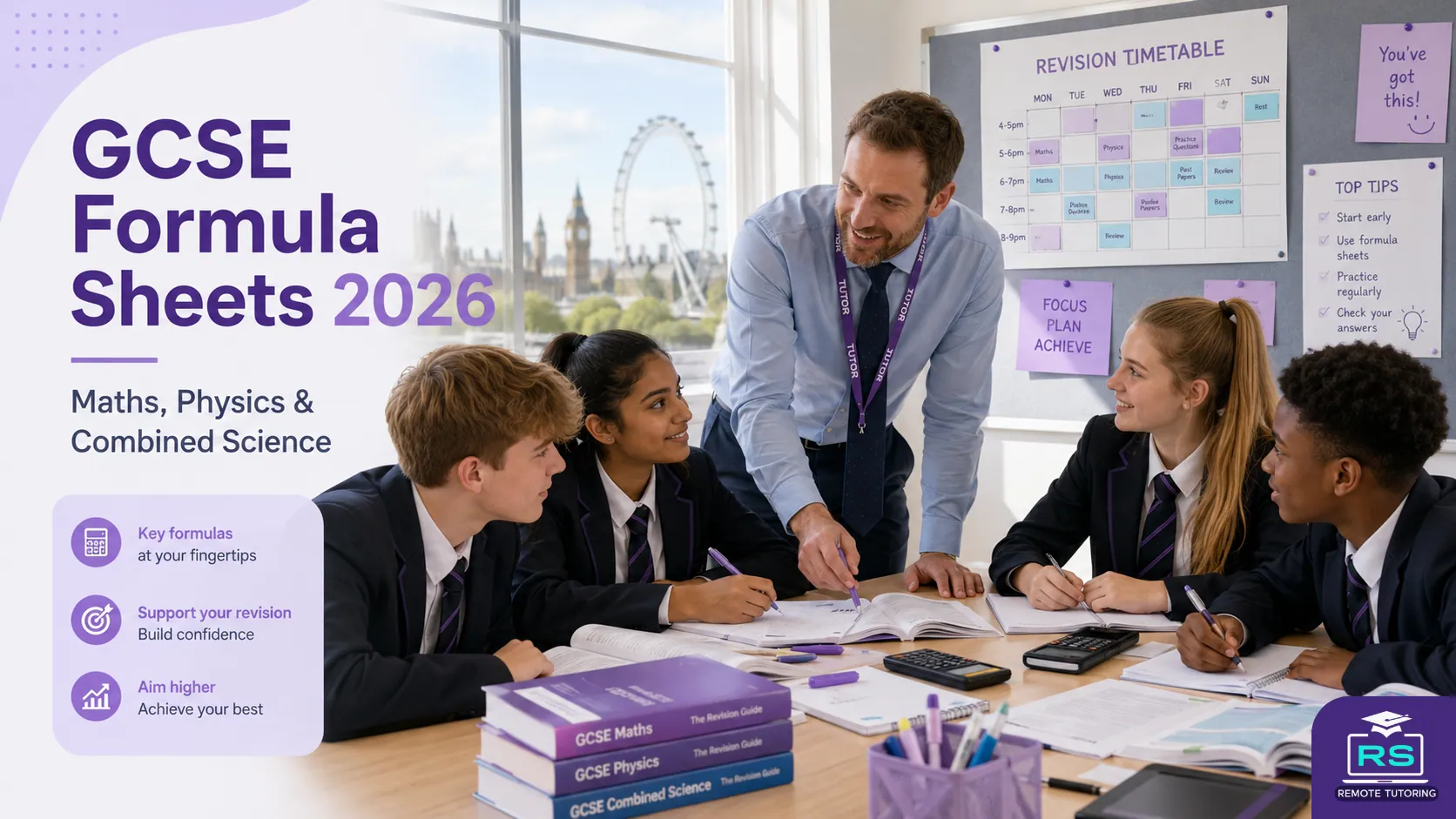
I still remember the spring of 2026 when I sat with a group of Year 11s in London preparing for their GCSEs. The air conditioners were humming against the early summer heat, revision timetables were pinned up and textbooks lay open. One thing my students kept asking was whether they still needed to memorise formulas for maths and science. “Sir, will there be a formula sheet?” They had heard rumours that the sheets were being scrapped after 2024. As a tutor and former examiner, I needed clarity.
What we discovered was reassuring: the Department for Education and Ofqual decided to continue providing formulae and equation sheets for GCSE mathematics, physics and combined science exams beyond 2024. A formal consultation concluded that exam boards must publish the sheets by 1 September each year and insert clean copies into exam papers. In other words, students sitting exams from 2026 through at least 2028 and very likely up to 2030 can rely on a formula sheet.
This guide, written from my experience as a tutor and from conversations with teachers, examiners and students, explains what these formula sheets contain, how to use them effectively and what you still need to memorise. Whether you’re a student in England, Wales, Northern Ireland or an international GCSE candidate in other countries, I’ll break down the latest policies and share practical tips to make the most of this support.
Jump to Section
What Are GCSE Formula Sheets and Why Do They Exist?
A formula sheet is an exam aid provided inside the question paper. Instead of expecting candidates to recall every mathematical or scientific equation, the sheet lists key formulas so students can focus on applying them. Formula sheets have been used in A‑level physics and maths for years, but they were introduced temporarily to GCSE exams in 2022 to mitigate COVID‑19 disruption. Teachers and students found them useful, and in 2025 the Department for Education confirmed that the sheets would remain for the 2025–27 exams.
Following a consultation in 2026, Ofqual decided that exam boards must continue to provide formulae and equation sheets for the lifetime of the current specifications. This means that exams from 2028 onwards will still include the sheets until new qualifications are developed. Exam boards are required to:
- Publish the formula sheets by 1 September of the academic year before each exam series.
- Insert clean copies of the sheets into exam papers.
- Avoid setting questions that can be answered by simply copying the formula.
As a result, you can expect formula sheets for GCSE mathematics and equation sheets for physics and combined science to remain through at least the 2030 exam series.
Subjects Covered: Maths, Physics and Combined Science
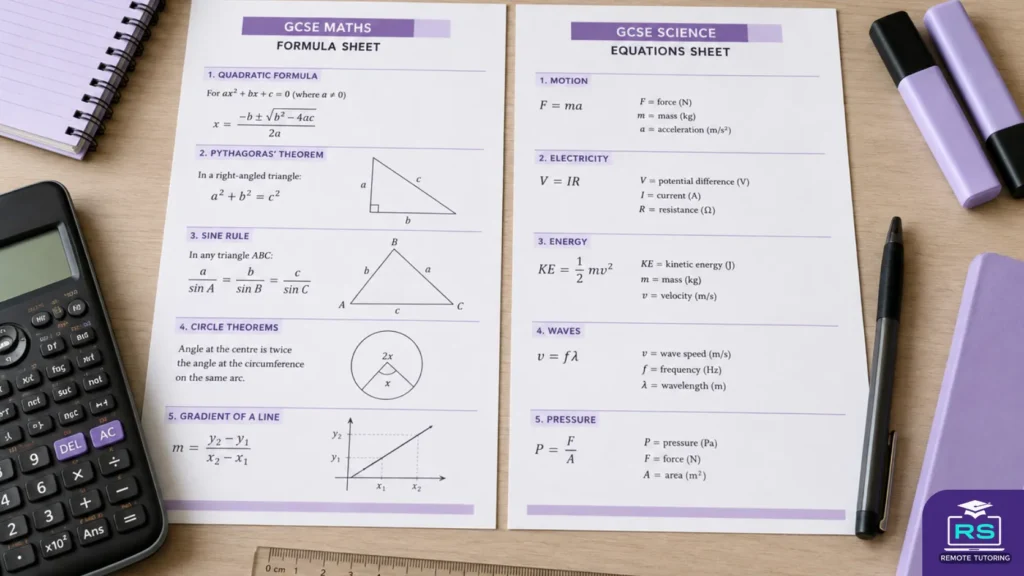
Formula sheets are currently provided for three subjects:
- Mathematics (Foundation and Higher tiers). The sheet lists formulas for geometry, algebra and probability. Official exam aids, such as the Edexcel maths formula sheet, include formulas for the area of a trapezium, volume of a prism, circumference and area of a circle, the quadratic formula, Pythagoras’ theorem, trigonometric ratios, sine and cosine rules, the area of a triangle, compound interest and probability rules.
- Physics and Combined Science. These exams include an equations sheet rather than a formula sheet. It lists key equations such as Newton’s second law (F = ma), kinetic energy (KE = ½mv²), wave speed (v = fλ) and Ohm’s law (V = IR). The sheets also cover equations for momentum, work done, power, density, pressure, efficiency and other topics, depending on the specification.
- Chemistry (as part of combined science). Students receive formulae for mole calculations (n = m/Mr), concentration (c = n/V) and the ideal gas law (PV = nRT). These equations help you calculate moles, reactant volumes and gas behaviour.
Currently there are no formula sheets for GCSE Biology or humanities subjects. In those exams you must recall definitions, processes and data handling skills without such aids.
Foundation vs Higher Tier
In mathematics, there are separate sheets for the Foundation and Higher tiers. The Higher tier sheet includes additional formulas such as the sine rule, cosine rule and area of a triangle (½ab sin C), which only appear on the more advanced papers. Physics and combined science equations sheets are the same across tiers but may include additional equations for triple science candidates.
Download the Free GCSE Formula Sheets PDF Guide
We have prepared a clear GCSE formula sheets PDF to help students revise the key maths, physics and combined science equations used in GCSE exams. It is designed for quick revision, past paper practice and last-minute exam preparation.
- ✓ Maths formulae for Foundation and Higher students
- ✓ Physics and combined science equations
- ✓ Clean layout for printing and revision
- ✓ Helpful for Year 10, Year 11 and GCSE resit students
Policy Updates Through 2030: What Has Changed?
Policies around formula sheets have evolved rapidly. Here’s a timeline to keep you informed:
| Year | Policy & key information | Source |
| 2022–23 | Formula sheets introduced as a temporary support due to COVID‑19 disruption. | Schools Week & DfE |
| 2024 | Some resources predicted sheets would end after 2024, but DfE later reversed this decision. | Tutorioo blog |
| 2025–27 | AQA, OCR and Edexcel confirm the sheets will continue. Each exam board publishes identical formula sheets for maths and inserts them with exam papers. | OCR & AQA updates |
| 2026 | Ofqual’s consultation outcome: formula sheets will remain for the lifetime of current specifications, meaning exams from 2028 onwards will still include them. Boards must publish the sheets by 1 September and cannot set questions answered solely by transferring information. | Ofqual decision document |
| 2028–2030 | The new GCSE qualifications will likely be introduced in 2029 or 2030, and the subject content (including memorisation requirements) is under review. Formula sheets will remain until these new qualifications take effect. | Ofqual & DfE |
Key takeaway: If you’re sitting GCSEs from 2026–2030, you will have access to a formula or equations sheet for maths, physics and combined science. After 2030, new GCSEs may be introduced, but any changes will be announced well in advance.
What’s on the Maths Formula Sheet?
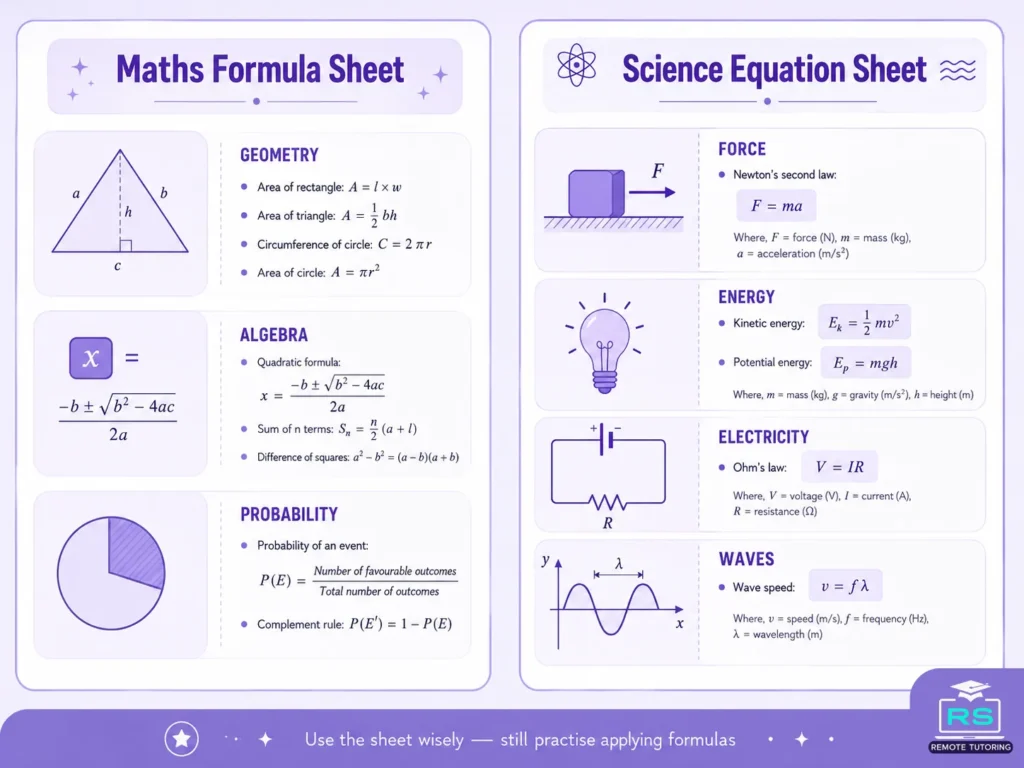
The maths formula sheet includes a range of geometry, algebra and probability formulas. Below is a summary of the formulas currently provided on the Edexcel/AQA/OCR sheet for the Higher tier. Foundation candidates use a subset of these:
- Geometric formulas
- Area of a trapezium: 12(a+b)h\frac{1}{2}(a + b)h21(a+b)h.
- Volume of a prism: area of cross-section×length\text{area of cross-section} \times \text{length}area of cross-section×length.
- Circumference of a circle: C=2πr=πdC = 2\pi r = \pi dC=2πr=πd; Area of a circle: A=πr2A = \pi r^2A=πr2.
- Trigonometric ratios (right‑angled triangles): sinθ=oppositehypotenuse\sin\theta = \frac{\text{opposite}}{\text{hypotenuse}}sinθ=hypotenuseopposite, cosθ=adjacenthypotenuse\cos\theta = \frac{\text{adjacent}}{\text{hypotenuse}}cosθ=hypotenuseadjacent, tanθ=oppositeadjacent\tan\theta = \frac{\text{opposite}}{\text{adjacent}}tanθ=adjacentopposite.
- Pythagoras’ theorem: a2+b2=c2a^2 + b^2 = c^2a2+b2=c2.
- Sine rule: asinA=bsinB=csinC\frac{a}{\sin A} = \frac{b}{\sin B} = \frac{c}{\sin C}sinAa=sinBb=sinCc; Cosine rule: c2=a2+b2−2abcosCc^2 = a^2 + b^2 – 2ab\cos Cc2=a2+b2−2abcosC.
- Area of a triangle: 12absinC\frac{1}{2}ab\sin C21absinC.
- Surface area of a sphere: 4πr24\pi r^24πr2; Volume of a sphere: 43πr3\frac{4}{3}\pi r^334πr3. These appear in the formula sheet for physics and combined science, not maths.
- Algebraic formulas
- Quadratic formula: x=−b±b2−4ac2ax = \frac{-b \pm \sqrt{b^2 – 4ac}}{2a}x=2a−b±b2−4ac.
- Compound interest formula: A=P(1+r100)nA = P\left(1 + \frac{r}{100}\right)^nA=P(1+100r)n, where PPP is principal, rrr is rate and nnn is number of compounding periods.
- Probability formulas:
- OR rule: P(A or B)=P(A)+P(B)−P(A and B)P(A \text{ or } B) = P(A) + P(B) – P(A \text{ and } B)P(A or B)=P(A)+P(B)−P(A and B).
- AND rule (Higher only): P(A and B)=P(A∣B)×P(B)P(A \text{ and } B) = P(A \mid B) \times P(B)P(A and B)=P(A∣B)×P(B).
Most of these formulas will also be included on foundation tier papers, except for the sine and cosine rules and the quadratic formula, which are reserved for the higher tier.
Which Formulas Are Not on the Sheet?
A common misconception is that the formula sheet lists every formula you might need. In reality, it covers only a core selection. Here are examples of formulas that do not appear and therefore must be memorised or derived:
- Area of a parallelogram, rectangle and triangle (other than the trapezium).
- Equation of a straight line y=mx+cy = mx + cy=mx+c and equation of a circle x2+y2=r2x^2 + y^2 = r^2×2+y2=r2.
- Compound measure formulas such as speed (distance=speed×time\text{distance} = \text{speed} \times \text{time}distance=speed×time), density (mass=density×volume\text{mass} = \text{density} \times \text{volume}mass=density×volume) and pressure.
- Mathematical identities like sin2θ+cos2θ=1\sin^2\theta + \cos^2\theta = 1sin2θ+cos2θ=1.
- Area and circumference formulas for sectors and arc lengths.
Tutor‑run blogs emphasise that over 20 formulas are still absent from the sheet. As a result, you should continue to practise deriving and remembering these formulas during your revision.
What’s on the Physics and Combined Science Equations Sheet?
The physics (and combined science) equations sheet contains the core equations you are expected to apply in calculations. According to Revision Genie’s summary, the 2026 sheets include:
- Newton’s second law: F=maF = maF=ma (force equals mass times acceleration).
- Kinetic energy: KE=12mv2KE = \frac{1}{2}mv^2KE=21mv2.
- Wave speed: v=fλv = f\lambdav=fλ (speed equals frequency times wavelength).
- Ohm’s law: V=IRV = IRV=IR (voltage equals current times resistance).
Combined science students also receive formulas for moles, concentration and the ideal gas law:
- Moles: n=m/Mrn = m/M_rn=m/Mr.
- Concentration: c=n/Vc = n/Vc=n/V.
- Ideal gas law: PV=nRTPV = nRTPV=nRT.
Physics and science papers provide additional equations such as momentum p=mvp = mvp=mv, work done W=F×dW = F \times dW=F×d, power P=W/tP = W/tP=W/t, potential difference V=W/QV = W/QV=W/Q, efficiency η=useful energy outtotal energy in\eta = \frac{\text{useful energy out}}{\text{total energy in}}η=total energy inuseful energy out and more. Always check your exam board’s published equations sheet, AQA, Edexcel and OCR make them available online each September.
How to Use the Formula Sheet Effectively
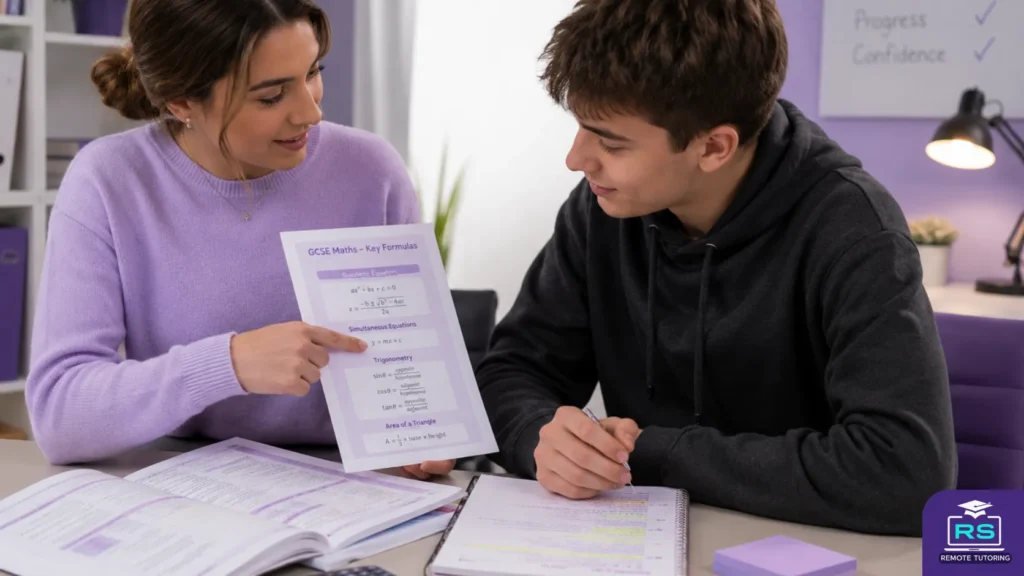
Having a formula sheet does not mean you should ignore revision. Instead, treat the sheet as a tool to support your understanding. Here are strategies I use with my students:
1. Print and Familiarise Early
Download the official sheet for your exam board as soon as it is released (usually by 1 September) and print it out. Keep a copy in your revision folder and another on your desk. Practise using it while answering past papers. Familiarity with the layout saves time in the exam, and you’ll avoid flipping back and forth looking for the right formula.
2. Understand, Don’t Memorise Blindly
The formula sheet takes away the pressure of memorising some equations, but you still need to understand what the letters mean and how to manipulate the formulas. For example, in the quadratic formula you must correctly substitute negative numbers and use brackets. Knowing the concept behind each formula helps you decide when to apply it and prevents you from misusing it.
3. Practise Rearranging and Substituting
When using formulas for area or probability, the exam question may require you to rearrange the formula to find a different variable. During revision, practise solving for each unknown. If you know C=2πrC = 2\pi rC=2πr and the question gives the circumference, you should be comfortable rearranging to find rrr. The same applies to equations like F=maF = maF=ma and P=IVP = IVP=IV.
4. Highlight Key Formulas
Mark the formulas you frequently use with a highlighter or sticky note. This technique, suggested by experienced tutors, allows you to find them quickly under exam pressure.
5. Write the Formula Before Calculations
When tackling a question, write down the relevant formula from the sheet before substituting numbers. This practice ensures you’re using the correct version and reminds you to include all terms (for example, the square root in the quadratic formula). Showing the formula and your working steps can earn method marks even if your final answer is incorrect.
6. Double‑Check Units
Physics and chemistry questions often require you to convert units. Always check whether mass is given in kilograms or grams, distances in metres or centimetres, and whether energy should be in joules or kilojoules. Revision Genie emphasises the importance of checking units to avoid careless errors.
7. Practise Without the Sheet
In the final weeks before the exam, try practising some questions without the formula sheet. This reinforces memory and highlights which formulas you still need to revise. It’s particularly useful for formulas not on the sheet (such as y=mx+cy = mx + cy=mx+c).
Common Mistakes and How to Avoid Them
Through years of tutoring, I’ve seen students make similar errors when using the formula sheets. Here are some pitfalls and how to avoid them:
Mixing up radius and diameter
Remember that r=d2r = \frac{d}{2}r=2d. Using the diameter instead of the radius (or vice versa) is one of the most common mistakes. Always identify whether the question gives the radius or diameter before substituting.
Mishandling negatives in the quadratic formula
When substituting values into the quadratic formula, put parentheses around negative numbers. This prevents calculator errors.
Using right‑angle formulas for non‑right‑angled triangles
Pythagoras’ theorem and SOHCAHTOA apply only to right‑angled triangles. For other triangles, use the sine or cosine rule (provided on the higher-tier sheet).
Forgetting to show working
Even though the formula is given, you should write down the formula, substitute values and show each step. You may receive method marks even if your arithmetic slips.
Not practising rearrangement
Many students rely on the formula sheet as a crutch and struggle when a question asks for an alternative variable. Practise rearranging formulas during revision to build confidence.
A Tutor’s Insights and Personal Experience
Working with GCSE students across the UK over the past decade has taught me that the formula sheet is a double‑edged sword. Here are some personal observations:
- We quickly realised that students who use the sheet as a learning aid perform better than those who treat it as a substitute for understanding. In my first group session in 2022, the top performers had highlighted the sheet, annotated each formula and practised rearranging them.
- One thing I did not expect was how much anxiety the sheet relieved. Students who worry about memorising formulas can focus on problem‑solving. This was particularly true during Ramadan when revision energy levels can dip; knowing they had the sheet helped them stay calm.
- Many parents I have spoken to say they’re unsure whether the sheet will disappear in future years. I reassure them that Ofqual has confirmed the sheets will remain until new GCSEs are introduced, likely around 2030. Staying informed about these policies helps parents support their children effectively.
- From experience, the biggest improvement comes from blending the formula sheet with active revision. One student of mine, Ahmad, kept a copy of the sheet on his bedroom wall. Each time he completed a past paper, he ticked the formulas he used and wrote a note about any mistakes. By exam day, the sheet looked like a colourful study map, and he achieved a grade 8.
- Students often do not realise that the formula sheet varies slightly between tiers and exam boards. I always encourage them to download the exact sheet for their board (AQA, Edexcel, OCR) as early as possible and to use it for every practice question.
FAQs
Do GCSE students get formula sheets?
Yes. Students taking GCSE mathematics, physics and combined science exams receive formulae and equations sheets inside the exam paper. Following Ofqual’s 2026 decision, exam boards are required to provide these sheets for the lifetime of the current specifications, including exams from 2028 onwards.
Are 2026 GCSEs getting equation sheets?
Absolutely. The Department for Education confirmed that the formula and equation sheets introduced during the pandemic will continue through 2026 and 2027. Ofqual’s decision means they’ll also remain for exams beyond 2028.
Will GCSE 2027 get formula sheets?
Yes. AQA, OCR and Edexcel have announced that the 2027 exams will use the same formula and equation sheets provided in 2025 and 2026. Students do not need to memorise the listed formulas but should practise using them.
What subjects have formula sheets?
Currently maths, physics and combined science have formula or equation sheets. Chemistry formulas are included in the combined science sheet. Biology and humanities subjects do not have formula sheets, so you must memorise key facts and processes.
Do I need to memorise formulas on the sheet?
No. The formulas on the sheet are provided so you can focus on applying them. However, you still need to understand how to use and rearrange them. Additionally, many formulas are not on the sheet (e.g., equation of a straight line, density, pressure), so you must learn those separately.
Where can I find the official formula sheet?
Exam boards publish the sheets by 1 September each year. You can download them from the AQA, Edexcel and OCR websites or from official links in revision guides. Avoid third‑party versions that may be outdated.
Will formula sheets be removed in the future?
Ofqual’s current rules state that formula sheets will remain for the lifetime of the current specifications. New GCSE specifications planned for around 2030 may change these arrangements, but no decisions have been made yet.
What if I sit iGCSE exams?
The Cambridge International (iGCSE) maths papers do not currently provide a formula sheet for all qualifications. Candidates are expected to memorise formulas unless otherwise stated. If you are taking a Cambridge qualification, check your syllabus carefully and practise accordingly.
Can I write on the formula sheet during the exam?
Yes. You can annotate and highlight the sheet during the exam. I recommend noting which formulas you’ve used in each question so you don’t miss any important information.

Raja specializes in Physics and Maths, with over 5 years of experience. He offers KS2, KS3, and GCSE Science and Maths lessons. He graduated from one of the top universities in the UK.