
Walk past any Year 11 bedroom in May and you’ll spot the same scene. A highlighter in one hand, a textbook open at the page it’s been open at for an hour, and almost nothing sticking. That’s the trap most revision falls into, and it’s why so many students work hard yet plateau. The GCSE revision hacks that move grades aren’t about more hours. They’re about what you do with the hours you’ve got.
Here’s the part schools rarely spell out. In a widely cited 2013 review in Psychological Science in the Public Interest, psychologist John Dunlosky and colleagues rated ten popular study methods. Only two earned top marks for real learning: practice testing and spaced practice. Re-reading and highlighting, the two things students do most, landed near the bottom.
So the students pulling grade 8s and 9s aren’t superhuman. They’ve swapped busywork for methods that make memory stick. Nine of those methods are below, along with how to start each one this week.
Why do some revision methods work better than others?
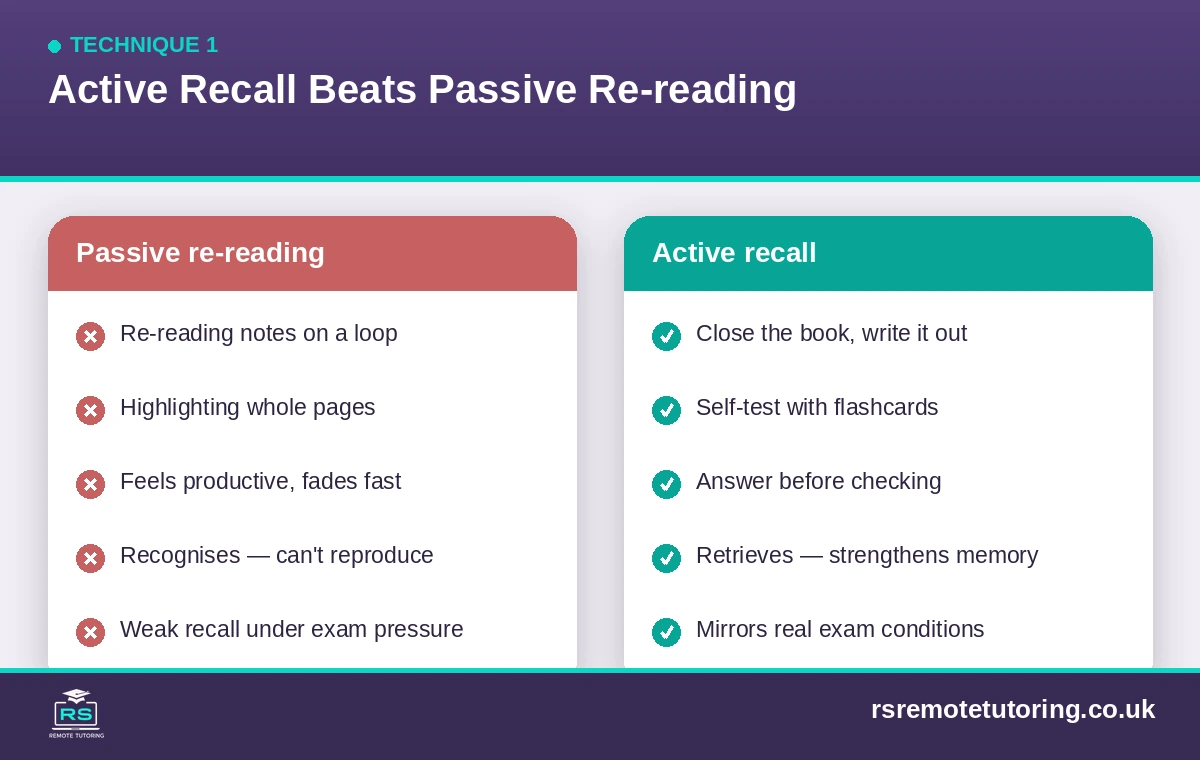
Some methods work because they force your brain to retrieve and rebuild information, which is what an exam demands. Passive methods like re-reading only ask your brain to recognise words on a page. Recognition feels easy, but it doesn’t survive exam pressure.
That single distinction, active versus passive, sits underneath every hack on this list. Keep it in mind and most revision advice suddenly makes sense.
How do you use active recall instead of passive reading?
Active recall means closing your book and pulling the answer out of your own head. You test first, then check. It’s harder than re-reading, and that difficulty is the point, because retrieval is what strengthens memory and prepares you for the real thing.
Passive reading is comfortable. You glide over familiar notes, nod along, and feel productive. The trouble comes in the exam hall, when the notes aren’t there and your brain has never practised working without them.
To switch to active recall, try three things:
- Close your notes and write down everything you remember about a topic. Then open them and mark the gaps in a different colour.
- Turn your notes into questions, not statements. “The heart has four chambers” becomes “How many chambers does the heart have, and what are they?”
- Use flashcards, but answer out loud before you flip the card.
If you want the science behind why this works, our guide to memory hacks for GCSE breaks down retrieval and the forgetting curve in plain English.
What is spaced repetition and how do you schedule it?
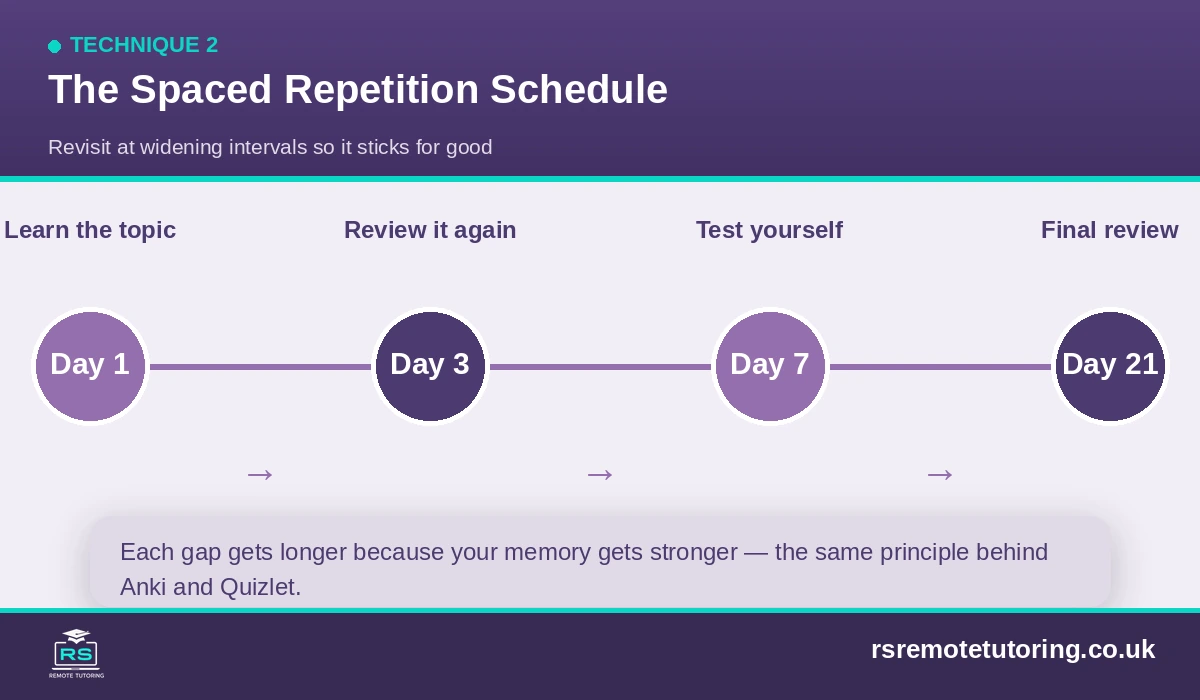
Spaced repetition means revisiting a topic several times with growing gaps between each review. Instead of one long cram, you meet the same material on day one, day three, day seven, and day twenty-one. Each return trip resets your memory just as it starts to fade.
Cramming can hold facts in place for a morning. It falls apart over weeks, which is exactly the timescale GCSEs run on. Spacing beats it because every gap you survive makes the memory a little more permanent.
A simple cycle looks like this:
- Day 1: Learn the topic and make a one-page summary.
- Day 3: Cover the page and rewrite it from memory.
- Day 7: Test yourself with questions or flashcards.
- Day 21: Do a final quick review, then rotate it into your past-paper practice.
Apps like Anki and Quizlet automate the timing, but a wall calendar works just as well. The system matters more than the tool.
Are past papers really the best way to revise?
Past papers are the single closest thing to the real exam, which is why they belong at the centre of revision, not the end. They train you on question wording, command words, timing, and the mark scheme. Used well, they turn knowledge into marks.
There’s a right order to them, though. Most students dive into a full timed paper too early, score badly, and feel deflated. Build up instead.
- Start open-book, one topic at a time, to link revision to real questions.
- Move to full papers under timed conditions once a topic feels solid.
- Mark your own work against the scheme, then note why you dropped each mark.
Free question banks like BBC Bitesize make a decent warm-up before you commit to full timed papers.
That last step is where the marks hide. If you want a full walkthrough, our post on how to use GCSE past papers shows how to squeeze real feedback out of every question, and the guide to answering GCSE exam questions decodes those command words examiners love.
Does teaching someone else actually help you revise?
Teaching a topic out loud forces you to organise it, simplify it, and spot the bits you only half understand. If you can explain photosynthesis to a bored sibling in plain words, you know it. If you stumble, you’ve just found your weak spot for free.
You don’t need a real audience. Explain to an empty chair, record a voice note, or write a paragraph as if a Year 7 will read it. The gaps show up fast, which is the whole point.
Which topics deserve the most revision time?
Not every topic pays the same. Some appear on almost every paper and carry heavy marks, while others show up rarely. Smart revision front-loads the high-frequency, high-mark topics and refuses to spread time evenly.
Work out where the marks live before you plan. Two moves help:
- Scan three or four past papers and tally which topics keep reappearing.
- Read the exam specification for your board and mark the fat, mark-heavy sections.
A quick word of caution, because it catches people out every year. Students tend to revise what they already enjoy, which usually means revising their strengths and quietly avoiding their weaknesses. Flip that.
How much does exam technique change your grade?
Exam technique can be the difference between a 5 and a 7 on the same knowledge. Examiners reward structure, the right command word response, and clear working. Knowing the content is only half the job; showing it the way the mark scheme wants is the other half.
Three habits carry most of the gain here. Learn what command words like “evaluate,” “analyse,” and “describe” are really asking for. Practise a repeatable answer shape such as PEEL for longer written responses. And rehearse timing so you never leave your best question unanswered because the clock ran out. Our roundup of common GCSE exam mistakes covers the small errors that quietly bleed marks.
Why should you mix subjects instead of blocking them?
Interleaving means switching between subjects or topics in a session instead of drilling one for hours. It feels less tidy, and it works better, because your brain has to keep reloading and applying different ideas, which is exactly what a mixed exam paper demands.
A blocked session might be three hours of Maths. An interleaved one might run 45 minutes of Maths, 45 of Biology, then 45 of English. The switching builds the flexible recall you need when a paper jumps between topics with no warning.
Do mind maps and diagrams make revision stick?
Dual coding, pairing words with visuals, gives your brain two routes back to the same fact. A labelled diagram, a flowchart, or a colour-coded mind map is easier to recall than a wall of text, because you can picture it under pressure.
It’s especially powerful for Science, History, and Geography, where processes and sequences matter. Sketch the nitrogen cycle rather than listing it. Draw the timeline rather than reading it. The image becomes a hook.
How do sleep and breaks affect your revision?
Your brain files new information while you rest, so sleep and breaks aren’t slacking, they’re part of the method. Marathon sessions past the point of focus mostly manufacture the feeling of work without the learning.
Protect your energy with a few basics:
- Work in focused blocks, roughly 25 minutes on and 5 off, then a longer break every couple of hours.
- Aim for seven to nine hours of sleep, especially the night before an exam.
- Eat and hydrate properly; a tired, hungry brain forgets faster.
Getting the balance right matters as much as the techniques themselves. If you’re not sure how many hours are realistic, our guide to how many hours you should study for GCSEs sets sensible targets by stage.
Which revision hacks should you start with?
If nine feels like a lot, start with two: active recall and spaced repetition. Dunlosky’s team rated exactly these as the highest-impact methods, and they cost nothing but a shift in habit. Layer the rest on once they’re routine.
Here’s the quick reference for all nine.
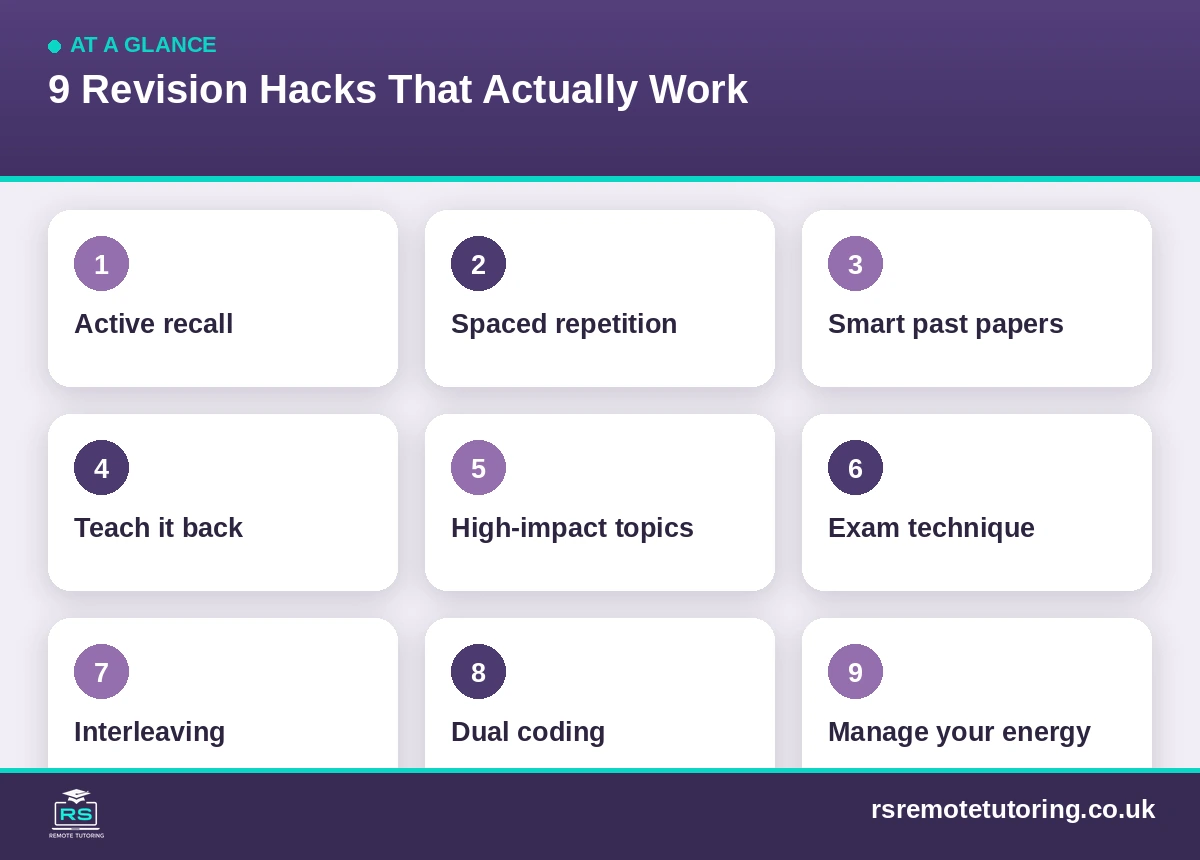
| Hack | What it does | How to start today |
| Active recall | Strengthens memory by retrieving | Close notes, write what you remember |
| Spaced repetition | Beats forgetting over weeks | Review on day 1, 3, 7, 21 |
| Smart past papers | Turns knowledge into marks | Open-book first, then timed |
| Teach it back | Exposes weak spots | Explain a topic out loud |
| High-impact topics | Spends time where marks are | Tally topics across past papers |
| Exam technique | Converts knowledge to grades | Learn command words, practise PEEL |
| Interleaving | Builds flexible recall | Rotate subjects in one session |
| Dual coding | Adds a visual memory hook | Turn notes into diagrams |
| Manage energy | Protects focus and recall | 25-minute blocks, real sleep |
What are the most common GCSE revision mistakes?
The most common mistakes are all passive: re-reading without testing, highlighting everything, cramming the night before, dodging weak subjects, and revising with no plan. Each feels productive and teaches little. Fixing them is often faster than adding new techniques.
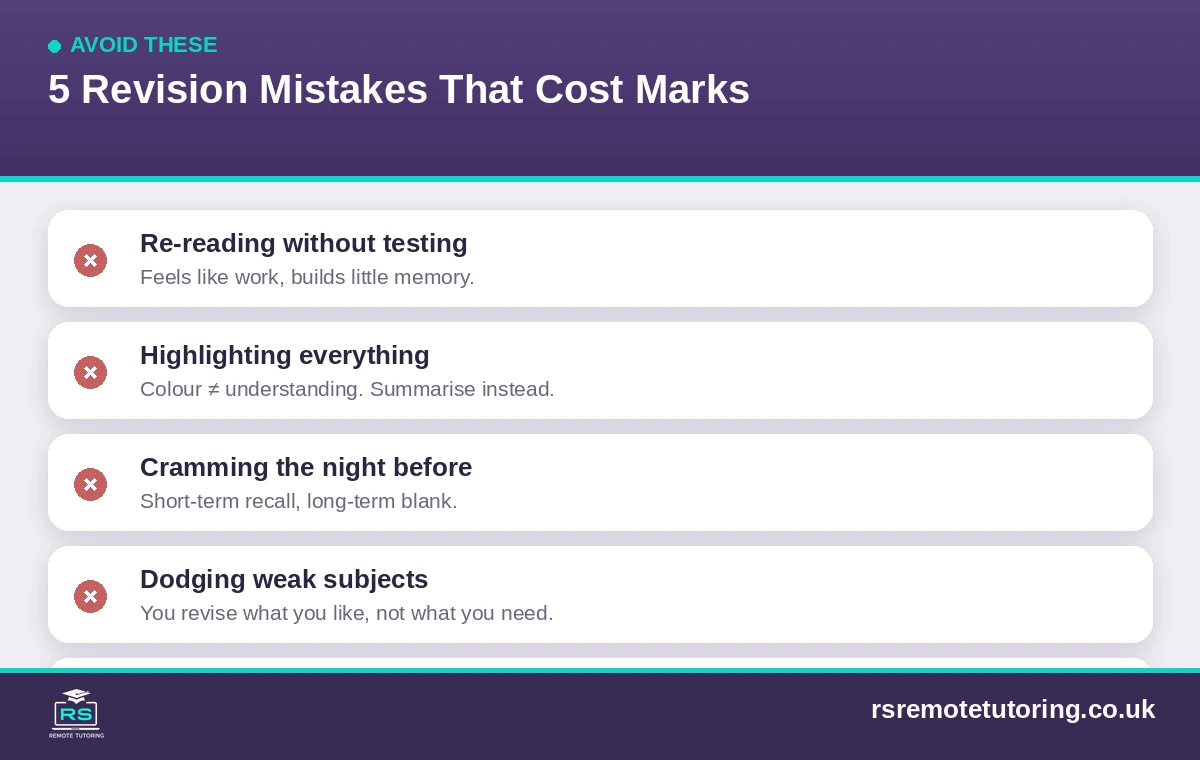
You’ll recognise a few of these, and that’s fine. Spotting the habit is most of the cure. Swap each passive move for its active twin and your existing hours start paying off.
Why do these strategies work when others don’t?
These methods aren’t trendy tips; they map onto how memory actually forms. Active recall and spaced repetition strengthen storage. Interleaving and teaching deepen understanding. Past papers and exam technique convert that understanding into marks on the day. Together they cover the whole journey from “I’ve seen this” to “I can prove it.”
Can a tutor make these hacks work faster?
A good tutor keeps you honest. Left alone, most students drift back to comfortable re-reading, because active methods feel harder in the moment. A tutor builds the plan, tests you properly, and marks your papers like an examiner would.
At RS Remote Tutoring, our online GCSE revision tutors build these exact strategies into a personalised plan, then hold students to it week by week. Whether it’s GCSE Maths, English, or a full timetable across subjects, sessions run one-to-one through flexible online tutoring. You can book a free trial and see the difference in a single session.
Frequently Asked Questions
How many hours a day should I revise for GCSEs?
Three to five focused hours with active techniques is plenty for most students. Quality beats quantity, so short, tested sessions outperform long, passive ones. Build up gradually rather than jumping straight to marathon days.
When should I start GCSE revision?
Start light habits in Year 10 and structured revision at least three to four months before your exams. Earlier is better, as long as it’s little and often rather than one late scramble.
Is it better to revise in the morning or at night?
Revise when you’re most alert, because consistency matters more than the clock. Test both for a week and keep whichever leaves you sharper. Just protect your sleep either way.
Are past papers enough on their own?
No. Past papers show you what the exam expects, but you still need active recall and content review to build the knowledge you’re testing. Use them together, not instead of each other.
How do I stay motivated during revision?
Set small, specific goals, track what you’ve covered, and keep a routine you can actually repeat. Progress you can see is the best motivator, and a fixed schedule removes the daily “should I revise today” argument.
Raja specializes in Physics and Maths, with over 5 years of experience. He offers KS2, KS3, and GCSE Science and Maths lessons. He graduated from one of the top universities in the UK.



1 Comment
[…] very possibly why the mocks went badly in the first place. A short detour through proven GCSE revision techniques like active recall and spaced repetition will repay itself within a […]