GCSE Chemistry can feel like one of the most confusing science subjects to revise. Unlike GCSE Biology, which often rewards strong memory, or GCSE Physics, which leans more towards logic and maths, Chemistry sits somewhere in the middle.
One minute, you may need to memorise the colours in flame tests. The next, you may be calculating the concentration of a solution.
As a tutor who has guided many students through GCSE revision, I have seen one thing again and again: most students do not struggle with Chemistry because it is impossible. They struggle because they revise it in the wrong way.
I still remember one student who spent weeks rereading notes and highlighting textbooks. She felt productive, but when we started past paper practice, her score barely improved.
That was when we rebuilt her entire approach.
This guide is based on what I have seen work with real students preparing for UK GCSE Chemistry exams. It will show you how to revise GCSE Chemistry properly, avoid common mistakes, and build confidence before your mocks or final exams.
Jump to Section
Why GCSE Chemistry Feels So Difficult
Before learning how to revise GCSE Chemistry, it is important to understand why students often find it challenging.
Many students:
- Memorise facts without understanding them
- Avoid calculations and equations
- Ignore required practicals
- Delay exam-style questions until too late
- Focus only on topics they already like
One thing many students fail to realise is that Chemistry is not just a reading subject. It is a doing subject.
You may think you understand a topic when reading your notes, but the real test comes when you have to apply that knowledge in an exam question.
That is where proper revision makes the biggest difference.
Step-by-Step Guide: How to Revise GCSE Chemistry
The best way to revise GCSE Chemistry is not to read everything again and again. You need a clear system that helps you understand, remember, apply, and improve.
Below is a practical step-by-step approach that works well for students who feel overwhelmed by GCSE Chemistry.
1. Start With a Simple GCSE Chemistry Revision Plan
One of the biggest mistakes students make is creating unrealistic revision timetables.
They plan to revise for five hours a day, cover every topic in one week, and complete full past papers before they have even understood the basics. This usually leads to stress and inconsistency.
Another common mistake is topic tunnelling. This means spending too much time on topics that feel easy, such as Atomic Structure, while avoiding harder areas like Quantitative Chemistry or Organic Chemistry.
When revising GCSE Chemistry, you need a balanced revision plan.
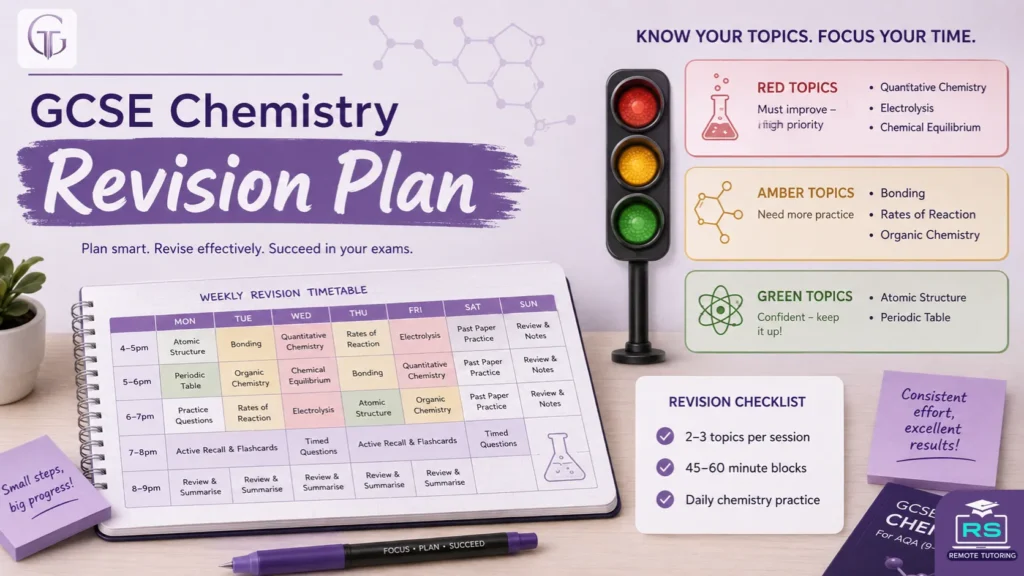
A helpful method is the traffic light system:
Red Topics
These are your weakest or most difficult topics. Examples may include:
- Quantitative Chemistry
- Electrolysis
- Chemical Equilibrium
- Chemical Calculations
Amber Topics
These are topics you partly understand but still need to practise. Examples may include:
- Bonding
- Rates of Reaction
- Organic Chemistry
- Energy Changes
Green Topics
These are topics you feel more confident with. Examples may include:
- Atomic Structure
- The Periodic Table
- States of Matter
I would recommend starting with your red topics first. In my experience, the anxiety of avoiding hard topics often drains the energy students need for the easier ones.
A realistic Chemistry revision session could include:
- 2 to 3 topics per session
- 45 to 60 minutes of focused revision
- Short daily exposure, even if it is only 30 minutes
- A mix of notes, recall, exam questions, and corrections
Consistency matters more than trying to revise everything at once.
2. Focus on Understanding Before Memorising
This is where GCSE Chemistry revision really starts to improve.
Many students try to memorise everything straight away. They copy definitions, highlight paragraphs, and read revision guides repeatedly. The problem is that memorising without understanding does not help much when the exam question is worded differently.
Instead of asking yourself:
“Can I remember this?”
Ask:
“Can I explain this in simple words?”
For example, if you are revising atomic structure, you should be able to explain:
- What protons, neutrons, and electrons are
- Where they are found in the atom
- What their charges are
- How atomic number and mass number work
- How electronic structure relates to the Periodic Table
I often tell students this:
If you cannot explain a topic without looking at your notes, you probably do not understand it well enough yet.
Good ways to build understanding include:
- Teaching the topic to someone else
- Speaking your explanation out loud
- Drawing diagrams
- Using simple examples
- Breaking long topics into smaller parts
Once you understand the concept, memorising becomes much easier.
3. Use Active Recall for GCSE Chemistry
Active recall is one of the most effective revision methods for GCSE Chemistry.
Instead of rereading your notes, you force your brain to retrieve information from memory. This helps you remember more and identify gaps quickly.
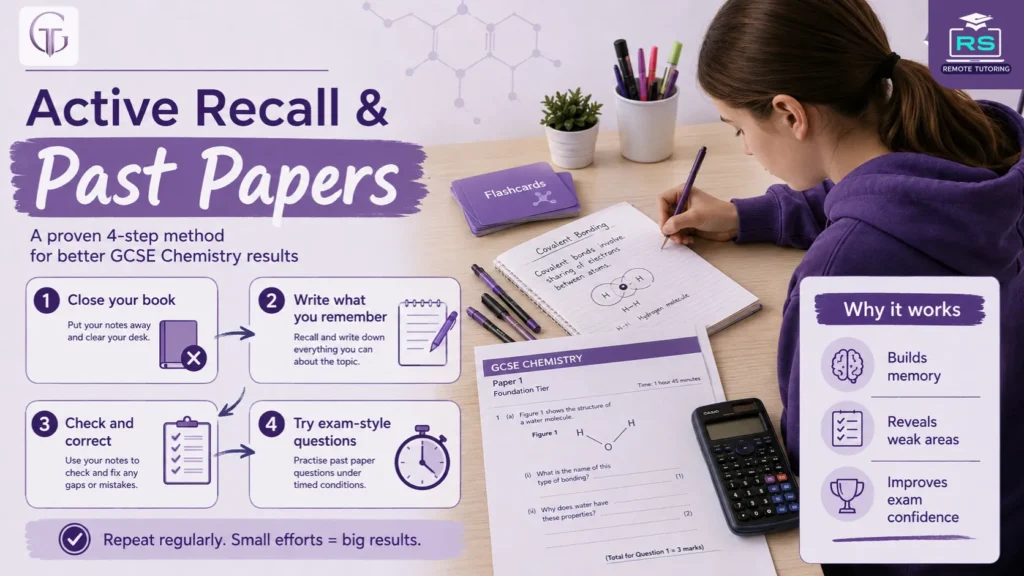
Here is a simple active recall method:
- Read a small section of your notes.
- Close your book.
- Write down everything you can remember.
- Check your notes.
- Correct what you missed.
- Repeat the process later.
For example, after revising electrolysis, close your book and try to answer:
- What is electrolysis?
- What happens at the cathode?
- What happens at the anode?
- How do you predict the products?
- What are the key rules for molten and aqueous compounds?
This is much more powerful than simply reading the same page multiple times.
Students who use active recall usually improve faster because they are training for the way exams actually work. In the exam, you will not have your notes in front of you. You will need to retrieve and apply information under pressure.
4. Start GCSE Chemistry Past Papers Early
Many students make the mistake of leaving past papers until the end of their revision.
This is risky.
Past papers should not only be used to test what you know. They should also be used to learn how examiners ask questions and how mark schemes reward answers.
Start past paper questions as soon as you have covered the basic topics.
Past paper practice helps because:
- You learn common exam question styles
- You understand how mark schemes work
- You spot repeated mistakes
- You improve your timing
- You learn the exact wording examiners expect
For example, in GCSE Chemistry, students often lose marks because their answers are too vague. They may understand the topic, but they do not use the correct scientific language.
Using mark schemes helps you learn phrases such as:
- “Increase in frequency of successful collisions”
- “Electrons are transferred”
- “Ions are free to move”
- “Forms a precipitate”
- “The reaction reaches equilibrium”
These small details can make a big difference to your final grade.
5. Do Not Ignore Required Practicals
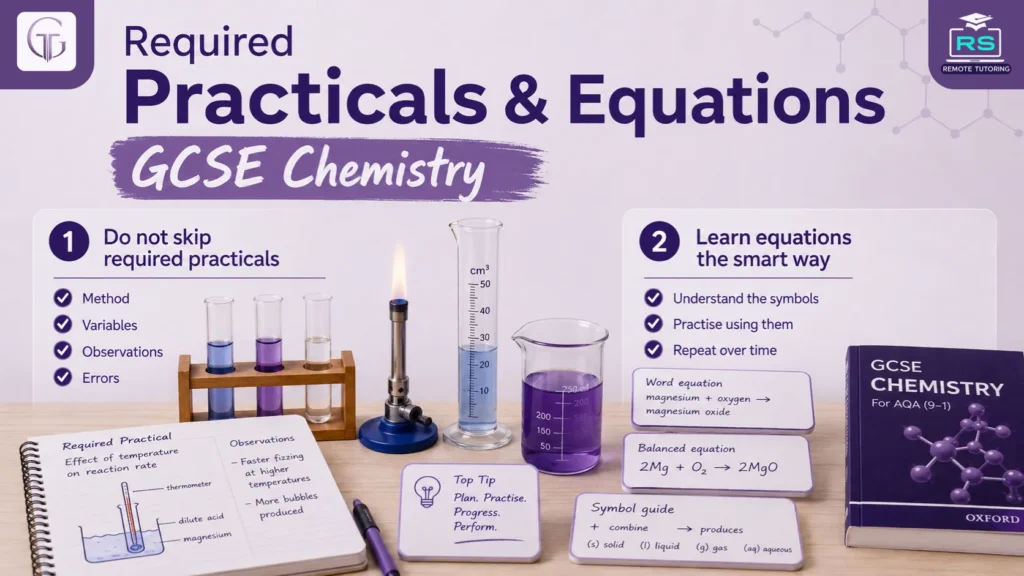
Required practicals are one of the most commonly ignored parts of GCSE Chemistry revision.
This is a mistake.
GCSE Chemistry exams often test practical knowledge, even if you are not physically carrying out the experiment in the exam.
You may be asked about:
- The method
- The apparatus
- Variables
- Observations
- Safety precautions
- Sources of error
- How to improve reliability
- How to interpret results
Students who revise required practicals properly often gain marks that others miss.
For each required practical, make sure you know:
- What the experiment is testing
- The steps in the method
- The independent, dependent, and control variables
- What results you would expect
- Common errors
- How to improve the experiment
Do not just memorise the practical. Understand why each step is done.
6. Learn GCSE Chemistry Equations the Smart Way
GCSE Chemistry includes equations, formulae, calculations, and theoretical concepts. Many students try to memorise equations blindly, but this rarely works well.
A smarter approach is to understand what each symbol means and practise applying the equation in exam questions.
For example, when revising concentration, do not just memorise the formula. Make sure you understand:
- What concentration means
- What volume means
- What units are being used
- How to rearrange the equation
- How to show your working clearly
The best method is to combine:
- Understanding
- Repetition
- Application
Write the equation several times, practise using it in questions, and check your working with the mark scheme.
This is especially important for topics such as:
- Relative formula mass
- Moles
- Concentration
- Gas volume
- Percentage yield
- Atom economy
- Rates of reaction
Chemistry calculations become easier when you practise them little and often.
Common GCSE Chemistry Revision Mistakes to Avoid
Let me be direct: these mistakes cost students marks.
Common GCSE Chemistry revision mistakes include:
- Highlighting instead of testing yourself
- Avoiding weak topics
- Not using mark schemes
- Cramming just before the exam
- Ignoring calculations
- Skipping required practicals
- Only revising topics you already enjoy
- Writing vague answers in exam questions
I have seen students stay stuck at grade 5 simply because they never practised structured answers properly.
To improve, you need to stop asking, “Have I revised this topic?”
Instead, ask:
“Can I answer exam questions on this topic accurately?”
That is the real measure of progress.
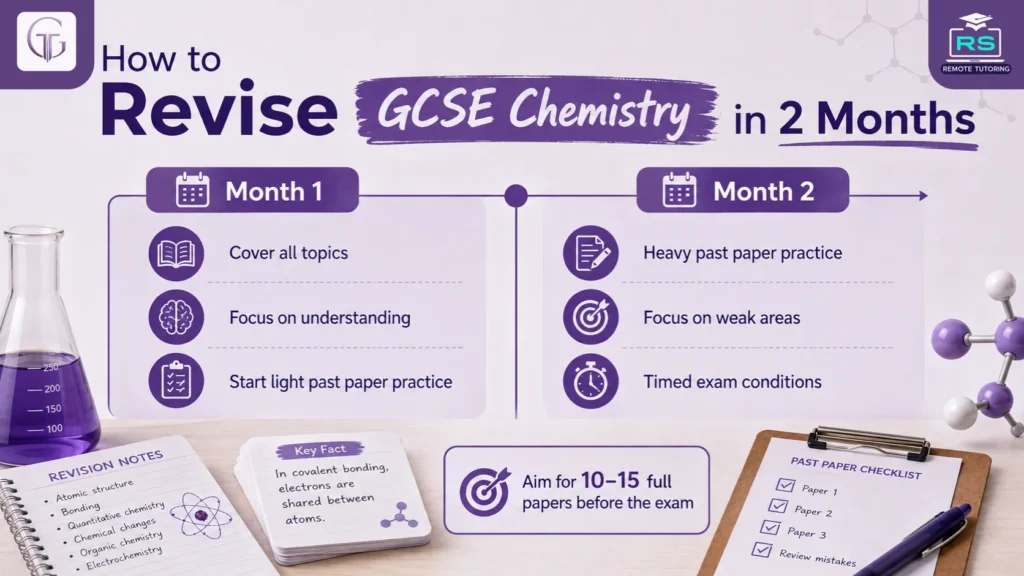
How to Revise for GCSE Chemistry in 2 Months
Many students ask whether two months is enough to revise GCSE Chemistry.
Yes, two months can be enough if you use the time properly. However, it requires focus, consistency, and a clear plan.
You cannot afford to spend the first month only rewriting notes. You need to combine content review with exam practice from the beginning.
Month 1: Build Understanding and Cover the Topics
In the first month, focus on covering the full specification and identifying weak areas.
Your goals should be to:
- Review all major topics
- Understand the key concepts
- Create short revision notes
- Use active recall regularly
- Start light past paper practice
- Identify red, amber, and green topics
During this stage, do not aim for perfection. Aim for coverage and understanding.
Month 2: Practise Past Papers and Fix Weak Areas
In the second month, past paper practice should become your main focus.
Your goals should be to:
- Complete timed exam questions
- Practise full papers
- Review mistakes carefully
- Learn mark scheme wording
- Revisit weak topics
- Improve calculation accuracy
- Practise required practical questions
I would recommend completing at least 10 to 15 full papers before your final exam if possible. This includes both full papers and topic-based exam question sets.
The key is not just doing the papers. The real improvement comes from correcting them properly.
How to Get a Grade 7 to 9 in GCSE Chemistry
Students often ask how to get a high grade in GCSE Chemistry.
The answer is not simply to revise more. It is to revise better.
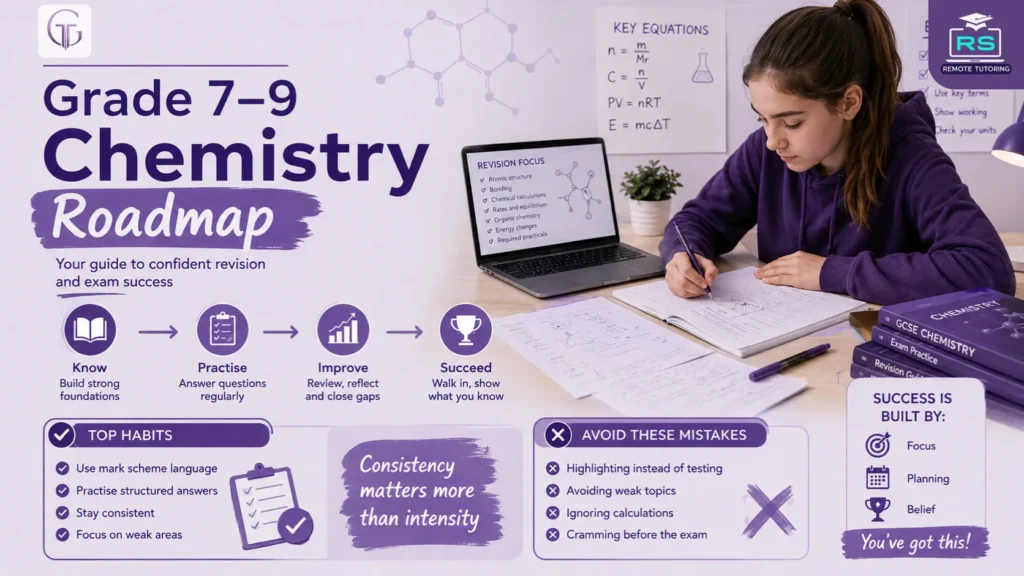
Top students usually:
- Practise structured answers
- Use mark scheme language
- Review mistakes carefully
- Focus on weak areas
- Practise calculations regularly
- Understand required practicals
- Stay consistent over time
One thing becomes clear very quickly: grade 9 students do not always do completely different things. They often do the same things more carefully and more consistently.
If you want a grade 7, 8, or 9, you need to move beyond basic memorisation. You need to understand the topic, apply it in exam questions, and write answers in the way examiners expect.
A Simple GCSE Chemistry Revision Routine
If you feel stuck, start small.
Here is a simple routine you can use today:
- Pick one Chemistry topic.
- Spend 20 minutes reviewing the key ideas.
- Close your notes and write down what you remember.
- Complete 3 to 5 exam-style questions.
- Mark your answers using the mark scheme.
- Write down what you got wrong.
- Repeat the weak parts tomorrow.
This routine is simple, but it works because it includes understanding, active recall, application, and correction.
That is exactly what GCSE Chemistry revision needs.
Final GCSE Chemistry Revision Tips
To revise GCSE Chemistry effectively, remember these key points:
- Do not rely on rereading notes
- Use active recall every week
- Start past papers early
- Learn from mark schemes
- Revise required practicals
- Practise calculations regularly
- Focus on weak topics first
- Stay consistent instead of cramming
GCSE Chemistry is not just about memorising facts. It is about understanding how atoms, substances, reactions, and calculations connect.
Once students realise this, Chemistry becomes much easier to manage.
FAQs About Revising GCSE Chemistry
What Is the Best Way to Revise GCSE Chemistry?
The best way to revise GCSE Chemistry is to combine active recall, understanding, past paper practice, and mark scheme review. Simply reading notes is not enough. Students should test themselves regularly and apply their knowledge to exam-style questions.
Is 2 Months Enough to Revise for GCSE Chemistry?
Yes, two months can be enough to revise GCSE Chemistry if the time is used effectively. The first month should focus on covering topics and understanding key ideas. The second month should focus heavily on past papers, weak areas, and timed exam practice.
How Many Past Papers Should I Do for GCSE Chemistry?
A strong target is 10 to 15 full papers before the exam, along with topic-based questions. However, the quality of your review matters more than the number of papers. Always mark your answers carefully and learn from your mistakes.
How Do I Improve My GCSE Chemistry Calculations?
To improve Chemistry calculations, learn what each formula means, practise rearranging equations, check your units, and complete regular calculation questions. Topics such as moles, concentration, percentage yield, and rates of reaction need repeated practice.
How Can I Get a Grade 9 in GCSE Chemistry?
To get a grade 9 in GCSE Chemistry, focus on deep understanding, accurate exam technique, regular past paper practice, and mark scheme language. Grade 9 students are usually consistent, precise, and confident in applying knowledge to unfamiliar questions.
Closing Thoughts
GCSE Chemistry can feel difficult at first, but it becomes much more manageable when you revise in the right way.
Do not spend all your time highlighting notes or memorising without understanding. Instead, focus on active recall, exam questions, required practicals, calculations, and mark scheme language. Start small if you feel overwhelmed. Pick one topic today, test yourself without notes, and try a few past paper questions.
Consistency matters more than intensity. The Periodic Table is your best friend in the exam hall. It contains a lot of useful information, but you need to know how to use it properly.
With the right revision strategy, GCSE Chemistry becomes less about guessing and more about applying what you understand.

Raja specializes in Physics and Maths, with over 5 years of experience. He offers KS2, KS3, and GCSE Science and Maths lessons. He graduated from one of the top universities in the UK.