Choosing a language at GCSE level can feel daunting because your decision might influence your grades, future university options and even your career path. Which language is easier to learn, French, German or Spanish? The answer depends on your goals, your interests and how much effort you’re willing to invest. This comprehensive guide compares French, German and Spanish in terms of difficulty, GCSE grading trends, global usefulness and cultural appeal. It also touches on Italian, another Romance language that some GCSE candidates consider.
Table of Contents
Understanding GCSE Modern Foreign Languages (MFL)
GCSEs in French, German and Spanish follow a similar structure: assessments cover listening, reading, speaking and writing, with a heavy emphasis on vocabulary, grammatical accuracy and the ability to translate between English and the target language. Historically, French and German have been graded more harshly than Spanish, prompting Ofqual to review grade boundaries.
A 2024 to 25 report noted that adjustments to grading brought French and German in line with Spanish, raising the proportion of grades at 7+ (equivalent to A/A*) for French from 26 % in 2023 to 28 % in 2024 and 29.7 % in 2025, and for German from 27.6 % in 2023 to 34 % in 2025.
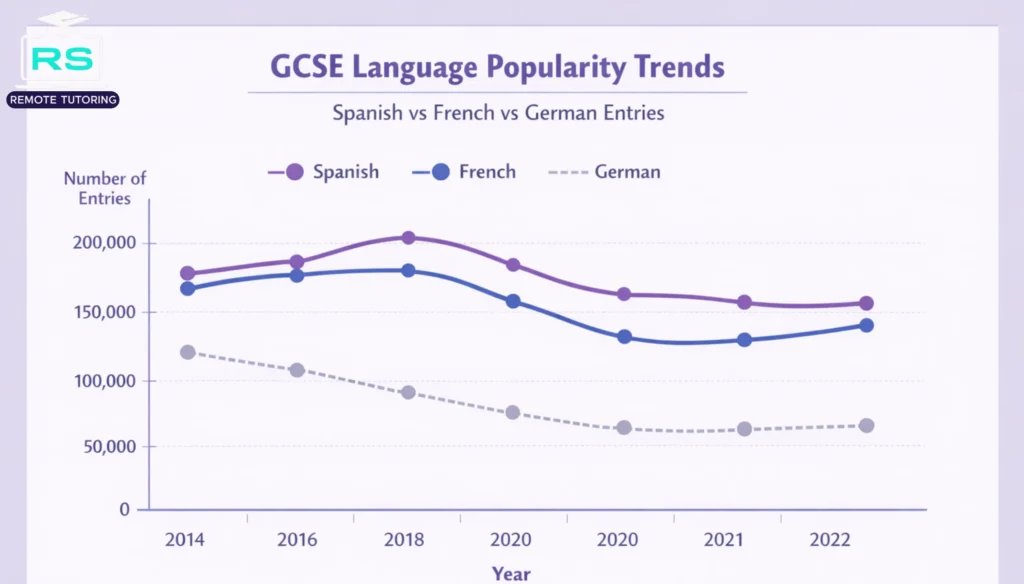
Despite these changes, Spanish remains the most popular GCSE language: entries rose from 109,594 in 2020 to 136,871 in 2025, whereas French entries dipped from 134,651 in 2024 to 132,808 in 2025. German entries fell by 7 % in 2025.
Why grades and popularity matter
While popularity doesn’t equate to ease, it does affect grading. A larger cohort can spread ability profiles, making grade boundaries fairer. Conversely, smaller cohorts (notably in German) often contain high‑attainment students, which pushes grade boundaries up. Understanding these trends helps you gauge how competitive each subject is and whether you’ll need higher scores to stand out.
Factors to Consider When Choosing a Language
1. Personal interest and motivation
You’ll spend hundreds of hours studying your chosen language. Enjoyment is the biggest predictor of success. Teachers at Scarborough College advise students to pick the language they enjoy most because dedication and curiosity make the difference. If you enjoy multiple languages, consider studying two; knowledge from one Romance language (French or Spanish) can reinforce the other.
2. Linguistic family and similarity to English
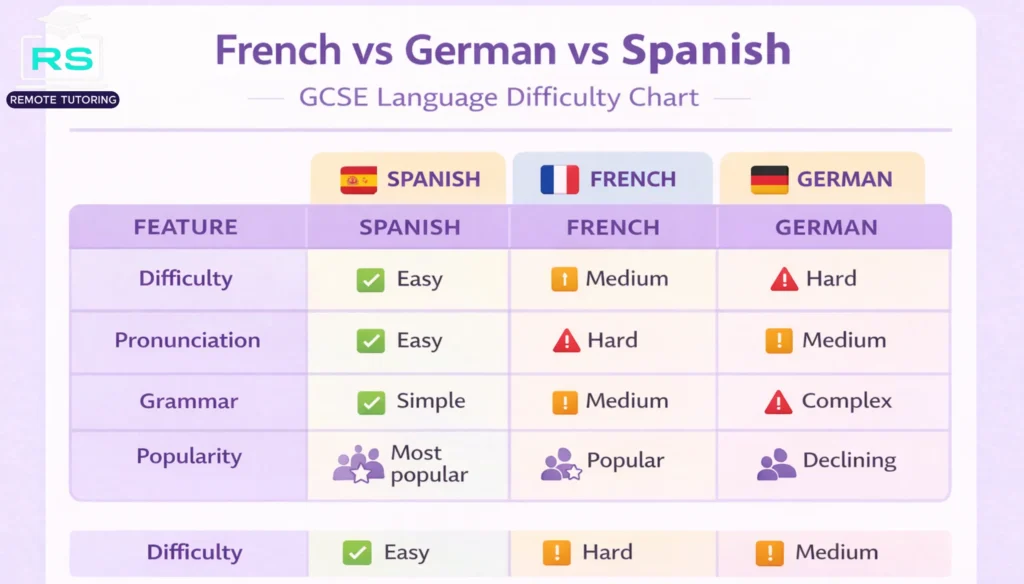
English is a Germanic language heavily influenced by French. That gives you an advantage when learning French vocabulary but makes Spanish grammar and pronunciation more predictable. German comes from the same family as English but uses four cases and three grammatical genders, making grammar less familiar. Spanish and French are both Romance languages derived from Vulgar Latin; they share roughly 75 % lexical similarity, which can make learning one easier if you already know the other.
3. Pronunciation and spelling
- Spanish has consistent pronunciation: each letter is pronounced one way, and stress generally falls on the penultimate syllable. Once you learn a few accent marks, you can read most words aloud with confidence. This predictability contributes to Spanish’s reputation as an “easy” language for English speakers.
- French spelling and pronunciation are less intuitive. Many letters are silent, and vowel sounds often change according to their position. Learning liaison and elision rules requires practice. However, because English borrowed much of its vocabulary from French, many words look familiar (e.g., nation, important).
- German pronunciation seems harsh but is systematic. Consonant clusters (e.g., sch, ch) always sound the same. Once you master the sounds, reading aloud becomes straightforward. Because spelling closely matches pronunciation, you don’t encounter as many silent letters as in French.
4. Grammar complexity
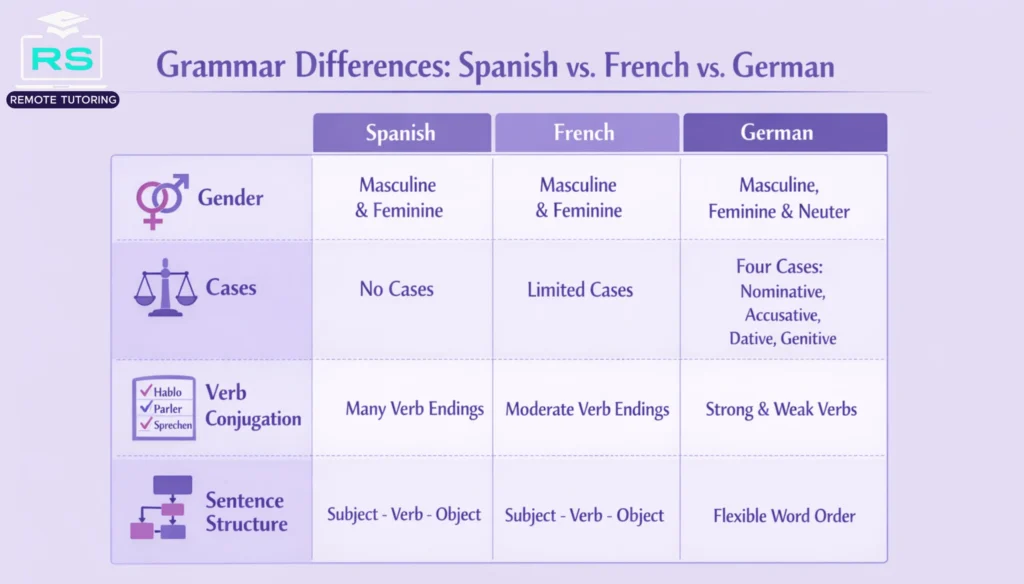
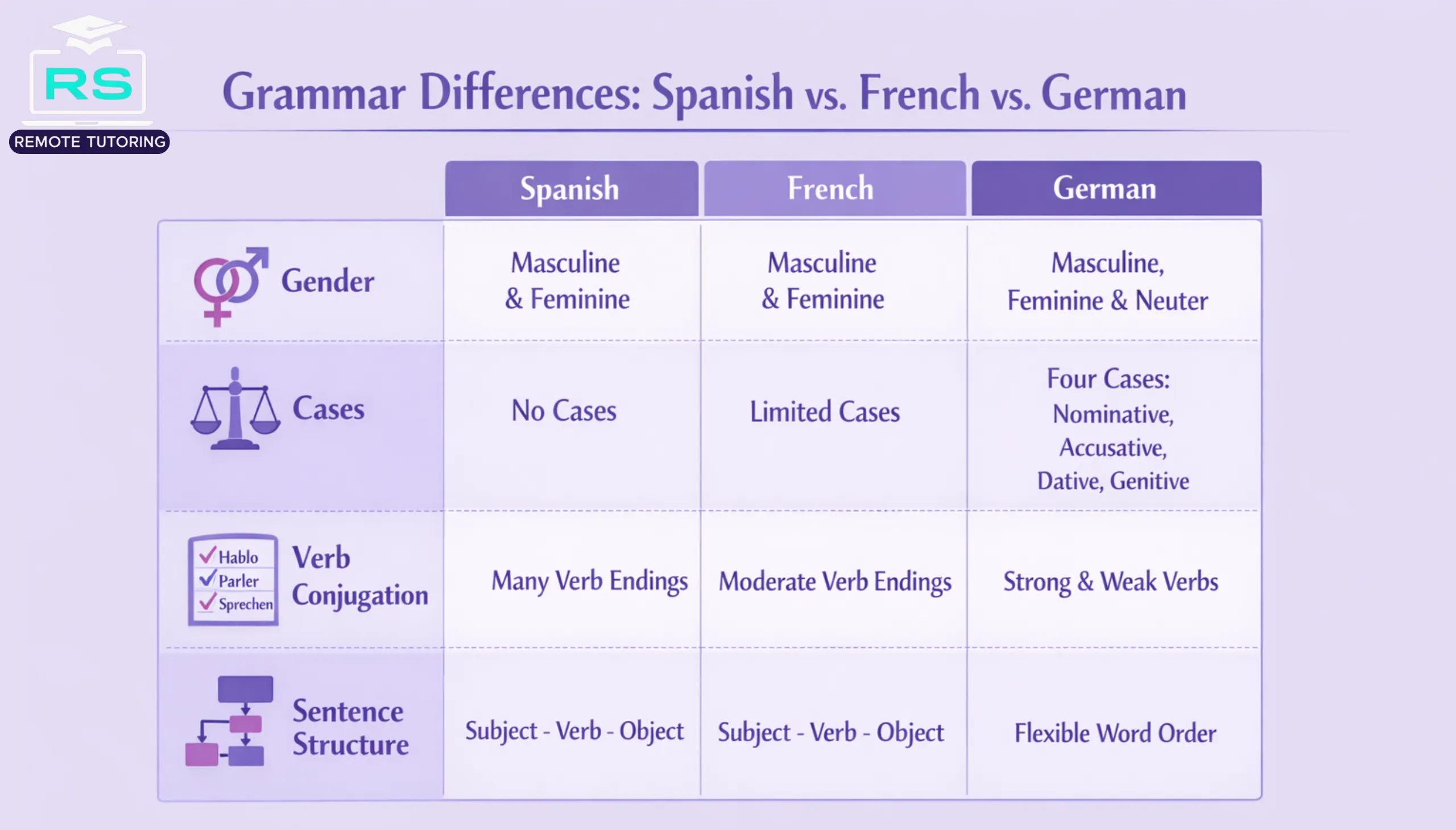
| Feature | Spanish | French | German |
| Gender | Two genders (masculine, feminine) | Two genders; nouns almost always end with predictable endings | Three genders (masculine, feminine, neuter) |
| Cases | No case system; word order determines roles | No case system | Four cases (nominative, accusative, dative, genitive) |
| Verb conjugation | Regular patterns; two main past tenses | More irregular verbs; use of auxiliary verbs makes compound tenses complex | Conjugation is regular and logical, with fewer exceptions; fewer past tenses than French or Spanish |
| Sentence structure | Subject–verb–object order; adjectives follow nouns | Subject–verb–object; adjectives often follow nouns but must agree in gender and number | Word order varies: verb is usually in second position; verbs move to the end in subordinate clauses. Once mastered, rules are consistent |
| Use of accents | Acute accent and diaeresis mark stress | Five different accent marks; silent letters | Umlauts (ä, ö, ü); ß sound |
5. Career relevance and global reach
Think beyond GCSEs. Which language will open the most doors for you? Spanish and French are used on multiple continents, while German dominates central Europe. Here’s how they compare:
Spanish
- Global speakers: About 560 million people speak Spanish worldwide, making it the second most spoken language by native speakers. It’s the official or national language in 21 countries.
- Popularity: Spanish has overtaken French as the most popular GCSE language; entries climbed from 109,594 in 2020 to 136,871 in 2025.
- Economic value: Spanish is crucial for sectors like tourism, customer service, marketing and trade, particularly in Latin America and the United States. The British Academy attributes the surge in GCSE Spanish entries to travel and cultural factors.
- Ease of learning: The U.S. Foreign Service Institute (FSI) classifies Spanish as a Category I language, requiring about 600 to 750 class hours (24 to 30 weeks) for English speakers. Straightforward pronunciation and regular verb patterns make it accessible.
- Cultural appeal: Spanish culture spans flamenco, salsa, La Liga football and Latin American literature. For UK students, Spanish immersion is easy thanks to budget flights to Spain and study-abroad programs.
French
- Global speakers: 321 million people speak French worldwide. French is the only language besides English spoken on all continents and is official in 32 countries. The Organisation internationale de la Francophonie (OIF) calls French the fifth most spoken language and notes that it’s the second most learned language globally.
- Popularity: French remains a popular GCSE option but has been overtaken by Spanish. Entries decreased slightly to 132,808 in 2025.
- Economic value: French is essential in diplomacy (UN, EU, NATO), fashion, gastronomy and the arts. Many international companies have headquarters in France, Switzerland and Africa. French universities offer scholarships for international students.
- Ease of learning: Like Spanish, French is a Category I language requiring 600 to 750 hours. However, irregular pronunciation and spelling make the early stages challenging.
- Cultural appeal: France offers iconic art (the Louvre), cinema, literature and cuisine. Canadian and African Francophonie adds rich diversity.
German
- Global speakers: About 130 million people speak German as their mother tongue. German is official in Germany, Austria, Switzerland, Luxembourg and Liechtenstein, and there are 7.5 million people in 42 countries belonging to German‑speaking minorities.
- Popularity: GCSE German entries are declining, falling by 7 % in 2025. The subject appeals primarily to high‑achieving students.
- Economic value: Germany has Europe’s largest economy and is a leader in engineering, renewable energy and manufacturing. Over 402,000 international students studied in Germany in 2024/25. German proficiency opens doors to universities with low tuition fees and scholarships.
- Ease of learning: German is a Category II language and takes slightly longer (approx. 750 to 900 hours) for English speakers. It features consistent grammar rules and logical verb conjugationsolesentuition.co.uk. Although cases and three genders add complexity, there are fewer irregularities than in French or Spanish.
- Cultural appeal: German culture encompasses classical music (Bach, Beethoven), philosophy and cutting‑edge science. Modern Germany offers vibrant cities like Berlin and Munich, famous for art, film and festivals.
Italian (optional)
Italian isn’t as widely taught in UK secondary schools but sometimes appears alongside other languages. Roughly 85 million people speak Italian worldwide, more than the population of Italy, and Italian communities exist in Argentina, the USA, Brazil and Canada. Italian is a Romance language, so if you’ve mastered Spanish or French, Italian grammar will feel familiar. However, it has many irregular verbs and is less globally relevant than Spanish or French. For those passionate about opera, fashion, design or cuisine, Italian offers cultural rewards but may not justify the limited GCSE exam entries.
Comparing Ease of Learning and Exam Performance
The Foreign Service Institute’s categories provide a useful benchmark for relative difficulty. Spanish and French are Category I languages; with dedicated practice, you can reach conversational proficiency in about 600 to 750 hours. German belongs to Category II; because of its case system and different word order, it demands slightly more time (30 to 36 weeks of study). Italian is also Category I.
GCSE performance trends
- Spanish: Historically considered the easiest GCSE language, partly because of accessible pronunciation and regular grammar. Government analysis found that Spanish GCSE was closer to the average difficulty for all subjects, while French and German were among the five hardest. This means grade boundaries are less severe, making it statistically easier to secure a top grade.
- French & German: Ofqual concluded that grading standards needed adjusting because French and German were marked more stringently. Adjustments from 2023 onwards increased the proportion of high grades for both languages, aligning them more closely with Spanish.
Summary of pros and cons
| Language | Advantages | Challenges |
| Spanish | Widely spoken; essential for travel and business; straightforward pronunciation and spelling; high GCSE success rates | Verb conjugations (subjunctive) can be tricky; popularity means you need high marks to stand out |
| French | Useful in diplomacy, art and global organisations; many English cognates; scholarships available | Irregular spelling and pronunciation; gender and agreement rules; historically harsh grading, though now improving |
| German | Logical grammar; strong economic and academic prospects; less competition at GCSE | Cases and three genders; longer learning curve; decreasing uptake in UK schools |
| Italian | Beautiful sound; gateway to opera, fashion and art; easier if you know another Romance language | Fewer GCSE opportunities; irregular verbs; limited global reach |
Tips for Excelling in Your Chosen Language
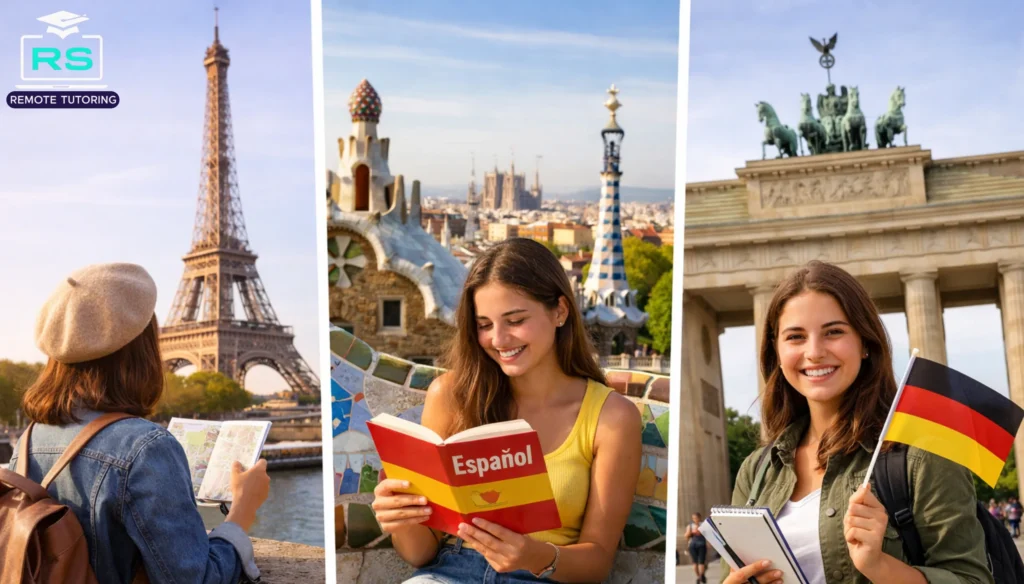
- Immerse yourself daily: Use apps like Duolingo or Memrise for vocabulary drilling. Listen to podcasts, music and YouTube channels in your target language. Immersion builds listening comprehension and pronunciation.
- Watch films and TV shows: Spanish telenovelas, French cinema and German dramas (such as Dark or Babylon Berlin) expose you to slang and idioms. Turn on subtitles in the target language to reinforce reading skills.
- Find a conversation partner: Language exchanges can be online or in person. Speaking regularly reduces exam anxiety and builds confidence.
- Review grammar in context: Use story‑based textbooks or graded readers rather than memorising charts. For German cases, practise writing sentences that highlight the nominative, accusative, dative and genitive forms.
- Integrate culture: Cooking French recipes, learning Spanish dances or reading German fairy tales can make study sessions enjoyable and memorable.
Seasonal immersion trips from the UK
For UK students, immersion experiences are just a short flight away. Consider these seasonal tips:
- France in spring (April to June): Mild temperatures make Paris and Lyon ideal for language immersion. Attend a café conversation class or volunteer with a cultural exchange group.
- Spain in summer (July to September): Barcelona’s language schools run intensive courses alongside beach activities. Andalusia’s flamenco festivals in September offer cultural immersion.
- Germany in autumn (September to October): Munich’s Oktoberfest isn’t just about beer; it’s a chance to practise listening to dialects and speak with locals. Universities host open days for prospective international students.
FAQs
Which GCSE language is easiest, French, German or Spanish?
Evidence suggests Spanish is generally easier for English speakers. It has consistent pronunciation and regular verb patterns, and government analysis found it closer to the average GCSE difficulty. However, recent grading adjustments have made French and German more accessible, so the easiest language for you depends on your motivation and learning style.
Is Spanish really easier than French?
Yes and no. Spanish pronunciation and spelling are more regular, which helps beginners. French contains silent letters and irregular pronunciations. Both are Category I languages requiring roughly the same study time. If you already know one Romance language, the other will feel easier because Spanish and French share about 75 % lexical similarity.
Why is German considered harder?
German’s four cases and three genders mean nouns change form depending on their role in the sentence. Its word order also places verbs in unusual positions. However, German grammar is logical and has fewer exceptions than French or Spanisholesentuition.co.uk. With consistent practice, many learners find it rewarding.
What languages can I choose for GCSE?
In most UK schools the main modern languages offered are French, German and Spanish. Some schools also offer Italian, Mandarin, Arabic or Urdu. Availability depends on teacher expertise and student interest. Entries in Spanish have increased significantly, while German entries are declining.
What are the hardest GCSE subjects overall?
According to Ofqual and independent studies, subjects like Chemistry, Physics, Maths, French and German rank among the top five hardest GCSEs. Spanish is closer to the average difficulty level.
What do A1, A2, B1, B2, C1 and C2 mean in French?
These refer to the Common European Framework of Reference for Languages (CEFR) levels. A1 and A2 represent basic user proficiency; B1 and B2 correspond to independent user levels (you can handle everyday interactions and understand main points); C1 and C2 denote proficient users capable of complex tasks and near-native fluency.
Conclusion
Ready to embark on your language journey? Whether you’re leaning towards Spanish for its global reach, French for its elegance, or German for its logic and economic relevance, our tutors can help. Contact us today for a free consultation and discover how personalised lessons can make your GCSE language choice enjoyable and successful.
Have questions about immersion programs or exam preparation? Reach out to our friendly team for expert advice. Languages open doors, let’s unlock them together.

Raja specializes in Physics and Maths, with over 5 years of experience. He offers KS2, KS3, and GCSE Science and Maths lessons. He graduated from one of the top universities in the UK.