If you are preparing for your Functional Skills English Level 2 qualification, one of the biggest things that helps calm the nerves is simply understanding how the exam actually works. What are the demands of the exams and how are the questions structured? I have worked with many students who were far more anxious about the unknown than the English itself. Once they finally understood the structure of the exam, the timings, the sections, and what examiners were genuinely looking for, their confidence changed almost immediately.
That is exactly what this guide is here to do.
This is not just a technical breakdown of the qualification. It clearly revolves around what the Functional Skills English Level 2 exam structure really looks like in practice, what catches students out most often, and how to approach each section with more confidence.
Whether you are returning to education after years away, applying for university, training to become a nurse or teacher, or simply trying to gain the equivalent of GCSE English, this guide will help you understand exactly what to expect.
Jump to Section
What Is Functional Skills English Level 2?
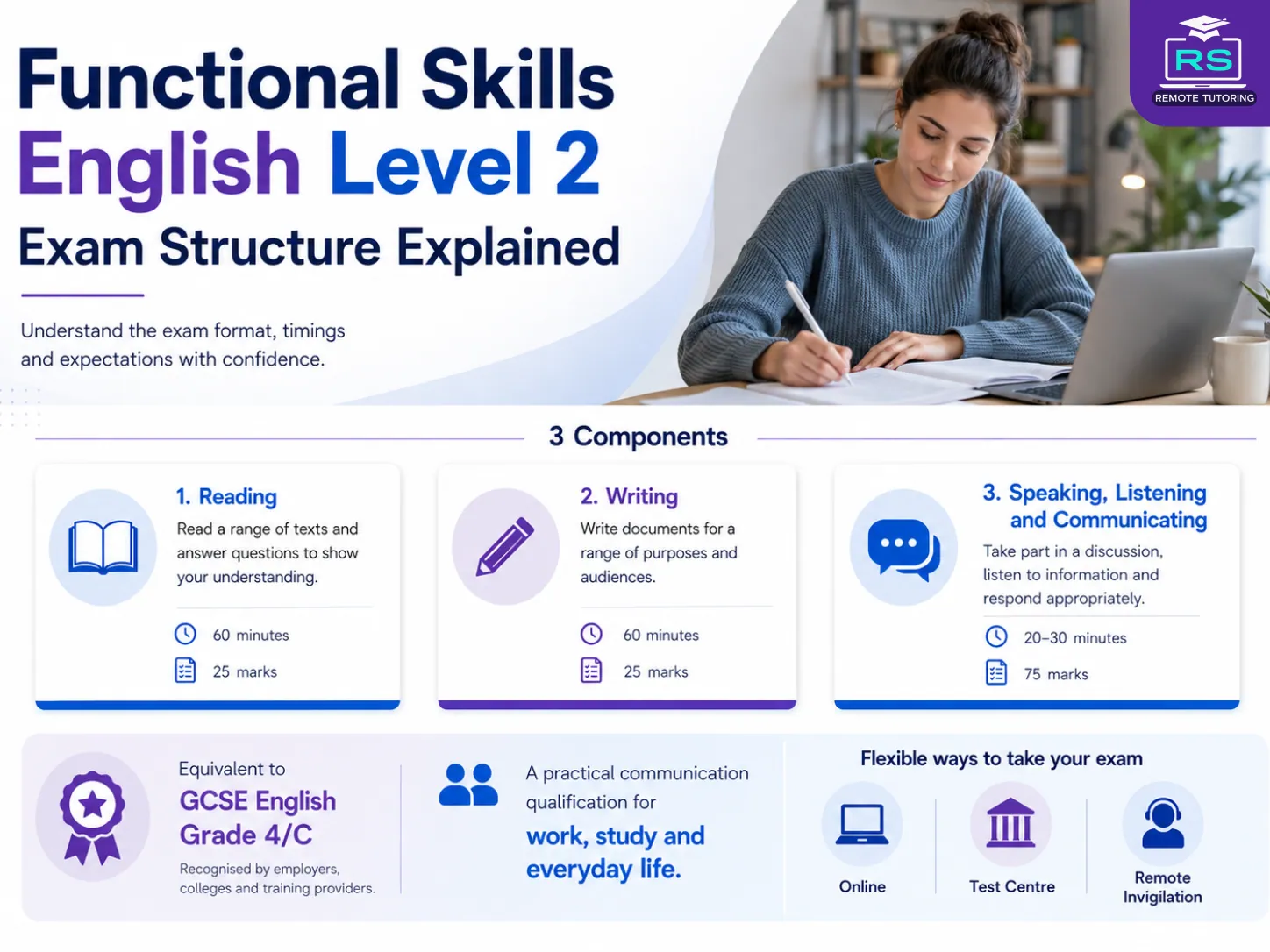
Functional Skills English Level 2 is a nationally recognised qualification in the UK that is considered equivalent to GCSE English grade 4 (C).The qualification is designed to test practical English skills used in everyday life, work, and further education rather than overly academic literary analysis.Most exam boards assess three core areas:
- Reading
- Writing
- Speaking, Listening and Communicating (SLC)
One thing students often do not realise is that the qualification focuses heavily on clarity, communication, and real-world understanding. The language tasks are usually practical rather than abstract.For many adult learners, that actually makes the qualification feel more approachable than traditional GCSE English.
Functional Skills English Level 2 Exam Structure Explained
The functional skills English exams usually comprise of the three sections. These are;
- Reading
- Writing
- Listening. Speaking and the Communication
Depending on your provider, you may complete the exams:
- Online
- In a test centre
- Remotely with online invigilation
Some providers allow all sections to be completed separately, which many students find less overwhelming.From experience, breaking the qualification into smaller stages often helps nervous learners perform much better.
The Reading Exam Structure
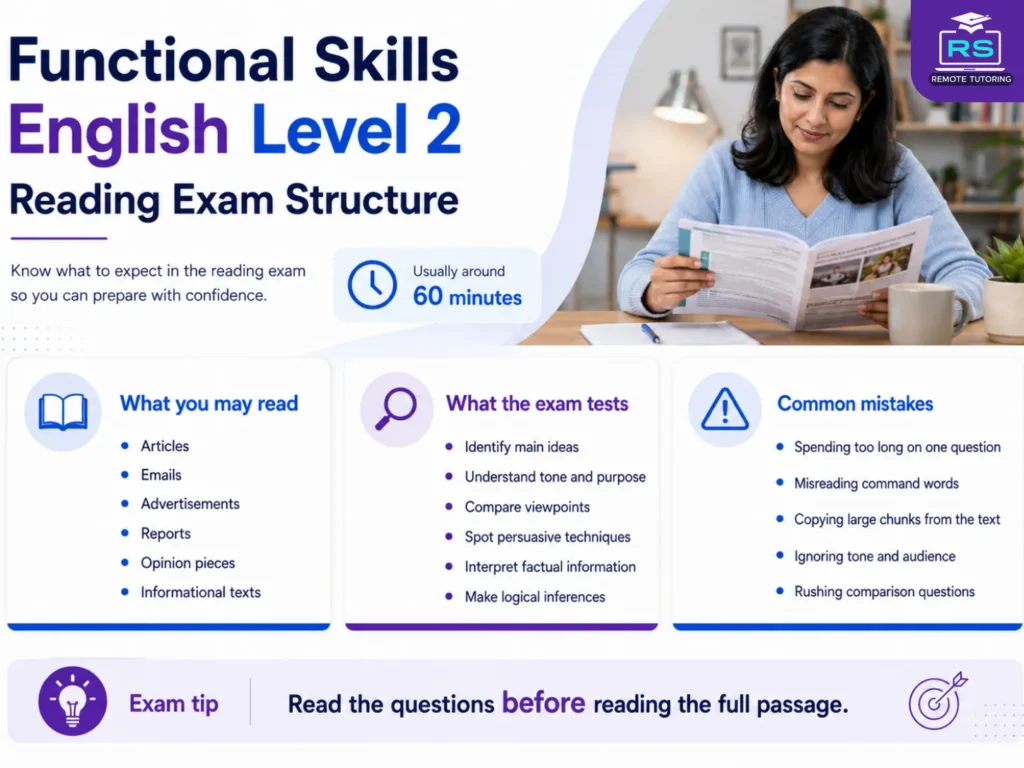
The reading assessment holds significant importance and ultimately it checks how well you can understand, analyse, and compare written information.You will usually read:
- Articles
- Emails
- Advertisements
- Reports
- Opinion pieces
- Informational texts
But here comes the most important part, which is actually the reading exam test. The exam normally focuses on the student’s ability to:
- Identify main ideas
- Understand tone and purpose
- Compare viewpoints
- Spot persuasive techniques
- Interpret factual information
- Make logical inferences
One thing I did not expect when first tutoring Functional Skills learners was how many students lost marks simply because they rushed the reading passages. Many students panic when they see long blocks of text. But the strongest candidates are rarely the fastest readers. They are usually the students who stay calm and carefully understand the question before scanning the text.
Common Reading Exam Mistakes
Students assume that reading is the easiest part but they commit the mistakes that actually hold them back from achieving the higher grades. They mostly;
- Spend too long on one question
- Misread command words
- Copy large chunks from the text
- Ignore tone and audience
- Rush comparison questions
A very common pattern I have seen is students answering based on personal opinion instead of evidence from the text. Examiners want answers supported directly by what is written.
I always recommend my student to Read the questions before reading the full passage.
This immediately gives your brain something specific to look for and saves valuable time.
The Writing Exam Structure
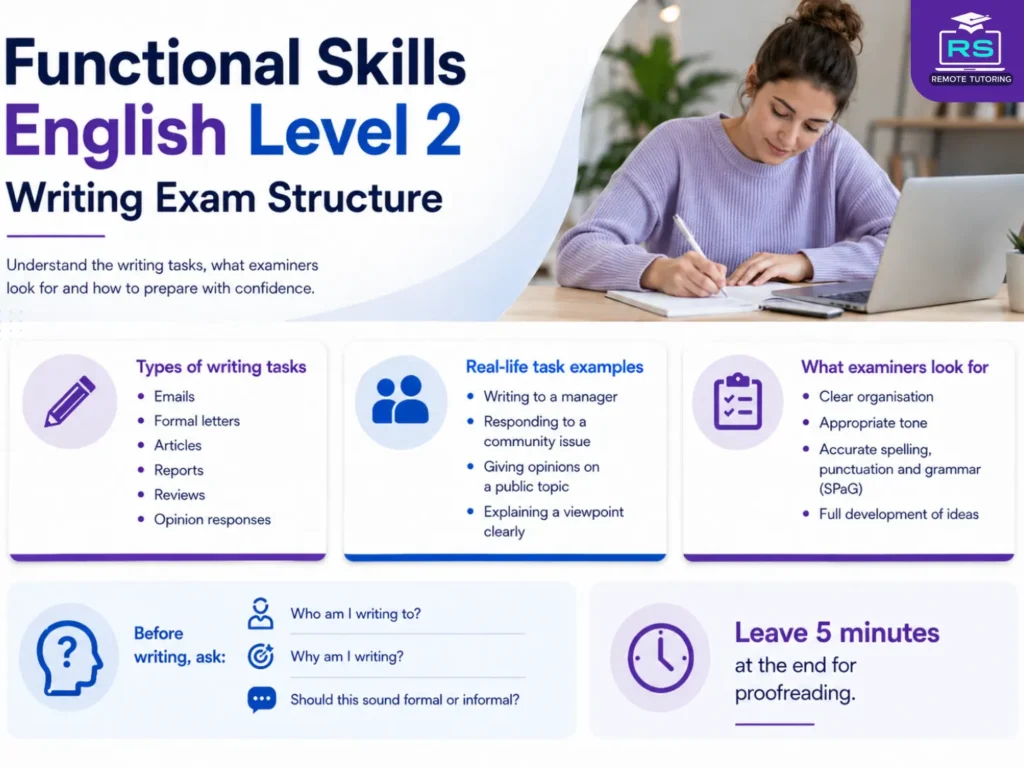
The writing assessment is where many learners become most nervous, especially adults returning to education after years away. But what surprises many students is that the exam is far more practical than they expect.You are not being asked to write university-level essays.
Instead, the Functional Skills English Level 2 exam structure focuses on whether you can communicate clearly, appropriately, and accurately.
Types of Writing Tasks
Writing exams may focus on asking students to write;
- Emails
- Formal letters
- Articles
- Reports
- Reviews
- Opinion responses
The tasks are usually linked to realistic situations. For example:
- Writing to a manager
- Responding to a community issue
- Giving opinions on a public topic
- Explaining a viewpoint clearly
What Examiners Look For in the Writing Paper
- Clear Organisation: Your ideas should flow logically.
- Appropriate Tone: Formal tasks should sound professional.
- Accurate SPaG: This means focusing on spellings, Punctuations and the Grammar.
- Full Development of Ideas:Short undeveloped answers lose marks quickly.One thing that becomes clear quite quickly is that examiners care more about clarity than fancy vocabulary.Some students try to sound overly academic and end up writing confusing sentences.Simple, clear communication almost always scores better.
A Real Writing Mistake Many Learners Make
I still remember a learner who wrote excellent ideas but lost marks because they ignored the audience completely. The task asked for a formal complaint email, but the response sounded like a casual text message.The structure matters just as much as the ideas. Before writing, always ask:
- Who am I writing to?
- Why am I writing?
- Should this sound formal or informal?
That small habit alone improves scores significantly.
Firstly, my advice for the students is to leave 5 minutes at the end purely for proofreading.
Students are often shocked by how many small grammar mistakes they catch during a final check.
Speaking, Listening and Communicating (SLC)
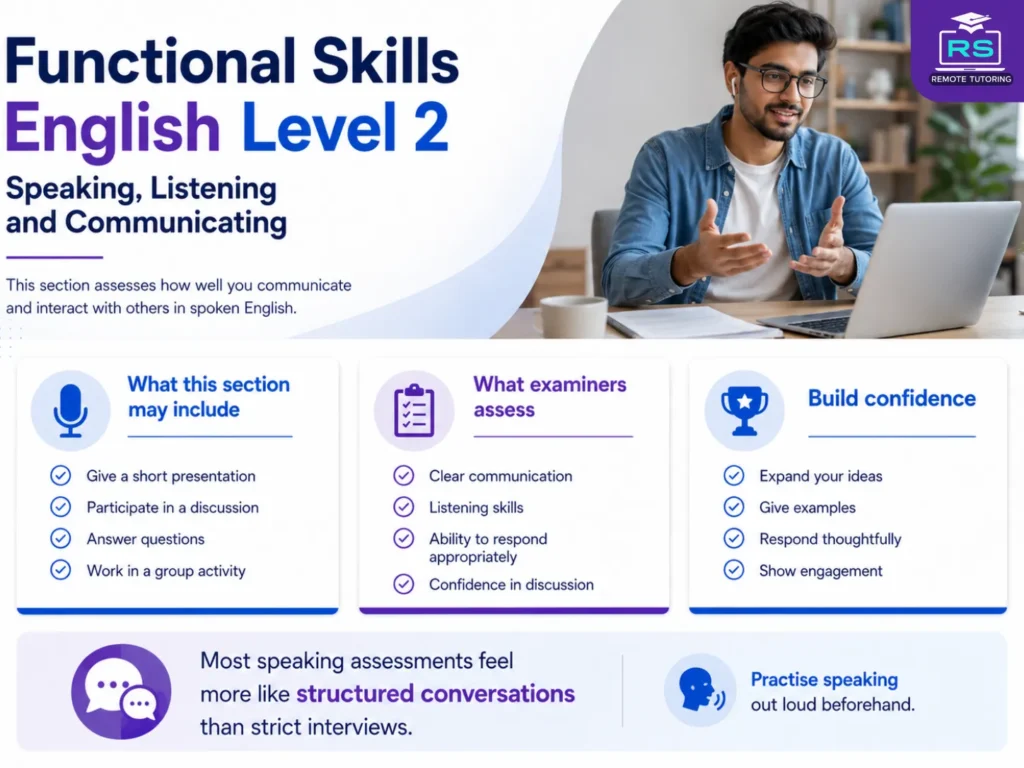
This part of the exam holds significant importance. The Speaking, Listening and Communicating section is usually less formal than the written exams, but it still matters. Depending on your provider, you may:
- Give a short presentation
- Participate in a discussion
- Answer questions
- Work in a group activity
Many students worry about this section unnecessarily. In reality, examiners are usually assessing:
- Clear communication
- Listening skills
- Ability to respond appropriately
- Confidence in discussion
You are not expected to sound perfect or overly polished. What made the biggest difference for many students I have worked with was simply practising speaking out loud beforehand.
What the Speaking Assessment Feels Like in Reality
Many learners imagine a strict interview environment. This section ultimately feels scariest to the student.But most Speaking and Listening assessments feel more like structured conversations. The atmosphere is often calmer than students expect. One of the most common patterns I have seen is learners speaking too briefly because they are nervous. Always remember:
- Expand your ideas
- Give examples
- Respond thoughtfully
- Show engagement
That matters far more than sounding “impressive.”
Is Functional Skills English Level 2 Hard?
This is the most important questions students ask but my answer genuinely lands that this actually depends heavily on:
- Your current English level
- How long you have been away from education
- Your confidence with exams
For many adult learners, the hardest part is not the content itself.It is rebuilding confidence.
I have spoken to students in their 30s, 40s, and even 50s who delayed taking the qualification for years because they assumed they were “bad at English.”Once they understood the structure and practised consistently, most performed far better than they expected.
How the Functional Skills English Level 2 Exam Is Marked
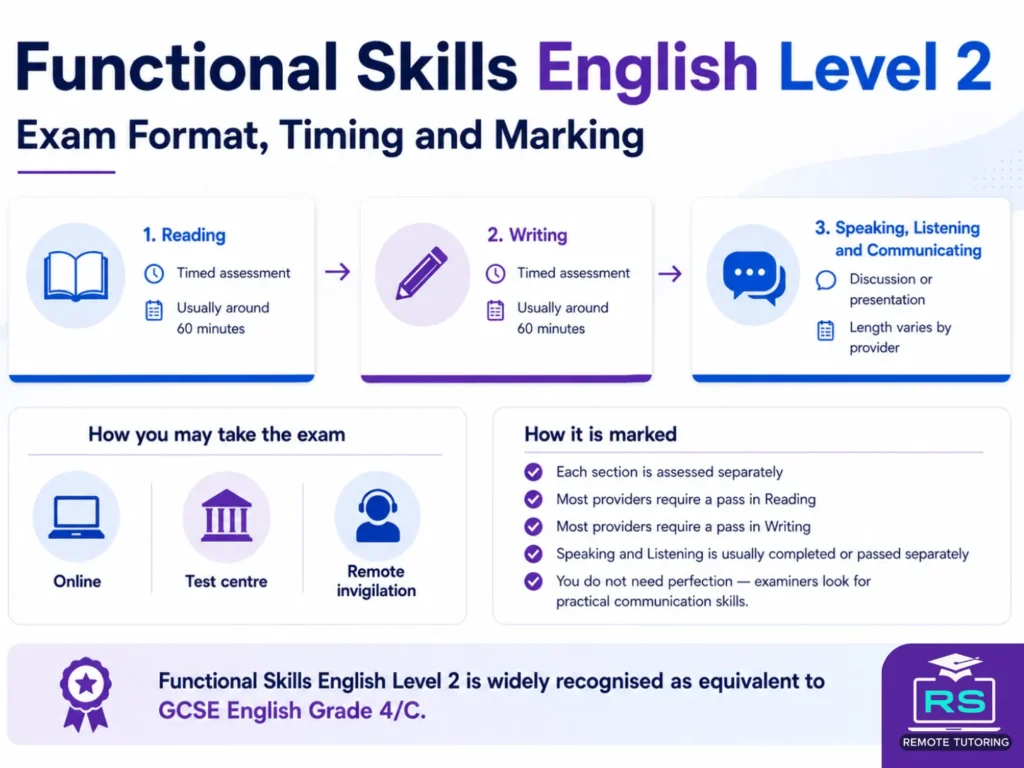
This exam is marked differently. Each section is assessed separately. Most providers require:
- Passing Reading
- Passing Writing
- Completing/passing Speaking and Listening
The exact pass mark can vary slightly depending on the exam board and assessment session.One important thing students often misunderstand is that you do not need perfection. Functional Skills assessments are competency-based. Examiners are looking for evidence that you can communicate effectively in practical situations.
Best Ways to Prepare for the Exam
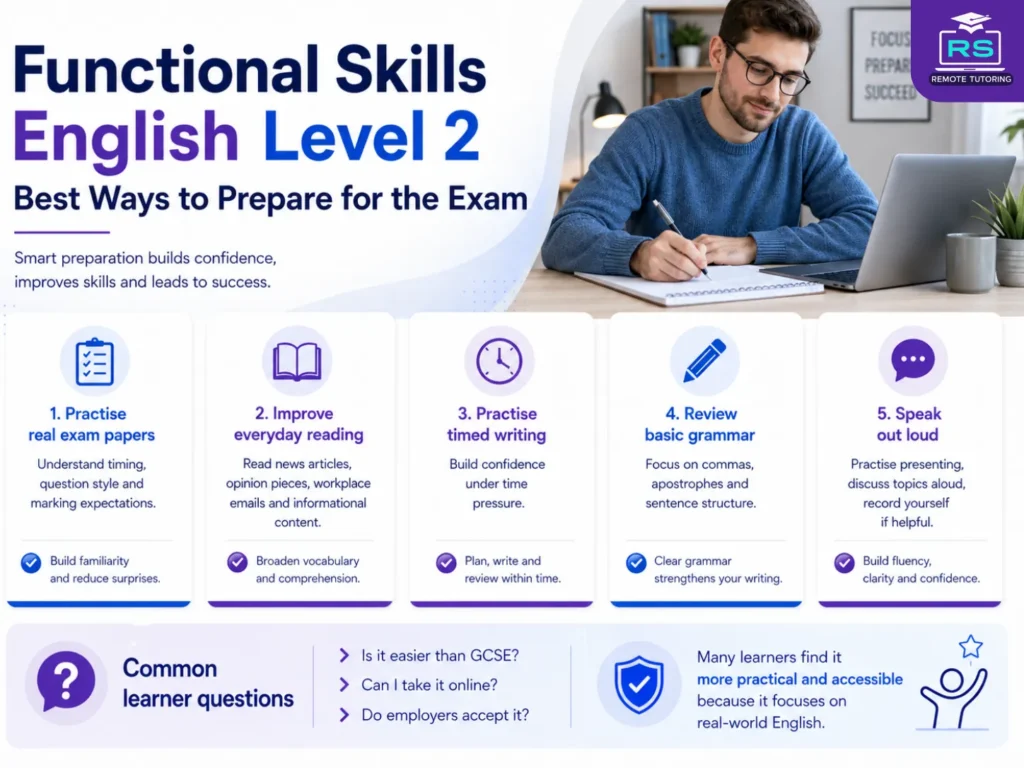
1. Practise Real Exam Papers
Practicing past papers ultimately helps to uncover what the examiner is seeking for. This helps you understand:
- Timing
- Question style
- Marking expectations
2. Improve Everyday Reading
Reading is ultimately important, most specifically for the reading exam assessment. Always Read:
- News articles
- Opinion pieces
- Workplace emails
- Informational content
3. Practise Timed Writing:Time pressure affects many students more than English itself.
4. Review Basic Grammar
Reviewing the basic grammar side by side is ultimately important. Especially:
- Commas
- Apostrophes
- Sentence structure
5. Speak Out Loud
For the SLC assessment:
- Practise presenting
- Discuss topics aloud
- Record yourself if helpful
Common Questions Students Ask Before the Exam
“Can I fail one section and still pass overall?”
Usually, no. Most providers require all main components to be passed separately.
“Is Functional Skills easier than GCSE?”
Many learners find it more practical and accessible because it focuses on real-world English rather than literature analysis.
“Do employers accept it?”
Yes. Functional Skills Level 2 is widely recognised across the UK.
“Can I take the exam online?”
Yes, many providers now offer online Functional Skills English Level 2 exams with remote invigilation.
FAQs
What is included in the Functional Skills English Level 2 exam?
The qualification normally includes three parts: Reading, Writing, and Speaking, Listening and Communicating. The reading and writing exams are timed assessments, while the speaking component is usually completed through discussion or presentation activities.
How long is the Functional Skills English Level 2 exam?
The reading exam is typically around 60 minutes, and the writing exam is usually around 60 minutes as well. The speaking and listening assessment length varies depending on the activity and provider.
Is Functional Skills English Level 2 equivalent to GCSE?
Yes. Functional Skills English Level 2 is considered equivalent to GCSE English grade 4 (previously grade C) in the UK.
What is the hardest part of the Functional Skills English Level 2 exam?
For many learners, the writing section feels hardest because it combines timing, grammar, structure, and communication skills together under exam conditions.
Can adults pass Functional Skills English Level 2 after years away from study?
Absolutely. Many adult learners successfully pass every year. One thing many students do not realise is that confidence often improves rapidly once they become familiar with the exam format and expectations.
Do I need to pass speaking and listening separately?
Most providers require completion or passing of the Speaking, Listening and Communicating component alongside the reading and writing assessments.
Final Thoughts
The Functional Skills English Level 2 exam structure becomes much less difficult once you understand what the qualification is actually trying to assess. At its core, this is a practical communication qualification. It is basically designed to test whether you can:
- Read effectively
- Write clearly
- Communicate confidently
Not whether you can produce perfect academic English. I have seen students walk into these exams convinced they would fail, only to realise afterwards that the assessment felt far more manageable than they imagined. The biggest shift usually happens when learners stop seeing the qualification as a “school English exam” and start treating it as a real-world communication test.
That mindset changes everything.

Raja specializes in Physics and Maths, with over 5 years of experience. He offers KS2, KS3, and GCSE Science and Maths lessons. He graduated from one of the top universities in the UK.