One of our learners completed fifteen past papers before her first tutoring session. Her score barely moved across all fifteen. She wasn’t short of effort: she was using papers as tests instead of teaching tools, and that single habit was holding her back.
It’s a common trap, and the numbers show why English support matters in the first place. The National Literacy Trust reports that 1 in 6 adults in England, around 6.6 million people, have very poor literacy skills. Functional Skills English Level 2 past papers are one of the best routes out of that statistic, but only when they’re used properly.
This guide covers how our tutors actually use past papers: what to do before them, the three-stage method that gets results, and the review process where the real improvement happens.
Jump to Section
What do past papers actually teach you?
Far more than your current score. Past papers show you the question styles, the command words examiners use, how much detail answers need, and how time pressure feels: the exam-craft knowledge that separates a near-miss from a comfortable pass.
Functional Skills English isn’t testing literary analysis. It tests practical communication: the reading and writing set out in the government’s Functional Skills English subject content. Papers teach you:
- How reading questions are worded, and what “identify”, “explain” and “compare” each demand
- Which text types keep appearing (articles, emails, reports, adverts, leaflets)
- What a full-mark writing answer includes that a passing one doesn’t
- How the marks split across the paper, so you know where your time should go
Familiarity is half the battle. The Level 2 exam structure stops being scary once you’ve walked through it a dozen times at your own pace.
Should you start with full papers straight away?
No. Jumping into full timed papers before your core skills are solid mostly measures how much you can’t do yet, which damages confidence without teaching much. Strengthen reading strategies, writing structure and SPaG basics first, then let papers sharpen them.
Think of it like running a marathon before building any fitness. Before leaning on papers, get comfortable with:
- Reading for meaning and separating fact from opinion
- Spotting persuasive language and the writer’s purpose
- Planning and structuring formal writing
- The punctuation and grammar rules that carry SPaG marks
The full English Level 2 topics checklist lists everything worth covering. You don’t need mastery before your first paper: you need enough foundation that mistakes teach you something specific rather than “everything”.
[Image placement: learner’s desk with printed English past paper, highlighters and notes | Alt: “Functional Skills English Level 2 past paper with highlighted command words” | Title: “Preparing an English Level 2 past paper for active review”]
What is the three-stage past paper method?
Stage one uses papers as open-book learning exercises with no timer. Stage two moves to independent practice with honest marking. Stage three simulates real exam conditions: strict timing, no notes, no interruptions. Each stage builds on the one before it.
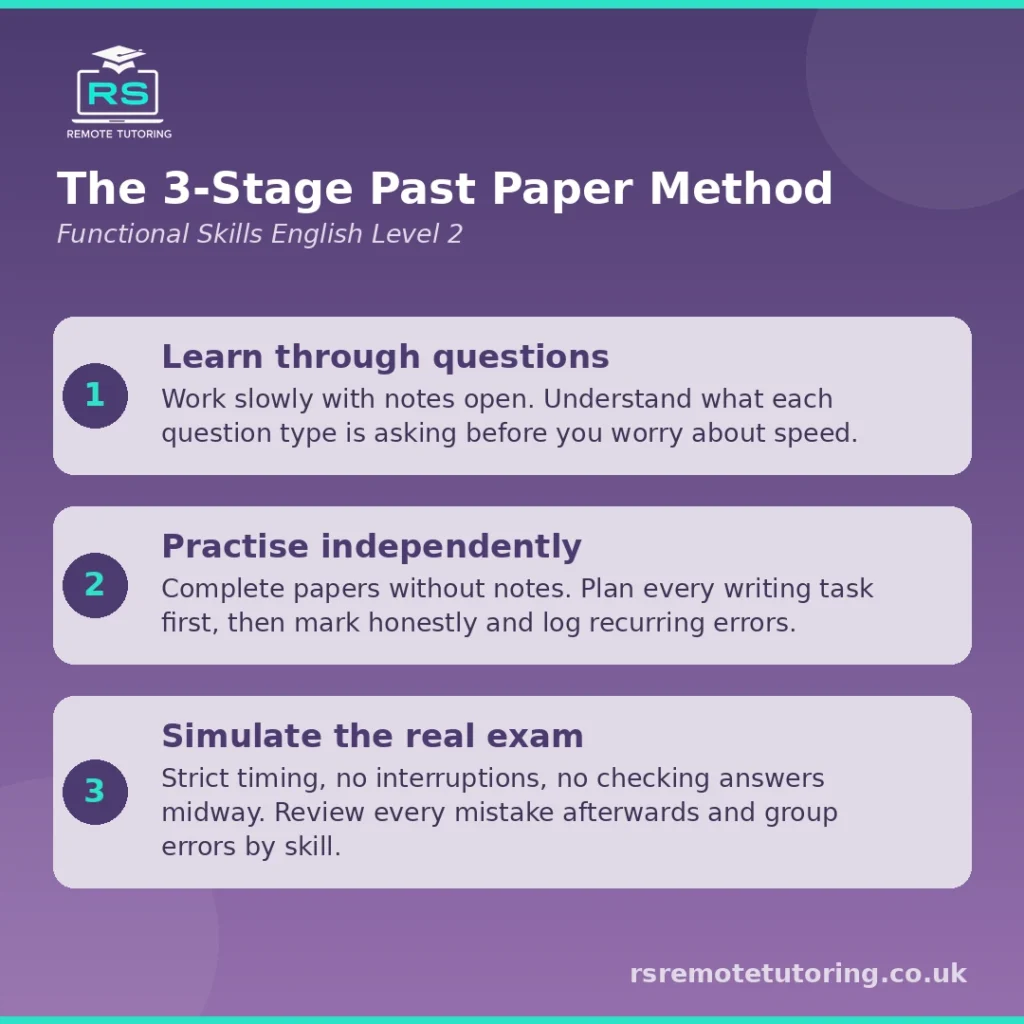
Here’s each stage in practice:
- Learn through questions. Work slowly. Check unfamiliar terms, look at mark schemes as you go, and focus on understanding what each question type wants. Speed is irrelevant here.
- Practise independently. Notes closed. Answer everything, plan every writing task before starting, then mark honestly and record what went wrong and why.
- Simulate the exam. Full timing, no interruptions, no peeking at answers midway. If your exam is on-screen, practise on-screen: our online exam guide explains what to expect.
One learner we worked with panicked constantly about timing. We removed the timer entirely for two weeks: stage one only. When the clock came back, her scores had climbed and the panic mostly hadn’t. Foundations first; speed follows.
How do you stop losing marks in the reading paper?
Read the question before the text. Most reading marks are lost through misreading the question, not misunderstanding the passage, so identify the command word and key terms first, then scan the text for evidence rather than answering from memory or instinct.
A simple process that fixes the majority of reading errors:
- Read the question and underline the command word
- Identify exactly what’s being asked (a fact? an opinion? a comparison?)
- Scan the text for the relevant section
- Highlight the supporting evidence
- Answer directly, using that evidence
The trap is instinct. Learners “remember” what the text said and answer from memory. The examiner wants what’s on the page, quoted or referenced, not your impression of it.
What makes a writing response score well?
Planning, structure and fit. High-scoring answers match the audience and purpose, follow a clear paragraph structure, and leave time for proofreading. Vocabulary showmanship matters far less than a response that does exactly the job the question set.
Before writing anything, spend three minutes answering four questions: who am I writing to, why, what tone fits, and what must be included? A formal complaint email and an article for a community newsletter need different registers, and picking the wrong one costs marks even when the writing itself is decent.
Then structure: opening that states the point, middle paragraphs that develop it one idea at a time, ending that closes it off. Nothing fancier is required at Level 2.
And proofread. Always. Two saved SPaG errors per task adds up quickly across a paper.
[Image placement: hands typing a formal email draft on a laptop with a plan on paper beside it | Alt: “Planning a formal email for the Functional Skills English writing exam” | Title: “A three-minute plan before writing improves structure and tone”]
Why is reviewing mistakes worth more than doing another paper?
Because an unreviewed paper repeats your errors; a reviewed one removes them. Sorting every lost mark into knowledge gaps, misread questions, structure problems or SPaG slips tells you precisely what to revise next, which is what actually moves scores.
Keep a simple error log after every paper:
| Question | Skill | What went wrong | Fix applied |
|---|---|---|---|
| Reading Q4 | Fact vs opinion | Gave an opinion as a fact | Re-practised with 5 similar questions |
| Writing task 1 | Tone | Too informal for a manager | Rewrote using formal openings |
| Reading Q7 | Evidence | Answered from memory | Now quoting the text directly |
Patterns appear within three or four papers. That fifteen-paper learner we mentioned? Her log showed most lost marks came from misread questions, not weak English. One targeted fix did what fifteen untargeted papers couldn’t. If you’d like a second pair of eyes on those patterns, our Functional Skills English Level 2 tutors do this analysis in every session.
How many papers should you complete, and when?
Five to eight full papers, properly reviewed, is enough for most learners: quality beats volume. Use individual questions early in revision, move to full papers in the final month, and keep the last week for review rather than new material.
A sensible timeline:
- Early revision: topic work plus individual past questions
- Middle weeks: one independent paper per week, fully reviewed
- Final month: timed simulations, error log driving the revision between them
- Final week: review the log, revisit weak spots, one confidence paper at most
Knowing the target helps too: pass marks for Level 2 typically sit around 55-65%, which most learners find far less frightening than the near-perfect score they’d imagined. For the full preparation picture beyond papers, see our guide on how to pass Functional Skills English Level 2 first time.
Frequently Asked Questions
How many Functional Skills English Level 2 past papers should I do?
Five to eight full papers with thorough review is enough for most learners. Completing more without reviewing mistakes adds little: the review stage is where scores actually improve.
Where can I get past papers for my exam board?
Awarding bodies such as Pearson Edexcel, City & Guilds, NCFE and Open Awards publish sample and past assessments on their websites. Prioritise papers from your own board so the question style matches your real exam.
Should I do papers under timed conditions?
Eventually, yes, but not at the start. Begin untimed to build understanding, then add timing once your accuracy is solid. Timed simulation belongs in the final weeks, not the first ones.
Do old papers still reflect the current exam?
Mostly. The reformed specifications have been stable since 2019, so recent papers match well. Very old papers remain useful for reading and writing practice even where formats differ slightly.
Can I pass using past papers alone?
Papers are the single most valuable resource, but they work best alongside targeted skill work: reading strategies, writing structure and SPaG. Papers reveal weaknesses; topic revision fixes them.
What if my scores aren’t improving between papers?
That almost always means the review stage is missing or too shallow. Log every lost mark by cause, fix one cause at a time, and expect movement within two to three papers.

Raja specializes in Physics and Maths, with over 5 years of experience. He offers KS2, KS3, and GCSE Science and Maths lessons. He graduated from one of the top universities in the UK.