
Sixth form car parks fill up before half seven. Someone is always sitting in the passenger seat refusing to go in, and someone else is already crying in the corridor before they’ve opened anything. That’s the texture of A-Level results day 2026, which lands on Thursday 13 August, and it is a strange few hours where a year of work turns into one line on a slip of paper.
The odds are better than the panic suggests. On results day 2025, UCAS confirmed 439,180 applicants of all ages had been accepted onto a course, up 3.1% on the previous year and the highest figure ever recorded on results day, with 82% of offer holders placed at their first choice. Most people get in. The ones who struggle are usually the ones who hadn’t thought past plan A.
This guide covers the timings, what your UCAS status really means, how Clearing works in 2026, when a remark is worth the money, and what to do if none of it goes your way.
Jump To Sections
When is A-Level results day 2026 and what time do grades come out?
A-Level results day 2026 is Thursday 13 August in England, Wales and Northern Ireland. Schools and colleges can release results from 08:00. Your UCAS Hub updates at the same time, and eligible applicants can add a Clearing choice from 13:00.
The date is set by the Joint Council for Qualifications, so it’s identical whether you sat AQA, Edexcel, OCR, WJEC or CCEA papers. GCSE results follow a week later on Thursday 20 August.
Two separate clocks run that morning, and mixing them up causes half the confusion. Your grades come from your school or college, and the exam board will not give them to you directly. Your UCAS status comes from the UCAS Hub, and it shows the decision on your application, not your marks.
How you’ll actually get them
Most centres open a hall or reception from 8am and hand out a printed statement of results. Some use an online portal that unlocks at the same time. A few will email or post them if you’ve arranged it in advance.
Go in person if you can. If something has gone wrong, the people who can fix it fastest are standing in that hall: your exams officer, your subject teachers, your head of sixth form. Trying to sort a priority remark over WhatsApp from a campsite in Cornwall is genuinely miserable.
What about Scotland, the IB and BTECs?
Qualifications Scotland results come out earlier, on 4 August 2026, and Scottish applicants can add a Clearing choice from 10:00 that day. International Baccalaureate results are published on 6 July. Most Level 3 vocational results, including BTECs, T Levels and Cambridge Technicals, arrive on or before 13 August, though some centres get them a little earlier, and universities treat them exactly like A-Levels when confirming a place. If you’re weighing up the two routes for a sibling or a resit year, we’ve compared BTECs against the academic route in more detail.

What does your UCAS status mean on results day?
Your UCAS Hub shows one of a handful of outcomes: unconditional firm (you’re in), unconditional insurance (you’re in at your backup), unsuccessful with a Clearing number, or no change yet. It shows decisions only, never your actual grades.
Unconditional firm means your first choice has confirmed you. Nothing more to do except accommodation and student finance.
Unconditional insurance means you missed your firm but met your insurance conditions. You’re placed there. You can still decline and go into Clearing, but think carefully first, for the reasons in the self-releasing section below.
No decision showing is the one that causes the most anxiety and usually means the least. Universities process results in batches. A blank status at 08:15 is often just a queue.
Unsuccessful at both, with a Clearing number means you’re free to find something else. It is not a disaster. Around 27,000 courses were listed in Clearing on results day 2025.
One thing worth knowing before you refresh for the ninth time: a university can still accept you with grades below your offer. It happens constantly, especially where you’ve narrowly missed one grade. Give them time to decide before you assume the worst.
What should you do in the first hour if you’ve missed your offer?
Slow down. The first hour is for gathering information, not making decisions. Get your actual grades, check your UCAS status, then talk to a teacher before you phone anyone. Clearing runs until October, so you are not racing a clock that morning.
Here’s a sequence that works:
- Get your printed grades. Not the UCAS status, but the marks per subject. You need to know how close you were.
- Check your UCAS Hub for a confirmed place, an insurance place, or a Clearing number.
- Ask your firm choice directly whether they’ll still take you. One phone call. They may say yes.
- Speak to your subject teacher about how close you were to the next grade boundary. Boundaries shift every year with the difficulty of the paper, which is why how grade boundaries are set matters more than most students realise. This decides whether a remark is worth pursuing.
- Ask your exams officer about a priority review of marking if a university place hinges on it. Only your centre can submit it.
- Write down your fallback courses, usually the other four on your original UCAS application, since you already researched them.
- Then start calling universities with vacancies.
Have your UCAS Personal ID, Clearing number, grades and a pen ready before you dial. Admissions staff ask for all four, and fumbling for them while on hold does not help.
How does UCAS Clearing work in 2026?
Clearing matches applicants without a place to courses with vacancies. It opened on 2 July 2026 and closes for new Clearing choices on 19 October. You search for courses, phone the university yourself, get verbal approval, then add the choice in your UCAS Hub.
The order matters and people get it wrong. Do not add a Clearing choice until the university has told you to. You only get one live choice at a time, so adding it without permission wastes it and slows everything down.
Who can use Clearing
- You applied and hold no offers
- You didn’t meet the conditions of your firm or insurance offer
- You applied after 30 June 2026, so you went straight into Clearing
- You’ve declined a place you were holding
Self-releasing: the button to be careful with
If you hold an unconditional firm place and want something else, there’s a “Decline my place” option in your application. Use it and your place is gone. There’s no reversing it, and the university is under no obligation to take you back.
I’d only self-release with a verbal offer already in hand from somewhere you actually want to go. Trading up is real, and thousands do it every August, but doing it on a hunch at 9am is how people end up somewhere worse than where they started.
What to say on the phone
Keep it short and factual. Name, UCAS ID, Clearing number, the course you’re calling about, your grades subject by subject. If they ask why you want the course, have two sentences ready. Admissions tutors on Clearing lines are making quick judgements, and rambling doesn’t help you.
Ask before you hang up: is that offer confirmed, how long do I have, and is accommodation still available?
When is an A-Level remark actually worth it?
A remark is worth it when you’re a few marks below a grade boundary in a subject where marking is more subjective, such as essay papers rather than multiple choice. It’s rarely worth it when you’re twenty marks off. Ask your teacher to check the raw marks first.
The official name is a review of marking. A reviewer rechecks whether the mark scheme was applied correctly. It is not a fresh marking of your paper, and reviewers can only raise a mark where the original marker made an identifiable error, not because a second examiner would have been a bit more generous. Understanding how examiners apply a mark scheme is the single best predictor of whether a review will go anywhere.
The Ofqual data is worth knowing before you spend anything. In summer 2025, 58,830 AS and A-Level grades were challenged and 14,150 of them changed, which is 24.1%. Of all challenged grades, 24.0% went up and fewer than 0.1% went down. Across the whole cohort, 14.8% of the 336,045 students receiving AS or A-Level results had a grade challenged, and 4.0% had one changed (Ofqual, GOV.UK).
So roughly one in four challenges works. Not a lottery ticket, not a formality.
Get the script first, where there’s time
Access to Scripts lets your centre request a copy of your marked paper, free of charge, so a teacher can see where marks were lost before you commit to a review. For A-Levels in summer 2026, the deadline for a script copy to support a review of marking is 27 August.
The catch is timing. If a university place depends on the outcome, you can’t wait for a script, because the priority deadline is 20 August. In that case your teacher makes a judgement from your marks alone. The process runs almost identically at GCSE, and our walkthrough of challenging a result and requesting a remark covers the paperwork side in more depth if you’re supporting a younger sibling through the same thing on 20 August.
There’s no grade protection
Marks can be raised, confirmed or lowered. Boards state this plainly, and every candidate has to give written consent before a request goes in. In practice downgrades are vanishingly rare, but it isn’t a free roll of the dice, and anyone telling you it is hasn’t read the paperwork.
How much do A-Level remarks cost in 2026, and when are the deadlines?
Priority reviews of marking must reach the exam board by 20 August 2026 and cost roughly £60–£84 per component. Standard reviews close on 24 September 2026 and cost around £51–£68. Most boards waive or refund the fee if the grade changes.
| Service | Deadline | AQA | OCR | Pearson (Edexcel) | WJEC |
| Clerical re-check (Service 1/1a) | 24 Sep 2026 | £9.70 | £12.00 | £14.00 | £11.00 |
| Review of marking (Service 2/2a) | 24 Sep 2026 | £51.95 | £67.75 | £57.00 (£72.00 with script) | £51.00 |
| Priority review of marking (2P/2Pa) | 20 Aug 2026 | £61.70 | £83.50 | £68.00 (£83.00 with script) | £60.00 |
| Copy of script to support a review (ATS A1) | 27 Aug 2026 | Free | Free | Free | Free |
| Copy of script for teaching (ATS A2) | 24 Sep 2026 | Free | Free | Free | Free |
Summer 2026 A-Level post-results fees as published by exam centres. Confirm exact charges with your exams officer, because some schools add an admin fee, and BTEC and Cambridge Technical units are priced separately.
Three things people don’t expect. Only your school or college can submit a request, so a private candidate has to go through their entry centre. Written student consent is required first. And a priority review is only available where a higher education place actually depends on the outcome, and everything else goes through the standard route, as set out in the JCQ post-results services guidance.
Turnaround: priority reviews are completed within 15 calendar days of the board receiving the request; standard reviews can take up to 20. A clerical re-check, which just confirms every page was marked and the marks were added up correctly, is quicker and much cheaper, and it’s the right first step if you suspect an administrative slip rather than a marking judgement.
What can you do if the remark doesn’t change anything?
Yes, but it’s a narrow route. After a review of marking, your centre can submit a Stage 1 appeal to the exam board, then request a Stage 2 appeal hearing. Ofqual’s Exam Procedures Review Service is the final step, and it only checks that procedures were followed.
Appeals aren’t a second remark. They test whether the board made a procedural error or reached an unreasonable academic judgement, and “unreasonable” has a high bar, meaning a mark no reasonable examiner could have given.
They also cost more. Stage 1 appeals run to around £133 and Stage 2 around £228 with AQA, on top of what you’ve already paid for the review.
Most schools will be reluctant, and honestly they’re often right to be. If the review has already confirmed the marking, an appeal rarely shifts it. The energy is usually better spent on Clearing, a resit plan, or negotiating with the university directly, since a deferred place for 2027 is sometimes easier to secure than a grade change.
If your university has already filled the course by the time a remark comes through, they are not obliged to hold a place open. Tell them a priority review is in progress on the day you find out. Some will hold; some won’t. Asking early costs nothing.
Which dates should be in your calendar after 13 August?
Results day is the start of a two-month window, not the end of one. The deadlines that catch people out are 20 August for priority remarks, 2 September for outstanding offer conditions, and 19 October for adding a Clearing choice.
| Date (2026) | What happens |
| 4 August | Qualifications Scotland results; Clearing choices from 10:00 |
| 13 August | A-Level and Level 3 results; UCAS Hub from 08:00; Clearing choices from 13:00 |
| 20 August | GCSE results day, and deadline for priority reviews of marking |
| 27 August | Deadline for a free script copy to support a review of marking |
| 2 September | Remaining offer conditions must be met; last day to use “Decline my place” |
| 24 September | Final date to submit a 2026 UCAS application (18:00); standard remark deadline |
| 19 October | Last date to add a Clearing choice |
| 21 October | Last date for universities to make Clearing decisions |
Source: UCAS Confirmation and Clearing 2026 key dates.
If you’re holding GCSE conditions as part of an offer, which is common for maths and English requirements, you’ll need to send those results to the university yourself when GCSE results day 2026 arrives on 20 August. UCAS doesn’t forward them. And if a grade 4 in maths or English is the thing standing between you and the course, targeted resit tutoring in the autumn is usually a faster fix than appealing.
What if university isn’t happening this year?
Not getting a place in 2026 isn’t a closed door. Resitting in summer 2027, reapplying with achieved grades, taking a degree apprenticeship, or starting on a foundation year are all routes that end in the same place, just on a different timeline.
Resits. A-Level resits sit in the summer 2027 series, so this is a year-long commitment. Check the A-Level exam and resit dates before you plan anything around it. The advantage is that you reapply with real grades rather than predictions, which removes most of the uncertainty from the process. Targeted work on the two or three topics that actually cost you the marks is far more efficient than repeating the whole syllabus, and a proper month-by-month preparation plan is what separates a productive resit year from a wasted one.
Reapplying in a gap year. Apply in autumn 2026 for 2027 entry. Work experience, a job, or a resit all strengthen the application, and applying with achieved grades often opens doors that predicted grades didn’t.
Degree apprenticeships. You earn while you study and finish without the tuition debt. Competition is genuinely stiff and the deadlines don’t align with UCAS, so start looking now rather than in January.
Foundation years. A four-year degree with a built-in preparatory year. Entry requirements are lower and many are still available in Clearing.
The students who recover fastest tend to be the ones who make a decision within a fortnight and commit to it. Drifting until October is what turns a setback into a lost year. If a resit is on the table, our one-to-one A-Level tutoring is built around exactly that problem, closing specific gaps rather than re-teaching a course you already sat, and a free trial lesson is a low-stakes way to work out whether the plan is realistic before you commit to it.
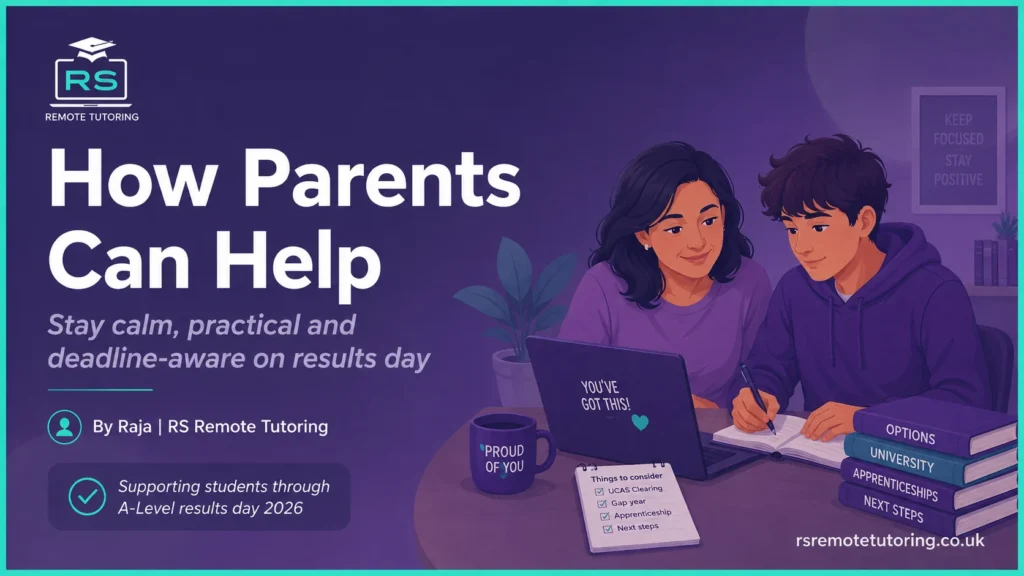
What parents can usefully do
Very little on the morning itself, which is the hard part.
Don’t ring round relatives before your teenager has processed it. Don’t compare with siblings. Don’t suggest a remark within ten minutes of seeing the grades, because you don’t have the mark breakdown yet, and neither do they.
What does help: driving them in, having the UCAS login details written down somewhere, and knowing the deadlines in the table above so nobody misses 20 August while everyone’s still upset. Practical beats reassuring on results day.
If the reaction is bigger than the grades warrant, that’s usually months of accumulated pressure surfacing rather than a verdict on the results themselves, and the same exam-related anxiety that built through the spring doesn’t disappear the moment the papers are over. Give it a day before anyone makes decisions.
Frequently Asked Questions
What time do A-Level results come out in 2026?
From 08:00 on Thursday 13 August 2026. Your school or college sets its own opening time, and some open earlier. UCAS Hub also updates from 08:00, though it shows your application decision rather than your grades.
Does UCAS show my A-Level grades?
No. UCAS shows whether your place is confirmed, whether you’re at your insurance choice, or whether you’re in Clearing. Your actual grades come only from your school or college’s statement of results.
Can I get into my firm choice with lower grades?
Sometimes, yes. Universities regularly confirm places for applicants who missed by one grade, particularly where the course is undersubscribed. Wait for your UCAS status to update, then phone the admissions office directly to ask.
How long does an A-Level remark take in 2026?
Priority reviews of marking are completed within 15 calendar days of the exam board receiving the request. Standard reviews take up to 20 calendar days. Clerical re-checks are faster, usually returning within about 10 days.
Can my A-Level grade go down after a remark?
Yes, in principle, because there is no grade protection, and marks can be lowered, confirmed or raised. In practice it’s rare: Ofqual recorded fewer than 0.1% of challenged AS and A-Level grades going down in summer 2025.
When does Clearing close for 2026 entry?
You can add a Clearing choice until 19 October 2026, and universities can make decisions until 21 October. The final date to submit any new 2026 UCAS application is 24 September at 18:00.
Can I apply for a remark myself as a private candidate?
No. Only the entering centre can submit a request, so private candidates must go through the school or college that entered them. Written candidate consent is required before any request is made.

Raja specializes in Physics and Maths, with over 5 years of experience. He offers KS2, KS3, and GCSE Science and Maths lessons. He graduated from one of the top universities in the UK.





1 Comment
[…] were, because that decides whether a review of marking is worth the money. Our full walkthrough of results day timings, UCAS statuses and remark deadlines covers the mechanics, including the 20 August priority deadline that catches people […]