
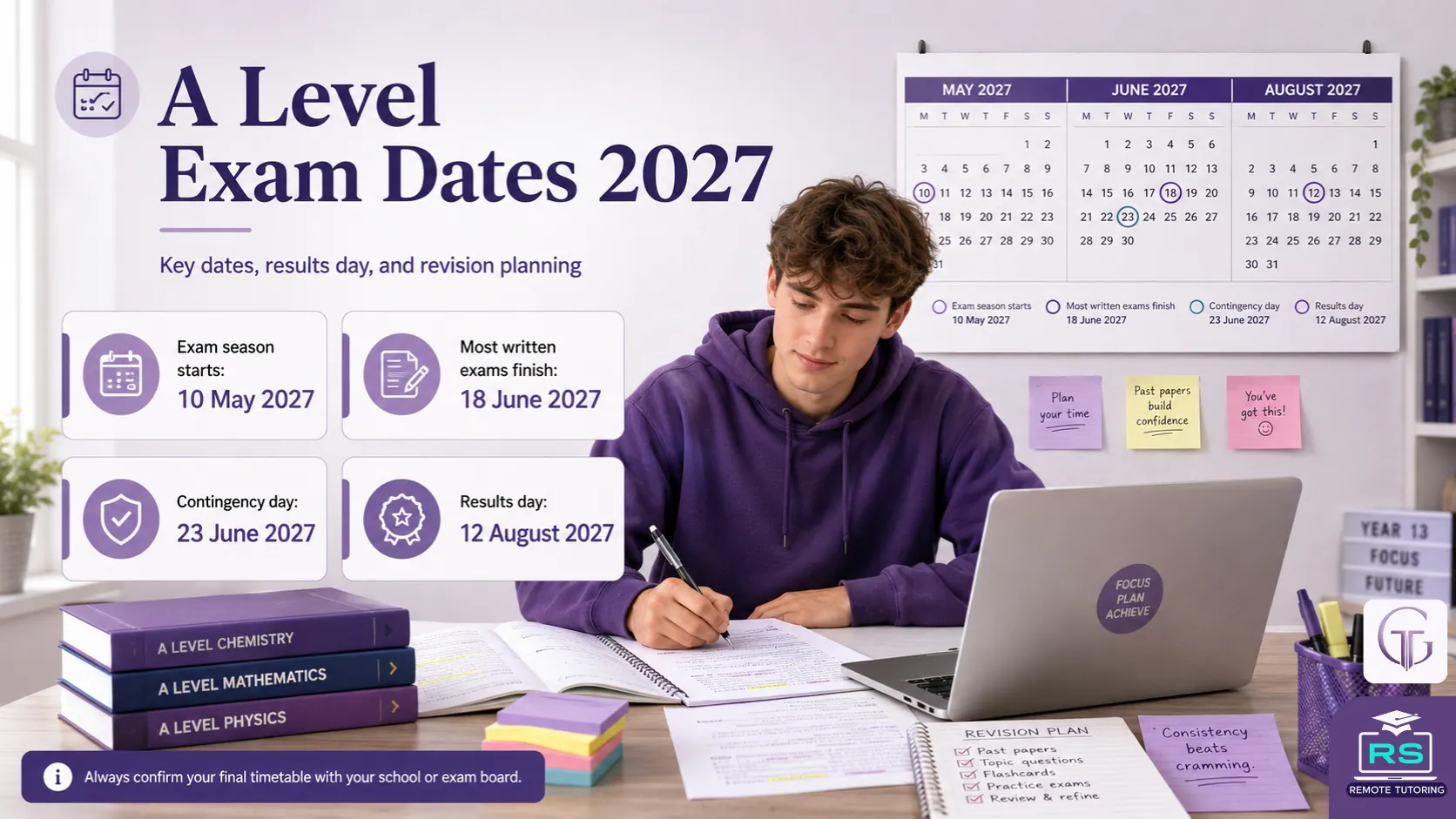
A Level exam dates can change if an exam board updates its timetable. Always check your final timetable with your school, college, exam centre or the official exam board website before making travel, revision or exam‑day plans. RS Remote Tutoring’s 2026 exam dates guide helped many students get organised and reduce last‑minute stress. This updated 2027 guide continues that mission with clear information and calm tutor‑led advice.
A Level Exam Season 2027 at a Glance
- Expected exam window: Most A‑Level exam boards currently schedule the first written papers on Monday 10 May 2027. Provisional guidance from private‑candidate services suggests exams may finish around Friday 18 June 2027.
- Contingency day: The Joint Council for Qualifications (JCQ) has designated Wednesday 23 June 2027 as the contingency day. Students must remain available until this date in case exams need to be moved due to national disruption.
- Results day: According to AQA’s timetable notes, results will be released to schools on 11 August 2027 and to students on Thursday 12 August 2027. International A‑Level students (OxfordAQA) will receive their results earlier on 28 July 2027.
These dates remain provisional. Final timetables from exam boards are usually confirmed by early 2027.
Table 1: 2027 Exam Board Timetable Status
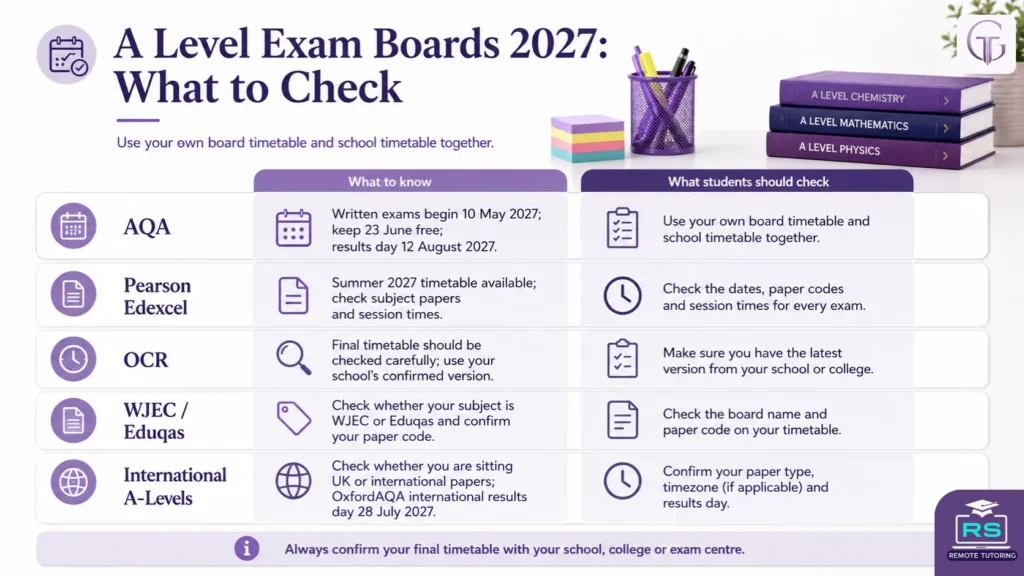
| Exam Board | Timetable Type (as of June 2026) | What Students Should Check | Official Sources |
| AQA | Provisional May/June 2027 timetable published; includes start date (10 May), contingency day and results day. | Confirm your specific subjects once the final timetable is released. Check the “Exam Timetable May/June 2027” PDF and your school’s personalised timetable. | AQA provisional timetable and exam timetable notes. |
| Pearson Edexcel (GCE) | Provisional summer 2027 timetable; first exams on 10 May. | Use the week‑by‑week tables in the provisional PDF and look for updates. Edexcel’s final timetables are usually issued via the exam‑centre portal. | Edexcel GCE summer 2027 provisional timetable. |
| OCR | June 2027 AS/A‑Level timetable labelled “to follow shortly” (republished May 2026 after corrections). | Wait for the final PDF; use your school’s internal timetable when available. | OCR key dates page. |
| WJEC/Eduqas | Provisional summer 2027 timetable published; morning and afternoon sessions for 10 May onward; contingency sessions on 23 June. | Check whether your subject is a Wales (blue) or Eduqas (orange) paper and confirm final details. | WJEC/Eduqas provisional timetable. |
| International A‑Levels (OxfordAQA/Edexcel) | Separate timetables for January and May/June series; January 2027 timetable is final and May/June is provisional. International results day is 28 July 2027. | If you’re taking the international syllabus, check the international timetable and release dates on your exam board’s global site. | OxfordAQA press release; Edexcel IAL January timetable. |
Jump to Section
What Are the 2027 A‑Level Exam Dates?
The main A‑Level exam season in the UK typically runs from mid‑May to mid‑June. According to AQA’s provisional timetable, the first written exams start on Monday 10 May 2027. Pearson Edexcel’s provisional GCE timetable also lists Monday 10 May as the first day, and WJEC/Eduqas begins the same week.
Why the Dates Are Provisional
The timetables released so far are labelled “provisional.” Exam boards sometimes change dates when they finalise timetables or adjust for unforeseen circumstances. On 27 May 2026, for example, OCR republished its June 2027 timetable to correct set texts. As a tutor, I always encourage students to treat early timetables as guides, not as fixed schedules. When I first started supporting A‑Level students, I learned quickly that exam boards occasionally adjust papers by a day or two. It’s inconvenient, but it’s better to be aware of that possibility now rather than relying on a single document.
Exam Window Overview
- Week beginning 10 May 2027: Early papers include AS Chemistry, A‑Level Economics, English Language, Spanish, Psychology and Further Maths.
- Mid‑May to early June: Science and humanities subjects continue. For example, AQA lists Physics Paper 2 on 18 May.
- Late June: Most exam boards finish written papers by 18 June 2027. However, keep Wednesday 23 June free in case the contingency day is needed.
AS exams often occupy the same slots as A‑Levels but are labelled separately. Even though AS qualifications no longer contribute to the final A‑Level grade for most subjects, they still follow the same exam season.
Are the 2027 Exam Dates Final or Provisional?
At the time of writing (June 2026), all major exam boards have released provisional timetables. Provisional means:
- Subject to change: Boards may adjust dates and times if they discover clashes or need to align with other boards.
- Not yet approved by regulators: Final approval usually occurs in autumn or winter of the preceding academic year (late 2026/early 2027).
- Students must check updates: Schools and colleges will issue personalised timetables when entries are confirmed.
Therefore, don’t treat any provisional date as fixed. Instead, use it to plan your revision schedule and keep an eye on updates from your exam board.
Exam Board‑by‑Exam Board Guidance
AQA (England & Wales)
- Start & end: Provisional AQA timetables show exams starting 10 May 2027. Some practical components (e.g. language speaking tests) run earlier between 19 April and 28 May 2027.
- Contingency day: AQA designates 23 June 2027 as the contingency day. You must be available until this date.
- Results: Results will be sent electronically to schools on 11 August 2027 and released to students on Thursday 12 August 2027.
- Submission deadlines: Coursework and NEA submissions are due 15 May 2027 for most subjects, with Art & Design deadlines on 31 May. These deadlines affect retake planning.
From experience, my A‑Level Physics students often forget that NEA marks must be finalized well before exams. Don’t leave practical write‑ups until the last minute, teachers need time to mark and moderate them.
Pearson Edexcel (GCE)
- Start & end: Edexcel’s summer 2027 provisional timetable also begins on 10 May and includes core papers such as English Language & Literature and Economics on that date.
- Timetable notes: The published starting time for UK centres is either 9:00 am or 1:30 pm, but centres may vary start times slightly (between 8:30 - 9:30 am or 1:00 - 2:00 pm).
- Key dates: Edexcel directs schools to its information manual for key dates, including results and pre‑released materials. Historically, Edexcel’s results day aligns with AQA’s (mid‑August), but international versions differ.
Edexcel often publishes final timetables earlier than other boards. Keep checking your exam officer’s updates.
OCR
- Status: OCR’s June 2027 AS/A‑Level timetable is pending. Their key‑dates page notes that the timetable is “to follow shortly” and was republished in May 2026 to correct the set texts for Drama and Theatre.
- Recommendation: If you study an OCR subject, anticipate a similar exam window (mid‑May to mid‑June) but do not commit to any provisional date until the final timetable is released.
WJEC & Eduqas (Wales and England)
- Start & end: The WJEC/Eduqas provisional timetable lists multiple AS and A‑Level papers beginning 10 May. Welsh GCE subjects are shown in blue; Eduqas (used in English centres) in orange.
- Contingency sessions: WJEC/Eduqas emphasises that both the morning and afternoon of 23 June 2027 are contingency sessions.
- Plan ahead: Colour coding means you must check whether your subject is the Wales or Eduqas version, as some subject codes differ.
International A‑Levels (OxfordAQA & Pearson Edexcel IAL)
- Different dates: International students should be aware that some boards have separate January, May/June and October/November series. The January 2027 IAL timetable is already finalised, and the May/June timetable is provisional.
- Earlier results: OxfordAQA has announced that International AS/A‑Level results day will be 28 July 2027 about two weeks earlier than the UK results day.
- Time zones: Exam start times vary by country; your centre will tell you the local time for each paper.
If you’re taking UK A‑Levels while living overseas (common for international schools), confirm whether you sit the UK or international syllabus.
A Level Results Day 2027
UK A‑Level results are expected on Thursday 12 August 2027, with electronic release to schools on 11 August. On results day:
- Schools/colleges often open early (around 8 am) so students can collect results.
- UCAS Track usually updates mid‑morning to show whether your university place has been confirmed.
- Remark deadlines and resit enquiries typically open immediately, talk to your teachers if you need advice.
International A‑Level students (OxfordAQA) will receive results on 28 July 2027, giving extra time for university decisions.
How to Check Your Exact Exam Dates
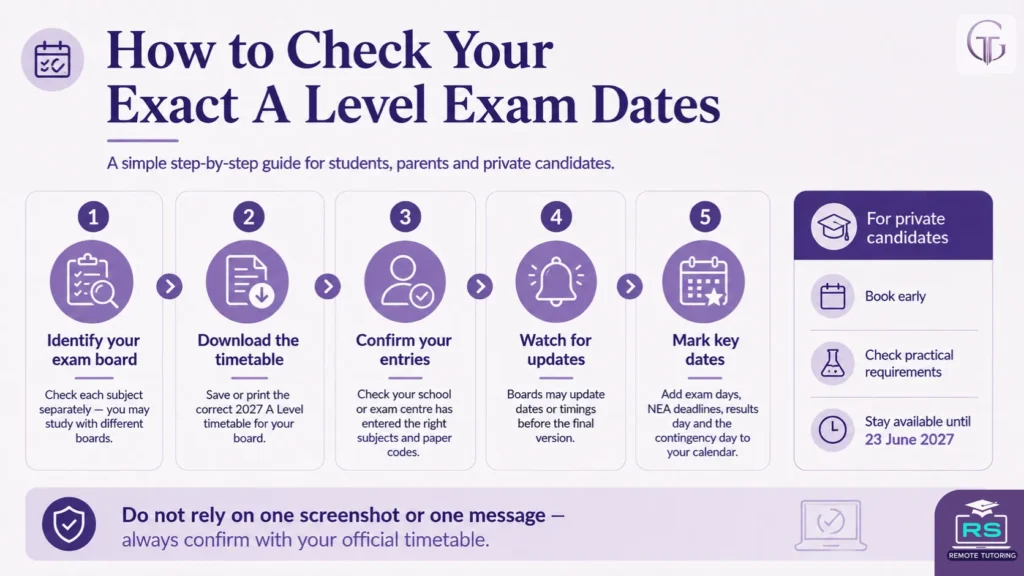
- Identify your exam board(s): You might take AQA Maths but Edexcel Economics. Use the exam board code on your course specification.
- Download the provisional timetable: Links to each board’s provisional timetable are provided in Table 1. Print or save the relevant pages for your subjects.
- Confirm entries with your school or centre: Schools finalise entries early in the spring term, and exam officers prepare personalised timetables. Check your exam number and subject codes match the provisional list.
- Watch for updates: Boards usually release final timetables between October 2026 and February 2027. Teachers will circulate changes, listen carefully and update your calendar.
- Consider practical/NEA dates: Some subjects (e.g. languages, Drama, Art) have assessment windows that run earlier in spring. Mark these in your diary.
One thing I didn’t expect in my early years of tutoring was how easily students confuse AS and A‑Level papers. Always check that you’re looking at the correct qualification code.
What If Two Exams Clash?
Exam clashes occur when two papers are scheduled at the same time. The JCQ guidance allows centres to rearrange papers within the same day. If you have a clash:
- Inform your exams officer early: They will schedule one paper for the morning and the other for the afternoon.
- Stay under supervision: Candidates cannot leave the centre or communicate with anyone between papers; a supervised break is provided.
- Avoid planning evening commitments: A clash may make your exam day longer.
Schools handle these arrangements regularly. I remember a Year 13 student who had both Physics and Business papers on the same morning; her school moved one paper to the afternoon, and she spent the lunch break in a supervised room doing quiet revision.
A Level Exam Dates 2027 for Private Candidates
Private candidates (students not enrolled in a school or college) must organise their own entry through an exam centre.
Key points
- Registration deadlines: Private‑candidate services such as Pass A Level suggest registering by mid‑February 2027. Some centres set earlier internal deadlines.
- Exam window: First day of exams is provisionally Monday 10 May 2027 and the last day Friday 18 June 2027. You must be available for the contingency day on 23 June.
- Fees: Expect to pay entry fees per paper plus centre administration fees. Science subjects may require practical endorsements; ensure your centre offers these.
- Centre locations: Book early to secure a centre near you, especially if you need specific boards (AQA, Edexcel, OCR).
- Results: Private candidates receive results through their centre on the same day as school students (12 August).
In my experience, private candidates who contact centres early have more choice and less stress. Once, a student preparing independently for A‑Level Physics struggled to find a centre for the practical endorsement because he left it until March. We had to find a centre further away that still had places.
When Should You Start Revising for 2027 Exams?
Revision should be a long‑term process, not a last‑minute sprint. Here are some guidelines I share with my students:
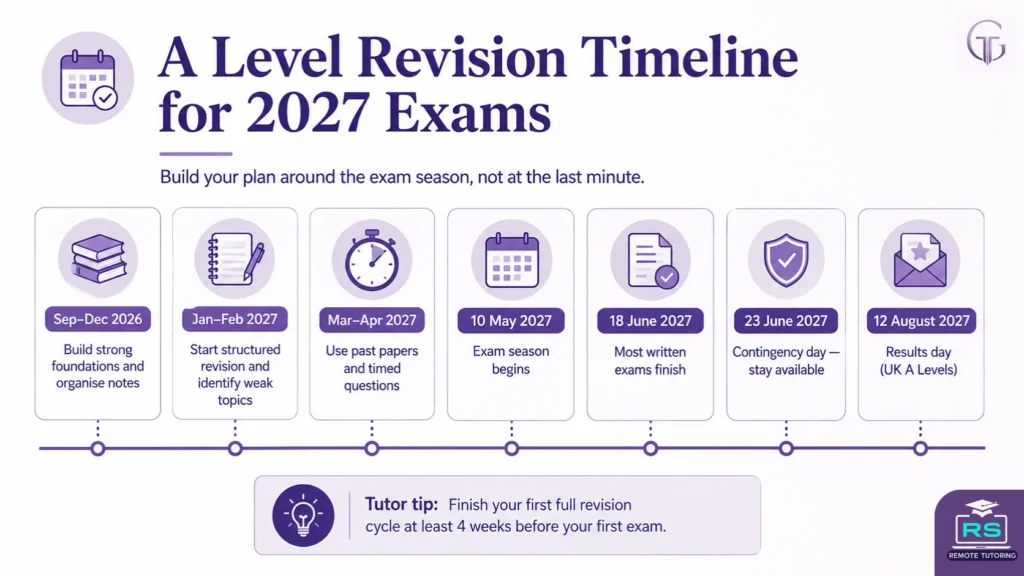
- Year 12 (Lower Sixth): Use Year 12 to build strong foundations. Start targeted A‑Level revision in January of Year 12 for end‑of‑year assessments and consider drafting your personal revision timetable for Year 13.
- Summer 2026: Consolidate Year 12 material. Spend a portion of your summer break reviewing notes and practising core topics.
- Autumn 2026 (Year 13): Begin serious revision. Aim to revisit every topic at least twice before Christmas.
- February to April 2027: Increase exam‑style practice. Use past papers, timed questions and mark schemes.
- April to May 2027: Finalise your revision timetable around the official exam dates. Focus on refining exam technique and addressing weak areas.
Building an A‑Level Revision Timetable Around Exam Dates
Here is a simple approach:
- List your subjects and topics: Break each subject into units or modules.
- Mark key dates: Write down the provisional exam date for each paper and the contingency day.
- Work backwards: Plan to finish your first full cycle of revision at least four weeks before the first exam.
- Mix subjects: Avoid spending entire days on one subject. Rotate between essay‑based and problem‑solving subjects to stay fresh.
- Include rest: Schedule days off and time for exercise and sleep. Burnout hinders performance.
- Review and adjust: Adapt your timetable as you receive mocks or feedback from teachers.
I noticed the biggest improvements when students kept their revision timetables flexible. One student shifted extra sessions to Chemistry after a weak mock paper and improved his grade dramatically.
Subject‑by‑Subject Revision Planning
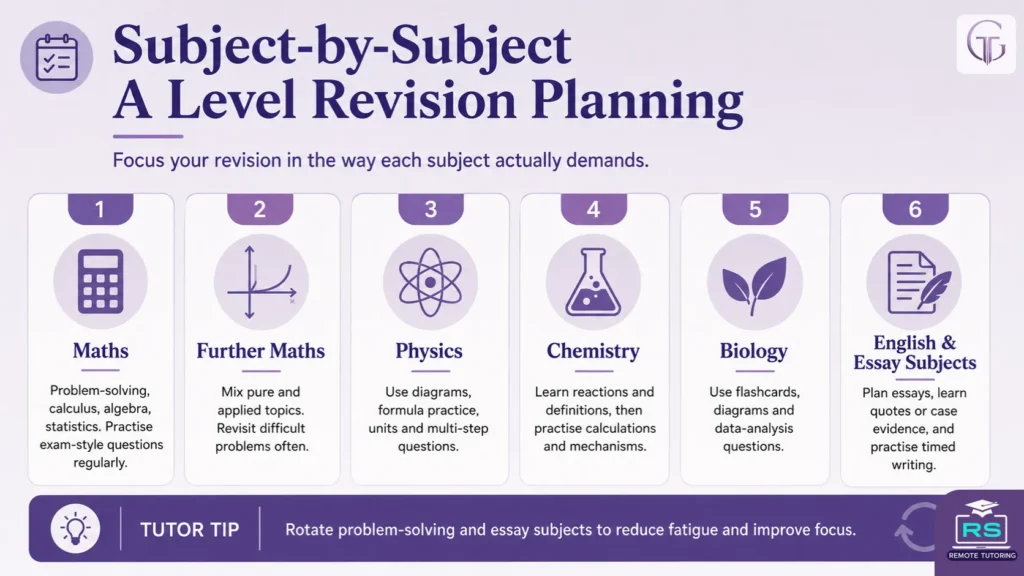
Table 2: Subject‑Specific Revision Tips
| A Level Subject | Main Revision Focus | Best Preparation Method | Tutor Tip |
| Maths | Problem‑solving, algebra, calculus, statistics. | Complete plenty of exam‑style questions; check solutions and understand mistakes. | Use formula booklets correctly and practise without calculators for non‑calc papers. |
| Further Maths | Complex numbers, matrices, mechanics, statistics. | Tackle challenging questions early; mix pure and applied topics each week. | Create a “difficult problems” journal; revisit these regularly. |
| Physics | Mechanics, electricity, waves, quantum physics. | Combine theory notes with calculation practice. Use diagrams and annotate past‑paper questions. | Use formula triangles and check units. Practise multi‑step questions. |
| Chemistry | Organic mechanisms, physical equilibria, inorganic trends. | Produce summary tables of reactions and conditions; practise multi‑part calculation questions. | Learn definitions verbatim (e.g., enthalpy change) and practise balancing equations. |
| Biology | Cell processes, physiology, genetics, ecology. | Create concise flashcards; explain processes aloud; tackle essay‑style questions if applicable. | Use diagrams to memorise cycles and practise data‑analysis questions. |
| English Literature/Language | Text analysis, critical essays, language frameworks. | Re‑read set texts; write timed essays; learn key quotes and techniques. | Plan essay structures; practise linking analysis to context; get feedback. |
| Psychology | Approaches, research methods, topics (memory, attachment). | Make mind maps; learn studies (name, year, findings); practise applying theories to scenarios. | Use acronyms to recall evaluation points; practise research‑methods questions. |
| Business/Economics | Markets, operations, finance, macro/micro topics. | Learn formulae; practise calculations; follow current events to apply theory. | Use real‑world examples in essays; practise data‑response questions. |
A Level Maths Exam Preparation
Maths requires continuous practice. Work through past papers systematically, start with open‑book attempts, then move to timed, closed‑book conditions. Remember that AQA provides formula booklets for AS/A‑Level and Further Maths; you cannot bring annotated copies into the exam. Familiarise yourself with these booklets early so you’re not wasting time flipping through them on exam day.
A Level Physics Exam Preparation
Physics papers combine theory with problem‑solving. Students often know formulas but struggle to apply them. From experience, drawing diagrams for mechanics and circuits helps clarify questions. Use mark schemes to learn how examiners expect you to set out working, and don’t forget the importance of units and significant figures.
A Level Chemistry & Biology
Chemistry demands both factual recall and calculation. Summarise organic mechanisms and practise multi‑step calculations. Biology involves large volumes of content; flashcards and spaced repetition can help, but you also need to practise applying knowledge to unfamiliar contexts. Many students underestimate data‑analysis and maths questions in Biology, incorporate them into your revision.
A Level English & Essay‑Based Subjects
Essay‑based subjects require structured argument, critical analysis and evidence. Practise planning essays using past questions. My students who created detailed essay plans before writing often saw large improvements. Also, memorise key quotes and learn how to integrate them naturally into your argument. Time management is critical, practise writing full essays under timed conditions to develop a sense of pacing.
Common Mistakes Students Make with Exam Timetables
- Not checking the final timetable: Many students assume provisional dates are final. Always check for updates and compare with your school’s confirmed timetable.
- Ignoring the contingency day: The 23 June contingency day exists for a reason. Don’t schedule holidays or work until after this date.
- Overloading revision right before exams: Cramming is inefficient. Spread revision over months and leave time for rest.
- Focusing only on favourite subjects: Neglecting weaker subjects can cost grades. Allocate more time to topics you find difficult.
- Misreading exam codes: Confusing AS and A‑Level papers or sitting the wrong paper can happen. Double‑check unit codes on your timetable.
How Parents Can Support A Level Students
- Create a calm study environment: A quiet, organised space helps students concentrate.
- Discuss dates together: Print the provisional timetable and stick it on a noticeboard. Reviewing dates together reduces confusion.
- Encourage balanced routines: Ensure your child eats well, sleeps enough and takes regular breaks.
- Be available, not intrusive: Offer help or a listening ear when your child is stressed, but respect their study plan.
- Monitor mental health: Exams can be overwhelming. Watch for signs of anxiety and encourage open conversations.
Many parents I speak to are surprised by the sheer volume of content at A‑Level. Open communication and realistic expectations go a long way towards reducing stress.
How Online A‑Level Tutoring Can Help
Online tutoring isn’t a magic wand, but it provides structured support, expert explanations and accountability. As a tutor, I’ve seen how one‑to‑one sessions can:
- Clarify difficult concepts quickly.
- Help students build efficient revision schedules.
- Provide immediate feedback on exam‑style answers.
- Boost confidence through consistent practice.
- Fit around busy school schedules.
However, improvement depends on regular attendance, active participation and independent study. Tutors provide guidance; students must put in the work.
Table 3: A Level Exam Date Planning Checklist
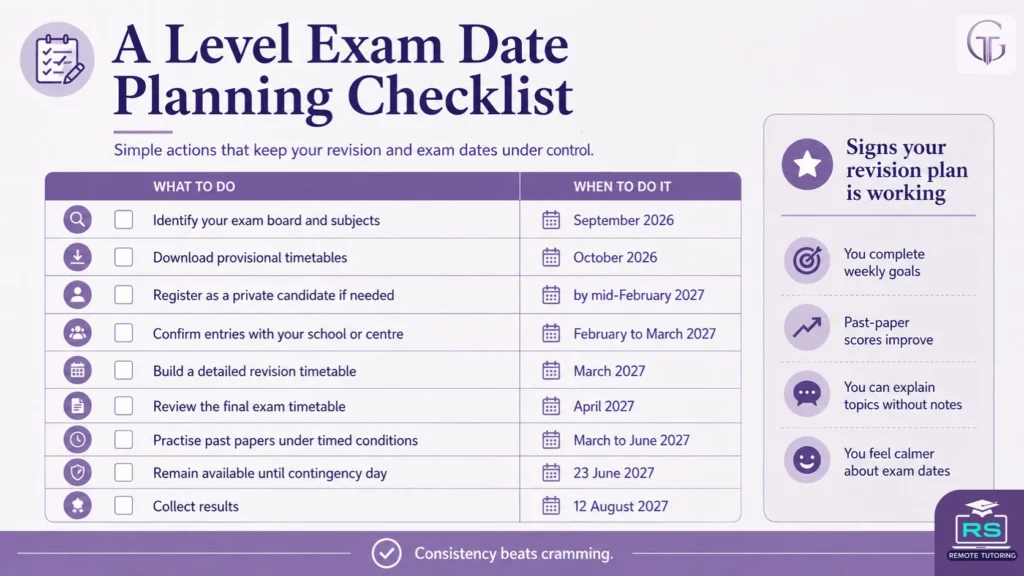
| Task | When to Do It | Why It Matters |
| Identify your exam board & subjects | September 2026 | Knowing the board lets you download the correct timetable and specification. |
| Download provisional timetables | October 2026 | Start building a rough revision plan and mark important dates. |
| Register as a private candidate (if applicable) | By mid‑February 2027 | Centres have limited spaces; early registration ensures you get your preferred venue and exam board. |
| Confirm entries with school/centre | February–March 2027 | Schools finalise entries; check for correct paper tiers and unit codes. |
| Build a detailed revision timetable | March 2027 | Plan revision in detail around exam dates and NEA deadlines. |
| Review final exam timetable | April 2027 | Boards release final timetables; update your calendar and adjust revision as needed. |
| Practise past papers under timed conditions | March–June 2027 | Simulate exam conditions and identify areas to improve. |
| Remain available for contingency day | Until 23 June 2027 | Exams may move; ensure travel or work plans don’t clash. |
| Collect results | 12 August 2027 (UK A‑Level) | Celebrate, plan next steps, and consider remarks or resits if necessary. |
Signs Your Revision Plan Is Working
| Sign | What It Means | What to Do Next |
| You consistently complete your weekly revision goals. | Your timetable is realistic and manageable. | Maintain the routine and gradually increase difficulty. |
| Past‑paper scores improve over time. | Revision is helping you retain and apply knowledge. | Identify which topics still need work and adjust your plan accordingly. |
| You can explain concepts to someone else without notes. | Deep understanding rather than rote memorisation. | Move on to exam‑style questions and timed practice. |
| You feel less stressed about the exam dates. | You have clarity and control over your preparation. | Continue balancing study with rest and adjust if stress levels rise. |
Frequently Asked Questions
When are A‑Level exams in 2027?
Provisional timetables from major exam boards show that written A‑Level exams begin on Monday 10 May 2027 and run until around Friday 18 June 2027. The exam window includes a contingency day on 23 June 2027, so students should remain available until then.
Are the 2027 A‑Level exam dates final?
No. As of June 2026, the published timetables are provisional. Exam boards may adjust dates before releasing final versions later in 2026 or early 2027. Always check updates from your board and confirm with your school or exam centre.
Where can I find the official A‑Level exam timetable for 2027?
Each exam board publishes its own timetable. Links to the provisional AQA, Edexcel, WJEC/Eduqas and International A‑Level timetables are provided in Table 1. You can also access them via your school’s exams office or the board’s website.
When do AQA A‑Level exams start in 2027?
AQA’s provisional timetable lists the first written exams (Economics, English Language, Spanish and others) on 10 May 2027. Practical components for languages and some arts subjects may take place earlier (19 April to 28 May).
When do Edexcel A‑Level exams start in 2027?
Pearson Edexcel’s provisional GCE timetable also begins on 10 May 2027 with English Language & Literature, Economics and Further Maths papers. Start times for UK centres are either 9 am or 1:30 pm, though schools may vary by up to 30 minutes.
When do OCR A‑Level exams start in 2027?
OCR has not yet published its June 2027 timetable. The provisional timetable is expected to follow the same mid‑May to mid‑June pattern, but you should wait for the official PDF before relying on specific dates.
When are WJEC and Eduqas A‑Level exams in 2027?
WJEC and Eduqas provisional timetables list the first AS/A‑Level papers on 10 May 2027. They highlight morning and afternoon contingency sessions on 23 June.
When is A‑Level results day 2027?
AQA’s timetable notes that results are dispatched to schools on 11 August 2027 and available to students on Thursday 12 August 2027. International A‑Level results (OxfordAQA) will be released on 28 July 2027.
Do exam dates vary by exam board?
Yes. While boards aim to align major papers, there are differences. For example, subject order can differ between AQA and Edexcel, and some boards schedule more than one paper on the same day. Always consult the specific timetable for each subject.
What should I do if two A‑Level exams clash?
Inform your school or exam centre as soon as possible. They will arrange for one paper to be taken at a different time on the same day, and you must remain supervised between sessions to maintain exam integrity.
When should I start revising for A‑Level exams in 2027?
Begin serious revision in the autumn of Year 13 and intensify it from February 2027 onwards. Effective preparation includes regular study sessions, past‑paper practice, and building a timetable around your confirmed exam dates.
How should I plan revision around exam dates?
Download the provisional timetable, mark each paper on a calendar and work backwards. Allocate more time to challenging subjects, mix study topics to avoid fatigue, and adjust your plan when the final timetable is released.
Can private candidates sit A‑Level exams in 2027?
Yes. Private candidates must book through an approved exam centre, usually by mid‑February 2027. Early booking is essential to secure a seat, especially for practical science endorsements.
How do private candidates book A‑Level exams?
Contact local schools or exam centres offering your desired board and subject. They will guide you through entry forms, payment of fees and any coursework or practical requirements. Some companies provide a service to arrange entries on your behalf.
What is the difference between AS‑Level and A‑Level exam dates?
AS‑Level exams occur within the same May/June window but are often scheduled earlier in the week. They are marked separately and no longer contribute to the final A‑Level grade in most subjects.
Can online A‑Level tutoring help with exam preparation?
Yes. Online tutoring provides structured guidance, explanations and feedback. However, success depends on your engagement and independent study. Tutoring supports your revision plan, it does not replace consistent effort.
How many tutoring sessions do I need before exams?
It varies. Some students benefit from weekly sessions throughout Year 13, while others seek targeted support before mocks or just ahead of the final exam season. Discuss your goals with a tutor to create a personalised plan.
Which A‑Level subjects need the most revision time?
It depends on individual strengths. Maths, Physics and Chemistry often require regular problem‑solving practice; essay‑based subjects demand time for reading and writing. Allocate extra time to subjects you find challenging.
Final Thoughts
Preparing for the 2027 A‑Level exam season doesn’t have to be overwhelming. By understanding the provisional timetable, staying alert for updates and planning your revision early, you can approach your exams with clarity and confidence. Remember to confirm all dates with your school or exam centre, and treat the contingency day as part of the exam period. With structured revision, subject‑specific practice and supportive guidance from teachers, parents and tutors, students can make the most of their hard work and enter the exam hall feeling prepared.
If you’re preparing for A‑Level Maths, Physics, Chemistry, Biology, English or another demanding subject in 2027, structured online tutoring can help you turn exam dates into a realistic revision plan instead of leaving everything until the final months. RS Remote Tutoring offers tailored support to fit around your schoolwork and schedule, helping you stay on track and approach exams with calm and confidence.
Author Bio: Raja Tahir – A Level Maths and Science Tutor | Physics and Maths Specialist
Raja Tahir has over five years of experience teaching KS2, KS3, GCSE Science, GCSE Maths, A Level Maths and A Level Physics. A graduate of a leading UK university, he specialises in helping students understand complex concepts, plan revision effectively and develop confidence ahead of important exams. At RS Remote Tutoring, Raja works with students across the UK and internationally, guiding them through the transition from GCSE to A‑Level and supporting them in building strong foundations for university and beyond.

Raja specializes in Physics and Maths, with over 5 years of experience. He offers KS2, KS3, and GCSE Science and Maths lessons. He graduated from one of the top universities in the UK.




1 Comment
Your comment is awaiting moderation.
Might I ask if taking International A Level ((EDEXEL) in Hong Kong, will the result be released earlier on Jul 28 or normal Aug 12?
Your comment is awaiting moderation.
Might I ask if taking International A Level ((EDEXEL) in Hong Kong, will the result be released earlier on Jul 28 or normal Aug 12?
[…] timetable only fixes the window. Your actual paper dates depend on the board and subject, and the 2027 A-Level exam dates vary enough that a Maths and Physics resitter could finish three weeks before an English Literature […]