Nobody searches“Functional Skills English Level 2 topics” for fun. In my experience, you’re here because something specific is riding on this, a nursing or teaching course that won’t confirm your place without it, an apprenticeship that can’t be signed off, a job application that keeps asking for GCSE English you don’t have. And there’s usually a deadline attached.
So the last thing you need is another vague topic list. What you need to know is: what does the exam actually test, and where should my limited hours go? That’s what this checklist is. It’s the same one I work through with my own learners, in the order I’d teach it, starting with a bit of orientation, because the exam makes far more sense once you know it’s officially equivalent to a GCSE English grade 4 (C) and, since the 2019 Ofqual reform, built around a fixed set of content standards. In other words: it’s predictable. That’s good news for you.
Jump to Section
What is Functional Skills English Level 2?
It’s a UK qualification that tests the English you actually use, reading an article and working out what the writer wants from you, writing an email that doesn’t embarrass you in front of an employer, holding your own in a discussion. Colleges, universities, employers and apprenticeship providers widely accept it in place of a GCSE grade 4/C.
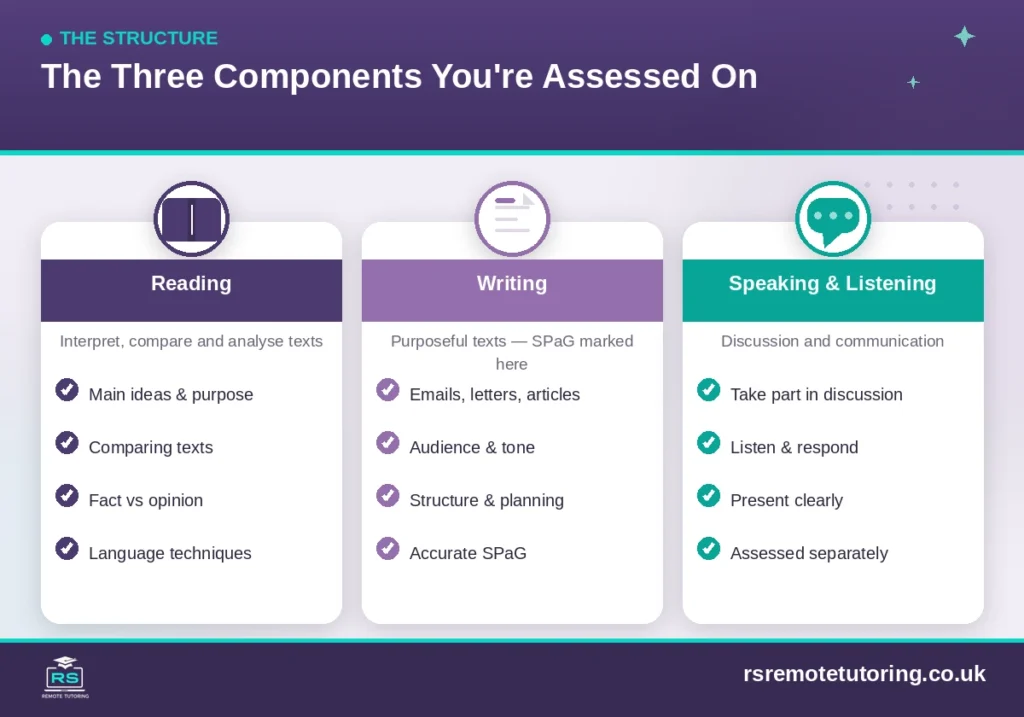
If school English put you off years ago, here’s the part worth hearing: there is no Shakespeare, no poetry analysis, no “what does the curtain symbolise”. You’re assessed on three things:
- Reading: Understanding and comparing everyday texts (articles, emails, adverts, reports)
- Writing: Producing clear, purposeful texts; this is also where spelling, punctuation and grammar are marked
- Speaking, Listening and Communicating: A discussion and short presentation, assessed separately by your provider
Most adults I teach are relieved when they see a real paper for the first time. The content isn’t the problem, it’s the exam habits, and those can be built quickly. If you’d rather not build them alone, that’s exactly what our Functional Skills English Level 2 tutoring is for.
What reading topics does Functional Skills English Level 2 cover?
Here’s what the reading paper looks like from inside the exam room: you get a handful of texts, maybe a news article, a leaflet and a blog post on the same subject and around an hour to answer questions about them. The questions rarely ask “what happened?”. They ask why the writer wrote it, who it’s for, how the two texts disagree, which statement is fact and which is opinion. That catches people out, because it’s not how most of us read day to day.
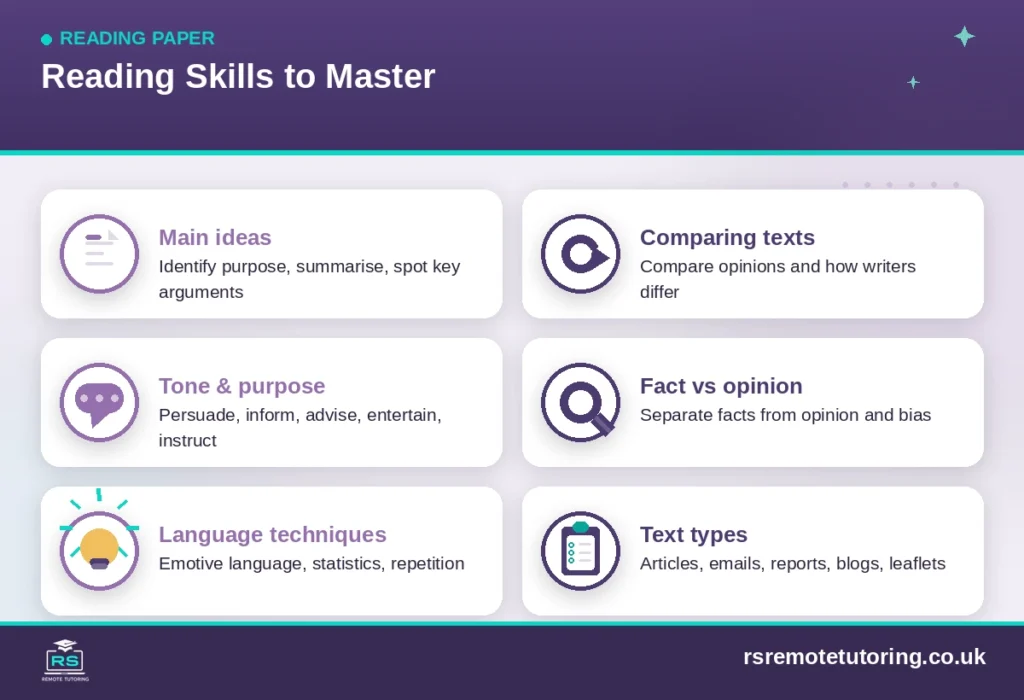
The checklist I work through with learners:
- Main ideas and purpose: What is this text for, and can you sum it up in a sentence?
- Comparing texts: Where do two writers agree, disagree, or present the same thing differently?
- Tone and purpose: Is it persuading, informing, advising, entertaining or instructing you?
- Fact vs opinion: Spotting when a confident sentence is actually just a viewpoint, or biased language
- Language techniques: Emotive language, statistics, rhetorical questions, repetition, expert quotes
- Text types: Articles, emails, adverts, reports, blogs, leaflets, letters and what each expects
The mistake I see most often has nothing to do with English ability: reading every line of every text carefully, then hitting the last two questions with five minutes left. Those last questions are usually the comparison ones, the highest-mark items on the paper. The fix is a habit, not a skill: read the question first, skim the text for the keywords it points to, and only then read that section closely. Learners who make this one switch often jump a grade band without learning anything “new”.
What writing topics do you need to master?
The writing paper typically gives you two tasks, something like a formal email to a manager and an article for a website, each with a stated purpose and audience. And here’s the thing I wish every learner knew before their first attempt: most failed writing papers are not failed because of bad English. They’re failed because of structure, ideas in the wrong order, no paragraphs, a formal task written like a text message.
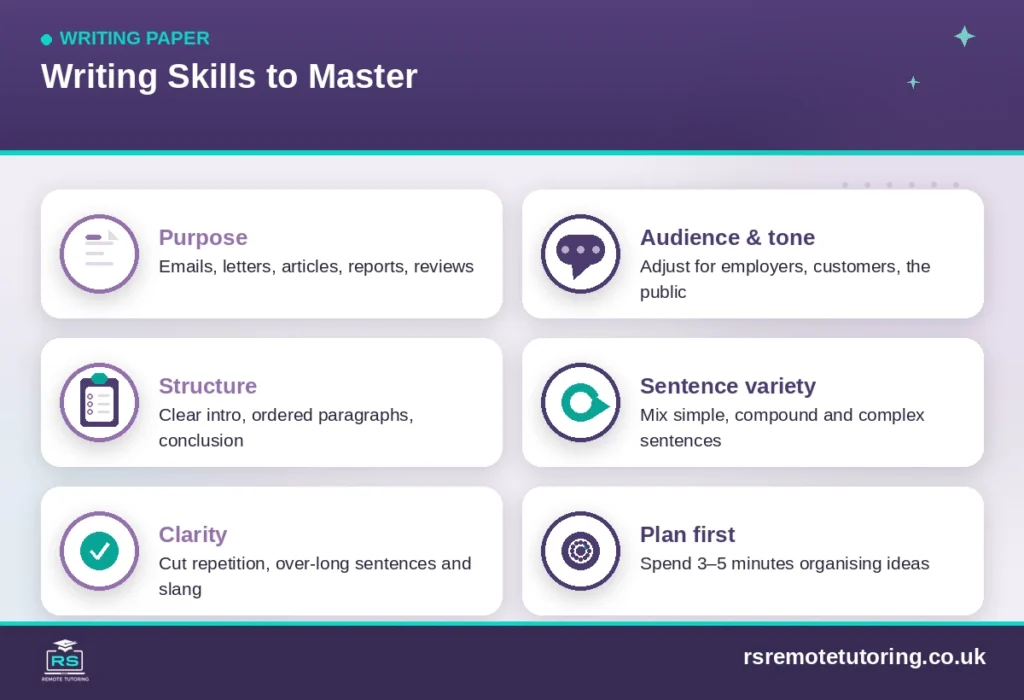
The writing checklist:
- Writing for purpose: Formal emails, complaint letters, articles, reports, reviews, informative pieces
- Writing for audience: The same message reads very differently to your boss, a customer, or the general public
- Paragraph structure: An opening that says why you’re writing, one idea per paragraph, a proper ending
- Sentence variety: Mixing short, punchy sentences with longer ones so it doesn’t read flat
- Clarity: Cutting repetition, run-on sentences and slang in formal tasks
- Planning: Three to five minutes of bullet points before you write a word
One learner sticks in my mind here, a care worker in her forties who’d failed the writing paper twice before we met. Her grammar was fine. Her emails at work were fine. But under exam pressure she’d pour everything into one long block of text with the main point buried in the middle. We didn’t touch her grammar at all; we just drilled one routine, plan for four minutes, one idea per paragraph, state your purpose in the first two lines. She passed the next sitting. Planning feels like losing time. On this paper, it’s where the marks are.
How important is spelling, punctuation and grammar (SPaG)?
Very, but not in the way people fear. SPaG is marked inside the writing paper, and it rewards consistent accuracy on ordinary things, not advanced grammar. Nobody loses their pass because they can’t use a semicolon. People lose marks because “your/you’re” slips through five times, or apostrophes go missing in every paragraph.
Where to focus:
- Punctuation: Full stops, commas, apostrophes, question marks; colons and semicolons if you’re confident
- Spelling: Homophones and commonly confused words (there/their, affect/effect), plus workplace vocabulary
- Grammar: Verb tenses, subject–verb agreement, sentence structure, connectives
- Capital letters: Names, places, organisations, sentence starts (easy marks, weirdly often dropped)
My honest advice: don’t revise SPaG from a giant generic list. Do two or three timed practice pieces, get them marked (or mark them ruthlessly yourself), and build a personal error list. Most people repeat the same four or five mistakes, fix those and your accuracy transforms. One thing I didn’t expect when I started tutoring adults: nerves cause more SPaG errors than ignorance does. Learners who write calmly in practice suddenly drop apostrophes everywhere in a mock. That’s not a grammar problem, it’s another reason timed, low-stakes practice matters.
What do learners struggle with most?
After years of this, the same five patterns show up again and again and notice that none of them is really about English:
- Comparing texts: Explaining one text well, then forgetting the second one exists
- Formal tone: “Hiya, just wondering…” in an email to a manager
- Time management: Strong answers on the first half, rushed guesses on the second
- Proofreading: Finishing with ten minutes spare and not using them
- Misreading the task: Writing a good answer to a question that wasn’t asked
Every one of these is a habit, and habits respond fast to structured practice. That’s genuinely encouraging: it means the gap between where you are and a pass is usually smaller than it feels.
Do you have to do the speaking and listening assessment?
Yes, Speaking, Listening and Communicating is a required component, but it’s nothing like the written papers. Your provider assesses it through a group discussion and a short presentation. No trick questions, no red pen for grammar; it rewards making a clear point, backing it up, and actually responding to what others say rather than waiting for your turn.
Most learners dread this part right up until they do it, then tell me it was the easiest of the three. If you’re nervous, practise out loud: pick a topic you know, talk through it for two minutes, and get used to hearing your own voice structure an argument. That’s 90% of it. (And if you’re sitting maths alongside English, the same calm-and-practical approach carries over, our guide to passing Functional Skills Maths Level 2 first time walks through it.)
What’s the best revision plan for Functional Skills English Level 2?
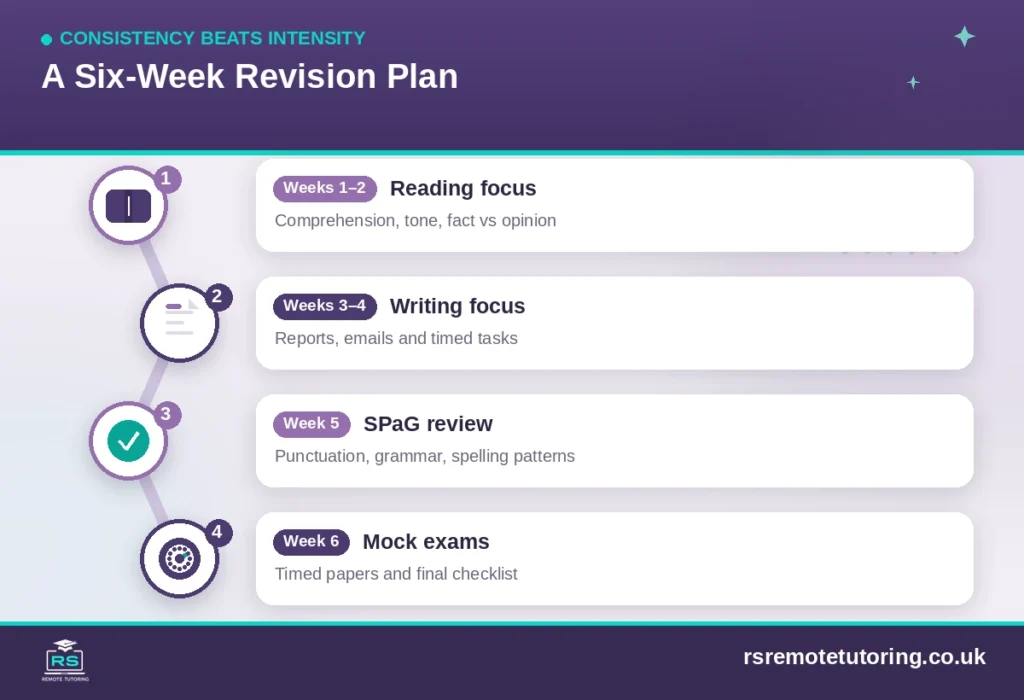
Six weeks of short, regular sessions beats one heroic weekend every time, partly because this exam rewards speed and calm, and neither can be crammed. Here’s the structure I set for most learners, adjusted around work and family:
| Week | Focus |
| Weeks 1–2 | Reading: purpose, tone, fact vs opinion, comparing texts, untimed at first |
| Weeks 3–4 | Writing: emails, articles, reports, start timing yourself from here, not week 6 |
| Week 5 | SPaG: your personal error list, apostrophes, commas, homophones, tenses |
| Week 6 | Full timed mocks, marked honestly, plus a final pass over this checklist |
Two things matter more than the exact weekly split. First: bring in timed conditions from week three, not week six, the exam-room version of you needs rehearsal too. Second: mark your own mocks harshly. A generous self-mark feels nice and teaches you nothing. There’s more on how the paper itself runs in our Level 2 online exam guide.
Frequently Asked Questions
What topics are included in Functional Skills English Level 2?
Reading comprehension, comparing texts, identifying tone and purpose, fact vs opinion, formal and informal writing, spelling, punctuation and grammar, and spoken communication. It’s assessed in three components: Reading, Writing (with SPaG marked inside it), and Speaking, Listening and Communicating.
Is Functional Skills English Level 2 difficult?
It’s a genuine Level 2 qualification, so it’s not trivial, but most learners find the content manageable once they’ve seen the format. What actually fails people is time pressure and exam habits, not the English, and both improve quickly with timed practice.
How long does it take to revise for Functional Skills English Level 2?
For most learners, four to eight weeks of focused revision is enough, short daily sessions rather than one long weekly slog. If your English is already strong and it’s the exam format that worries you, even a fortnight of past papers can be enough.
What is the most important topic in Functional Skills English Level 2?
If you have to prioritise: reading comprehension and functional writing, because they carry the most weight and combine several skills at once including purpose, tone, structure and accuracy. Then tighten your personal SPaG weak spots across everything you write.
Is Functional Skills English Level 2 accepted instead of GCSE English?
Yes, employers, colleges, universities and apprenticeship providers across the UK accept it as equivalent to a GCSE grade 4/C. A few specific courses still insist on the GCSE itself, so check with your institution first; our equivalence guide covers where it’s accepted.
Can adults take Functional Skills English Level 2 online?
Yes. Online courses, mock exams and remote assessments are widely available, which is why so many adults fit it around shifts and childcare. If you want structured support rather than going it alone, have a look at our online tutoring.
Final thoughts
If you take one thing from this checklist, make it this: the learners who pass fastest aren’t the ones with the best English or the most hours, they’re the ones who know exactly what the exam tests and practise those things under time pressure. That’s a plan, not a talent.
And if you’re carrying an old story about being “bad at English” from school, most of my adult learners are, and most of them pass. This is a practical communication qualification, not a rerun of your GCSEs. If you’d like a plan built around your actual weak spots rather than a generic list, book a free trial and we’ll map it out together.

Raja specializes in Physics and Maths, with over 5 years of experience. He offers KS2, KS3, and GCSE Science and Maths lessons. He graduated from one of the top universities in the UK.