Passing Functional Skills Maths Level 2 isn’t about being a maths genius. It’s about having the right strategy.
After helping hundreds of learners prepare for this qualification, I’ve noticed the ones who pass first time aren’t usually the strongest mathematicians. They’re the ones who understand the exam, revise with purpose, and stop making the handful of mistakes that quietly hold everyone else back. It helps to remember what this qualification actually is: Functional Skills Maths Level 2 is recognised as equivalent to a GCSE grade 4 or C, and since the 2019 reform it’s weighted heavily towards applying maths to real situations rather than abstract theory. In this guide I’ll share the same advice I give my own learners, so you can walk in prepared, calm and ready to pass.
Jump to Section
Does passing Functional Skills Maths Level 2 start with mindset?
Yes, more than most learners expect. The biggest barrier I see isn’t fractions or percentages, it’s self-doubt. Learners arrive saying “I’ve never been good at maths” or “I failed GCSE, so I’ll fail this too”, and that belief does more damage than any topic on the paper.
Here’s the reframe I always offer: Level 2 assesses practical maths, working out discounts, reading graphs, checking measurements, managing a budget not advanced theory. I once worked with a learner who’d failed GCSE Maths three times and was certain they weren’t “a maths person”. A few weeks of structured practice later, they passed Functional Skills Maths Level 2 on the first attempt. The difference wasn’t talent. It was preparation.
Progress in maths isn’t about getting every answer right. It’s about understanding why you got the last one wrong. If you’re willing to stay consistent and learn from your mistakes, you’ve already given yourself the best possible chance.
What should you understand about the exam before revising?
You should understand what the exam actually tests before you revise a single topic. Functional Skills Maths Level 2 sets practical, real-world problems rather than asking you to recall complex formulas, so it rewards mathematical reasoning applied to everyday and workplace situations. Revising without knowing this is like training for a race without knowing the distance.
Across the paper, you can expect questions involving:
- Money and budgeting
- Fractions, decimals and percentages
- Ratio and proportion
- Area, perimeter and volume
- Time calculations
- Data interpretation, graphs and charts
- Probability
- Measurements and unit conversions
Many learners assume they must master every hard topic before sitting the exam. In reality, success comes from becoming genuinely confident with the practical skills that appear again and again. As I tell my students: don’t revise everything equally, revise everything intelligently. If you want the full breakdown, our Maths Level 2 exam structure guide and topics checklist map it out properly.
How do you build a revision plan you’ll actually stick to?
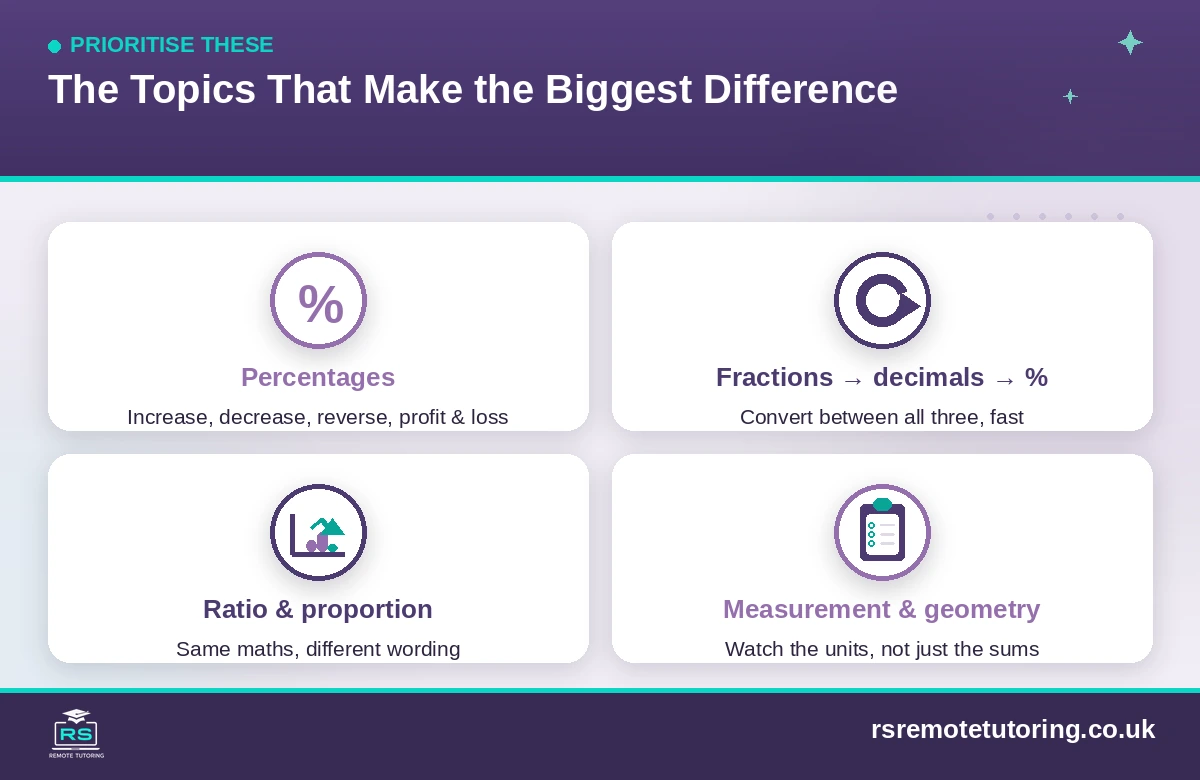
You build a plan you’ll stick to by choosing consistency over intensity. Short, focused sessions of 45–60 minutes, four or five times a week, beat occasional weekend marathons every time. You don’t need five-hour evenings, you need regular, deliberate practice that fits your life.
A simple weekly routine might look like this:
| Day | Focus |
| Monday | Percentages and money calculations |
| Tuesday | Fractions, decimals and conversions |
| Wednesday | Ratio, proportion and measurements |
| Thursday | Graphs, charts and data handling |
| Friday | Mixed-topic revision |
| Weekend | One timed practice paper, then review your mistakes |
Notice that reviewing mistakes is built into the plan, that’s deliberate. Too many learners finish a paper, glance at the score, and move straight on, missing the biggest learning opportunity of the week. Whenever you get something wrong, ask yourself: did I misread the question, choose the wrong method, slip on the calculation, or rush because of time? Learners who analyse mistakes this way improve far faster than those who just grind through more questions.
Which topics make the biggest difference to your grade?
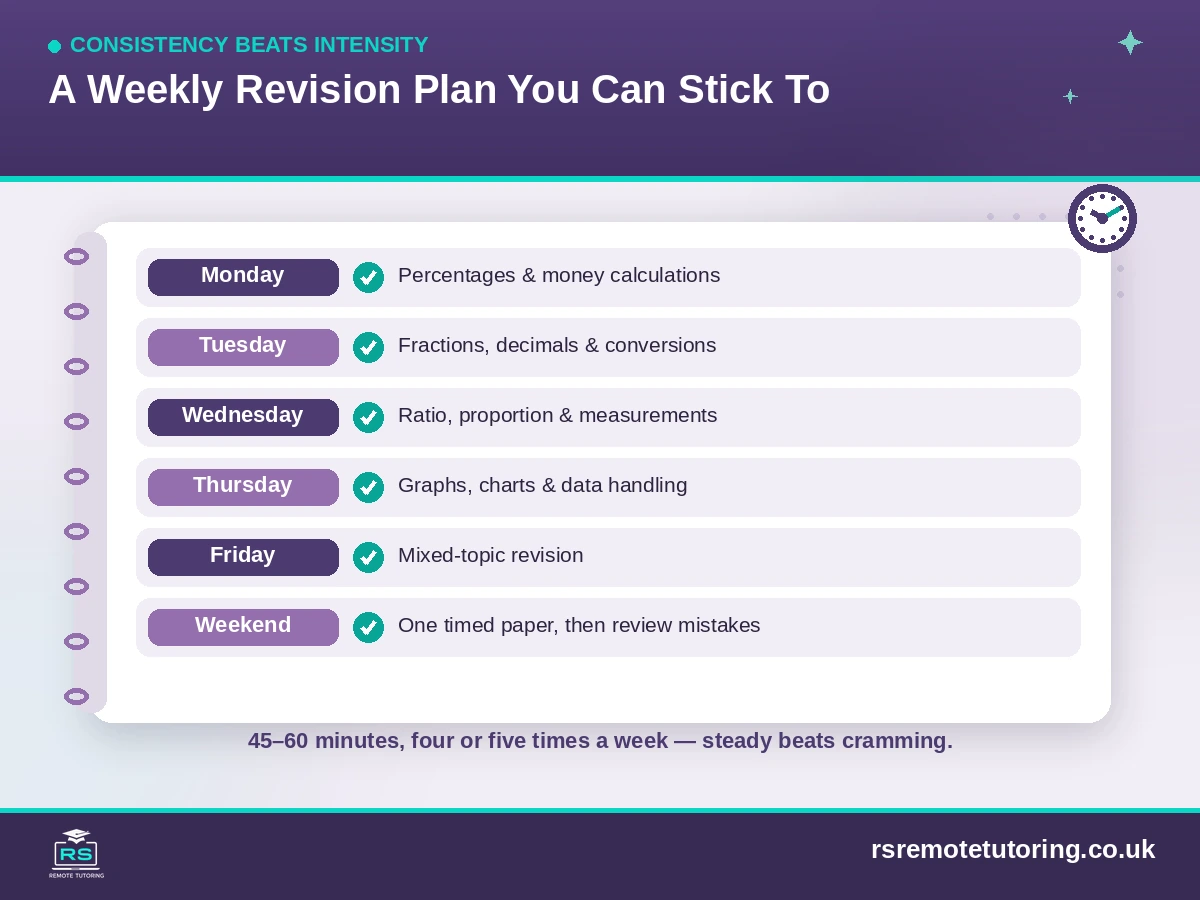
The topics that make the biggest difference are percentages; fractions, decimals and percentages together; ratio and proportion; and measurement and geometry. They appear constantly and cause the most trouble, so prioritising them gives you the highest return on your revision time.
Percentages turn up everywhere, discounts, VAT, interest, wage rises. Rather than memorising formulas, learn to recognise the language: percentage increase and decrease, profit and loss, sale prices, and reverse percentages.
Fractions, decimals and percentages are closely linked. Plenty of learners handle them separately but freeze when asked to convert quickly between them. Practising conversions until they’re automatic is one of the highest-return activities you can do.
Ratio and proportion questions look intimidating because the wording changes, sharing money one day, scaling a recipe the next even though the maths stays the same. Once you spot that pattern, confidence usually jumps.
Measurement and geometry, area, perimeter, volume and unit conversions, cost learners more marks than the calculations themselves. Always check whether the question wants metres, centimetres or millimetres before you start. Often it’s the units, not the sums, that catch people out.
Why should practice papers be the heart of your revision?
Practice papers should be the heart of your revision because they’re the only activity that rehearses the real thing, answering exam-style questions, under time pressure, with no notes. Reading revision guides builds understanding and videos introduce methods, but neither prepares you for the clock. Papers do.
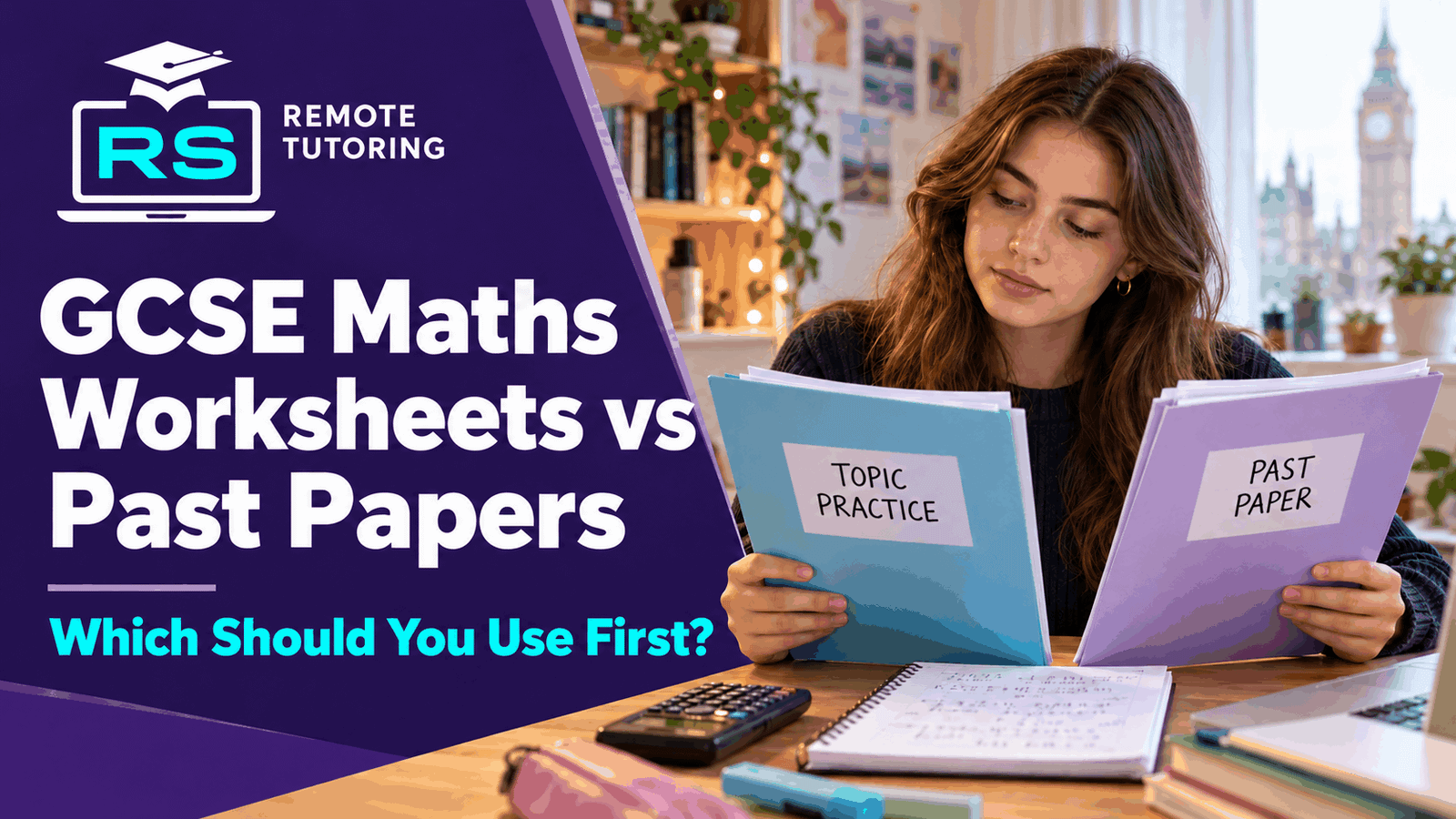
Timed papers build the skills that actually get tested: reading exam wording, managing time, working through multi-step calculations, and spotting the key information fast. Most of my students feel nervous before their first timed paper that’s completely normal. The goal isn’t a perfect score straight away; it’s getting comfortable working under exam conditions. Every paper you complete tells you something new about your strengths and your gaps. Treat them as the centre of your plan, not a final-week afterthought, there’s a full method in our guide to Functional Skills Maths past papers.
What revision techniques help you remember more?
The techniques that help most are active ones. Reading notes and highlighting feel productive but rarely improve real understanding. Testing yourself, correcting your errors, and explaining your reasoning aloud do far more, because they force your brain to retrieve and apply rather than just recognise.
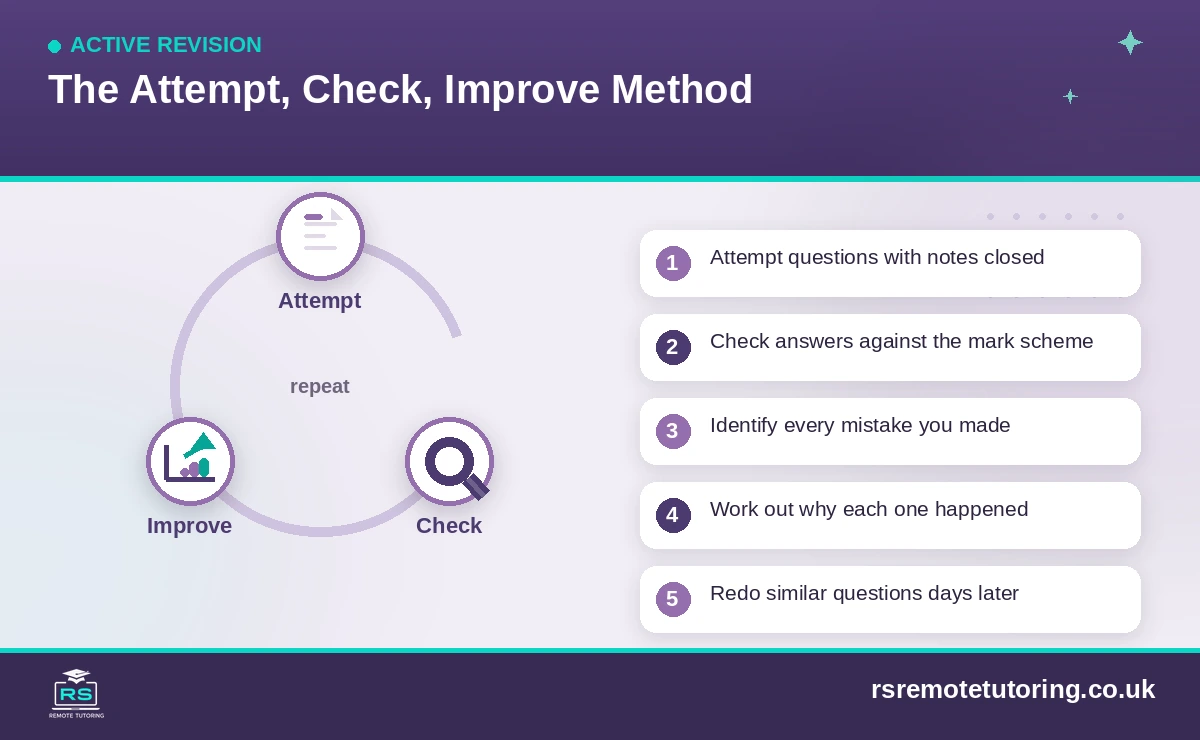
The method I recommend to almost every learner is attempt, check, improve:
- Attempt several questions with your notes closed
- Check your answers carefully against the mark scheme
- Identify every mistake
- Work out why each one happened
- Redo similar questions a few days later
This strengthens understanding far more than re-reading worked examples. The other technique that consistently works is explaining your method out loud, if you can talk clearly through how you solved a problem, you’ve genuinely understood it. If you can’t, that’s a useful sign you need a little more practice.
What are the most common mistakes learners make?
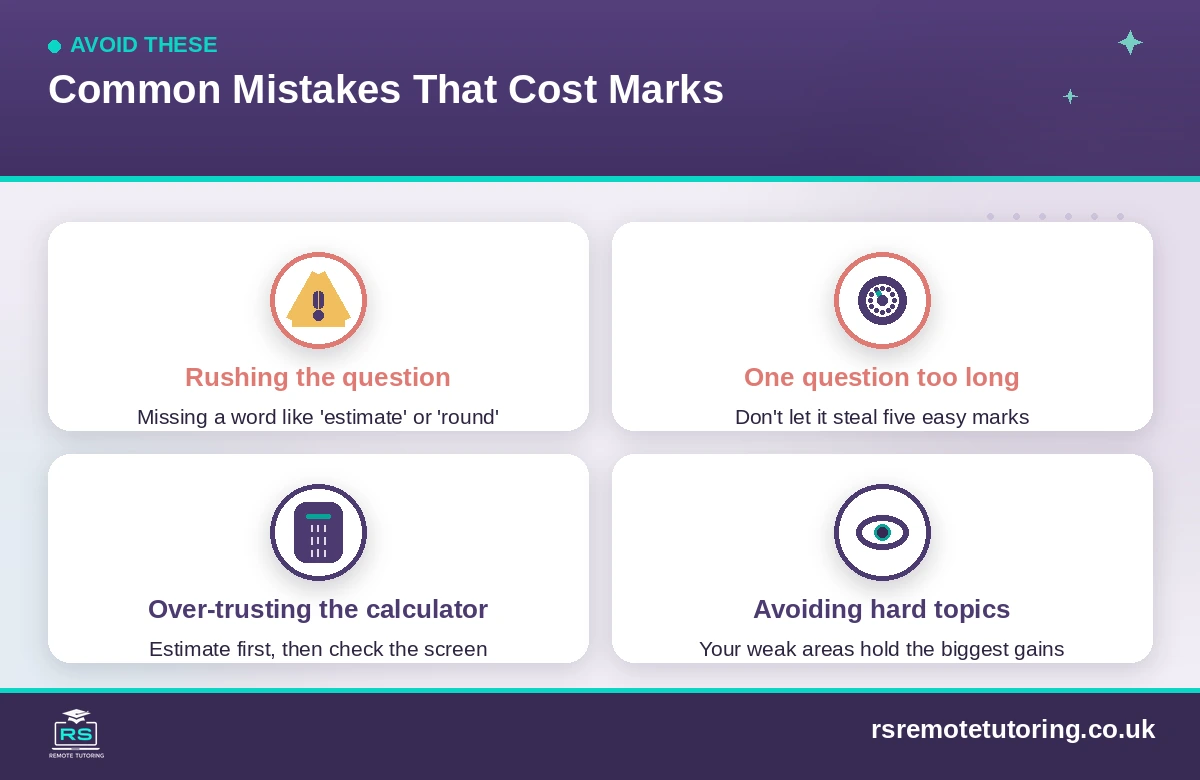
The most common mistakes have nothing to do with the maths being too hard. After years of tutoring, I can tell you most learners lose marks to the same avoidable habits, rushing, over-investing in one question, leaning on the calculator, and dodging difficult topics. The good news is that once you’re aware of them, they’re easy to fix.
Rushing through the question: Functional Skills questions hide important details in the context, and missing a single word, estimate, round, show your working, costs marks. Before reaching for the calculator, pause and ask what information you’ve been given, what you’re actually being asked, and how many steps are involved.
Spending too long on one question: We’ve all hit a question that refuses to make sense. Panicking and burning ten minutes on it usually means running out of time for easier marks later. Don’t let one difficult question steal marks from five easy ones make your best attempt, move on, and come back if time allows.
Depending too much on the calculator: Your calculator supports your thinking; it can’t tell you whether you’re solving the right problem. Before you press equals, estimate roughly what the answer should be. If a £15 item somehow costs £250 after a 10% discount, you’ll spot the error instantly.
Ignoring topics that feel difficult: It’s natural to revise what you enjoy, which usually means avoiding the areas that need the most work. Tackling ratio or probability when they feel uncomfortable is exactly where the biggest improvements come from.
Frequently Asked Questions
How long does it take to prepare for Functional Skills Maths Level 2?
It depends on your starting confidence, but many learners who revise consistently for four to eight weeks are well prepared. The key is regular, focused practice rather than last-minute cramming, steady sessions across several weeks beat any amount of panic revision.
Are practice papers really the best revision resource?
Yes. Practice papers show you the style of questions, sharpen your time management, and reveal which topics still need work. Sitting them under timed conditions and reviewing every mistake is one of the most effective ways to prepare for the exam.
Is Functional Skills Maths Level 2 harder than GCSE Maths?
It’s recognised as equivalent to a GCSE grade 4 (C), but the focus is different. Functional Skills emphasises practical, real-world problem-solving over advanced theory, which many adult learners actually find more approachable than the GCSE. Our equivalence guide explains it fully.
Can I pass without a tutor?
Many learners do pass through independent study. But if you’ve struggled with maths before or keep repeating the same mistakes, a tutor can pinpoint the gaps, explain difficult concepts clearly, and keep your revision on track. You can explore one-to-one support if that sounds like you.
How many times can I sit the exam?
There’s no limit, if you don’t pass first time, you can rebook. Use the examiner feedback to target your weak areas before you sit it again. That said, following a structured plan gives you a strong chance of passing on the first attempt.
Do I need to show my working?
Yes, and it matters. You earn marks for method as well as the final answer, so even a wrong answer with correct working can score well. Always set your steps out clearly rather than jotting a bare number.
Final thoughts
Passing Functional Skills Maths Level 2 isn’t about luck, talent, or having a “maths brain”. It’s about building practical skills, following a plan you can actually keep, and believing improvement is possible.
If you’re preparing for your first attempt, trust the process and stay consistent. And if you’re coming back after a setback, remember that one result doesn’t define your ability. Success here isn’t measured by how many questions you get right the first time, it’s measured by your willingness to keep improving until you do. If you’d like a hand with that, book a free trial and we’ll build the plan around you.

Raja specializes in Physics and Maths, with over 5 years of experience. He offers KS2, KS3, and GCSE Science and Maths lessons. He graduated from one of the top universities in the UK.