GCSE Exams Today: Full 2026 Timetable, Dates, Times and Paper Codes
Note: This guide uses the official exam timetables from AQA, Pearson Edexcel, OCR and WJEC/Eduqas. Exact times and paper codes come from those sources. CCEA timetables were not accessible at the time of writing; Northern Irish students should consult their centres or the CCEA website. Always confirm final arrangements with your school or exam centre. The GCSE exam season can feel like an endless list of dates, papers and codes. As a calm and experienced GCSE tutor, I know that students and parents often just want a straight answer: “What GCSE exams are on today?” and “When are the main exams happening this year?” This guide answers those questions by pulling together the 2026 GCSE timetables for each major exam board. It explains how to read the schedule, highlights the main GCSE exams by date, lists upcoming papers, and offers practical tips for exam day. Use this as a planning aid, but always check your personal timetable issued by your school or exam centre. How to Check GCSE Exams Today To find today’s GCSE exams, simply match today’s date with the timetable sections below. Each date includes the session, exam board, subject, paper title, paper code, tier and duration where available. GCSE exams normally take place in two main sessions: Schools may adjust the exact start time within the permitted exam window, so your school timetable is always the final version to follow. If you are asking “What GCSE exam is today?”, check today’s date first, then scroll to the matching timetable entry below. For example, if today is Monday 18 May 2026, the main exams include Chemistry, Combined Science, Media Studies, Chinese and Urdu papers, depending on your board and subject entry. If today is a different date, use the full GCSE exam timetable further down the page to find the correct papers. Today’s GCSE Exams: How This Timetable Works The table below summarises one of the key GCSE exam dates in the 2026 timetable. It is useful for students searching for GCSE exams today, especially during the May and June exam period. However, this page is not limited to one day only. Use this section like a daily GCSE exam checker: GCSE Exams Scheduled for Monday 18 May 2026 The table below summarises all written GCSE exams scheduled for Monday 18 May 2026 across the major UK exam boards. If today’s date is 18 May 2026, these are the main GCSE exams taking place today. If you are checking this page on a different date, use the full timetable below to find the correct date for today’s GCSE exams. Morning exams usually start at 9 am and afternoon exams at 1:30 pm; schools may vary start times within the permitted window. Students must check their own centre’s timetable. Date Session Exam Board Subject Paper title & code Tier Duration Notes 18 May 2026 (Mon) Morning AQA Chemistry Chemistry Paper 1 (codes 8462/1F and 8462/1H) Foundation / Higher 1 h 45 m Students sit one tier only. 18 May 2026 (Mon) Morning AQA Combined Science Trilogy Chemistry Paper 1 (codes 8464/C/1F and 8464/C/1H) Foundation / Higher 1 h 15 m Trilogy course only. 18 May 2026 (Mon) Morning Edexcel Chemistry Paper 1 (codes 1CH0 1F and 1CH0 1H) Foundation / Higher 1 h 45 m 18 May 2026 (Mon) Morning Edexcel Combined Science Paper 2: Chemistry 1 (1SC0 1CF/1CH) Foundation / Higher 1 h 10 m 18 May 2026 (Mon) Morning OCR Chemistry A Paper 2 (J248/02) and Paper 4 (J248/04) Foundation / Higher 1 h 45 m 18 May 2026 (Mon) Morning OCR Chemistry B Depth in Chemistry (J258/02 foundation, J258/04 higher) Foundation / Higher 1 h 45 m 18 May 2026 (Mon) Morning OCR Combined Science A Chemistry Paper 3 (J250/03, foundation) Foundation 1 h 10 m 18 May 2026 (Mon) Morning OCR Combined Science A Chemistry Paper 9 (J250/09, higher) Higher 1 h 10 m 18 May 2026 (Mon) Morning OCR Combined Science B Chemistry (J260/02, foundation; J260/06, higher) Foundation / Higher 1 h 45 m 18 May 2026 (Mon) Morning WJEC / Eduqas Chemistry (Wales) Unit 2 (codes 3410U20-1 foundation, 3410UB0-1 higher) Foundation / Higher 1 h 45 m Wales specification. 18 May 2026 (Mon) Morning WJEC / Eduqas Media Studies (Wales) Unit 1 (3680U10-1) Single 1 h 30 m Wales specification. 18 May 2026 (Mon) Morning WJEC / Eduqas Media Studies (Eduqas) Component 1 (C680U10-1) Single 1 h 30 m Eduqas specification. 18 May 2026 (Mon) Morning WJEC / Eduqas Science (Double Award) (Wales) Unit 5 (codes 3430U50-1 foundation, 3430UE0-1 higher) Foundation / Higher 1 h 15 m Wales specification. 18 May 2026 (Mon) Afternoon AQA Chinese (Mandarin) Writing papers (8673/WF – foundation, 8673/WH – higher) Foundation / Higher 1 h / 1 h 15 m 18 May 2026 (Mon) Afternoon Edexcel Chinese Paper 4: Writing (1CN0 4F/4H) Foundation / Higher 1 h 20 m / 1 h 25 m 18 May 2026 (Mon) Afternoon Edexcel Urdu Listening and understanding (1UR0 1F/1H) Foundation / Higher 0 h 35 m / 0 h 45 m 18 May 2026 (Mon) Afternoon Edexcel Urdu Reading and understanding (1UR0 3F/3H) Foundation / Higher 0 h 50 m / 1 h 05 m 18 May 2026 (Mon) Afternoon OCR Media Studies Paper 2: Music and news (J200/02) Single 1 h 15 m No major GCSE written exams for other subjects are scheduled on 18 May beyond those listed above. If you do not take Chemistry, Combined Science, Media Studies or the languages mentioned, you may not have an exam on this date. Always check your personal timetable. Next GCSE Exams Coming Up Below is a snapshot of the next key written exams after Monday 18 May 2026 across the boards. Only major subjects are shown; numerous language papers and smaller subjects are omitted for brevity. Students must consult the full timetable for their subjects. Date Session Board(s) Major subjects & papers Notes Tue 19 May 2026 Morning AQA, Edexcel, OCR, WJEC/Eduqas English Literature Paper 2: AQA (8702/2), Edexcel
How to Pass GCSE English Language: Proven Strategies that Actually work
Passing GCSE English Language is one of those things that sounds straightforward until you are sitting in front of the paper and realise you are not quite sure what the examiner actually wants from you. I have been tutoring English at GCSE level for years, and that moment, the realisation that something felt off in an exam they had prepared for, is something students describe to me again and again. It is not usually a lack of effort. It is usually a lack of the right kind of preparation. This guide is my attempt to give you everything I wish more of my students had known from the start. Whether you are sitting AQA in summer 2026, working through a November resit, or supporting someone at home, this is a genuine, practical walkthrough of how to pass GCSE English Language, not just the obvious tips you will find everywhere, but the things that actually make the difference. Why Students Struggle With GCSE English Language One of the most common patterns I have seen is students treating English like a memory-based subject. They mostly enter the exam hall with vague ideas, especially when it comes to the structure. Most Probably; But then the exam paper arrives with an unseen text, and suddenly everything feels unfamiliar. The reality is that GCSE English Language is mostly a skills-based exam. Examiners reward students who can: This is why passive revision rarely works. The Biggest Shift That Helps Students Improve Fast The biggest transformation not only lies just shifting your study patterns but the students actually achieve high when they stop asking; “What technique is this?” And start asking: “Why did the writer use it here?” That shift matters enormously. A Grade 5 answer often identifies techniques. Similarly; Grade 8 or 9 answer explains: For example: Weak analysis may include;The writer uses a metaphor.” While the Stronger analysis may encompass; “The metaphor creates a sense of emotional suffocation, making the setting feel oppressive and claustrophobic.” The second answer actually explores meaning. That is what examiners reward. How to Pass GCSE English Language Without Burning Out This is the most important question I have usually encountered, even when I was the students, similarly as the teacher also and the only one thing I would recommend is that One thing I genuinely recommend is avoiding massive revision marathons. Students often think: “I need to revise English for five hours.” But In reality, shorter focused sessions work far better. A much more effective structure is: This keeps concentration sharper and prevents mental exhaustion.From experience, students who revise consistently for smaller periods often outperform students doing occasional all-night cramming sessions. The Most Effective Revision Method for GCSE English Language Use Past Papers Earlier Than You Think Many students save past papers until the final few weeks. That is the biggest mistake they usually commit. Past papers are not just for testing knowledge. They train you to recognise: We quickly realised that students improve fastest when they: That third step matters most. Simply completing papers is not enough. How High-Grade Students Actually Analyse Texts Students often think Grade 9 analysis means sounding sophisticated, even though one of my students lamented innocently, Teacher these students hold special capabilities, we are too far from them. But actually this is the whole myth. The grade 9 truly does not revolve around the capabilities but it wholly means sounding thoughtful. A strong answer usually does three things: For example:Instead of: “The word ‘dark’ creates tension.” A stronger response might say: “The adjective ‘dark’ creates uncertainty and vulnerability, suggesting the character is emotionally trapped as well as physically isolated.” Notice how the second response explores layers. That depth matters. The Truth About Vocabulary in GCSE English Language Students often force complicated vocabulary into answers because they believe it sounds intelligent. Examiners notice this immediately. What stayed with me most from examiner feedback sessions was how often markers preferred: over random advanced words. You do not need to sound like a Victorian novelist. You need to sound confident and intentional. Strong vocabulary should feel natural. Creative Writing: What Actually Gets High Marks This is where many students lose marks unnecessarily. A lot of creative writing advice online focuses on: But genuinely strong creative writing usually succeeds because it creates: I remember reading a student story that barely used any complex vocabulary, yet it scored extremely highly because the emotional tension felt authentic from beginning to end. That student understood pacing.And pacing matters far more than throwing in twenty metaphors. A Creative Writing Structure That Works Consistently A reliable structure is: Beginning Start in the middle of something interesting. Avoid: “It was a dark and stormy night.” Instead: Middle Focus on one central emotion or atmosphere.Do not overload your story with too many ideas. This is the point where truly the audience or the examiner reflects deeply. Ending The resolution of the story leaves an emotional impact. Many strong endings: Common Mistakes Students Make in Paper 1 Writing Too Much for Early Questions Students often spend: This damages overall marks badly.Question 5 carries huge weighting.Time management matters and it should be taught even though practised more and more to sound more discipline and practical. Feature Spotting Instead of Analysis Listing techniques are not enough.Examiners want interpretation.Adding analysis and in depth content truly matters a lot and this is where examiners differentiate between and high achieving student and the average student. Overcomplicated Writing Trying too hard usually weakens clarity. Use simple sentences, or more often the compound ones. The complex sentences add to the ambiguity and usually students deviate from the existing topic. Ignoring Structure Questions Students focus heavily on language analysis but forget structural analysis completely. This is the foremost biggest mistake that further unlocks another step of losing marks. How to Revise Paper 2 Properly Paper 2 often scares students because it combines: But once students understand the structure, confidence improves quickly. One thing many parents I have spoken to say is: “My child understands the texts
GCSE Formula Sheets PDF 2026: What Students Get and Still Need to Revise
I still remember the spring of 2026 when I sat with a group of Year 11s in London preparing for their GCSEs. The air conditioners were humming against the early summer heat, revision timetables were pinned up and textbooks lay open. One thing my students kept asking was whether they still needed to memorise formulas for maths and science. “Sir, will there be a formula sheet?” They had heard rumours that the sheets were being scrapped after 2024. As a tutor and former examiner, I needed clarity. What we discovered was reassuring: the Department for Education and Ofqual decided to continue providing formulae and equation sheets for GCSE mathematics, physics and combined science exams beyond 2024. A formal consultation concluded that exam boards must publish the sheets by 1 September each year and insert clean copies into exam papers. In other words, students sitting exams from 2026 through at least 2028 and very likely up to 2030 can rely on a formula sheet. This guide, written from my experience as a tutor and from conversations with teachers, examiners and students, explains what these formula sheets contain, how to use them effectively and what you still need to memorise. Whether you’re a student in England, Wales, Northern Ireland or an international GCSE candidate in other countries, I’ll break down the latest policies and share practical tips to make the most of this support. What Are GCSE Formula Sheets and Why Do They Exist? A formula sheet is an exam aid provided inside the question paper. Instead of expecting candidates to recall every mathematical or scientific equation, the sheet lists key formulas so students can focus on applying them. Formula sheets have been used in A‑level physics and maths for years, but they were introduced temporarily to GCSE exams in 2022 to mitigate COVID‑19 disruption. Teachers and students found them useful, and in 2025 the Department for Education confirmed that the sheets would remain for the 2025–27 exams. Following a consultation in 2026, Ofqual decided that exam boards must continue to provide formulae and equation sheets for the lifetime of the current specifications. This means that exams from 2028 onwards will still include the sheets until new qualifications are developed. Exam boards are required to: As a result, you can expect formula sheets for GCSE mathematics and equation sheets for physics and combined science to remain through at least the 2030 exam series. Subjects Covered: Maths, Physics and Combined Science Formula sheets are currently provided for three subjects: Currently there are no formula sheets for GCSE Biology or humanities subjects. In those exams you must recall definitions, processes and data handling skills without such aids. Foundation vs Higher Tier In mathematics, there are separate sheets for the Foundation and Higher tiers. The Higher tier sheet includes additional formulas such as the sine rule, cosine rule and area of a triangle (½ab sin C), which only appear on the more advanced papers. Physics and combined science equations sheets are the same across tiers but may include additional equations for triple science candidates. GCSE 2026 Revision Resource Download the Free GCSE Formula Sheets PDF Guide We have prepared a clear GCSE formula sheets PDF to help students revise the key maths, physics and combined science equations used in GCSE exams. It is designed for quick revision, past paper practice and last-minute exam preparation. ✓ Maths formulae for Foundation and Higher students ✓ Physics and combined science equations ✓ Clean layout for printing and revision ✓ Helpful for Year 10, Year 11 and GCSE resit students Download Formula Sheets PDF Free guide by RS Remote Tutoring ∑ GCSE Formulae Sheet Guide Keep it beside you while revising, use it with past papers and learn how to apply each formula correctly. Policy Updates Through 2030: What Has Changed? Policies around formula sheets have evolved rapidly. Here’s a timeline to keep you informed: Year Policy & key information Source 2022–23 Formula sheets introduced as a temporary support due to COVID‑19 disruption. Schools Week & DfE 2024 Some resources predicted sheets would end after 2024, but DfE later reversed this decision. Tutorioo blog 2025–27 AQA, OCR and Edexcel confirm the sheets will continue. Each exam board publishes identical formula sheets for maths and inserts them with exam papers. OCR & AQA updates 2026 Ofqual’s consultation outcome: formula sheets will remain for the lifetime of current specifications, meaning exams from 2028 onwards will still include them. Boards must publish the sheets by 1 September and cannot set questions answered solely by transferring information. Ofqual decision document 2028–2030 The new GCSE qualifications will likely be introduced in 2029 or 2030, and the subject content (including memorisation requirements) is under review. Formula sheets will remain until these new qualifications take effect. Ofqual & DfE Key takeaway: If you’re sitting GCSEs from 2026–2030, you will have access to a formula or equations sheet for maths, physics and combined science. After 2030, new GCSEs may be introduced, but any changes will be announced well in advance. What’s on the Maths Formula Sheet? The maths formula sheet includes a range of geometry, algebra and probability formulas. Below is a summary of the formulas currently provided on the Edexcel/AQA/OCR sheet for the Higher tier. Foundation candidates use a subset of these: Most of these formulas will also be included on foundation tier papers, except for the sine and cosine rules and the quadratic formula, which are reserved for the higher tier. Which Formulas Are Not on the Sheet? A common misconception is that the formula sheet lists every formula you might need. In reality, it covers only a core selection. Here are examples of formulas that do not appear and therefore must be memorised or derived: Tutor‑run blogs emphasise that over 20 formulas are still absent from the sheet. As a result, you should continue to practise deriving and remembering these formulas during your revision. What’s on the Physics and Combined Science Equations Sheet? The physics (and combined science) equations sheet contains the core equations you
AI Marking for GCSE: How It Helps Before Exams
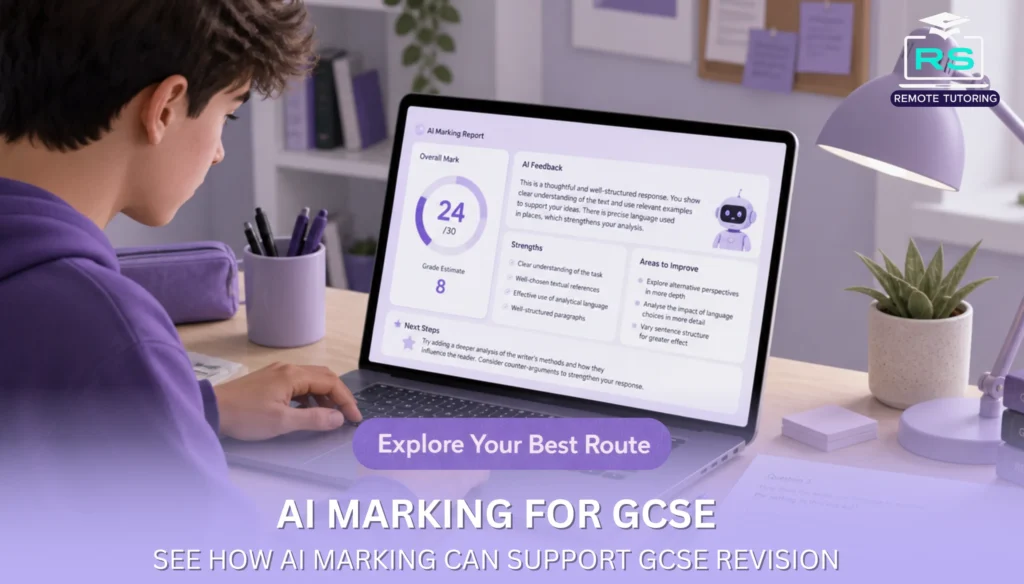
As a tutor, I still remember how stressful the lead-up to GCSE exams can be for students. Many are trying to manage several subjects at once, complete past papers, write longer answers, and wait for feedback before they know what to improve. That waiting time is often where progress slows down. In the past, students would print exam questions, complete them by hand, submit them to a teacher or tutor, and then wait days for marking. By the time the feedback arrived, the student had often moved on to another topic or forgotten the thinking behind their answer. This is where AI marking tools such as MarkMe can make a real difference. At first, many students and parents were unsure about AI marking for GCSE work, and that is understandable. But when used properly, it can give students quick, focused feedback on their answers, highlight missing analysis, point out weak structure, and suggest practical improvements based on exam-style expectations. In this guide, I’ll explain how AI marking works, why it can be useful before GCSE exams, and how students can use it without becoming fully dependent on it. I’ll also share examples from students I have supported, learners in the UK, to show how digital marking tools can fit into a real revision routine. By the end, you’ll understand whether AI marking is right for your child or students, which subjects benefit most from it, and how to use it alongside proper teaching, past papers, and tutor feedback to improve exam performance. Understanding AI Marking for GCSE What is AI marking? At its core, AI marking uses natural language processing (NLP) to assess a piece of student work against exam board criteria. When you upload a handwritten answer, the system first converts it to digital text using OCR (optical character recognition). It then compares your response to the mark scheme: does your essay include the required evidence? Is your argument structured logically? Are key terms used correctly? Finally, it generates structured feedback that mirrors what an examiner might say. This might include an overall grade band, strengths, areas for improvement and specific tips for the next attempt. Crucially, AI marking tools do not “understand” your essay like a human does. They look for patterns in language and compare them to training data. That means they excel at marking structured, criteria‑based writing but may struggle with highly creative responses. The most effective tools, like MarkMe, are trained on actual exam board mark schemes and examiner reports, making their feedback exam‑specific. Why Use AI Marking Before Your GCSE Exams? 1. Speed of feedback The revision cycle that drives improvement is simple: write a practice answer → get feedback → apply that feedback → write again. The faster you can repeat this cycle, the more you learn. Waiting a week for your teacher’s comments means maybe one feedback cycle per week. Using AI marking for GCSE essays, you can complete two or three cycles in a single session. When exam dates are looming (typically from early May to late June), time is precious. 2. Objective assessment Even the best teachers have busy days and unconscious biases. AI marking evaluates work based on the criteria you’re aiming to meet. It doesn’t get tired, and it won’t award marks out of sympathy or frustration. For example, when I practised a history essay, the AI flagged that I’d used too few examples of causation; my teacher hadn’t noticed because she was juggling dozens of scripts. 3. Fits with exam practice conditions Tools like MarkMe allow you to upload photos of handwritten answers, so you practise under exam conditions, writing by hand, organising your time and still receive digital feedback. This replicates the real exam more closely than typing, which is an advantage for subjects like English, History or Geography. 4. Personalised and actionable feedback The most helpful AI tools do more than assign a mark. They tell you what you did well and where you missed marks, often citing specific lines or parts of the mark scheme. In my case, the feedback wasn’t generic: it highlighted that I used evidence well but needed to “zoom in on individual word choices” to reach the highest level. That specificity guided my next revision session. 5. Confidence boost and stress reduction Revision for GCSEs can be stressful, especially when exam season is condensed. Getting immediate, constructive feedback reassures you that you’re on the right track. It also prevents last‑minute panic because you’ve tested yourself repeatedly under timed conditions. Who Benefits Most from AI Marking? AI marking is most valuable for subjects that require extended written responses. Based on my experience and research, here’s how it breaks down: Choosing an AI Marking Tool: What to Look For Not all AI markers are created equal. When evaluating tools like MarkMe or others, consider: Alignment with exam boards Does it mark against AQA, Edexcel, OCR or WJEC criteria? Generic AI models cannot reliably apply UK mark schemes. Handwriting support Since GCSE exams are handwritten, look for tools that accept photo uploads and handle typical student handwriting. Subject coverage Make sure the tool supports the subjects you’re taking. Many free AI markers focus on English; MarkMe covers several humanities and science subjects. Quality of feedback Feedback should be specific and actionable. Avoid tools that just give a grade without explaining how to improve. Data privacy and ethics Check whether your answers are stored, how they’re used and whether the tool complies with data protection laws. AI markers should treat students’ work confidentially and avoid using identifiable data. Cost and accessibility Some tools offer free trials; others require subscriptions. Choose one that fits your budget, but remember that free tools may have limited features. Using MarkMe: Step‑by‑Step Over the past year, we’ve guided several students through MarkMe, and we’ve settled on a straightforward process: Collect practice questions Use past papers or sample questions from your exam board. For essay‑based subjects, pick questions that cover different themes and question types. Write under timed conditions
What to Do Before GCSE Exams: Revision & Exam‑Day Tips
Facing a summer of GCSE exams can feel like preparing for a marathon. Between 6 May and 28 June, Year 11 students sit dozens of papers across multiple subjects, and it’s easy to become overwhelmed by revision, timetables and equipment lists. From experience, I know that feeling organised and calm before you walk into the exam hall makes a huge difference. In this guide, I’ll share practical steps you can take weeks before your exams, the night before and on the morning itself to help you know exactly what to do before GCSE Exams so you stay on top of everything and perform your best. Four Weeks Before: Build Your Revision Routine In the month leading up to your first GCSE paper, good planning will make everything feel more manageable. Save My Exams stresses that creating a revision timetable, gathering materials and looking after yourself are key parts of early preparation. Here are ways to put those ideas into practice: If revision feels overwhelming, RS Remote Tutoring can help you organise your topics, practise past papers and build confidence before each paper. Contact us for one‑to‑one online GCSE tutoring. One Week Before: Check the Details and Practise Exam Skills As exam day approaches, shift your focus from learning new content to consolidating what you already know and getting comfortable with exam formats. The Night Before: Prepare Calmly, Don’t Cram The evening before a GCSE paper should be about calm preparation rather than frantic studying. Both Save My Exams and PMT Education emphasise packing your bag, checking details and getting enough sleep. From experience, what you do the night before can set the tone for exam day. The Morning of the Exam: Stay Calm and Focused Exam morning can be tense, but a few simple habits will help you start strong. The BBC Bitesize article offers practical reminders: check your details, arrive early, have breakfast and take the right equipment. What Not to Do Before an Exam Knowing what to avoid is as important as knowing what to do: Revising Without Panicking Keeping a clear head during revision is crucial. Here are techniques to help you revise effectively without burning out: Managing Stress and Anxiety Exam stress is normal, but persistent anxiety can hinder performance. To stay calm: Feeling anxious? RS Remote Tutoring offers supportive tutors who can guide you in your GCSE last minute revision through tricky topics and teach stress‑management techniques so you feel calmer heading into each exam. Staying Motivated During a Long Exam Season GCSE exams stretch over almost two months. Maintaining momentum across numerous subjects can be challenging, especially when friends finishing earlier may start enjoying summer. To stay motivated: Avoiding Common Exam‑Day Mistakes Many mistakes in exams stem from nerves or poor planning. The Soham survival guide’s action checklist for the exam room provides useful dos and don’ts: Making the Most of Exam Skills During the Paper Beyond avoiding mistakes, effective exam skills can boost marks: Parent Support: Helping Without Pressure Parents often want to help but worry about adding pressure. From my conversations with parents, the most effective support is practical and emotional: Between Exams: Balancing Rest and Revision When exams span several weeks, use the gaps wisely: Recovering After a Difficult Paper There will be exams that don’t go as planned. Whether a paper felt harder than expected or you ran out of time, it’s important to move forward: Conclusion: You’ve Got This GCSE exam season is intense, but with the right preparation you can walk into each paper feeling calm and ready. Start early, organise your revision, take care of your wellbeing and keep perspective. I still remember how reassured I felt when I had my bag packed the night before and arrived at the exam hall knowing I’d done everything I could. Trust your preparation and remember that no single exam defines you. If you or your child would like personalised guidance throughout exam season, RS Remote Tutoring offers one‑to‑one online GCSE tutoring. Our experienced tutors help students organise revision, practise exam skills and manage stress so they can approach each paper with confidence. What to do Before GCSE Exam FAQs RajaRaja specializes in Physics and Maths, with over 5 years of experience. He offers KS2, KS3, and GCSE Science and Maths lessons. He graduated from one of the top universities in the UK.
Memory Hacks for GCSE Revision That Actually Work
GCSE exams are the stepping stones for the future, but i was the one thinking that certain thing only happened to me but no when i have passed the stage feel like from my experience that every students, even though the hardworking ones encounter this difficulty Wonder if you have ever spent hours revising only to forget everything a week later, you are not alone. I still remember sitting at my desk, highlighters everywhere, thinking I was being productive. But when it came to recalling anything without my notes in front of me, unfortunately I could not recall, even though I was totally blank at some peaks and some topics seemed unfamiliar. One thing that becomes clear quite quickly to me during the crucial phase of my preparation journey is this:GCSE revision is not about how long you study, it is about how well your brain retains information. That is where the right memory strategies change everything. This guide walks you through memory hacks for GCSE revision that go beyond generic advice, these are techniques that students actually use successfully under real exam pressure. How Memory Really Works During GCSE Revision Before jumping into techniques, it is necessary to understand something simple: Your brain forgets by default and it is the natural process.This is called the forgetting curve. Unless you actively revisit and use information, it fades quickly. What made the biggest difference for me was realising that: Revision is not about reading again and again but it is wholly about retrieval. Once you shift to that mindset, everything changes. Active Recall: The Most Powerful GCSE Memory Hack The first and foremost revision technique that I usually recommend is the active recall method. If you only use one technique, make it this. Active recall means: How to use it: I remember how uncomfortable this felt at first. It is harder than re reading, but that is exactly why it works. It naturally works because it strengthens neural connections, making recall faster in exams. Spaced Repetition: Stop Cramming Forever Another Effective GCSE revision hack is the spaced repetition. One of the biggest mistakes students make is cramming everything in one go.I quickly realised that spacing revision out over days and weeks made information stick naturally. Simple method can be used which is really much effective; It works because; It interrupts forgetting and strengthens long-term memory.Interleaving: Mix Subjects for Better Recall Another crucial memory hack that ultimately boosts your GCSE revision is mixing multiple subjects for a better recall process. Instead of studying one subject for hours, mix them. For Example: At first, this feels messy. I did not expect it to work, but it actually improved focus. Blurting Method: Fast and Effective Memory Test Another go to strategy is the blurting method; the fast and effective GCSE revision hack especially for the students aspiring for the GCSE in the UK. This became one of our go to strategies. How it works: Then compare with your notes. What stood out most for me while using this method is that ; You instantly see what you do not know, no guessing. Flashcards, But Use Them Properly Flashcards are another memory savior but if used properly. They only work if used correctly. Many students: Best approach to rely on is that; From my experience, I still remember digital apps help, but handwritten cards feel more memorable for many. Memory Techniques That Make Information Stick Following techniques makes the information more sich, The things i learned from my preparation days, using them makes your information more sticky to your brain. Association One of the foremost strategies is the association techniques, Link the new strange topics to something that is totally familiar making them more easy to carry out. Visualization Most people are different when it comes to learning, some learn the information in a more specific way , one of my friends easily grasps the information just by listening to the lectures while I was the one waiting for the infographics or the diagram to attain the whole concept. Visualization is another important technique that keeps the information longer. Chunking Chunking is another fine strategy that actually works best, this can be done by breaking the large information into smaller chunks so that it can easily be grabbed.One thing I did not expect was how powerful storytelling is, even for subjects like science. Common GCSE Revision Mistakes to Avoid One of the most common patterns I have seen is: These feel productive, but don’t build memory. I genuinely recommend everyone heavily to avoid this trap. GCSE Specific Advice for UK Students If you are studying in the UK, timing matters. Exam Season Reality: Seasonal Impact: What helped most was starting early, even light revision months before exams made things less stressful. How to Make Revision Fun (Without Losing Effectiveness) Let us be honest, revision is not always fun.But you can make it less painful. Try these: Many students I have spoken to, utter seemingly Studying in short bursts with rewards works better than forcing long sessions FAQs RajaRaja specializes in Physics and Maths, with over 5 years of experience. He offers KS2, KS3, and GCSE Science and Maths lessons. He graduated from one of the top universities in the UK.
Last Minute GCSE Revision Tips to Boost Your Grades
There is a point every GCSE student reaches during the hectic phase of preparation. Usually it is about a week before exams, when reality hits a little harder. The difficulty level increases as the notes are not fully done. Some topics feel confused. And suddenly, time is all about to run, students anxiously feeling like it is slipping faster than expected. I have already seen this pattern again and again, and to be very honest, I have also experienced this phase during a crucial part of my own journey. But here comes the good news: last minute GCSE revision is not only possible, it can actually be incredibly effective when done right, especially with the support of expert GCSE revision tutors. But here is the truth most guides would not tell you: “It is not about working harder in this final week. It’s about working smarter than you ever have before.” Emily Johnson , Expert English Tutor at Rs Remote Tutoring Why Last Minute GCSE Revision Can Still Work Before moving towards the revision strategies, it is important to understand why last minute revision strategies are thoroughly important. One thing that became clear quite quickly to me was that memory works differently under pressure. When time is limited: From my experience, as during the initial years of my preparation, students who panic and try to cover everything struggle the most. But those who narrow down their focus and apply smart strategies to their preparation phase often get the output more of their expectations. Want to revise properly before your GCSE exams? Join our GCSE Revision Program. Join Now The Biggest Mistake Students often commit in the Final Week of their preparation I remember a student telling me, “I am just re-reading everything again and again.” This is where things go wrong. Passive revision (reading, highlighting, copying notes) Trying to cover every topic equally Studying for long hours without strategy What made the biggest difference for us, and for many students I have all worked with was wholly to: How to Prioritise in Your Final Week You do not have time for everything, and that is okay. What you actually need to do is a simple decision system: Step 1: Divide Topics into 3 Categories Step 2: Apply the 60-30-10 Rule Many students do not realise this, but it is important to understand that over-revising strong topics feels productive but gives almost no grade improvement. The Most Effective Last Minute GCSE Revision Techniques The following are some of the most effective last minute GCSE revision techniques that can genuinely help students improve their results when used properly. 1. Active Recall (Your utmost Number 1 Tool) Instead of reading notes, ask yourself: The active recall forces your brain to retrieve the information, strengthening your brain memory to actually hold on and work better when anxiously recalled during the exam hours. 2. Past Papers Are Non-Negotiable If there is one thing I would genuinely recommend, it is this: Do as many past paper questions as possible. Not full papers every time, even: This builds: 3. The Teach It Out Loud Method This method refers to the process of revising the topic and then significantly teaching it to yourself for better results. For this method, Explain a topic as if you are teaching someone. I remember doing this and realising: If you can’t explain it simply, you don’t understand it yet.. Want to revise properly before your GCSE exams? Join our GCSE Revision Program. Join Now A Realistic Final Week Revision Plan I usually encounter a certain thing that students do not lack with the strategies, as they are aware of proven strategies for their GCSE revision and maximizing their final week to avoid the pressure during the exam hours. What really makes them fail or attain the low grade is the revision timetable, Here is a structure that actually works: Daily Framework Morning (High Focus) Afternoon Evening Night Study Sessions Use: This keeps your focus sharp without burnout. How Many Hours Should You Study in the Final Week? This is the most important concern of the students. They are often entangled , torn between the question about how many hours one should study during the final week. This is where many students go wrong, because anxiously focusing on studying more hours actually is not true in most of the cases. More hours ≠ better results. From what me and our other tutors have seen: What actually matters more is : What to Do the Night Before the Exam This part matters more than most students think. Do NOT: Instead: I still remember how much clearer everything felt after a good night’s sleep compared to a late-night cram. FAQs Final Thoughts Last minute GCSE revision is not just about catching up on everything. It is all about: From experience, what stayed with me most is this: And if you do that, even now, there is still a lot you can turn around. RajaRaja specializes in Physics and Maths, with over 5 years of experience. He offers KS2, KS3, and GCSE Science and Maths lessons. He graduated from one of the top universities in the UK.
GCSE Exam Timetable 2027: Key Dates & Full Guide
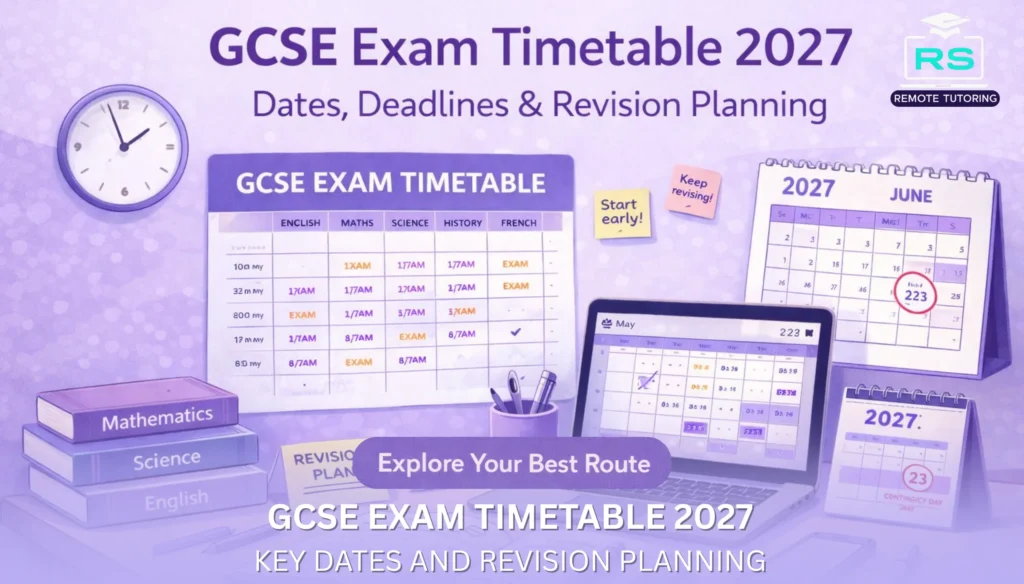
Choosing when to sit your General Certificate of Secondary Education (GCSE) exams can feel daunting, especially as timetables change every year. In 2027 the UK exam boards, Pearson Edexcel, AQA, OCR, WJEC/Eduqas and CCEA have released provisional exam timetables ahead of a formal consultation. These tables outline when each subject exam will be held, along with guidelines on start times and contingency days. Since GCSE grades are often critical for sixth‑form, apprenticeship or university entry, students and parents need clarity on the key dates well in advance. This guide provides a complete overview of the GCSE exam timetable 2027 for England and the wider United Kingdom. It covers provisional and final schedules, board‑specific deadlines, the summer 2026 timetable for comparison, and even explores the perennial question of which language is easier to learn, French, German or Spanish, to help you choose your Modern Foreign Language (MFL) option. How GCSE timetables are created The exam boards collaborate through the Joint Council for Qualifications (JCQ) to agree common exam slots. Each board then publishes provisional timetables the year before the exams and invites feedback from schools and candidates. AQA notes that a six‑week consultation for the summer 2027 timetables ran between 2 February and 20 March 2026, after which the final timetables will be published in early May. The WJEC/Eduqas website explains that provisional timetables allow centres to comment on clashes and that feedback received by 20 March 2026 will inform the final version. This collaborative approach ensures that exams across different boards avoid overlapping sessions and that contingency planning for disruptions is consistent. GCSE 2027 Preparation Get Ready for GCSE 2027 with Expert Online Tutoring Help your child build confidence before exam pressure starts. RS Remote Tutoring provides one-to-one GCSE support for Maths, English, Science and more, with expert tutors and a free trial lesson. Book a 30 Min Trial Lesson × Free Trial Lesson Free GCSE Tutoring Trial Fill in your details and our team will contact you to arrange a free online GCSE tutoring trial lesson. Key timetable principles GCSE exam timetable 2027: week‑by‑week overview Although the detailed subject schedule varies by board, the provisional timetables follow a similar structure. GCSE exams will start in early May 2027 and continue until late June 2027, with the contingency day on 23 June. Below is a high‑level overview based on the Pearson Edexcel and AQA provisional timetables findings: Week (2027) Key subjects & examples Notes Week 1: Monday 10 May to Friday 14 May Languages (e.g. Turkish listening & reading), Citizenship Studies, German listening and understanding (Foundation & Higher) and Psychology begin on Monday. Biology Paper 1 and Combined Science Paper 1 follow on Tuesday, while English Literature Paper 1 and Business Paper 1 appear on Wednesday. Start of formal written exams. MFL speaking tests should already be underway since mid‑April. Week 2: Monday 17 May to Friday 21 May Mathematics Papers 1 or 2, Geography, History and French listening/reading typically occur. OCR lists Ancient History, Biology and Chemistry exams during this week. Humanities and core subjects such as Maths gain prominence. Centres manage timetable clashes when students sit multiple sciences. Week 3: Monday 24 May to Friday 28 May English Language, Computer Science, Religious Studies and Physics are often scheduled. Combined Science Paper 2 and Business Paper 2 appear in many boards. Mid‑exams period. Students should take advantage of the half‑term break to revise remaining papers. Week 4: Monday 7 June to Friday 11 June Higher tier mathematics or further maths, Geography Paper 2, History Paper 2, and Languages such as Spanish listening & reading. OCR schedules Latin and Media Studies. After half‑term, exams resume. Some boards hold art and practical assessments during this week. Week 5: Monday 14 June to Friday 18 June Chemistry, Physics, Economics and Music. Edexcel lists German reading and writing papers here. Many science and optional subjects conclude. Week 6: Monday 21 June to Friday 25 June Final examinations in subjects like Additional Maths, Drama and Late entry languages. The contingency day on 23 June stands ready for any rescheduled papers. Students should remain available in case of unexpected disruptions. Pro tip: Create a personalised calendar that marks each exam date, NEA submission deadline and speaking test window. Begin revision early for subjects scheduled in the first two weeks and prioritise coursework tasks due in early May. Board‑specific details Pearson Edexcel The Pearson Edexcel GCSE Summer 2027 Provisional Examination Timetable highlights the following: AQA AQA’s May/June 2027 Provisional Exam Timetable provides additional context: OCR (Cambridge) OCR’s June 2027 Provisional Examination Timetable (for GCSE and Cambridge Nationals) offers similar guidance: WJEC/Eduqas WJEC’s provisional timetable is currently under review. The board invited comments on proposed Summer 2027 exam dates until 20 March 2026. Final timetables will be published after review. The site reminds schools that timetable clashes must be managed according to JCQ guidance and that supervised rest breaks are permitted. CCEA (Northern Ireland) CCEA’s draft timetable for Summer 2027 emphasises moderation and speaking test windows: Summary table: core GCSE exam dates 2027 Event Date (2027) Evidence Earliest written exams Monday 10 May Edexcel lists Biblical Hebrew, Computer Science and Turkish papers on 10 May. MFL speaking tests window 12 April – 21 May (AQA) and 5 April – 30 April (CCEA) Students must arrange oral exams within these windows. NEA submission deadline 7 May (most subjects) and 31 May (Art & Design) All coursework must be submitted. Contingency day Wednesday 23 June All boards designate this day for rescheduled exams. Results days Schools: 18 August; Students: 19 August AQA provisional timetable provides results publication dates. GCSE 2027 Preparation Get Ready for GCSE 2027 with Expert Online Tutoring Help your child build confidence before exam pressure starts. RS Remote Tutoring provides one-to-one GCSE support for Maths, English, Science and more, with expert tutors and a 30 Min trial lesson. Book a 30 Min Trial Lesson × Free Trial Lesson Free GCSE Tutoring Trial Fill in your details and our team will contact you to arrange a
How To Use Tutor Feedback After GCSE Mock Exams
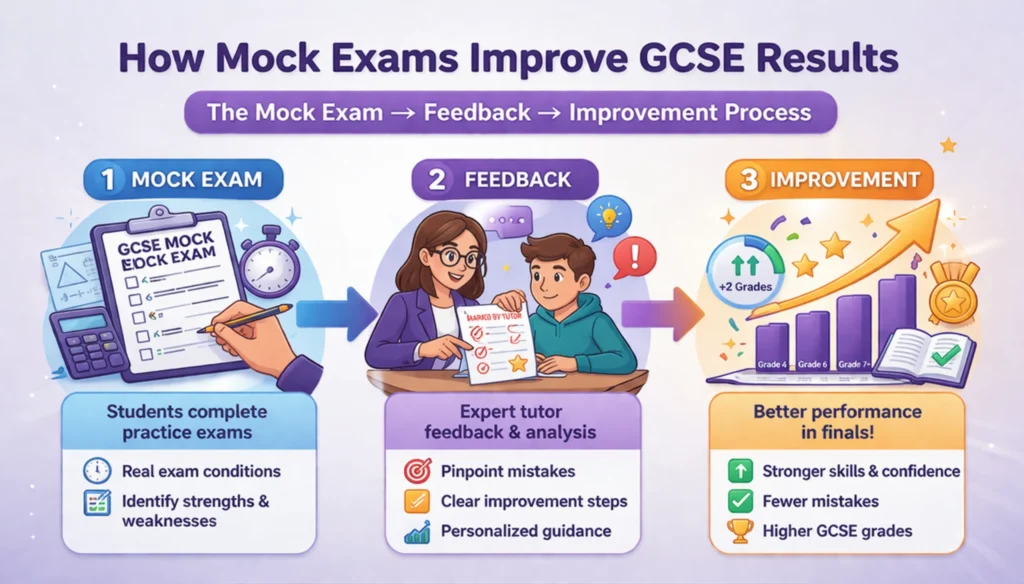
GCSE Tutoring is not only about just delivering extra lectures and guidance other than school that helps the students to achieve their desired grades but it is a whole hearted and tiring process. Tutors are another form of guidance that helps to clear the brain fog already set in the minds of students appearing for the GCSE exams. Online GCSE tutoring helps in many ways but the most beneficial aspect is the one on one, personalised feedback that cannot be easily gained from the school teachers. Similarly, the mock exams are not just those papers but they are the most important practice exams, the predicative indicator of the performance, confidence and exam readiness. Getting the higher tier grade is not just the only valuable outcome but the most important is the tutor’s feedback. Additionally, the student’s gain can also lie in how effectively the student uses the tutor’s feedback after the GCSE mock exam. For the parents and students investing their time and energy in the online tuitions in the UK, mock exams provide the structured, predictable checkpoints. When tutors’ feedback is analyzed and interrupted clearly, it becomes a powerful academic accelerator, transforming all the weaknesses into measurable improvements before the final GCSE examination. Most parents and Students are worried about how to use the tutor’s feedback effectively in order to unleash all the negativity and get the desired grades. This research informed guide well explores how to systematically use the tutors feedback after the mock exams to upgrade the performance, refine the exam techniques and build long term academic confidence. Understanding Why Tutor’s Feedback Matters More than Ever In GCSE Exams Before diving into how to use the feedback effectively it is important to learn the benefits why this matters a lot. Educational research suggests that feedback is one of the highest impact strategies for academic progress. Furgorore, according to the findings widely cited in the UK education research states that, structured and well organized feedback can increase the learning process when it is; Additionally, mock exams are the diagnostic tools. They further highlights; But most of the students are highly inclined towards achieving good grades, that is Grade 8, 7 and 6 without critically analyzing why their marks were lost. For most families, using Online tuitions in the UK, it is important to understand that mock feedback becomes more important and valuable because tutors can personalise the target’s improvement plans immediately after reviewing the mock exam scripts. Types of Tutors Feedback After GCSE mock exams, tutors’ feedback typically falls into the following categories. Content Gaps: One important feedback category is that students lack the content. For example; The tutor may provide a feedback like; This further indicates that the student lacks the knowledge depth, misunderstanding or the incomplete revision. Application Errors: Another important type of feedback is the application error. Students may fail to attempt the answer correctly by incorporating a failed methodology. For example, tutor may imply the feedback as; This further suggests that students may hold the conceptual clarity but struggle to apply it under exam conditions. Depth and Analysis Weakness: Another important category of the feedback is the lack of ana;ysis and depth in the answer. It is particularly evident in the higher tier GCSE examinations. Tutor may refer; This is the point that separates the Grade 6 student from the grade 7 and 8 It is important to understand the feedback category without fully understanding in which point you are lacking, you may fail to achieve your desired grades. How to Use the Tutors Feedback The following guide encapsulates the steps that should be navigated in order to correctly and effectively the tutors feedback. Conduct a Post Mock Performance Audit: Before jumping into revision, students should firstly conduct a post mock performance audit. In order to do this you should create a mock analysis table. This further includes the detailed postmortem of the feedback given by the tutor. This further transforms vague feedback into measurable targets, To illustrate this with an example, if the students gains the less marks should make the table: 6-mark biology question | -3 marks | Limited explanation | Depth issue | Practise extended answers | The structured analytical approach is far more effective than simply re-reading notes. Prioritizing the High Impact Weakness: Another important step to inca;clate into your revision strategy is prioritising the weak areas that are utmost important. Not all mistakes are equal. Research into the effective revision states that targeted intervention produces stronger gains than broad revision. Firstly focus on; For example, if allergic errors appear multiple in maths questions, prepare algebra before your niche topics. Students using the structured online tuition in the UK such as ur platfrom RS remote tutoring, benefit from tutors creating topic weighted revision plans thoroughly aligned with the exam board specifications. Turning Feedback Into Small Academic Goals: Feedback is utmost necessary and it must translate into the precise goals. Instead of just vaguely mentioning; I need to improve science. Set clear and precise goals such as ; “I will complete three 6-mark biology questions on osmosis this week and receive tutor marking by Friday.” In order to make clear smart goals are; Goal clarity reduces the overwhelming and increases the confidence. How to Use Evidence Based Revision Methods: Not all revision techniques benefit the students. Cognitive Science highlights the strategies that are genuinely effective and improves retention and exam performance. It is important to note that testing yourself without notes strengthens memory pathways more effectively than re reading. After feedback is analyzed, weak topics are identified then student should; Focusing on Exam Techniques rather than Knowledge: One of the foremost benefits of online tutoring is that it focuses on exam techniques, guides the students on how to prepare the answer effectively instead of just focusing on the knowledge and the content. Common techniques problem revealed in the mock exams includes; For example: A 6-mark question requires six developed points or three well-developed ones. Writing only two points automatically caps
GCSE Subjects List 2026: Core, Options & How to Choose
Choosing your General Certificate of Secondary Education (GCSE) subjects is one of the first major academic decisions most UK students make. These qualifications mark the end of Key Stage 4 and provide the bridge to A‑levels, T‑levels, apprenticeships or vocational training. A good set of GCSE grades can also broaden your career choices and improve your prospects in the UK’s competitive job market. By 2026 there are roughly sixty GCSE subjects to choose from, but only a handful are compulsory. The rest allow you to customize your education based on your interests and future goals. This guide gives you the complete GCSE subjects list, explains which subjects are compulsory, explores emerging options like the new Natural History GCSE, and provides tips on choosing the right number of subjects. What are GCSEs and how many should you take? GCSEs are Level 2 qualifications taken mainly by pupils aged 15 to 16. They serve three purposes: assessing learning at the end of Key Stages 3 and 4, providing a gateway to further study and apprenticeships, and demonstrating literacy and numeracy skills to employers. Most students sit between eight and ten GCSEs; schools often cap the total at around twelve to avoid overload. The absolute minimum to progress comfortably to A‑levels or other post‑16 pathways is five GCSEs including English, maths and science. Some schools require English Literature and a language or humanity as part of the core. Choosing around nine subjects offers a balance of breadth and depth, keeping your future options open. Core versus optional GCSE subjects The national curriculum divides GCSEs into core (compulsory) and foundation (optional) subjects. Compulsory GCSE subjects All students across England must study the following core subjects: Many schools also treat English Literature as core. In Wales, Welsh is compulsory instead of a modern language. In Northern Ireland, students must study Learning for Life and Work alongside English, maths and science. Foundation (optional) GCSE subjects The remaining subjects, approximately sixty, are optional. Students choose from these to suit their interests and career aspirations. Schools encourage taking at least one subject from each of the following groups to keep options open: Compulsory requirements within optional choices Most schools require at least one humanities (History or Geography) and one modern foreign language. For example, Leigh Academy Mascalls insists that students take English Language, English Literature, Mathematics, Combined Science and either Geography or History, while Physical Education and PSHRE lessons are non‑examined. At Prior Park College in Bath, the core curriculum includes English, Mathematics, Core RE and PSHE, and students typically study nine GCSEs, around 70 % of which they choose themselves. The combination of required and elective subjects varies by school, so always consult your school’s options booklet. Full list of GCSE subjects in 2026 (categorized) Below is a categorized list of GCSE subjects available in 2025–26. While not every school offers every subject, this list reflects the range across exam boards. Bolded entries denote some of the most popular choices. Sciences Mathematics English & Languages Humanities and Social Sciences Business & Computing Design & Technology and Engineering Creative & Performing Arts Physical Education and Sport Vocational and Technical Awards In addition to GCSEs, many schools offer Level 1/2 vocational qualifications like BTEC Tech Awards and OCR Cambridge Nationals in Child Development, Health & Social Care, Travel & Tourism, Digital Media and Engineering. These qualifications count towards the 2026 performance tables and are taken alongside GCSEs. They provide practical learning but still require written assessments. New and emerging subjects of GCSE How to choose your GCSE subjects Selecting optional subjects can be daunting. Here are practical steps to guide your decision: Comparing modern foreign languages: French, Spanish and German Languages sit at the intersection of core skills and cultural enrichment. Many students wonder which language is easier to learn: French, Spanish or German. Here’s a comparison to help you decide. Difficulty and linguistic features According to the U.S. Foreign Service Institute (FSI) rankings, French and Spanish are Category I languages for English speakers, requiring about 600–750 classroom hours (24–30 weeks) to achieve proficiency. German is classified as Category II because of its case system and different word order, requiring slightly more study time. German grammar is logical but involves four cases and three genders, which can be challenging at first; however, its verb conjugation and word formation are consistent, making rules easier once learned. Number of speakers and usefulness GCSE exam difficulty A government analysis of grade standards found that GCSE French and German are among the five hardest subjects, whereas Spanish is closer to average. This means that achieving a top grade in Spanish may be slightly easier than in French or German, though personal interest and teaching quality matter more than statistics. Choosing a language GCSE subjects for medicine and other careers If you already have a career in mind, certain GCSE subjects will provide a stronger foundation: Grades and exam reforms: understanding GCSE results The 9 to 1 grading scale Since 2017, GCSEs in England use a 9 to 1 grading scale, where 9 is the highest grade. A Grade 4 is considered a standard pass, roughly equivalent to the old Grade C, while Grade 5 is a strong pass. Grades 7 to 9 correspond to the old A/A* and are considered very good. A Grade 7 is not bad; it equates to an old A and demonstrates high proficiency. Schools and colleges often require Grade 4 or 5 in English and Maths for entry, while competitive sixth‑forms may ask for Grade 7 in specific subjects. Grade boundaries and fairness Ofqual’s analysis shows that French and German are graded more leniently than some subjects because they are statistically more difficult. When planning your GCSE portfolio, do not be deterred by perceptions of difficulty, choose subjects that play to your strengths. Recent reforms From 2025 onward, formula sheets for mathematics, physics and combined science exams help students focus on problem‑solving rather than memorisation. The government is also piloting digital exams in English and maths, which