There is something very specific about Functional Skills Maths Level 2 that many people outside adult education do not fully understand.It is rarely just “another maths qualification.”For many learners, it represents:
- finally qualifying for university,
- getting into nursing,
- progressing in an apprenticeship,
- applying for a promotion,
- becoming eligible for teacher training,
- or proving to themselves that they are capable after years of believing they were “bad at maths.”
As a tutor, I have seen students walk into their first session apologising before we even started.
“I’ve never been good at maths.”
“I forget everything.”
“I panic in exams.”
“I’m too old to learn this now.”
And honestly, one thing that becomes clear quite quickly is that most learners are not struggling because they are incapable. They are struggling because previous maths experiences damaged their confidence.That is why understanding the Functional Skills Maths Level 2 topics properly matters so much. Once students know exactly what is included, what the exam expects, and where to focus their energy, things begin to feel manageable again.
This guide breaks everything down clearly, including the full topic checklist, common mistakes, revision advice, and what learners genuinely need to focus on to pass.
Jump to Section
What Is Functional Skills Math Level 2?
Mathematics is a nationally recognised qualification in the UK that is considered equivalent to a GCSE Grade 4 (C). It focuses less on abstract academic maths and more on practical real-world problem-solving.Instead of memorising complicated theories, learners apply maths to situations such as:
- budgeting,
- bills,
- percentages,
- workplace calculations,
- interpreting data,
- measurements,
- and everyday reasoning.
Many colleges, employers, apprenticeships, and universities accept Functional Skills Level 2 as an alternative to GCSE maths. From experience, learners are often surprised by how practical the qualification feels compared to school maths.
One of the biggest differences I notice is this:
Students who hated GCSE maths sometimes perform far better in Functional Skills because the questions feel relevant to real life.
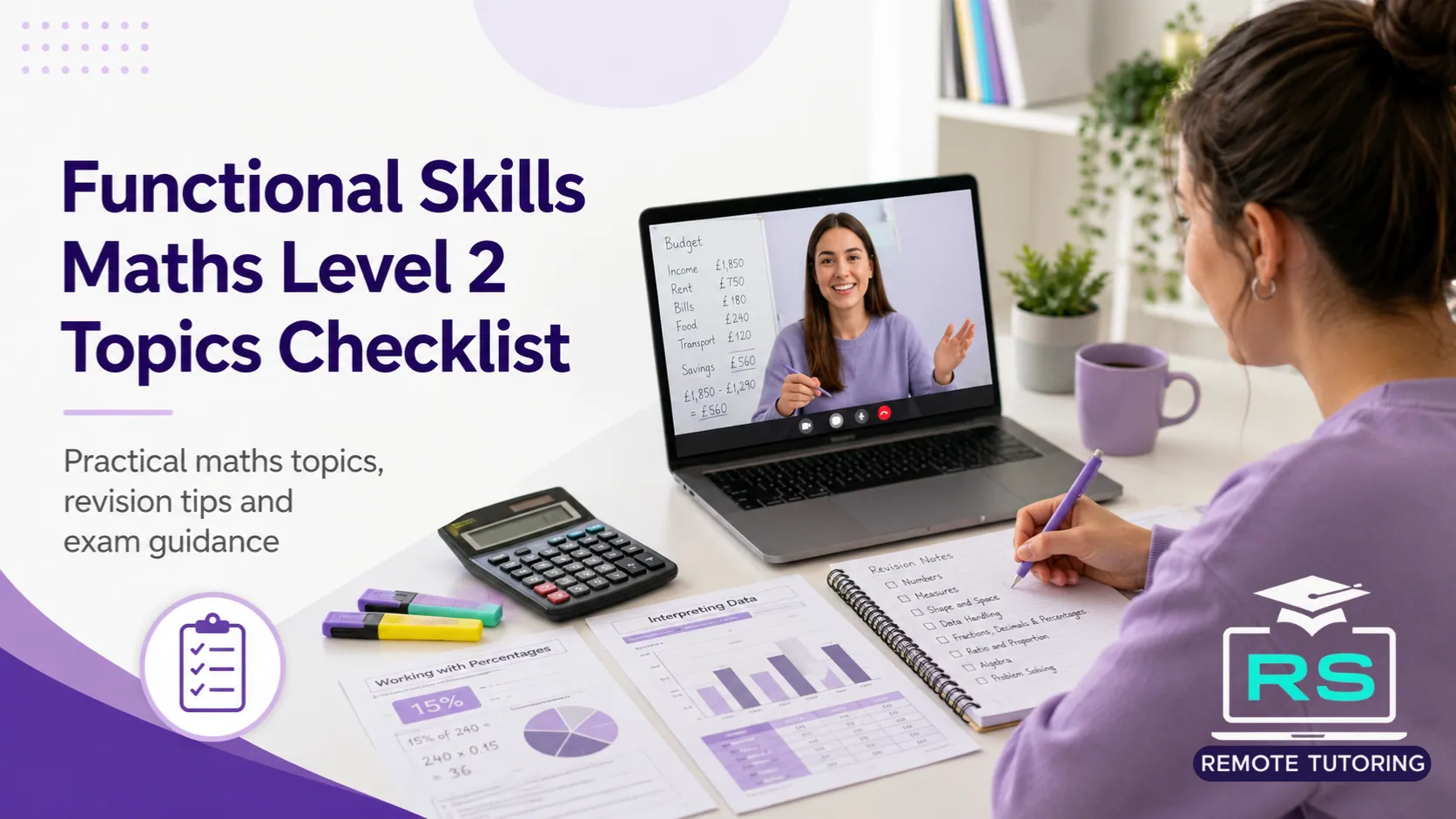
Full Functional Skills Maths Level 2 Topics Checklist
Here is the complete breakdown of the major areas that need to be understood.
Numbers and Percentages
This is one of the most important sections in the entire qualification.Students often underestimate it because the calculations themselves can seem basic at first. But under exam pressure, multi-step percentage questions become one of the most common places learners lose marks. Functional Maths includes;
- Adding, subtracting, multiplying, and dividing
- BIDMAS
- Fractions, decimals, and percentages
- Converting between fractions, decimals, and percentages
- Percentage increase and decrease
- Finding percentages of amounts
- Ratio and proportion
- Using negative numbers
- Estimation and rounding
I still remember one learner who could solve percentage questions perfectly in class but froze completely when percentages appeared inside a word problem.That happens a lot.The maths is usually not the real issue. Interpreting the wording is.The Pro tip is;
Always underline the actual question first before calculating anything.
Many learners start calculating immediately and solve the wrong thing.
Fractions, Decimals, and Ratios
This section appears constantly throughout the exam.You need confidence with:
- simplifying fractions,
- equivalent fractions,
- mixed numbers,
- ratio sharing,
- scaling recipes,
- converting units,
- proportional reasoning.
One thing I did not expect when I first started tutoring adults was how many learners feared fractions specifically.Not algebra.Not even the graphs.But the Fractions.Usually because they missed one small foundation years ago and carried that anxiety for years afterward.
The good news is that once fractions are taught visually and practically, confidence improves very quickly.
Measures, Shape, and Space
This area focuses heavily on practical applications.Topics further includes:
- Area
- Perimeter
- Volume
- Metric conversions
- Reading scales
- Time calculations
- Distance-speed-time
- Temperature
- Money calculations
You may also need to work with:
- rectangles,
- triangles,
- compound shapes,
- cuboids,
- circles,
- and real-world measurements.
The most important concern the students show is tirelessly worrying about the exam patterns. Functional Skills papers include workplace-style questions involving:
- flooring,
- paint coverage,
- packaging,
- construction measurements,
- or travel timings.
Students often do better when they stop seeing maths as “school maths” and start seeing it as decision-making.
Data Handling and Statistics
This section is usually more accessible for many learners. Because the topics are far more easy to cover,
- Reading tables
- Interpreting charts and graphs
- Mean, median, mode, and range
- Probability basics
- Comparing data
- Extracting information from diagrams
Graph Types that are Commonly Used
- Bar charts
- Pie charts
- Line graphs
- Timetables
- Frequency tables
From experience, learners who rush this section lose easy marks.The information is usually already there.The challenge is accuracy.
The most recommended advice from my side is to slow down when reading graphs.
Most mistakes happen because students misread labels, units, or scales.
Using Maths in Real-Life Contexts
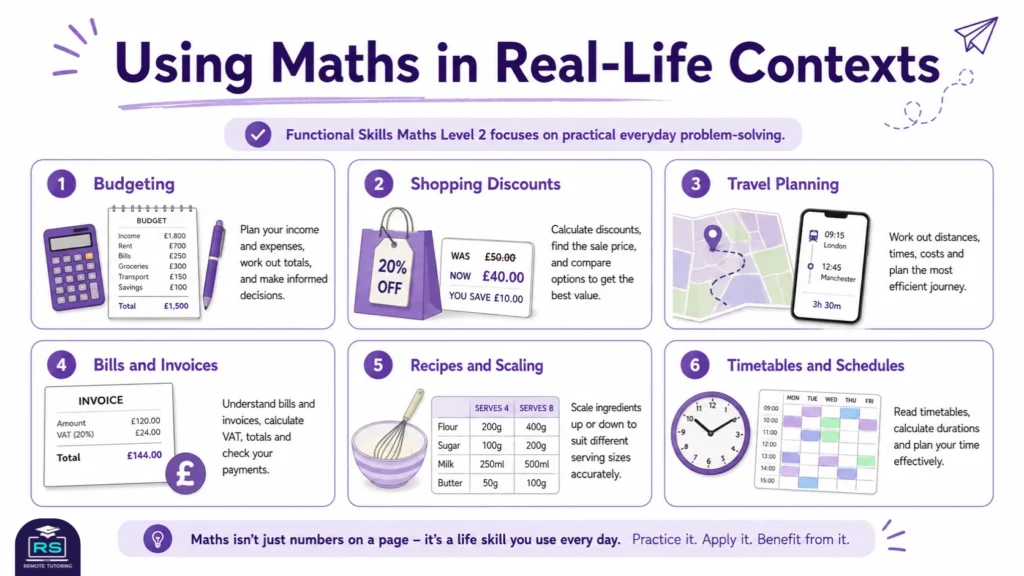
This is where Functional Skills differ most from traditional school maths. Mostly the questions are designed around everyday situations such as:
- payslips,
- shopping discounts,
- fuel costs,
- travel planning,
- business budgets,
- cooking,
- invoices,
- mobile phone contracts,
- and household bills.
Many students initially feel overwhelmed because the questions look “wordy.”But what made the biggest difference for us in lessons was learning how to break questions into smaller steps.Once learners stop trying to solve everything mentally in one go, confidence improves dramatically.
Functional Skills Maths Level 2 Exam Structure
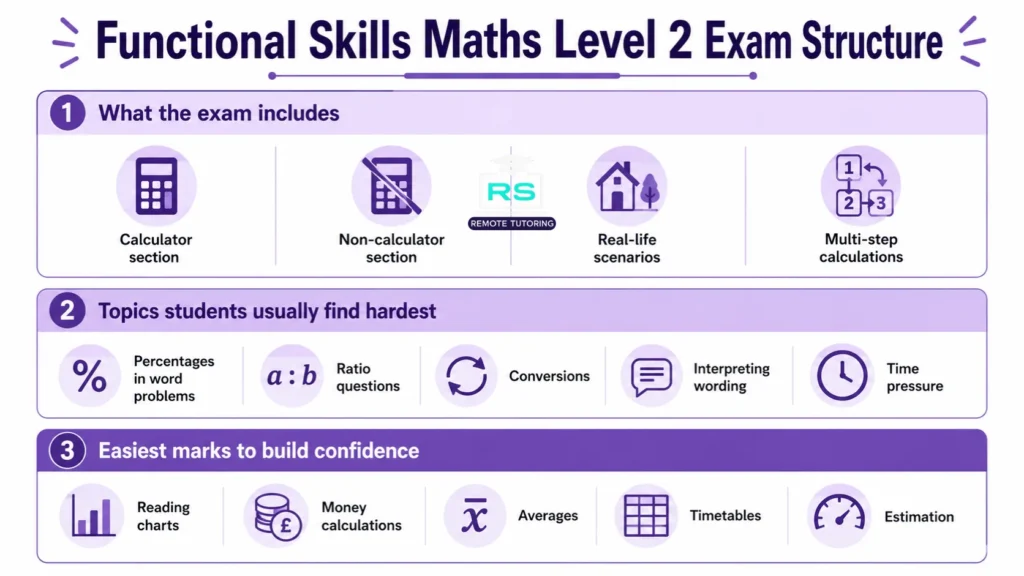
Understanding the exam structure is far more important to easily get the targeted score. The exact structure varies slightly between exam boards like Pearson and City & Guilds, but most exams include:
- A calculator section
- A non-calculator section
- Problem-solving questions
- Real-life scenarios
- Multiple-step calculations
Exams are usually completed onscreen or on paper depending on the provider
The Topics Students Usually Find Hardest
As a tutor, there are clear patterns.The topics learners struggle with most are usually:
- Percentages in word problems
- Ratio questions
- Multi-step conversions
- Interpreting exam wording
- Time-pressure calculations
Interestingly, the hardest part is often not the maths itself.It is confidence.Many learners panic the moment they see numbers because they already expect failure before trying.
I have seen students answer difficult questions correctly during relaxed practice sessions and then suddenly forget basic calculations in mock exams purely due to anxiety.That emotional side matters more than many people realise.
The Easiest Marks to Pick Up Quickly
If you are revising efficiently, focus on these high-return areas first:
- Reading charts correctly
- Basic percentages
- Money calculations
- Mean and averages
- Unit conversions
- Estimation
- Timetables
These topics appear regularly and can build confidence quickly.
One of the most common patterns I have seen is this:
students improve fastest once they begin getting small wins consistently.Confidence grows through evidence.Not motivation speeches.
Best Revision Strategy for Functional Skills Maths Level 2
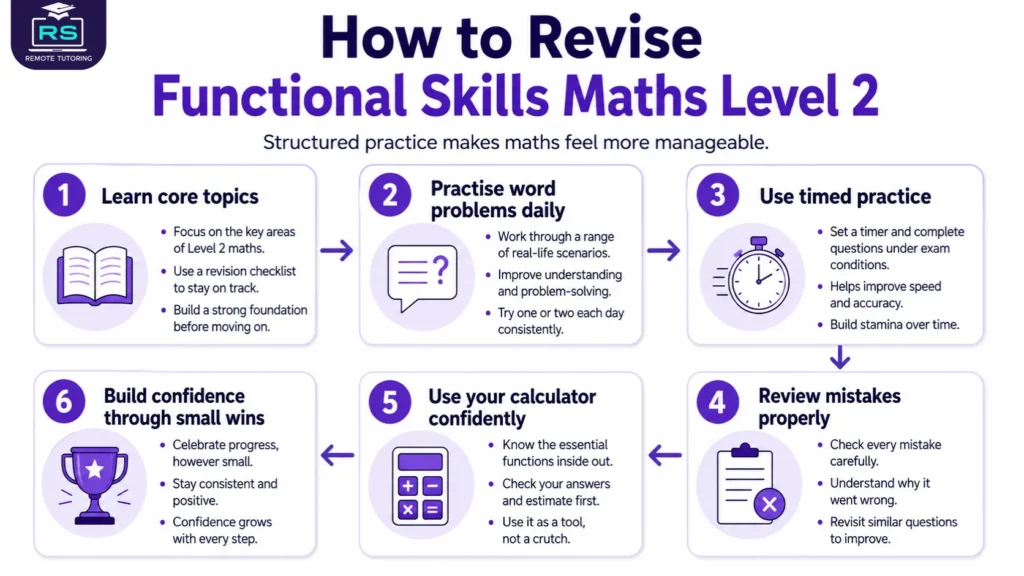
Learn the Core Topics First
Do not jump randomly between topics.Build confidence in:
- percentages,
- fractions,
- ratios,
- and measurements first.
These appear everywhere.
Practise Word Problems Daily
Functional Skills is heavily context-based.You must practise:
- reading carefully,
- identifying key information,
- choosing the correct method
I would genuinely recommend rewriting complicated questions in your own words first.That alone helps many learners understand what is actually being asked.
Use Timed Practice
Many students know the maths but struggle under pressure. Maths requires unlimited practice with careful time management. Timed practice helps reduce panic.
Even 15 to 20 minutes daily makes a difference over time.
Review Mistakes Properly
This is one thing students often avoid.Practicing and then rechecking what you have done wrong or which topic needs more focus. Do not just mark answers wrong and move on.Instead ask:
- Why did I lose marks?
- Did I misread?
- Forget a method?
- Rush?
- Use the wrong operation?
Real progress happens during review.
Common Mistakes That Cause Learners to Fail
- Rushing Word Problems: Students often calculate too early.
- Ignoring Units: Centimetres vs metres causes many avoidable mistakes.
- Weak Calculator Skills: Some learners lose marks simply because they enter calculations incorrectly.
- Skipping Difficult Questions Entirely:Always attempt something.Marks are often available for methods.
- Revising Passively: Watching videos alone is not enough.Maths improves through active practice.
Free Resources That Actually Help
This is the area that students need to know. Apart from the tutor’s guidance there are certain useful resources that students should encounter in order to get the desired grades. Useful revision tools include:
- practice papers,
- topic worksheets,
- video walkthroughs,
- online quizzes,
- and mock exams.
But from experience, the biggest improvement usually comes from combining:
- structured topic revision
- timed practice,
- and feedback from mistakes.
Random revision without direction often leads to frustration.
FAQs
What topics are in Functional Skills Maths Level 2?
The main topics in Mathematics include numbers, percentages, fractions, ratios, measurements, area, volume, data handling, probability, graphs, averages, and real-life problem-solving. Questions are designed around practical everyday situations such as budgeting, travel, shopping, and workplace maths.
What is included in Functional Skills Level 2?
Functional Skills Level 2 includes practical maths and English skills used in daily life and work. In maths, learners study calculations, percentages, measurements, statistics, and problem-solving. The qualification is widely accepted as equivalent to a GCSE Grade 4 (C).
What do you need to pass Functional Skills Level 2?
To pass Functional Skills Level 2 maths, you need strong understanding of core topics, accurate calculator use, and the ability to solve real-life maths problems under timed conditions. Consistent practice with exam-style questions is one of the most effective ways to improve pass rates.
Can I get a free Level 2 Functional Skills course?
Yes. Some colleges, apprenticeship providers, adult education centres, and online learning platforms offer free Functional Skills Level 2 courses, especially for adults without a previous Level 2 qualification. Availability depends on funding eligibility and location.
Is Functional Skills Maths Level 2 harder than GCSE maths?
Most learners find Functional Skills Maths more practical and accessible than GCSE maths because it focuses on real-life applications rather than abstract theory. However, the wording and problem-solving style can still feel challenging without practice.
How many times can you retake Functional Skills Maths Level 2?
Most providers allow multiple retakes, although policies vary depending on the course provider or funding arrangement. Many learners pass after improving exam technique and confidence through additional practice.
Final Thoughts
If there is one thing I would want learners to understand, it is this:Struggling with maths in the past does not automatically predict your future.I have watched students go from avoiding calculators completely to passing confidently within months.Not because they suddenly became “maths people,” but because they finally had:
- structure,
- support,
- repetition,
- and realistic guidance.
And honestly, once learners understand the actual Functional Skills Maths Level 2 topics clearly, the qualification starts feeling far less intimidating. That clarity changes everything.

Raja specializes in Physics and Maths, with over 5 years of experience. He offers KS2, KS3, and GCSE Science and Maths lessons. He graduated from one of the top universities in the UK.