Functional Skills Maths Level 2 fractions, decimals and percentages revision guide banner
A learner once told us she’d rather rewire a plug than convert 3/8 into a percentage. Six weeks later she passed her exam with room to spare. Fractions, decimals and percentages in Functional Skills Maths Level 2 feel harder than they are and that gap between feeling and reality is exactly what this guide closes.
The stakes are real. According to National Numeracy’s analysis of the 2023 OECD adult skills survey, 52% of adults in England have numeracy at or below the level expected of a primary school leaver. Many of them can’t confidently work out a 10% discount. If that’s you right now, you’re in the majority, not the minority and it’s fixable.
Below you’ll find the methods our tutors teach every week, the conversions worth memorising, and the mistakes that cost learners marks they should never lose.
Jump to Sections
Why do fractions, decimals and percentages matter so much in the Level 2 exam?
They matter because they run through the whole paper, not one section of it. Money, ratio, probability, measures and data questions all lean on fraction, decimal and percentage skills, so improving this one area lifts your score across the entire Functional Skills Maths Level 2 assessment.
Look at the government’s subject content for Functional Skills Mathematics and you’ll see these skills listed as core “number” content. But in practice they hide everywhere: a probability written as a fraction, a wage rise given as a percentage, a fuel price in decimals.
That’s also why they’re worth your revision time more than almost any other topic on the Functional Skills Maths Level 2 topics checklist. One skill, marks everywhere.
And here’s the mindset shift that matters most: fractions, decimals and percentages aren’t three topics. They’re three costumes for the same number. 0.5, 1/2 and 50% are identical. Once that clicks, half the fear disappears.
How do fractions actually work?
A fraction shows part of a whole. The top number (numerator) tells you how many parts you have; the bottom number (denominator) tells you how many equal parts the whole was split into. In 3/4, you hold three parts out of four.
Before exam practice, get comfortable with five moves:
- Simplifying fractions (divide top and bottom by the same number)
- Finding equivalent fractions (multiply top and bottom by the same number)
- Comparing and ordering fractions
- Converting between mixed numbers and improper fractions
- Finding a fraction of an amount (divide by the bottom, multiply by the top)
That last one earns the most marks. “Find 3/5 of £40” means £40 ÷ 5 = £8, then 8 × 3 = £24. Two steps, done.
Draw things. Honestly. A shaded rectangle explains equivalent fractions faster than a page of working, and there’s no rule against sketching in the exam.
What’s the easiest way to understand decimals?
Decimals are fractions written in place value. 0.5 is five tenths, 0.25 is twenty-five hundredths. You already use them daily, prices, bank balances, fuel costs so the exam is testing a skill you’ve practised for years without noticing.
Where learners slip is precision. One misplaced digit changes everything:
- 0.5 is ten times bigger than 0.05
- £2.50 is not £25.00
- 3.06 is not 3.6
Slow down on decimal placement, especially when multiplying or dividing by 10, 100 and 1,000. Moving the digits the wrong way is one of the most common errors we see in marked papers, and it’s a whole-mark loss every time for something you actually understand.
Why does “per cent” just mean “out of 100”?
Because that’s literally the Latin: per centum, “by the hundred”. So 25% means 25 out of every 100. Keep that meaning in view and percentages stop being abstract, they become a fraction with a fixed denominator of 100.
Percentages are everywhere in Level 2 papers because they’re everywhere in life: sale discounts, VAT at 20%, interest rates, pay rises, exam marks. The examiners aren’t inventing scenarios; they’re borrowing yours.
A quick non-calculator toolkit our students love:
- 10%: divide by 10
- 5%: halve your 10%
- 1%: divide by 100
- 20%: double your 10%
- 25%: divide by 4
Build any percentage from these blocks. 35% of £60? That’s 10% (£6) × 3 = £18, plus 5% (£3) = £21. No panic required.
How do you convert between fractions, decimals and percentages?
Four rules cover every conversion question: fraction to decimal, divide top by bottom; decimal to percentage, multiply by 100; percentage to decimal, divide by 100; percentage to fraction, write it over 100 and simplify. Learn these and the common equivalents below.
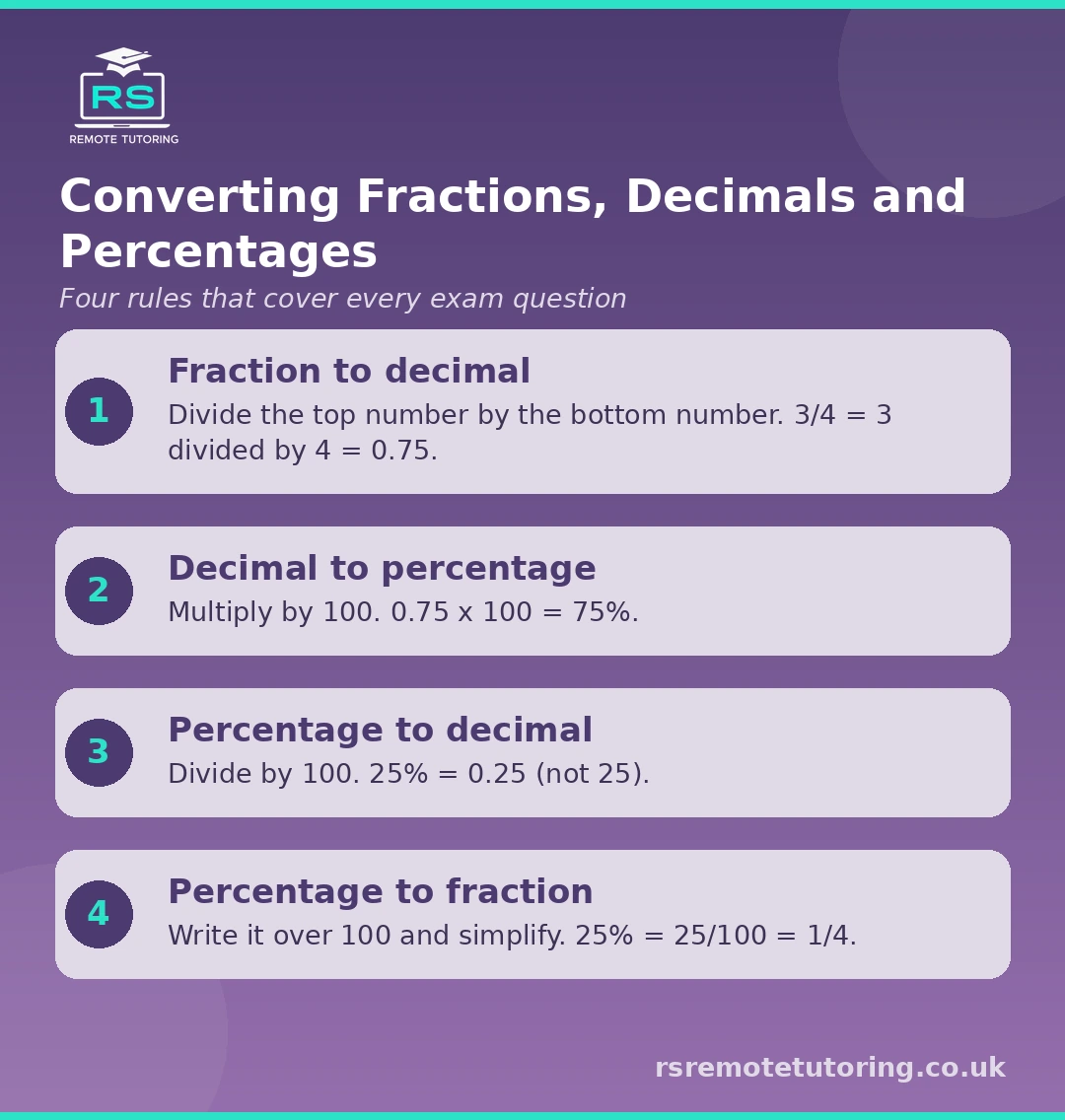
Chart showing the four conversion rules between fractions, decimals and percentages
These equivalents are worth knowing cold, they save time on both the calculator and non-calculator sections of the exam:
| Fraction | Decimal | Percentage |
| 1/2 | 0.5 | 50% |
| 1/4 | 0.25 | 25% |
| 3/4 | 0.75 | 75% |
| 1/5 | 0.2 | 20% |
| 1/10 | 0.1 | 10% |
| 1/3 | 0.333… | 33.3% |
Don’t memorise fifty values. Memorise these six and the four rules, and derive the rest.
How do you handle percentage increase and decrease questions?
Work in small, numbered steps: find the percentage of the original amount first, then add it on (increase) or take it away (decrease). Rushing to a single-line answer is where learners make errors; two short calculations are safer than one clever one.
Here’s the process for a typical exam question, a jacket costs £80 and is reduced by 25%:
- Find the percentage: 25% of £80 = £20
- Decide the direction: it’s a reduction, so subtract
- Calculate: £80 − £20 = £60
- Sanity-check: £60 is a bit less than £80. Sensible.
That fourth step matters more than students expect. If your “25% off £80” answer comes out at £2,000, something went wrong, and thirty seconds of checking recovers the marks. Percentage change also connects tightly to ratio and proportion questions, so time spent here pays twice.
Which mistakes lose learners the most marks?
Misplaced decimal points, unsimplified fractions, confusing 25% with 25 rather than 0.25, and answering a different question from the one asked. None of these reflect weak maths, they reflect rushing, and all four are avoidable with deliberate checking habits.
We mark a lot of practice papers. The same four errors appear on almost every one:
- Not simplifying. The working is right, the final fraction isn’t reduced, the mark is gone.
- Decimal drift. 0.35 becomes 3.5 somewhere in the working.
- Percentage-decimal confusion. Multiplying by 25 instead of 0.25.
- Answering too fast. The question asked for the sale price; the learner gave the discount.
Read each question twice. Underline the numbers and the actual demand. It feels slow; it’s faster than resitting.
What does a good revision plan look like for this topic?
Short, mixed, frequent sessions beat marathon cramming. Twenty minutes covering a few conversions, one fraction-of-amount question and one percentage-change problem, several times a week, builds fluency that survives exam pressure and past paper practice then confirms it.
A structure that works for our learners:
- Five conversion questions (mix all three directions)
- Three fraction-of-amount questions
- Three percentage increase/decrease questions
- One multi-step word problem, done slowly, with full working
Then, weekly, one timed set under exam conditions. Knowing what the pass mark actually looks like helps here too, most boards want roughly 55–60%, not perfection, which changes how the exam feels.
And if you’re preparing alone and hitting a wall, structured one-to-one help moves things faster than another stack of worksheets. Our Functional Skills Maths Level 2 tutors work on exactly these topics every week, and you can book a trial lesson to see whether the approach suits you before committing.
Frequently Asked Questions
Are fractions, decimals and percentages hard at Level 2?
No, they’re among the most learnable topics on the paper. The methods are short and repeatable, and the same handful of question styles appears in every exam series. Most learners who struggle simply haven’t practised the four conversion rules enough.
Do I need to memorise conversion tables?
Only a small core: halves, quarters, fifths, tenths and thirds. Everything else can be derived using the conversion rules in seconds. Memorising the rules matters more than memorising values.
Can I use a calculator for these questions?
Partly. Level 2 Maths includes a short non-calculator section and a longer calculator section, so you need confident mental methods for the first and efficient calculator habits for the second.
What’s the fastest way to find a percentage without a calculator?
Build it from 10%, 5% and 1%. Divide by 10 to get 10%, halve that for 5%, divide by 100 for 1%, then combine the blocks to reach any percentage you need.
How much of the exam involves these topics?
There’s no fixed quota, but fraction, decimal and percentage skills feed into money, ratio, probability and data questions throughout the paper, so treat them as a foundation rather than a single topic.
What if I keep making decimal point errors?
Slow the specific step down. Write the place-value columns out, estimate the answer first (“about £20, not £200”), and check the final figure against that estimate before moving on.

Raja specializes in Physics and Maths, with over 5 years of experience. He offers KS2, KS3, and GCSE Science and Maths lessons. He graduated from one of the top universities in the UK.