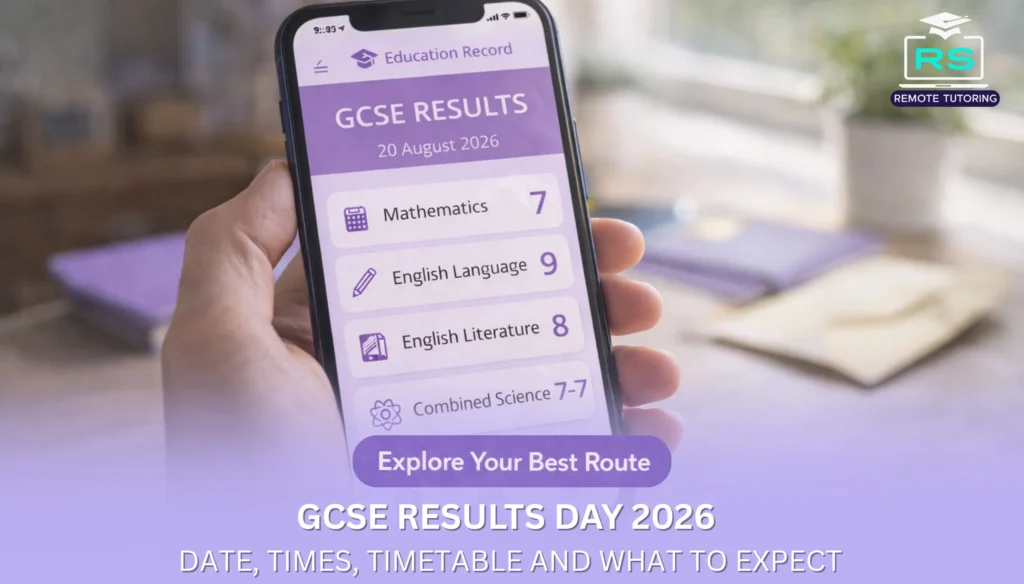

A grade 3 in maths, two marks off the boundary. Within an hour of opening the envelope on 20 August, somebody in the family will say “get it remarked” and somebody else will say “just resit in November,” and both will sound completely certain.
Neither is automatically right. The GCSE remark or resit decision depends on one number almost nobody checks first: how many marks you actually were from the next grade. Ofqual’s data for summer 2025 shows that of the 5.66 million GCSE grades awarded, 4.3% were challenged and only 1.0% changed, which means roughly three out of four reviews came back with the same grade (Ofqual, GOV.UK).
So this is a decision about odds, deadlines and money, not about which option feels less painful. This guide puts the two routes side by side, shows you when each one wins, and covers the third option most people forget exists.
Jump to Section
What’s the difference between a GCSE remark and a resit?
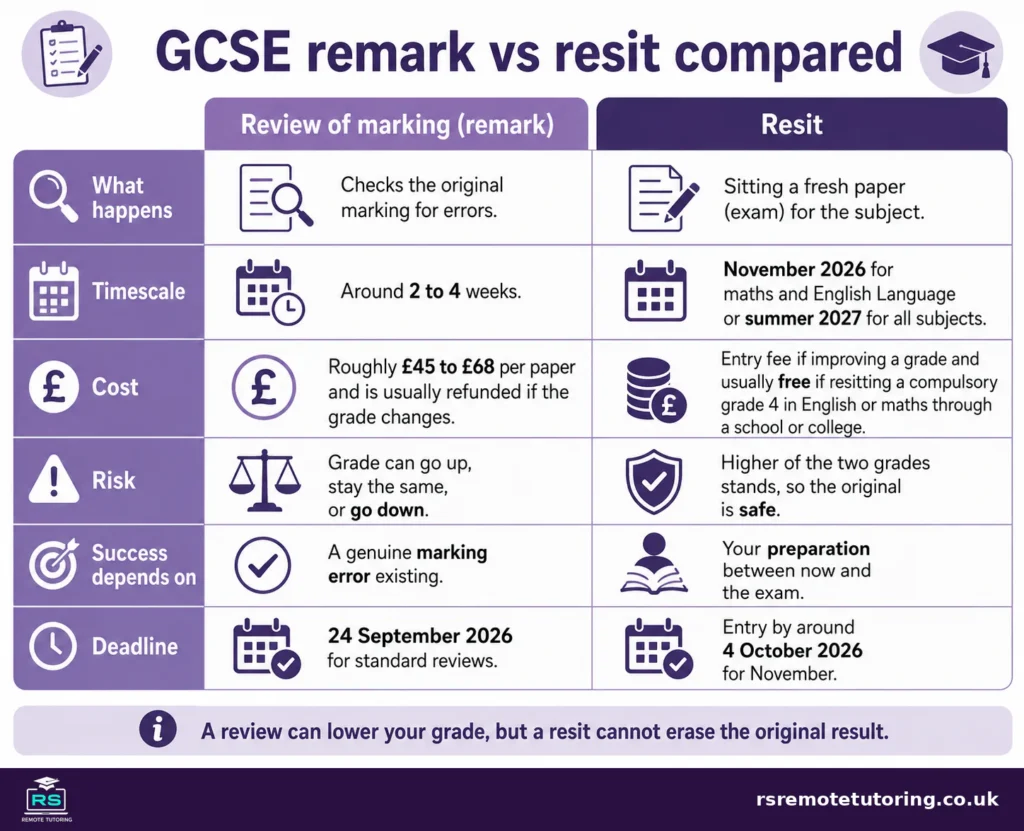
A remark, officially a review of marking, is a check that your existing paper was marked correctly, done within weeks for a fee. A resit is sitting the exam again, in November 2026 for maths and English Language, or summer 2027 for everything else.
The two routes answer different questions. A review asks “did the examiner make a mistake?” A resit asks “can I do better with another attempt?” Mixing those up is how people waste money on reviews for papers that were marked perfectly fine.
| Review of marking (remark) | Resit | |
| What happens | A reviewer checks the original marking for errors | You sit a fresh paper |
| Timescale | Around 2 to 4 weeks; priority reviews faster | November 2026 (maths and English Language) or summer 2027 (all subjects) |
| Cost | Roughly £45 to £68 per paper depending on board; usually refunded if the grade changes | Entry fee if improving a grade; usually free if resitting a compulsory grade 4 in English or maths through a school or college |
| Risk | Grade can go up, stay the same, or go down | Higher of the two grades stands, so the original is safe |
| Success depends on | A genuine marking error existing | Your preparation between now and the exam |
| Deadline | 24 September 2026 for standard reviews | Entry by around 4 October 2026 for November |
The risk line matters more than people realise. A review can lower your grade, though in practice fewer than 0.1% of challenged GCSE grades went down in summer 2025. A resit can’t touch your original result, because the better grade stands.
Got Your GCSE Results? Let’s Plan the Right Next Step
Whether your child is preparing for GCSE 2027, considering a resit or wants to improve a particular subject, our expert tutors can help. Book a free 30-minute one-to-one assessment to discuss their current grade, target grade and the support they need.
When is a GCSE remark worth the money?
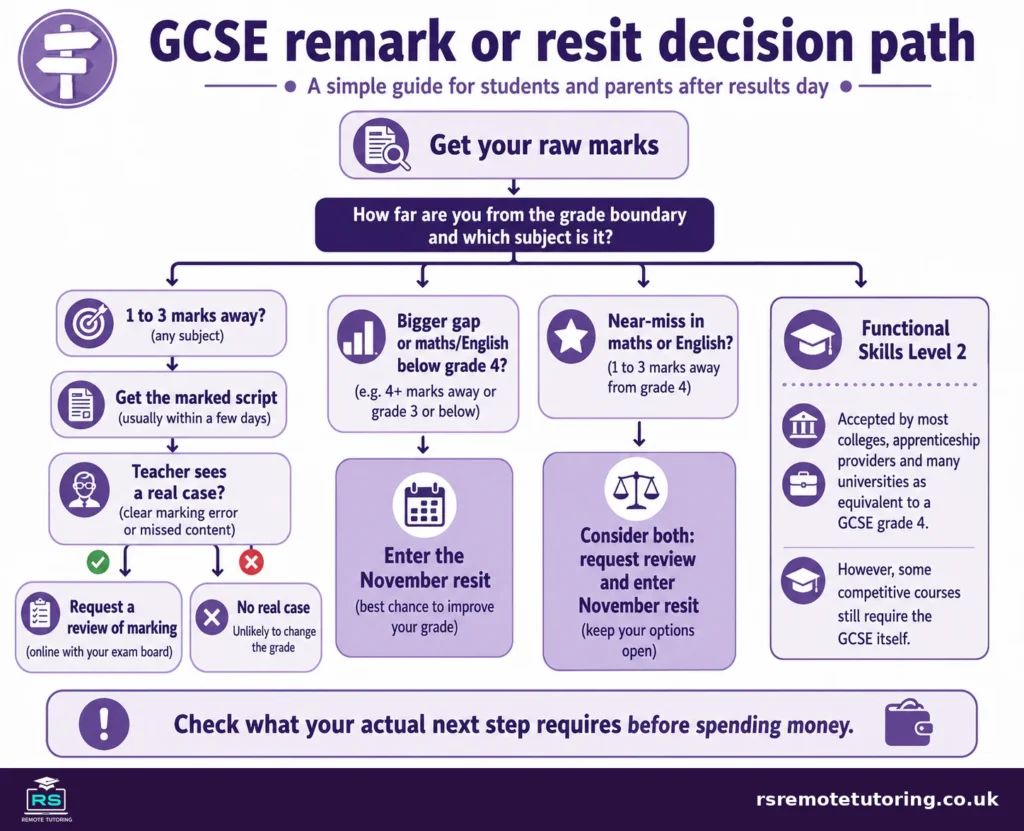
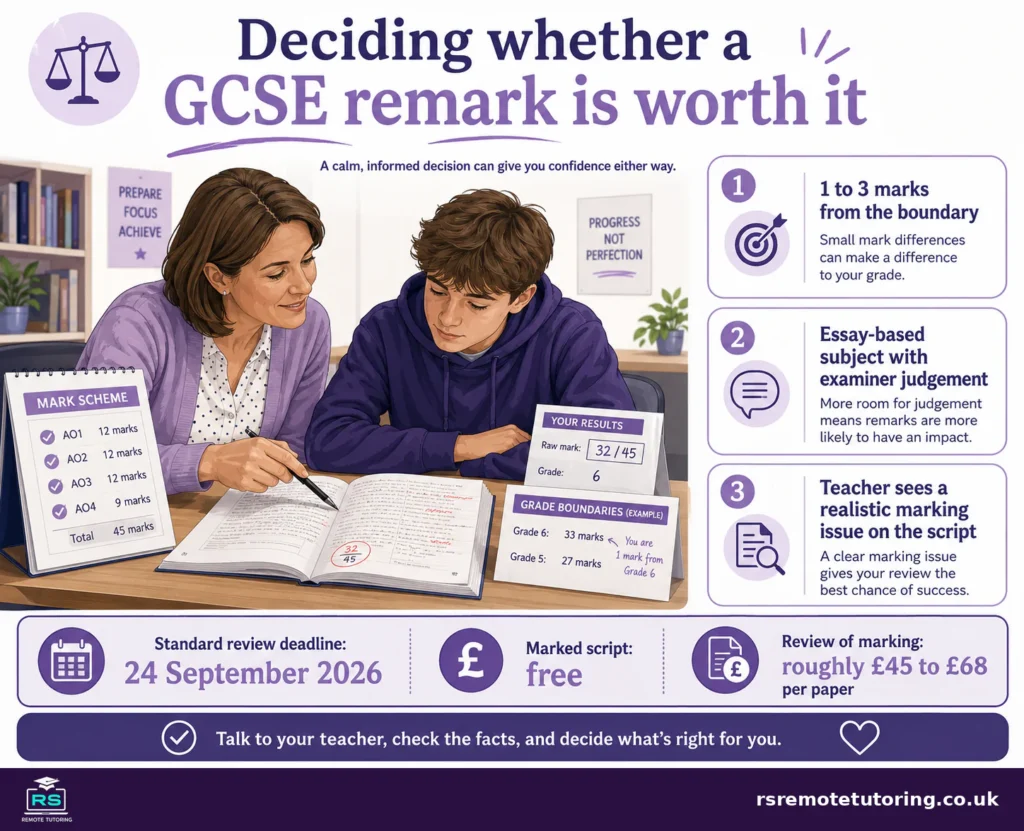
A remark is worth it when you’re one to three marks below a grade boundary in a subject with extended writing, and a teacher who’s seen your marked script agrees the mark scheme may have been misapplied. Twenty marks off, it’s almost certainly wasted money.
Start with the raw marks, not the grade. Your exams officer can tell you exactly how far each paper landed from the boundary, and your school can request a free copy of the marked script before committing to anything. That script is the whole decision. A teacher reading it can usually tell within ten minutes whether there’s a realistic case.
Three things stack the odds:
- Distance from the boundary. One to three marks is a live case. Five or more needs a visible error on the script.
- Subject type. Essay-based papers like English Literature, History and RS see more movement than maths or multiple-choice science, because there’s more examiner judgement to review. Ofqual’s data backs this up: English subjects account for a disproportionate share of grade changes every year.
- A teacher’s opinion after seeing the script. Not before. “I expected better” is a feeling. “Question 4 wasn’t credited against the mark scheme” is a case.
Reviewers don’t re-mark the paper from scratch, and they can’t add marks because a second examiner might have been kinder. They correct errors in how the mark scheme was applied, which is a narrower thing than most families expect. Understanding how grade boundaries are set also helps here, because boundaries move every year with paper difficulty, and being one mark short is not evidence of a mistake.
Worth knowing: the most commonly challenged grade in combined science last summer was the 4-3, which tells you exactly what everyone is fighting for. The grade 4 in maths and English is where a review has the most practical value, because so much hangs on it.
What does a GCSE remark cost in 2026, and what’s the deadline?
Standard reviews of marking must reach the exam board by 24 September 2026 and cost roughly £45 to £68 per paper. Clerical re-checks are cheaper at £10 to £14. The marked script is free. Most boards refund the fee if the grade changes.
| Service | Deadline | AQA | Pearson (Edexcel) | OCR | WJEC/Eduqas |
| Copy of marked script | 24 Sep 2026 | Free | Free | Free | Free |
| Clerical re-check | 24 Sep 2026 | £9.70 | £14.00 | £12.00 | £11.00 |
| Review of marking | 24 Sep 2026 | £44.85 | £50.00 | £67.75 | £45.00 |
| Priority review (place at risk) | Late Aug 2026, board-specific | Varies | Varies | Varies | Varies |
Per-paper fees as published by exam centres for summer 2026. Some schools add an admin charge, and only your centre can submit the request, so confirm exact figures with your exams officer.
Two process points that catch families out. You must give written consent before a review goes in, because the grade can drop. And private candidates can’t apply directly to the board; the request goes through the centre that entered you. The full paperwork side, including what happens if the review fails and you want to appeal, is covered in our walkthrough of challenging a GCSE result and requesting a remark.
If a sixth form or college place hangs on the outcome, tell them a review is in progress the day you find out, and ask your exams officer about a priority review. Some centres will hold a place or let you start provisionally while the review runs. Asking costs nothing.
Got Your GCSE Results? Let’s Plan the Right Next Step
Whether your child is preparing for GCSE 2027, considering a resit or wants to improve a particular subject, our expert tutors can help. Book a free 30-minute one-to-one assessment to discuss their current grade, target grade and the support they need.
When is a GCSE resit the better choice?
Resit when the gap is bigger than a marking error can explain, when the subject is maths or English below grade 4, or when your performance on the day genuinely didn’t reflect what you know. The November 2026 series runs from 29 October to 10 November for maths and English Language only.
The maths of a resit is simply better in most cases. A review needs an error to exist. A resit only needs you to improve, and improving from a near-miss is very achievable in ten weeks with focused work. Students who missed grade 4 by a handful of marks are usually missing technique and two or three topics, not the whole subject.
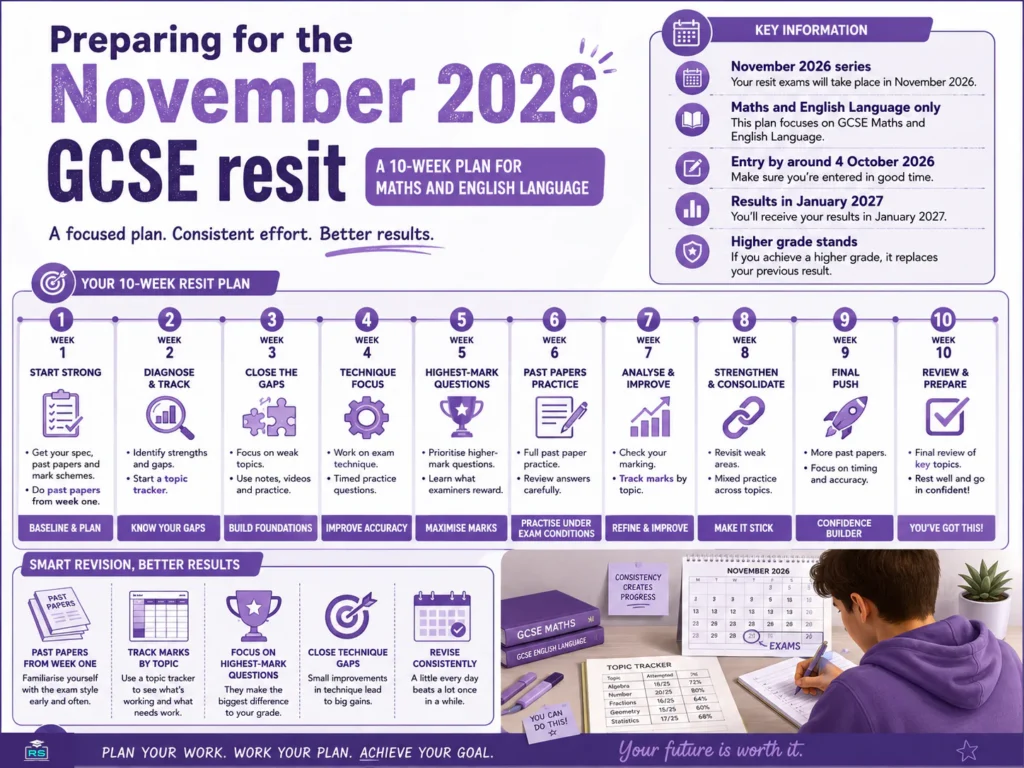
The rules worth knowing:
- English Language and maths resit in November 2026. Exams run 29 October to 10 November, entry closes around 4 October, and results arrive in January 2027. English Literature is not in the November series.
- Every other subject waits for summer 2027, sitting alongside the next Year 11 cohort.
- Below a grade 4 in English or maths, continued study is a condition of funding, so your sixth form or college will normally enter you and there’s usually no fee. Resitting to upgrade a 5 to a 6 is optional and paid.
- The higher grade stands. A worse resit performance doesn’t erase the original.
- Left school entirely? You’ll enter as a private candidate through an exam centre, and popular centres fill up by September.
The entry deadlines, timetables and how-to-apply detail all sit in our GCSE resit 2026 guide, and the January results process is covered in the resit results day guide.
One honest caveat. National pass rates on November resits are historically low, and the reason isn’t ability. It’s that most resit students repeat the same revision that didn’t work in Year 11, with less classroom time. A resit that works looks different: past papers from week one, marks tracked by topic, and effort concentrated on the highest-mark questions you’re currently dropping. That’s the exact model behind our GCSE resit tutoring, and it’s why a ten-week November plan can move a grade 3 to a 4 or 5 when a re-run of last year’s revision won’t.
Got Your GCSE Results? Let’s Plan the Right Next Step
Whether your child is preparing for GCSE 2027, considering a resit or wants to improve a particular subject, our expert tutors can help. Book a free 30-minute one-to-one assessment to discuss their current grade, target grade and the support they need.
Can you do both a remark and a resit?
Yes, and for a near-miss on grade 4 in maths or English it’s often the smartest play. Request the review in September and enter the November resit at the same time. If the review lifts the grade, you withdraw from the resit or simply treat it as insurance.
The timelines were practically designed for this. Standard reviews close on 24 September and typically return within two to four weeks. November entry closes around 4 October. Run both and you lose nothing except a review fee that’s refunded if the grade changes.
The sequence that works:
- 20 August: collect results, get raw marks per paper from your exams officer.
- By end of August: request the free marked script for any near-miss paper.
- Early September: teacher reviews the script; decide on the review.
- Before 24 September: submit the review of marking if the case is real.
- Before 4 October: enter the November resit regardless, if the grade matters.
- October: revise as if the review will fail, because three times out of four it does.
Where I’d push back on conventional wisdom: don’t let a pending review become an excuse to delay revision. The most expensive outcome isn’t a failed review. It’s a failed review discovered in mid-October, followed by a panicked three-week cram for November.
What if neither a remark nor a resit fits?
Functional Skills Level 2 in maths or English is accepted by most colleges, apprenticeship providers and universities as equivalent to a GCSE grade 4, and it can be sat year-round rather than waiting for November or next summer.
The qualification suits a specific person: someone who has struggled with GCSE-style abstract questions across multiple attempts but handles practical, real-world maths and English fine. The exam tests exactly that, and there’s no fixed exam window. We’ve compared Functional Skills Level 2 against GCSE in detail, including who accepts it and who doesn’t, because a minority of competitive courses still insist on the GCSE itself.
Beyond that, a low grade in an optional subject often needs no action at all. A grade 3 in geography changes nothing if your sixth form offer is built on maths, English and the sciences. Check what your actual next step requires before spending money fixing a grade nobody will ever ask about. If the disappointing results run wider than one or two subjects, the bigger-picture options, from vocational routes to a different sixth form, are mapped out in what to do if you fail your GCSEs.
Which deadlines decide everything after 20 August?
Three dates do most of the work: 24 September 2026 for standard reviews of marking and script requests, around 4 October 2026 for November resit entry, and late August for priority reviews where a sixth form place is at risk.
| Date (2026) | What closes or happens |
| 20 August | GCSE results day |
| Late August (board-specific) | Priority review deadline where a place depends on the grade |
| 24 September, 12:00 in many centres | Standard reviews of marking, clerical re-checks and script requests |
| Around 4 October | Entry deadline for November maths and English Language resits |
| 29 October to 10 November | November 2026 resit exams |
| January 2027 | November resit results |
| February 2027 | Entry deadline for summer 2027 resits in other subjects |
Reviews: exam board post-results schedules for summer 2026 via the JCQ post-results services guidance. Resit dates: confirmed board timetables.
Notice how tight the middle is. Between results day and the review deadline sit five weeks, and schools are closed for two of them. The families who handle this well have spoken to the exams officer before the end of August, not in the third week of September.
How should parents handle the remark or resit conversation?

Get the raw marks before anyone argues about anything. Every productive version of this conversation starts with “you were two marks off” or “you were fourteen marks off,” because those two sentences lead to completely different decisions.
Avoid deciding on results day itself. The script request is free, the review window is five weeks long, and a decision made at 9am on 20 August is a decision made on emotion. Let the script and a teacher’s read of it do the deciding.
And watch the pressure you’re applying. A November resit taken to satisfy a parent, on top of new sixth form courses, is a heavy load for a 16-year-old, and the exam anxiety that built through Year 11 doesn’t reset over one summer. If the resit is genuinely needed, structure and outside support carry more of the weight than pressure does. A free trial lesson is a low-stakes way to find out whether a November target is realistic before anyone commits to it.
Frequently Asked Questions
Should I get a GCSE remark or just resit?
Check your raw marks first. One to three marks below the boundary in an essay-based subject points to a review of marking. A bigger gap, or maths and English below grade 4, points to the November resit, and doing both together is often the safest route.
How much does a GCSE remark cost in 2026?
Between £44.85 and £67.75 per paper depending on the exam board, with clerical re-checks at £9.70 to £14.00. The marked script is free. Most boards refund the review fee if your grade changes.
Can my grade go down after a GCSE remark?
Yes, in principle, and you must give written consent acknowledging that before the review goes in. In practice it’s rare: fewer than 0.1% of challenged GCSE grades were lowered in summer 2025 according to Ofqual.
What subjects can I resit in November 2026?
Only GCSE maths and English Language, with exams from 29 October to 10 November 2026 and results in January 2027. English Literature, sciences and all other subjects resit in the summer 2027 series.
Do I have to pay for a GCSE resit?
Usually not if you’re resitting English or maths below grade 4 through a school or college, since continued study is a condition of funding. Resitting to improve a passing grade, or entering as a private candidate, carries an entry fee.
What happens if my resit grade is lower than my original?
Nothing bad. The higher of the two grades stands, so a resit can only improve your record. Colleges and employers see your best result.
How long does a GCSE review of marking take?
Standard reviews typically return within two to four weeks of the board receiving the request. Priority reviews, available where a sixth form or college place depends on the outcome, are faster and have earlier deadlines in late August.